

The prime minister of Haiti, Alix Didier Fils-Aimé, on Tuesday defended the bilateral agreement with El Salvador to strengthen operations against the gangs and maintained that demands for respect for human rights must be accompanied by recognition of the right of the Haitian population to live without fear.
That position responds to the statement published by Amnesty International, which called on the Haitian and Salvadoran authorities to guarantee that the deployment of forces sent by President Nayib Bukele respects human rights.
The organization also demanded that both states make public the agreement, the rules for the use of force, and the oversight and complaint mechanisms.
“The Haitian people have the full right to security, freedom, and respect for their fundamental rights,” Fils-Aimé stated on X.
In addition, the official added that the protection of individual guarantees and transparency must be part of every security operation, although he warned that those conditions cannot be used as an argument for disregarding the situation the country is going through.
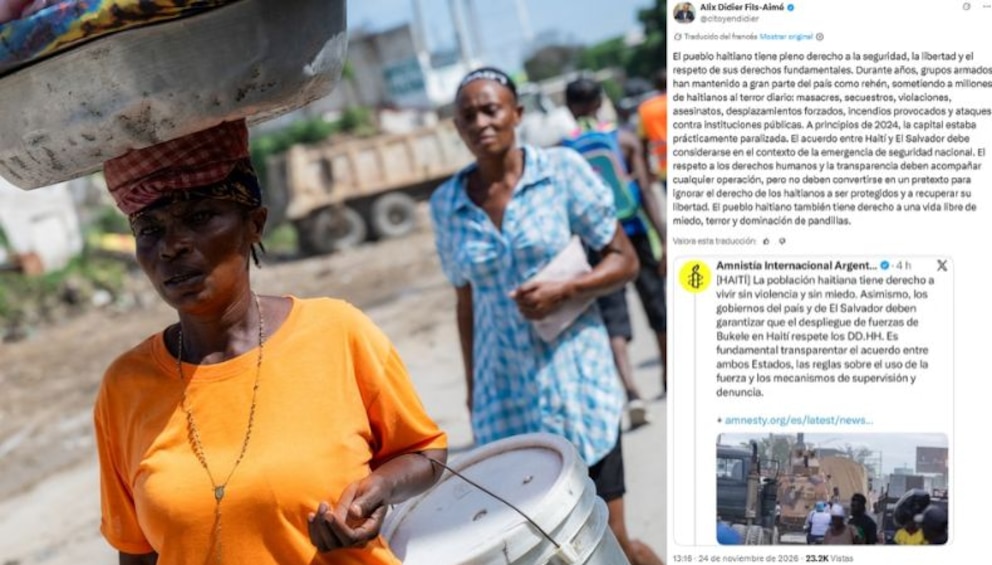
Transcript of the screenshot: Alix Didier Fils-Aimé’s response (translation from French shown on X)
The Haitian people have the full right to security, freedom, and respect for their fundamental rights. For years, armed groups have held a large part of the country hostage, subjecting millions of Haitians to daily terror: massacres, kidnappings, rapes, murders, forced displacement, arson, and attacks against public institutions. In early 2024, the capital was practically paralyzed. The agreement between Haiti and El Salvador must be considered in the context of the national security emergency. Respect for human rights and transparency must accompany any operation, but they must not become a pretext for ignoring the right of Haitians to be protected and to regain their freedom. The Haitian people also have the right to a life free from fear, terror, and gang domination.
Message from Amnesty International Argentina quoted in the screenshot
[HAITÍ] The Haitian population has the right to live without violence and without fear. Likewise, the governments of the country and of El Salvador must guarantee that the deployment of Bukele’s forces in Haiti respects human rights. It is essential to bring transparency to the agreement between both states, the rules on the use of force, and the oversight and complaint mechanisms.
“For years, armed groups have taken a large part of the country hostage,” he said. According to his position, the gangs imposed on millions of Haitians a scenario marked by massacres, kidnappings, rapes, murders, forced displacement, fires, and attacks against public institutions.
The Haitian government frames the understanding with El Salvador in light of the emergency that the Caribbean country has been facing for several years and that deepened during 2024.
At the beginning of this year, gang violence left Port-au-Prince practically paralyzed, with attacks against police stations, state facilities, airports, and residential areas.
“The Haitian population also has the right to a life without fear, without terror, and without domination by the gangs,” Fils-Aimé maintained.
Haiti ruled out a truce with the armed groups
On Sunday, November 22, Fils-Aimé visited a base of the Salvadoran forces in Port-au-Prince. During that event, he reaffirmed that the Haitian government does not envisage a truce with the gangs and presented the Salvadoran presence as part of bilateral cooperation to support local authorities.
El Salvador’s deployment increased after the disappearance of four Salvadoran aeronautical technicians, who were attacked on October 18 in an area under the control of armed groups. So far, they have not been located.
Before that episode, El Salvador had close to 100 personnel in Haiti under a mission backed by the United Nations. Following the disappearance of the technicians, the contingent grew to reach about 2,500 Salvadoran service members.
The mission also suffered casualties. To date, the toll stands at three Salvadoran service members dead during operations in Haiti. President Bukele identified the deceased as Lieutenant Cristian Daniel Palacios Santos and Corporals Emerson Alexander Zepeda Zelada and Wilber Manuel Serrano Medina.
In turn, Bukele announced that his government will provide USD 200,000 and a monthly allowance to the families of the three soldiers who died on Friday.
The cooperation with El Salvador is taking place in a country where the Haitian National Police, international forces, and private contractors take part in the fight against the gangs. Fils-Aimé’s government maintains that external support is necessary while Haitian institutions seek to regain territorial control and prepare the elections planned for 2027.
Primer ministro haitiano defiende acuerdo con El Salvador: “La población tiene derecho a un país sin miedo”
José Cerón
El primer ministro de Haití, Alix Didier Fils-Aimé, defendió este martes el acuerdo bilateral con El Salvador para reforzar las operaciones contra las pandillas y sostuvo que las exigencias de respeto a los derechos humanos deben ir acompañadas del reconocimiento al derecho de la población haitiana a vivir sin miedo.
Dicha posición responde al pronunciamiento publicado por Amnistía Internacional, la cual pidió a las autoridades haitianas y salvadoreñas que garanticen que el despliegue de fuerzas enviadas por el presidente Nayib Bukele respete los derechos humanos.
La organización reclamó, además, que ambos Estados hagan público el acuerdo, las reglas para el uso de la fuerza y los mecanismos de supervisión y denuncia.
“El pueblo haitiano tiene pleno derecho a la seguridad, la libertad y el respeto de sus derechos fundamentales”, afirmó Fils-Aimé en X.
Además, el funcionario agregó que la protección de las garantías individuales y la transparencia deben formar parte de toda operación de seguridad, aunque advirtió que esas condiciones no pueden utilizarse como argumento para desconocer la situación que atraviesa el país.
Transcripción de la captura: respuesta de Alix Didier Fils-Aimé (traducción del francés que se muestra en X)
El pueblo haitiano tiene pleno derecho a la seguridad, la libertad y el respeto de sus derechos fundamentales. Durante años, grupos armados han mantenido a gran parte del país como rehén, sometiendo a millones de haitianos al terror diario: masacres, secuestros, violaciones, asesinatos, desplazamientos forzados, incendios provocados y ataques contra instituciones públicas. A principios de 2024, la capital estaba prácticamente paralizada. El acuerdo entre Haití y El Salvador debe considerarse en el contexto de la emergencia de seguridad nacional. El respeto a los derechos humanos y la transparencia deben acompañar cualquier operación, pero no deben convertirse en un pretexto para ignorar el derecho de los haitianos a ser protegidos y a recuperar su libertad. El pueblo haitiano también tiene derecho a una vida libre de miedo, terror y dominación de pandillas.
Mensaje de Amnistía Internacional Argentina citado en la captura
[HAITÍ] La población haitiana tiene derecho a vivir sin violencia y sin miedo. Asimismo, los gobiernos del país y de El Salvador deben garantizar que el despliegue de fuerzas de Bukele en Haití respete los DD.HH. Es fundamental transparentar el acuerdo entre ambos Estados, las reglas sobre el uso de la fuerza y los mecanismos de supervisión y denuncia.
“Hace años que grupos armados han tomado como rehén a gran parte del país”, indicó. Según su postura, las pandillas impusieron a millones de haitianos un escenario marcado por masacres, secuestros, violaciones, asesinatos, desplazamientos forzados, incendios y ataques contra instituciones públicas.
El Gobierno haitiano enmarca el entendimiento con El Salvador debido a la emergencia que enfrenta el país caribeño desde hace varios años y que se profundizó durante 2024.
A comienzos de este año, la violencia de las bandas dejó a Puerto Príncipe prácticamente paralizada, con ataques contra comisarías, instalaciones estatales, aeropuertos y zonas residenciales.
“La población haitiana también tiene derecho a una vida sin miedo, sin terror y sin dominación de las pandillas”, sostuvo Fils-Aimé.
Haití descartó una tregua con los grupos armados
El domingo 22 de noviembre, Fils-Aimé visitó una base de las fuerzas salvadoreñas en Puerto Príncipe. Durante esa actividad, ratificó que el Gobierno haitiano no prevé una tregua con las pandillas y presentó la presencia salvadoreña como parte de una cooperación bilateral para apoyar a las autoridades locales.
El despliegue de El Salvador aumentó después de la desaparición de cuatro técnicos aeronáuticos salvadoreños, quienes fueron atacados el 18 de octubre en un área bajo control de grupos armados. Hasta el momento, no fueron localizados.
Antes de ese episodio, El Salvador tenía cerca de 100 efectivos en Haití bajo una misión respaldada por las Naciones Unidas. Tras la desaparición de los técnicos, el contingente creció hasta alcanzar unos 2,500 militares salvadoreños.
La misión también registró bajas. Hasta la fecha, se contabilizan tres militares salvadoreños muertos durante operaciones en Haití. El presidente Bukele identificó a los fallecidos como el teniente Cristian Daniel Palacios Santos y los cabos Emerson Alexander Zepeda Zelada y Wilber Manuel Serrano Medina.
A su vez, Bukele anunció que su gobierno entregará USD 200,000 y una asignación mensual a las familias de los tres soldados que murieron el viernes.
La cooperación con El Salvador se desarrolla en un país donde la Policía Nacional de Haití, fuerzas internacionales y contratistas privados intervienen en la lucha contra las pandillas. El Gobierno de Fils-Aimé sostiene que el apoyo externo resulta necesario mientras las instituciones haitianas buscan recuperar el control territorial y preparar las elecciones previstas para 2027.