
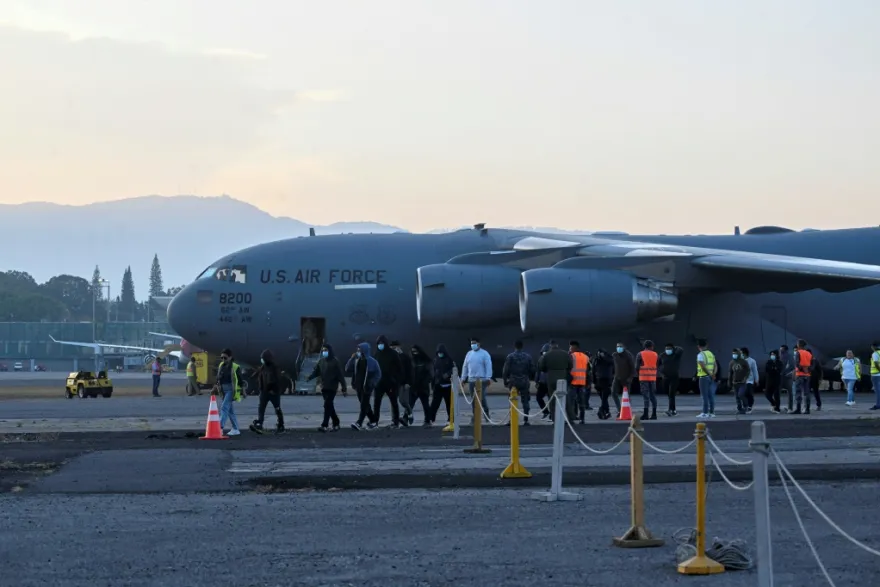
Between January and September 2026, a total of 133 flights carrying people deported from the United States landed on Salvadoran territory, according to records compiled by the organization Human Rights First through its ICE Flight Monitor platform. This figure represents 76% of all flights recorded during the whole of 2025, when 175 return air operations to El Salvador were tallied.
Meanwhile, the Inter-American Dialogue estimates that deportations by the end of 2026 will amount to 17,000 Salvadorans; that is, an increase over those reported in 2025, when they numbered 16,051.
When comparing flights from the United States exclusively for the first nine months of both years, the flow to El Salvador shows a slight upward variation.
While 132 flights were carried out from January to September 2025, in the same period of 2026 one additional operation was added to reach 133.
In monthly terms, July was the month with the most air activity so far in 2026, with 18 flights, followed by June and September with 17 each; by contrast, February and May reported the lowest frequency, with 12 flights each.
Monthly comparison of flights to El Salvador
The month-by-month breakdown makes it possible to observe the pattern of deportation air operations to El Salvador during the first three quarters of 2025 and 2026, according to ICE Flight Monitor:
Month | Flights 2025 | Flights 2026 | Year-over-year difference
- January | 8 | 14 | +6
- February | 11 | 12 | +1
- March | 14 | 15 | +1
- April | 13 | 13 | 0
- May | 17 | 12 | -5
- June | 22 | 17 | -5
- July | 22 | 18 | -4
- August | 12 | 15 | +3
- September | 13 | 17 | +4
- Cumulative (Jan-Sep) | 132 | 133 | +1
During the last quarter of 2025, 16 flights were added in October, 14 in November and 13 in December, completing the annual total of 175 operations.
The Northern Triangle: higher volume in Guatemala and Honduras
When the analysis is extended to the rest of the countries that make up the Northern Triangle of Central America, El Salvador records the lowest number of flights received.
Between January and September 2026, Guatemala tallied 454 flights (compared with 366 in the same period of 2025 and 532 for that entire year).
For its part, Honduras received 376 flights in the first nine months of 2026 (compared with 314 from January to September 2025 and 451 for all of last year).
However, the monitoring records produced by Human Rights First show a significant methodological difference regarding the number of passengers transported:
- El Salvador: The available data do not specify the number of deported people who traveled on each of the 133 flights recorded in 2026.
- Guatemala: The monitoring details the exact number of people returned in all the months evaluated in 2026, totaling 48,904 deported Guatemalans through September (with peaks of 7,035 in July and 6,684 in September).
- Honduras: The record lists 22,280 deported people, albeit partially, since it includes the figures for January (3,451), February (3,519), March (4,007), April (3,371), May (4,308) and August (3,624), but omits the passenger count for the months of June, July and September.
ICE’s all-time record and the economic impact on Central America
The pace of flights to Central America comes amid a tightening of immigration operations in the United States.
According to an official statement from the Department of Homeland Security (DHS) published on November 12, 2026, Immigration and Customs Enforcement (ICE) broke its all-time record in fiscal year 2026 (FY26) by carrying out 483,200 deportations and more than 491,000 arrests on immigration grounds, surpassing the previous mark of 442,640 deportations recorded in fiscal year 2025.
This scenario coincides with the warnings contained in the report Current Challenges for Remittances and Migration: Options for Central America, 2026, published in October by the Inter-American Dialogue and prepared by researcher Manuel Orozco, who is director of the Migration, Remittances and Development Program.
The study notes that the increase in deportations and the decline in migration flows are generating an economic turning point in the region (made up of El Salvador, Guatemala, Honduras and Nicaragua):
- Deportation projections: The document estimates that deportations to El Salvador will close 2026 at around 17,000 people (compared with 16,051 in 2025), while 73,000 are projected for Guatemala and 51,150 for Honduras. It also specifies that the returnees had resided in the United States for an average of five years.
- Remittance slowdown: Lower migration and the increase in returns have caused at least 500,000 fewer remittance transactions since 2025. In the specific case of El Salvador, remittance growth moderated from 18% in 2025 to a projected 4.8% in 2026 (estimating a volume of $10,458 million), with a further slowdown to 2.5% expected for 2027.
- Labor pressure and households with returnees: According to a survey of remittance recipients conducted by the Inter-American Dialogue between February and March 2026, 21.6% of the households surveyed in El Salvador stated that they had at least one family member who had returned from abroad, a proportion similar to that of Guatemala (21.1%) and Honduras (20.1%). The report warns that the reintegration of this population will raise the labor supply in the region and put pressure on labor markets already marked by informality.
El Diario de Hoy: https://www.eldiariodehoy.com/noticias/nacionales/el-salvador-proyecta-17000-deportados-en-2026-segun-organizacion-en-washington/101020/2026/
El Salvador proyecta 17,000 deportados en 2026, según organización en Washington
Cristian Díaz
Entre enero y septiembre de 2026, un total de 133 vuelos con personas deportadas desde Estados Unidos aterrizaron en territorio salvadoreño, según los registros recopilados por la organización Human Rights First a través de su plataforma ICE Flight Monitor. Esta cifra representa el 76 % de la totalidad de vuelos registrados durante todo el año 2025, cuando se contabilizaron 175 operaciones aéreas de retorno hacia El Salvador.
Mientras que Diálogo Interamericano estima que las deportaciones para el cierre de 2026 ascenderán a 17,000 salvadoreños; es decir un incremento a las reportadas en el 2025 cuando fueron 16,051.
Al comparar los vuelos desde Estados Unidos exclusivamente de los primeros nueve meses de ambos años, el flujo hacia El Salvador muestra una leve variación al alza.
Mientras que de enero a septiembre de 2025 se efectuaron 132 vuelos, en el mismo período de 2026 se sumó una operación adicional para alcanzar las 133.
En términos mensuales, julio fue el mes con mayor actividad aérea en lo que va de 2026 con 18 vuelos, seguido de junio y septiembre con 17 cada uno; en contraste, febrero y mayo reportaron la menor frecuencia, con 12 vuelos respectivamente.
Comparativa mensual de vuelos hacia El Salvador
El desglose mes a mes permite observar el comportamiento de las operaciones aéreas de deportación hacia El Salvador durante los primeros tres trimestres de 2025 y 2026, de acuerdo a ICE Flight Monitor:
Mes | Vuelos 2025 | Vuelos 2026 | Diferencia interanual
- Enero | 8 | 14 | +6
- Febrero | 11 | 12 | +1
- Marzo | 14 | 15 | +1
- Abril | 13 | 13 | 0
- Mayo | 17 | 12 | -5
- Junio | 22 | 17 | -5
- Julio | 22 | 18 | -4
- Agosto | 12 | 15 | +3
- Septiembre | 13 | 17 | +4
- Acumulado (Ene-Sep) | 132 | 133 | +1
Durante el último trimestre de 2025 se sumaron 16 vuelos en octubre, 14 en noviembre y 13 en diciembre, completando el total anual de 175 operaciones.
El Triángulo Norte: mayor volumen en Guatemala y Honduras
Al extender el análisis al resto de países que integran el Triángulo Norte de Centroamérica, El Salvador registra la menor cantidad de vuelos recibidos.
Entre enero y septiembre de 2026, Guatemala contabilizó 454 vuelos (frente a los 366 del mismo período de 2025 y los 532 de todo ese año).
Por su parte, Honduras recibió 376 vuelos en los primeros nueve meses de 2026 (en comparación con los 314 de enero a septiembre de 2025 y los 451 de todo el año pasado).
Sin embargo, los registros de monitoreo realizados por Human Rights First presentan una diferencia metodológica relevante en cuanto al número de pasajeros transportados:
- El Salvador: Los datos disponibles no especifican la cantidad de personas deportadas que viajaron en cada uno de los 133 vuelos registrados en 2026.
- Guatemala: El monitoreo detalla el número exacto de personas retornadas en todos los meses evaluados de 2026, sumando 48,904 guatemaltecos deportados hasta septiembre (con picos de 7,035 en julio y 6,684 en septiembre).
- Honduras: El registro consigna 22,280 personas deportadas, aunque de forma parcial, ya que incluye las cifras correspondientes a enero (3,451), febrero (3,519), marzo (4,007), abril (3,371), mayo (4,308) y agosto (3,624), pero omite el conteo de pasajeros para los meses de junio, julio y septiembre.
Récord histórico del ICE y el impacto económico en Centroamérica
El ritmo de los vuelos hacia Centroamérica se enmarca en un endurecimiento de las operaciones migratorias en Estados Unidos.
Según un comunicado oficial del Departamento de Seguridad Nacional (DHS) publicado el 12 de noviembre de 2026, el Servicio de Inmigración y Control de Aduanas (ICE) batió su récord histórico en el año fiscal 2026 (AF26) al ejecutar 483,200 deportaciones y más de 491,000 arrestos por motivos de inmigración, superando la marca previa de 442,640 deportaciones registrada en el año fiscal 2025.
Este escenario coincide con las advertencias recogidas en el informe Desafíos actuales para las remesas y la migración: Opciones para Centroamérica, 2026, publicado en octubre por el Diálogo Interamericano y elaborado por el investigador Manuel Orozco quien es director del Programa de Migración, Remesas y Desarrollo.
El estudio señala que el incremento de las deportaciones y la caída en los flujos migratorios están generando un punto de inflexión económica en la región (integrada por El Salvador, Guatemala, Honduras y Nicaragua):
- Proyecciones de deportación: El documento estima que las deportaciones hacia El Salvador cerrarán 2026 en alrededor de 17,000 personas (frente a las 16,051 de 2025), mientras que para Guatemala se proyectan 73,000 y para Honduras 51,150. Además, detalla que los retornados habían residido un promedio de cinco años en Estados Unidos.
- Desaceleración de remesas: La menor migración y el aumento de retornos provocaron al menos 500,000 transacciones menos de remesas desde 2025. En el caso específico de El Salvador, el crecimiento de las remesas se moderó del 18 % en 2025 a una proyección del 4,8 % en 2026 (estimando un volumen de 10.458 millones de dólares), con una desaceleración adicional prevista al 2,5 % para 2027.
- Presión laboral y hogares con retornados: Según una encuesta realizada por el Diálogo Interamericano entre febrero y marzo de 2026 a receptores de remesas, el 21,6 % de los hogares encuestados en El Salvador afirmó tener al menos a un familiar que retornó del exterior, una proporción similar a la de Guatemala (21,1 %) y Honduras (20,1 %). El informe advierte que la reinserción de esta población elevará la oferta laboral en la región y presionará mercados de trabajo ya marcados por la informalidad.
El Diario de Hoy: https://www.eldiariodehoy.com/noticias/nacionales/el-salvador-proyecta-17000-deportados-en-2026-segun-organizacion-en-washington/101020/2026/