
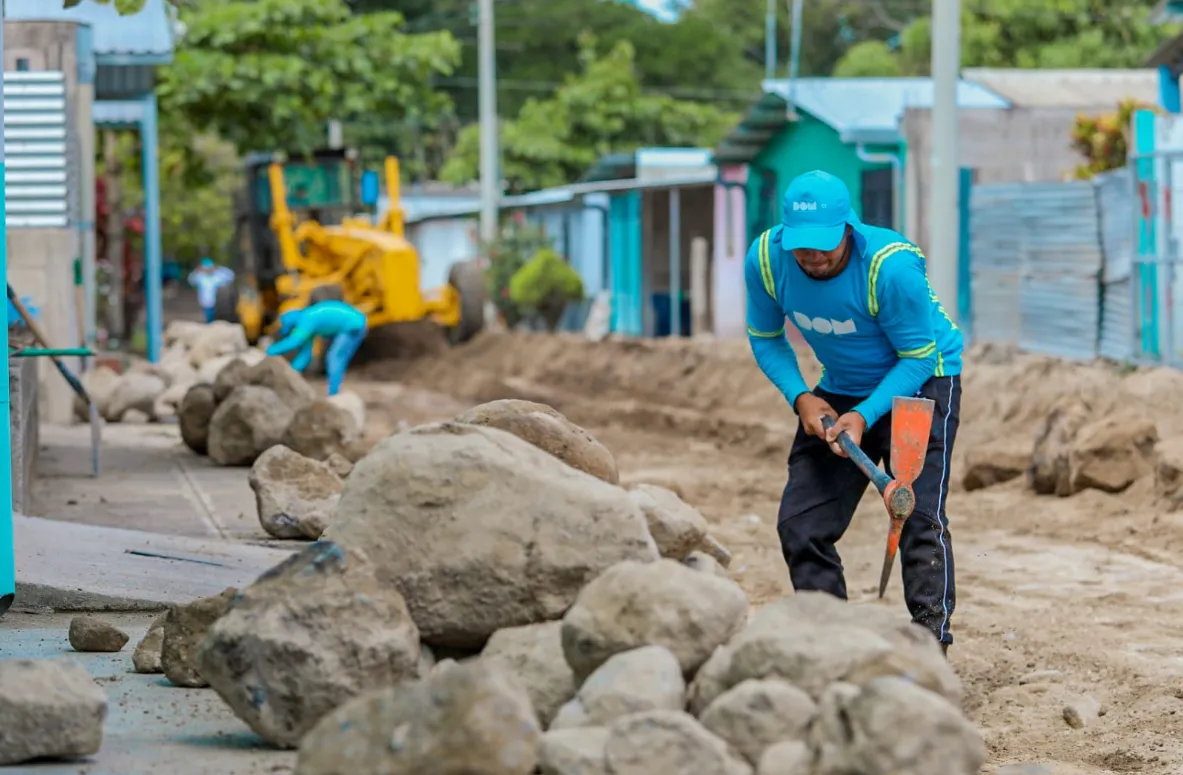
The creation of the Directorate of Municipal Works and the approval of new laws to adjust the funds invested in municipalities allowed the Salvadoran State to save $544 million that, under the previous law, would have been handed over to mayors’ offices.
The Directorate of Municipal Works (DOM) marks five years of legal existence this November 18, the date on which the law was approved that gave rise to the institution and entrusted it with carrying out projects in the country’s municipalities, under a scheme centralizing the funds that were previously transferred directly to mayors’ offices.
When the DOM was announced, the Government and the Nuevas Ideas lawmakers in the Legislative Assembly defended the centralization of municipal funds, arguing that it would allow for a more efficient use of resources, reduce corruption and guarantee better works for communities.
However, five years later, a calculation of the allocation of resources for municipal works shows that the amounts invested have been lower than what mayors’ offices would have received if the previous legislation had remained in force. Added to this are criticisms from lawmakers and council members about the lack of transparency in the management of the funds and the absence of works in some municipalities.
Less funding
In 2019, when the current government took office, the legislation established that mayors’ offices were to receive, as FODES (Fund for the Economic and Social Development of Municipalities), the equivalent of 8% of the State’s current revenue. Taking as a reference the $37,565.8 million in current revenue that the Ministry of Finance reported between 2022 and September 2026, it is estimated that the resources allocated to municipalities would have amounted to $3,005.2 million if that percentage had been maintained.
However, with the creation of the Directorate of Municipal Works (DOM), in November 2021, the ruling party reduced the FODES allocation to 1.5% and established that the resources allocated to municipal works could not be less than 3% of current revenue. Under this scheme, between 2022 and September 2026, the State reported municipal investment of $2,460.5 million: $1,601.4 million through the DOM and $859.1 million in FODES transfers.
The difference between the two scenarios represents an estimated reduction of $544.8 million in the resources allocated to municipalities, compared with what they would have received if the 8% share established in the previous legislation had been maintained.
Distribution
The funds executed by the DOM, however, have nuances, since the government includes in its records the execution of projects that were not usually considered municipal in nature.
Thus, the $1,601.4 million recorded as municipal works includes:
- $701.6 million for road works
- $671.7 million for various works (bridges, revitalization of historic centers, or others)
- $228 million in renovations of schools, its institutional training school and projects to improve and equip public hospitals.
Previously, the latter were normally carried out through the Ministry of Health. However, when this is done through the DOM, the acquisition of supplies for them is conducted under the directorate’s procurement law, which has fewer controls than the Public Procurement Law.
In addition to the above, the DOM has been the subject of criticism for its lack of transparency. The entity does not even have an access-to-information portal. Its contracts are not public on the websites where the Government publishes that information, and there is no accountability on budget execution either, even though reporting it is mandatory. Its salary law is also unknown.
“It must not be denied that the DOM has carried out projects, but the public should know how much they have cost, which companies have carried them out, how contracts were awarded and what the concrete benefits have been,” questioned lawmaker Claudia Ortiz, of Vamos.
On the other hand, there is also no clarity about how the DOM chooses the projects and municipalities it will prioritize. Although, in theory, the directorate carries out projects at the request of the municipalities, La Libertad Sur council member Xiomara Lazo asserts that there are no channels of communication between the institutions.
“I have asked and questioned many times in the Municipal Council where the project plan for the municipality is, but they always respond ‘that is the DOM’s responsibility’ without themselves having clear information about what is going to be worked on,” Lazo said.
Sharing a similar view is Cayetano Cruz, a council member in San Salvador Este, who stated that “in the time I have been a council member (from 2021 to date), the interventions it (the DOM) has carried out are minimal.”
Cruz said that in the municipalities that fall under his mayor’s office (San Martín, Tonacatepeque, Soyapango and Ilopango) there is no evidence of more or better works, despite the resources that were granted to the DOM and that belonged to them.
“It would have been better for the municipality to keep the funds. What the population complains about most is the lack of works, recovery of spaces, community centers, which to this day remain abandoned,” the council member stated.
This outlet requested, through DOM communications staff, a consultation with the institution to discuss its five years of work. As of press time, there had been no response.
La Prensa Gráfica: https://www.laprensagrafica.com/elsalvador/concentracion-de-fondos-en-la-dom-redujo-recursos-municipales-en-544.8-millones-en-cinco-anos-20261119-0079.html
Concentración de fondos en la DOM redujó recursos municipales en $544.8 millones en cinco años
Denni Portillo
La creación de la Dirección de Obras Municipales y la aprobación de nuevas leyes para ajustar los fondos que se invierten en municipios le permitió al Estado salvadoreño ahorrarse $544 millones que, bajo la ley anterior, habrían sido entregados a alcaldías.
La Dirección de Obras Municipales (DOM) cumple cinco años de existencia legal este 18 de noviembre, fecha en que se aprobó la ley que dio origen a la institución y le encomendó la ejecución de proyectos en los municipios del país, bajo un esquema de centralización de los fondos que anteriormente eran transferidos directamente a las alcaldías.
Cuando la DOM fue anunciada, el Gobierno y los diputados de Nuevas Ideas en la Asamblea Legislativa defendieron la centralización de los fondos municipales con el argumento de que permitiría un uso más eficiente de los recursos, reduciría la corrupción y garantizaría mejores obras para las comunidades.
Sin embargo, cinco años después, un cálculo sobre la asignación de recursos para obras municipales refleja que los montos invertidos han sido inferiores a los que las alcaldías habrían recibido si se hubiera mantenido vigente la legislación anterior. A esto se suman los señalamientos de diputados y concejales sobre la falta de transparencia en el manejo de los fondos y la ausencia de obras en algunos municipios.
Menos fondos
En 2019, cuando asumió funciones el actual gobierno, la legislación establecía que las alcaldías debían recibir, en concepto de FODES (Fondo para el Desarrollo Económico y Social de los Municipios), el equivalente al 8 % de los ingresos corrientes del Estado. Tomando como referencia los $37,565.8 millones de ingresos corrientes que el Ministerio de Hacienda reportó entre 2022 y septiembre de 2026, se estima que los recursos destinados a las municipalidades habrían ascendido a $3,005.2 millones si se hubiera mantenido ese porcentaje.
Sin embargo, con la creación de la Dirección de Obras Municipales (DOM), en noviembre de 2021, el oficialismo redujo la asignación del FODES al 1.5 % y estableció que los recursos destinados a obras municipales no podían ser inferiores al 3 % de los ingresos corrientes. Bajo este esquema, entre 2022 y septiembre de 2026, el Estado reportó una inversión municipal de $2,460.5 millones: $1,601.4 millones por medio de la DOM y $859.1 millones en transferencias del FODES.
La diferencia entre ambos escenarios representa una reducción estimada de $544.8 millones en los recursos destinados a las municipalidades, en comparación con lo que habrían recibido si se hubiera mantenido el porcentaje del 8 % establecido en la legislación anterior.
Distribución
Los fondos ejecutados por la DOM, sin embargo, tienen matices, puesto que el gobierno incluye en sus registros la ejecución de proyectos que no solían ser considerados de índole municipal.
Así, los $1,601.4 millones registrados de obra municipal incluyen:
- $701.6 millones para obra vial
- $671.7 millones para obras diversas (puentes, revitalización de centros históricos, u otros)
- $228 millones en remodelaciones de centros escolares, su escuela institucional de capacitación y proyectos de mejoramiento y equipamiento de hospitales públicos.
Estos últimos, anteriormente, se ejecutaban normalmente desde el Ministerio de Salud. Sin embargo, al hacerlo desde la DOM, la adquisición de insumos para estos se ejecuta con la ley de compras de la dirección, que tiene menos controles que la Ley de Compras Públicas.
Además de lo anterior, la DOM ha sido objeto de cuestionamientos por su falta de transparencia. La entidad ni siquiera tiene un portal de acceso a la información. Sus contratos no son públicos en las páginas web donde el Gobierno publica esa información, y tampoco hay rendición de cuentas sobre la ejecución presupuestaria, pese a que es obligación reportarlo. También se desconoce su ley de salarios.
“No hay que desconocer que la DOM ha realizado proyectos, pero la población debería conocer cuánto han costado, qué empresas los han ejecutado, cómo se adjudicaron contratos y cuáles han sido los beneficios concretos”, cuestionó la diputada Claudia Ortiz, de Vamos.
Por otro lado, tampoco hay claridad sobre cómo la DOM elige los proyectos y municipios que priorizará. Pese a que, en teoría, la dirección ejecuta proyectos a solicitud de los municipios, la concejal de La Libertad Sur Xiomara Lazo asegura que no hay canales de comunicación entre las instituciones.
“He solicitado y cuestionado muchas veces en el Concejo Municipal donde está el plan de proyectos para el municipio pero siempre responden ‘eso le compete a la DOM’ sin ellos tener información clara de lo que se va a trabajar”, indicó Lazo.
De opinión similar es Cayetano Cruz, concejal en San Salvador Este, quien expuso que “en lo que he sido concejal (de 2021 a la fecha), las intervenciones que ha realizado (la DOM) son mínimas”.
Cruz dijo que en los municipios que le competen a su alcaldía (San Martín, Tonacatepeque, Soyapango e Ilopango) no se evidencian másni mejores obras, pese a los recursos otorgados a la DOM y que pertenecían a estos.
“Salía mejor que la municipalidad siguiera con los fondos. Lo que más se queja la población es la falta de obras, recuperación de espacios, casas comunales, que hasta el día de hoy siguen en abandono”, expuso el concejal.
Este medio gestionó con personal de comunicaciones de la DOM un espacio de consulta con la institución para abordar su trabajo de cinco años. Hasta el cierre de esta nota, no hubo respuesta.
La Prensa Gráfica: https://www.laprensagrafica.com/elsalvador/concentracion-de-fondos-en-la-dom-redujo-recursos-municipales-en-544.8-millones-en-cinco-anos-20261119-0079.html