
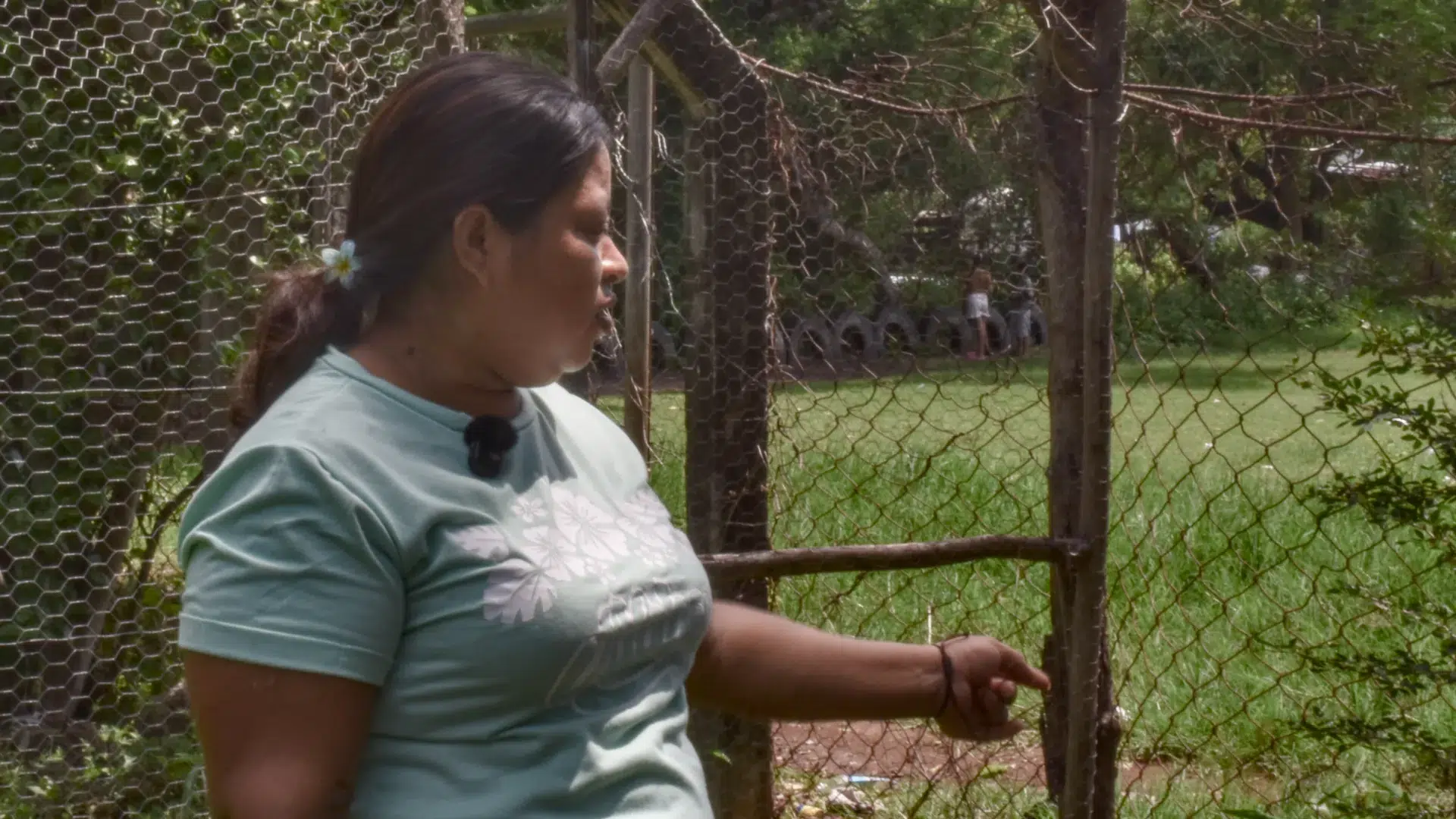
Every morning, Magdalena Meléndez opens the gate of the church in La Bolsona and walks toward a garden located behind the church building. A space to grow food, native seeds, and hope. Amid the crowing of roosters and the singing of birds, a routine begins that has become a way of caring for the territory.
Before reaching the garden, she has already put out water and food for the hens and taken care of the household chores. But she always devotes enough time to the project she manages together with six other women: a collective garden that they themselves sustain and organize, in a green community, surrounded by hills, with abundant trees and near the grandfather river Sensunapan, which is essential for many families and for the crops. This is how Magdalena describes her community, part of the district of Nahulingo, in Sonsonate.
At the center of that collective effort is a cardboard box with a photo of a plant on a pair of hands. It reads: “Semillas Esperanza” (“Hope Seeds”). Inside are clear glass jars, arranged with their respective names: corn, beans, peanuts, chili, cacao, chipilín, pipián, ayote, eggplant. It is the collective bank of native seeds that Magdalena and her companions safeguard. If one of them needs seeds, she takes them from the bank and, after the harvest, must replenish the same variety. This ensures that this heritage keeps circulating among the families of the area.
Magdalena walks through the garden with the familiarity of someone who knows every corner. She points out the beans, the chipilín, the eggplant. She comes across a pipián plant with no harvest and takes it in her hand while explaining that one of the challenges has been the lack of moisture due to the high temperatures, the pests, and the fungi. Despite this, the cucumber has been one of the least affected: it bears fruit 45 to 70 days after planting.
“We make the organic fertilizers to maintain the garden. We prepare our own foliar sprays to care for the vegetables,” she explains.
A majestic ceiba tree draws the eye with its sturdiness, although some of its branches were recently cut. On the other side, the garden borders the community’s soccer field. Balls frequently fall into the plot, hitting the plants and the crops. The solution they found was simple: they planted trees along the edge so that, when they grow, they will serve as a protective barrier.
When they meet, Magdalena confesses that sometimes they don’t arrive feeling like working, but that there is a different energy when they are all together. Besides dividing up the tasks among themselves, the garden has become a space to rest from everyday burdens, share experiences, and support one another. “It feels good to be in that communion of women,” she asserts. When the time comes to gather the harvest, if the amount is small, they agree to distribute it equitably among all of them.
In addition to the collective garden, fifteen women from the community, including Magdalena, grow their own home gardens. In hers, she plants radish, cassava, loroco, and cilantro. But she has brought home more than food.
Despite having lived in La Bolsona for 18 years—half her life—her participation in this collective project dates back three years. She joined an intersectoral committee at the invitation of the Community Development Association (Adesco). It was not until then that she began to hear about the importance of environmental protection and ancestral knowledge.
By participating in the project and in other activities such as cleanup and reforestation campaigns, Magdalena also brought inspiration home. Her 18-year-old daughter is currently studying agribusiness at the University of Sonsonate. This degree program covers everything from seed production and cultivation to processing, transportation, and final distribution to the consumer.
“What gives me strength is leaving my daughter a good lesson, because she is the one who is learning it. It fills me with hope that everything I am learning, I am teaching to her. I feel happy and eager for her to achieve her goal. To help her keep moving forward so that she achieves everything she dreams of,” she shares, as a smile of satisfaction and an expression of pride spread across her face.
That knowledge also made its way to her dad’s house. When she visits him, she tells him about her work. On one occasion, she taught him how to prepare foliar sprays: a fertilizer that is applied directly to the leaves, flowers, or fruits, as an alternative to traditional fertilizers. Convincing him to reduce the use of toxic agrochemicals was not easy. For years, that was the way he dealt with pests in his crops. However, little by little, Magdalena showed him agroecological alternatives and shared the knowledge she acquired in the processes in which she participates alongside her companions, facilitated by the Salvadoran Ecological Unity Association (UNES). “That helps with eating healthier food,” she states. That exchange of knowledge even led them to set up a small family garden.
Magdalena is convinced that it is never too late to start. “Every tree planted is life and every river protected. Every action we take counts a lot.” That is why she has also been part of the women’s collective for three years and hopes more will join.
Although household chores keep her busy most of the day, Magdalena has found time to keep learning. Among the opportunities UNES has offered her, one of her favorites has been embroidery. In her free time, she clings to her threads, fabric, and needle, and the problems stay outside. “When you’re embroidering, you feel good,” she says.
Between the native seeds, the garden, the hens, and the embroidery, Magdalena has found a new way of relating to nature. In the box that reads “Semillas Esperanza,” she also keeps the certainty that this future has a name: that of her daughter, who is studying what her mom taught her to love.
GatoEncerrado: https://gatoencerrado.news/2026/11/17/magdalena-melendez-semillas-criollas-nahulingo-sensunapan/
Magdalena y las guardianas del huerto en La Bolsona
Por Karla Chicas · Entrevista y edición: Metzi Rosales Martel · Fotos: Lisseth Ortiz
Cada mañana, Magdalena Meléndez abre el portón de la iglesia de La Bolsona y camina hacia un huerto que se encuentra detrás del templo. Un espacio para cultivar alimentos, semillas criollas y esperanza. Entre el canto de los gallos y las aves, empieza una rutina que se ha convertido en una forma de cuidar el territorio.
Antes de llegar al huerto, ya ha puesto agua y comida a las gallinas y ha atendido los trabajos del hogar. Pero siempre dedica suficiente tiempo al proyecto que gestiona junto a otras seis mujeres: un huerto colectivo que ellas mismas sostienen y organizan, en una comunidad verde, rodeada de cerros, con abundantes árboles y cerca del abuelo río Sensunapan, que es esencial para muchas familias y para los cultivos. Así describe Magdalena su comunidad, parte del distrito de Nahulingo, en Sonsonate.
Al centro de ese esfuerzo colectivo hay una caja de cartón con una foto de una planta sobre unas manos. Se lee: “Semillas Esperanza”. Adentro hay frascos de vidrio transparentes, ordenados con sus respectivos nombres: maíz, frijol, maní, chile, cacao, chipilín, pipián, ayote, berenjena. Es el banco colectivo de semillas criollas que Magdalena y sus compañeras custodian. Si alguna necesita semillas, las toma del banco y, tras la cosecha, debe reponer la misma variedad. Así se garantiza que ese patrimonio siga circulando entre las familias de la zona.
Magdalena recorre el huerto con la familiaridad de quien conoce cada rincón. Muestra el frijol, el chipilín, la berenjena. Se cruza con una mata de pipián sin cosecha y la toma con la mano mientras explica que uno de los retos ha sido la falta de humedad por las altas temperaturas, las plagas y los hongos. A pesar de esto, el pepino ha sido uno de los menos afectados: da frutos de 45 a 70 días después de la siembra.
“Nosotras hacemos los abonos orgánicos para darle mantenimiento al huerto. Preparamos nuestros propios foliares para el cuido de las hortalizas”, explica.
Una majestuosa ceiba atrae las miradas por su robustez, aunque hace poco le cortaron parte de sus ramas. Al otro lado, el huerto colinda con la cancha de fútbol de la comunidad. Es recurrente que caigan pelotas en la parcela, golpeando las plantas y los cultivos. La solución que encontraron fue sencilla: sembraron árboles en la orilla para que, cuando crezcan, sirvan de barrera de protección.
Cuando se reúnen, Magdalena confiesa que a veces no llegan con ganas de trabajar, pero que hay una energía diferente al estar todas juntas. Además de repartirse las tareas, el huerto se ha convertido en un espacio para descansar de las cargas cotidianas, compartir experiencias y sostenerse entre ellas. “Se siente bien al estar en esa comunión de mujeres”, asegura. Cuando llega el momento de recoger la cosecha, si la cantidad es poca, acuerdan distribuirla de forma equitativa entre todas.
Además del huerto colectivo, quince mujeres de la comunidad, entre ellas Magdalena, cultivan sus propios huertos caseros. En el suyo siembra rábano, yuca, loroco y cilantro. Pero ella ha llevado más que alimentos a su casa.
A pesar de llevar 18 años viviendo en La Bolsona —la mitad de su vida— su participación en este proyecto colectivo se remonta a hace tres años. Se incorporó a un comité intersectorial por invitación de la Asociación de Desarrollo Comunal (Adesco). Fue hasta entonces que empezó a escuchar sobre la importancia de la protección ambiental y los saberes ancestrales.
Al participar en el proyecto y en otras actividades como campañas de limpieza y reforestación, Magdalena también llevó inspiración a casa. Su hija, de 18 años, estudia actualmente agronegocios en la Universidad de Sonsonate. Esta carrera abarca desde la producción de semillas y el cultivo, hasta el procesamiento, el transporte y la distribución final al consumidor.
“Lo que me da fuerza es dejarle una buena enseñanza a mi hija, porque ella es quien lo está aprendiendo. Me llena de esperanza que todo lo que yo estoy aprendiendo, se lo estoy enseñando a ella. Me siento feliz y con ganas de que ella logre su propósito. Ayudarle a que siga adelante para que logre todo lo que sueña”, comparte, mientras se le dibuja una sonrisa de satisfacción y una expresión de orgullo en su rostro.
Esos conocimientos también llegaron hasta la casa de su papá. Cuando lo visita, le cuenta sobre su trabajo. En una oportunidad, le enseñó cómo preparar foliares: un fertilizante que se aplica directamente sobre las hojas, flores o frutos, como alternativa a los abonos tradicionales. Convencerlo de reducir el uso de agrotóxicos no fue fácil. Durante años, esa fue la forma en que él enfrentó las plagas en sus cultivos. Sin embargo, poco a poco, Magdalena le fue mostrando alternativas agroecológicas y compartiendo los conocimientos que adquirió en los procesos en los que participa junto a sus compañeras, facilitados por la Asociación Unidad Ecológica Salvadoreña (UNES). “Eso ayuda a comer alimentos más saludables”, afirma. Ese intercambio de saberes incluso los llevó a establecer un pequeño huerto familiar.
Magdalena está convencida de que nunca es tarde para empezar. “Cada árbol sembrado es vida y cada río protegido. Cada acción que hagamos cuenta mucho”. Por eso también forma parte del colectivo de mujeres desde hace tres años y espera que se sumen más.
A pesar de que los trabajos del hogar la mantienen ocupada la mayor parte del día, Magdalena ha encontrado tiempo para seguir aprendiendo. Entre las oportunidades que le ha brindado la UNES, una de sus favoritas ha sido el bordado. En sus ratos libres, se aferra a sus hilos, tela y aguja, y los problemas se quedan afuera. “Bordando una se siente bien”, dice.
Entre las semillas criollas, el huerto, las gallinas y el bordado, Magdalena ha encontrado una nueva forma de relacionarse con la naturaleza. En la caja que dice “Semillas Esperanza” guarda también la certeza de que ese futuro tiene nombre: el de su hija, que estudia lo que su mamá le enseñó a amar.
GatoEncerrado: https://gatoencerrado.news/2026/11/17/magdalena-melendez-semillas-criollas-nahulingo-sensunapan/