
Editor’s clarification: This article was published on November 4, 2026. Legislative Decree No. 181 was issued on December 20, 2024 and extended in October 2025 through October 2, 2026. Its Article 9 required periodic reports to the Legislative Assembly. The replacement law, enacted on September 29, 2026 and effective on October 2, 2026, does not reproduce that reporting clause. The article’s closing question about Decree No. 181 must be read in light of that change, not as confirmation that the former provision remained in force after October 2.
The first official account of what happened comes from a terse statement by the Armed Forces of El Salvador. According to that version, four aviation technician soldiers stationed in Haiti were ambushed as they were returning to their camp. The information provided does not explain where they were coming from or what task they had carried out that afternoon of October 18. It only mentions that the attack, with firearms and explosives, set fire to the vehicle in which they were traveling. Although they managed to get out, they could not defend themselves. The air support that arrived in the area was also attacked with gunfire and could not rescue them. The next day, the institution specified that the service members belonged to Task Force Libertad II, the Salvadoran contingent of the Gang Suppression Force (GSF).
The statement did not identify where the ambush took place, but Haitian media placed it in Santo, in the commune of Croix-des-Bouquets, northeast of Port-au-Prince. According to the Haitian newspaper Le Nouvelliste, that is territory controlled by the Chen Mechan gang. The newspaper, which cited government sources without identifying them, reported that the service members were looking for a market to do some shopping and that they arrived at the site of the ambush, without notifying the National Police, by following directions from Google Maps.
Salvadoran authorities have not yet revealed the identities of the four ambushed service members, nor have they explained anything about their profiles and work in Haiti. In fact, in these weeks since the disappearance, the government has not publicly shown any outreach to the families either. For their part, content creators have circulated the purported identities of the four soldiers on social media, but they have not explained how they obtained or verified that information.
Univision was able to verify that one of those four missing service members is Edimar Rosales, who had been in Haiti for seven months. The young man, 23, a native of Ahuachapán with four years in the Armed Forces, managed to send audio messages and videos to his family while the armored vehicle in which he was traveling was being attacked. According to the testimony of his relatives, that was the last communication they had with him. And then, silence.
The Dominican media outlet “Al Tanto TV” interviewed General William Reyes, of that country’s Armed Forces, who stated that the surnames of the other three missing Salvadoran soldiers are Orellana Ortiz, Perez Trejo and García. The general asserted that his sources are reliable and that he could not reveal them.
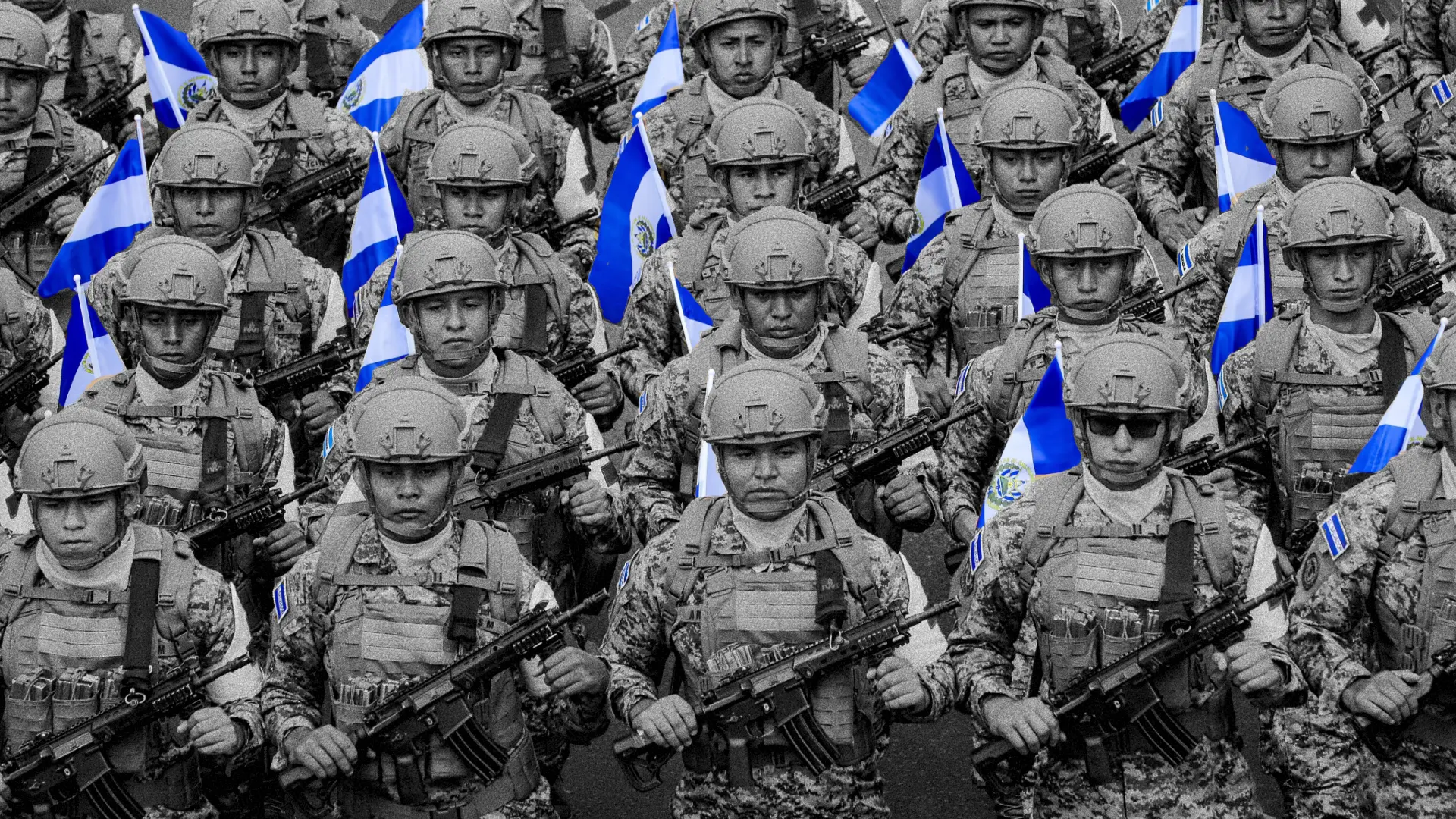
Although official information about the missing soldiers remains scarce, Bukele has focused his rhetoric on threatening to finish off the Haitian gangs, as he claims to have done in El Salvador, if they do not hand over the aviation technicians alive. That threat has been accompanied by the dispatch of 2,000 Salvadoran troops to Haiti, a figure that could increase in the coming days.
The information is so opaque that, as this article went to press on November 4, it had not even been publicly established that the four service members were still alive. So the government deployed those 2,000 troops to supposedly rescue them without clarifying whether it was still possible to find them alive.
Despite that opacity, the rescue has broad support among Salvadorans. According to a CID Gallup poll, released by Diario El Mundo, 86% of the people surveyed support the rescue.
One of the few things Bukele has explained is that before the ambush, the Salvadoran mission in Haiti was made up of about 200 service members, solely pilots and technical personnel, who supported medical evacuations. Ten days after the disappearance of the four soldiers, the contingent had grown to represent one-tenth of the Salvadoran Army, according to calculations by the AFP news agency. Jake Johnston, a researcher at the Center for Economic and Policy Research, has described it as El Salvador’s largest military deployment abroad since the war with Honduras in 1969.
Since the ambush, the information that has been emerging about the condition of the four soldiers has at times even been contradictory or without evidence to verify it. For example, on October 19, the United States ambassador to the UN, Mike Waltz, said at the Security Council: “We believe the four men survived.” Two days later, Bukele called them hostages and demanded that the Haitian gangs return them “alive and unharmed.” But on October 24, The New York Times reported that charred human remains had been found. Bukele responded: “They are not our men,” and cited differences in height, age and clothing.
The next day, the GSF confirmed that it had received remains through a humanitarian organization, but said it could not confirm whom they belonged to. It also clarified that the ID card of a Chadian service member, circulated on social media, belonged to a living soldier who had lost it in another attack.
On October 27, various media outlets reported that Wilson Joseph, alias Lanmò San Jou, leader of the 400 Mawozo gang, was claiming that the four had died in a clash. No outlet was able to verify it.
On October 31, Donald Trump told reporters that he had spoken with Bukele and that in Haiti “they killed some of his people.” Bukele confirmed the call, without clarifying whether he also confirmed that statement.
On November 1, Haitian media circulated a letter attributed to the same Wilson Joseph, addressed to the UN secretary-general, requesting international mediation to engage in dialogue with the forces present in Haiti. The letter does not prove that a negotiation exists or that its alleged author is holding the missing service members. UN spokesperson Stéphane Dujarric confirmed receipt of the letter, but clarified that this did not imply endorsement or dialogue. He added that the “majority” of the Salvadoran personnel in the Caribbean country are not deployed under the GSF and, therefore, fall outside the logistical support of UNSOH, the United Nations office that supports the GSF. That clarification from the UN leaves open the questions about the chain of command, supply and the legality under which the Salvadoran troops are operating.
How did the Salvadoran soldiers get to Haiti?
As early as December 2021, Vice President Félix Ulloa, who was resident director of the National Democratic Institute (NDI) in Haiti for more than 10 years, said the country deserved support in solidarity and revealed that, before the assassination of President Jovenel Moïse, a plan for collaboration between El Salvador and Haiti to replicate the Salvadoran security model already existed. In other words, the idea of the Bukele government exporting its “model” to Haiti had already been on the table since 2021. But it did not begin to take concrete shape until October 30, 2024, when the Legislative Assembly of El Salvador ratified an agreement that granted the personnel of the multinational mission judicial and tax immunities, as well as freedom of movement in Haitian territory.
That agreement, which remains in force, was initially signed between Haiti and Kenya, and El Salvador then formally joined it in October 2024. The agreement establishes the legal terms, immunities and operational powers that allow the troops of the participating States to deploy in Haitian territory to support the stabilization and security of the country, within the framework of the resolutions of the United Nations Security Council.
In December of that same year, Legislative Decree 181 authorized the deployment of helicopters equipped for medical evacuations until October 2, 2025. That decree required President Bukele to report “periodically” to the Assembly and held him responsible for the contingent’s activity, exempted the Ministry of Defense’s procurements for the mission from the Public Procurement Law, and ordered that the deployed personnel be prevented from being handed over to international courts.
The first eight aviation specialists arrived in Haiti in January 2025. A month later, another 70 service members arrived. By October of that year, when the Assembly extended the authorization for one more year, El Salvador already had 78 service members in Haiti, and in the following months more troops were gradually added.
The scope of the mission changed on September 29, 2026. That day, while the UN Security Council was renewing the GSF’s mandate until March 31, 2027, the Salvadoran Assembly approved, with a waiver of procedure, a new transitory law for an extendable twelve-month period. This new law no longer mentioned medical evacuations and, instead, authorized the dispatch of aircraft “fully equipped for specific missions,” as well as of civilian and military personnel according to the needs of the mission, military aid and defense equipment. It kept the exemption from the Public Procurement Law and the clause on protecting personnel from being handed over to international courts. The transitory law also eliminated the article (9) that made Bukele responsible for the soldiers’ activity in Haiti and that required him to submit reports to the Assembly. This new law took effect on October 2; that is, sixteen days before the ambush.
The country receiving the soldiers
These agreements and the urgency of the Salvadoran mission to rescue the four aviation technicians can make one lose sight of the complex history of Haiti, the first republic to emerge from a victorious revolution of enslaved people. Its trajectory was marked by France’s financial impositions, the U.S. occupation and the authoritarian governments that controlled it for decades, among them the Duvalier dictatorship.
Independence was proclaimed on January 1, 1804, after an anti-slavery revolution that defeated French colonial rule. In 1825, under naval threat, France imposed, as a condition for recognizing it, an indemnity of 150 million francs intended for former colonial property owners. The sum was reduced to 90 million in 1838, but the indemnity and the associated loans burdened Haitian finances for nearly a century, as historian Gusti-Klara Gaillard-Pourchet has documented. The United States militarily occupied the country between 1915 and 1934. Decades later, François Duvalier and his son Jean-Claude headed a dynastic dictatorship that lasted from 1957 to 1986.
Subsequent international interventions also left documented harm. The United Nations Stabilization Mission in Haiti, known as MINUSTAH, operated between 2004 and 2017. During that mission there was a cholera epidemic that began in October 2010. In December 2016, UN Secretary-General Ban Ki-moon apologized to the Haitian people for the organization’s role in the crisis and for its insufficient response to the outbreak.
The assassination of President Jovenel Moïse on July 7, 2021, worsened the institutional crisis and made it easier for the gangs, which already wielded growing influence, to expand their territorial control. This assassination exacerbated a political crisis that has led to Haiti not holding presidential elections since November 2016. The last legislative and local elections were held in January 2017.
The figures describe a prolonged crisis. The World Bank estimates that the Haitian economy contracted for the eighth consecutive year in 2026. Close to 1.5 million people are displaced within the country, according to the UN. A food security assessment published on October 28 places almost six million people at crisis or worse levels of acute food insecurity. Between January 1 and September 11, 2026, the UN documented at least 5,700 people killed or injured by the violence of the gangs and the operations against them.
Almost a year after the Security Council authorized the GSF, it had about 1,500 personnel deployed: slightly more than a quarter of the 5,500 military and police personnel authorized. Separately, a task force of the Haitian authorities has used armed drones with support from Vectus Global, the company run by Erik Prince, founder of Blackwater. According to data from multiple sources reviewed by Human Rights Watch, those attacks killed at least 1,243 people, including 17 children, between March 1, 2025, and January 21, 2026.
It is in that Caribbean country, with that deep crisis, where the four aviation technicians disappeared in a gang-controlled territory and where Bukele has made an incursion with a large-scale military operation.
The record that travels with the troops
In his narrative, Bukele has offered Haiti his experience as an exportable model. “We are teaching the gangs a lesson,” he said on October 29, while at the same time defending the deployment and asserting that it was not an invasion. But beyond his propagandistic rhetoric, his “model” has a long documented record of human rights violations.
Since the state of exception took effect in March 2022, homicides have fallen drastically, but at the same time the independent press and organizations such as HRW and Cristosal have documented hundreds of indiscriminate raids that police officers and soldiers carried out without court orders, especially in impoverished neighborhoods.
Among the cases that directly involve Salvadoran service members is that of a young 16-year-old student detained in Sensuntepeque in May 2022. According to HRW, the soldiers stripped him, burned his torso with a lighter and forced him to confess that he belonged to a gang, even though he was not actually a gang member. The teenager was sentenced to six years in prison.
In November 2022, service members arrested, without justification, eight adolescents who were sleeping in their homes with their families in Bajo Lempa. They burst in at midnight, broke down doors and mistreated the relatives who were begging them not to take the adolescents away and insisting that they were not gang members. In the early morning hours, they took them to a remote location, where they forced them to do endurance exercises and hit them on the head when they were unable to do them. To justify these arrests, the service members lied. They recorded a false version in the arrest reports. They claimed that the adolescents were gang members, that they were gathered on a street corner and that they had fled upon seeing the military presence.
In September 2023, a group of adolescents was walking from Mizata beach, in a tourist area of El Salvador, when six service members intercepted them. One of the soldiers took a 13-year-old girl aside and sexually abused her, while the other five threatened the rest of the adolescents to make them stay still and silent.
On October 27, 2026, as Salvadoran service members were arriving in Haiti, Cristosal reported to the Inter-American Commission on Human Rights (IACHR) that 454 people had died in El Salvador’s prisons while in the custody of the State. In 87 of those cases there were signs of torture. Many of those people were in prison, waiting to be tried in mass trials after having been arbitrarily arrested in the operations of the state of exception. These allegations join those of five international jurists who published a report in which they concluded that “there is a reasonable basis to believe that crimes against humanity have been committed under the state of exception.” Amnesty International also reached a similar conclusion when documenting cases of human rights violations that occurred under the militarization of public security.
The military personnel, under Bukele’s command, have not only served him in public security tasks; he has also used them for political purposes, even though that is expressly prohibited by the Constitution of the Republic. On February 9, 2020, for example, Bukele burst into the plenary chamber of the Legislative Assembly escorted by armed soldiers to pressure for the approval of a loan. That was the first sign that Bukele was willing to invade the other branches of the State and that he would use the Armed Forces as his political instrument to achieve it.
That, in general terms, is the background of the Armed Forces commanded by Bukele, the same force that today is on a military mission in Haiti, without a clear chain of command at the international level and under the narrative that, in their search for the four aviation technicians, they are “teaching the Haitian gangs a lesson.”
A mission in an election year
Another important element is that the military operation in Haiti is also taking place in the midst of El Salvador’s presidential campaign, in which Bukele is seeking a third consecutive term after having amended the Constitution so that continuous reelection is now legal.
In this electoral context, the military operation offers Bukele an international stage on which to showcase the “security model” that sustains his popularity, with the explicit backing of U.S. President Donald Trump. This, despite the fact that the “model” has also entailed the concentration of power in Bukele’s hands and the use of military personnel in public security tasks, in which serious human rights violations have been documented and which international organizations have identified as abuses that could constitute crimes against humanity.
What the government must clarify
With all this context and background, the Bukele government has an obligation to clarify a series of questions regarding the military deployment in Haiti. Answering these questions does not compromise the search or specific plans to find El Salvador’s four aviation technicians; it is simply information that any democratic State should provide to its citizens when it sends thousands of its soldiers to another country.
On the four missing
Regarding the ambushed and missing soldiers, the government must explain what the actual known situation of each one is and what evidence it holds to assert that they were “kidnapped.” Likewise, there must be an explanation of who authorized the October 18 movement to the place where they were ambushed, with what risk assessment and with what escort. Although Bukele asserted that the charred human remains that were found do not correspond to the Salvadoran soldiers, it is necessary to know which laboratory examined those remains, whether reference samples were taken from the families and what has been communicated to the relatives. Similarly, it has not been made public whether there is an ongoing investigation into the decisions prior to the attack.
On command and the law
Given that the UN has dissociated itself from El Salvador’s military operation in Haiti, it is important that the chain of command be explained, along with what the Haitian government consented to in writing and under what agreement the troops operate outside the GSF. Furthermore, what reports has Bukele sent to the Assembly, as required by Decree 181, which extended the military presence in Haiti just a few days before the ambush?
On the objective and the exit
Although Bukele has said that this “is not an invasion” and that they are searching for the four aviation technicians, he must clarify what objectives and actions are authorized when he also says that they are “teaching a lesson to the gangs” of Haiti. It still remains to be clarified: what will happen if they confirm the deaths of the four aviation technicians, or whether the search will be prolonged if, as has been the case so far, they find nothing? What are the rules of engagement, and what aircraft and weaponry have specifically been deployed?
On civilians and human rights
Before sending the Salvadoran soldiers to Haiti, were there human rights screenings applied to select them? Who investigates complaints of harm to civilians, and where can they be filed? Will flight logs and operational reports be published in response to complaints that may arise?
On the money
In a country like El Salvador, where almost one million people are on the brink of famine and the majority of the population says it has economic problems surviving, it is necessary for the government to detail the total cost of the military operation in Haiti, which budget line it comes from and what it includes. Likewise, for the sake of transparency, the government must detail which purchases were made outside the Public Procurement Law. Are there contracts, payments or coordination with Vectus Global or other private military companies?
In the end, four Salvadoran soldiers were attacked on October 18 in Haiti. Following that event, their families need to know what happened to them, and the citizenry needs to know what is being decided, paid for and done in its name.
GatoEncerrado: https://gatoencerrado.news/2026/11/04/operacion-militar-el-salvador-haiti-bukele/
Operación militar de El Salvador en Haití: Lo que se sabe y lo que Bukele debe aclarar
Aclaración editorial: Este artículo fue publicado el 4 de noviembre de 2026. El Decreto Legislativo n.º 181 fue emitido el 20 de diciembre de 2024 y prorrogado en octubre de 2025 hasta el 2 de octubre de 2026. Su artículo 9 exigía informes periódicos a la Asamblea Legislativa. La ley que lo sustituyó, aprobada el 29 de septiembre de 2026 y vigente desde el 2 de octubre de 2026, no reproduce esa cláusula de informes. La pregunta final del artículo sobre el Decreto n.º 181 debe leerse a la luz de ese cambio, no como confirmación de que la disposición anterior seguía vigente después del 2 de octubre.
Por Ezequiel Barrera
El primer relato oficial de lo ocurrido proviene de un escueto comunicado de la Fuerza Armada de El Salvador. Según esa versión, cuatro soldados aerotécnicos destacados en Haití fueron emboscados cuando regresaban a su campamento. La información brindada no explica de dónde venían ni qué tarea habían realizado esa tarde del 18 de octubre. Solo menciona que el ataque, con armas de fuego y explosivos, incendió el vehículo en el que viajaban. Aunque lograron salir, no pudieron defenderse. El apoyo aéreo que llegó a la zona también fue atacado con disparos y no pudo rescatarlos. Al día siguiente, la institución precisó que los militares pertenecían a la Fuerza de Tarea Libertad II, el contingente salvadoreño de la Fuerza de Supresión de Pandillas (GSF, por sus siglas en inglés).
El comunicado no identificó dónde ocurrió la emboscada, pero los medios haitianos la situaron en Santo, en la comuna de Croix-des-Bouquets, al noreste de Puerto Príncipe. Según el periódico haitino Le Nouvelliste, ese es un territorio controlado por la pandilla Chen Mechan. El diario, que citó fuentes gubernamentales sin identificarlas, publicó que los militares buscaban un mercado para hacer compras y que llegaron al lugar de la emboscada, sin avisarle a la Policía Nacional, siguiendo las indicaciones de Google Maps.
Las autoridades salvadoreñas aún no han revelado la identidad de los cuatro militares emboscados ni han explicado nada sobre sus perfiles y trabajo en Haití. De hecho, en estas semanas desde la desaparición, el Gobierno tampoco ha mostrado públicamente algún acercamiento a las familias. Por su lado, creadores de contenido han difundido en redes sociales las supuestas identidades de los cuatro soldados, pero no han explicado cómo obtuvieron o verificaron esa información.
Univisión logró verificar que uno de esos cuatro militares desaparecidos es Edimar Rosales, quien llevaba siete meses en Haití. El joven, de 23 años, originario de Ahuachapán y con cuatro años en la Fuerza Armada, alcanzó a enviar audios y videos a su familia mientras el vehículo blindado en el que viajaba era atacado. Según el testimonio de sus parientes, esa fue la última comunicación que tuvieron con él. Y después silencio.
El medio dominicano “Al Tanto TV” entrevistó al general William Reyes, de las Fuerzas Armadas de ese país, quien afirmó que los apellidos de los otros tres soldados salvadoreños desaparecidos son Orellana Ortiz, Perez Trejo y García. El general aseguró que sus fuentes son confiables y que no podía revelarlas.
Aunque la información oficial sobre los soldados desaparecidos sigue siendo escasa, Bukele ha centrado su discurso en amenazar a las pandillas haitianas con acabar con ellas, como asegura haberlo hecho en El Salvador, si no entregan con vida a los aerotécnicos. Esa amenaza ha sido acompañada con el envío de 2,000 efectivos salvadoreños a Haití, una cifra que podría aumentar en los próximos días.
La información es tan opaca que, al cierre de esta nota el 4 de noviembre, ni siquiera se había establecido públicamente que los cuatro militares seguían con vida. Así que el Gobierno desplegó esos 2,000 efectivos para supuestamente rescatarlos sin aclarar si aún era posible encontrarlos vivos.
A pesar de esa opacidad, el rescate cuenta con un amplio respaldo entre los salvadoreños. Según una encuesta de CID Gallup, divulgada por Diario El Mundo, el 86 % de las personas consultadas apoya el rescate.
De las pocas cosas que ha explicado Bukele es que antes de la emboscada, la misión salvadoreña en Haití estaba integrada por unos 200 militares, únicamente pilotos y personal técnico, que apoyaban en evacuaciones médicas. Diez días después de la desaparición de los cuatro soldados, el contingente creció hasta representar una décima parte del Ejército salvadoreño, según cálculos de la agencia de noticias AFP. Jake Johnston, investigador del Center for Economic and Policy Research, lo ha descrito como el mayor despliegue militar de El Salvador en el exterior desde la guerra con Honduras en 1969.
Desde la emboscada, la información que ha ido surgiendo sobre el estado de los cuatro soldados ha sido, a veces, hasta contradictoria o sin pruebas para verificarla. Por ejemplo, el 19 de octubre, el embajador de Estados Unidos ante la ONU, Mike Waltz, dijo en el Consejo de Seguridad: “Creemos que los cuatro hombres sobrevivieron”. Dos días después, Bukele los llamó rehenes y exigió a las pandillas haitianas que fueran devueltos “vivos e ilesos”. Pero el 24 de octubre, The New York Times informó que fueron encontrados restos humanos calcinados. Bukele respondió: “No son nuestros hombres”, y alegó diferencias de estatura, edad e indumentaria.
Al día siguiente, la GSF confirmó que había recibido restos por medio de una organización humanitaria, pero dijo no poder confirmar a quién pertenecían. También aclaró que la credencial de un militar chadiano, difundida en redes sociales, era de un soldado vivo que la había perdido en otro ataque.
El 27 de octubre, diferentes medios publicaron que Wilson Joseph, alias Lanmò San Jou, líder de la pandilla 400 Mawozo, afirmaba que los cuatro murieron en un enfrentamiento. Ningún medio pudo verificarlo.
El 31 de octubre, Donald Trump dijo a periodistas que había hablado con Bukele y que en Haití “mataron a algunos de los suyos”. Bukele confirmó la llamada, sin aclarar si confirmaba también esa frase.
El 1 de noviembre, medios haitianos difundieron una carta atribuida al mismo Wilson Joseph, dirigida al secretario general de la ONU, en la que solicitaba mediación internacional para dialogar con las fuerzas presentes en Haití. La carta no demuestra que exista una negociación ni que su presunto autor tenga en su poder a los militares desaparecidos. El portavoz de la ONU, Stéphane Dujarric, confirmó la recepción de la carta, pero aclaró que eso no implicaba respaldo ni diálogo. Agregó que la “mayoría” del personal salvadoreño en el país caribeño no está desplegado bajo la GSF y, por lo tanto, queda fuera del apoyo logístico de UNSOH, la oficina de Naciones Unidas que apoya a la GSF. Esa precisión de la ONU deja abiertas las preguntas sobre la cadena de mando, el abastecimiento y la legalidad con la que actúan las tropas salvadoreñas.
¿Cómo llegaron los soldados salvadoreños a Haití?
Desde diciembre de 2021, el vicepresidente Félix Ulloa, quien fue director residente del National Democratic Institute (NDI) durante más de 10 años en Haití, expresó que ese país merecía un apoyo solidario y reveló que, antes del magnicidio del presidente Jovenel Moïse, ya existía un plan de colaboración entre El Salvador y Haití para replicar el modelo de seguridad salvadoreño. En otras palabras, la idea de que el Gobierno de Bukele exportara su “modelo” a Haití ya estaba sobre la mesa desde 2021. Pero comenzó a concretarse hasta el 30 de octubre de 2024, cuando la Asamblea Legislativa de El Salvador ratificó un acuerdo que otorgaba al personal de la misión multinacional inmunidades judiciales y fiscales, así como libertad de movimiento en territorio haitiano.
Ese acuerdo, que sigue vigente, inicialmente fue firmado entre Haití y Kenia y luego El Salvador se sumó formalmente en octubre de 2024. El acuerdo establece los términos legales, inmunidades y facultades operativas que permiten a las tropas de los Estados participantes desplegarse en territorio haitiano para apoyar en la estabilización y seguridad del país, en el marco de las resoluciones del Consejo de Seguridad de las Naciones Unidas.
En diciembre de ese mismo año, el Decreto Legislativo 181 autorizó el despliegue de helicópteros equipados para evacuaciones médicas hasta el 2 de octubre de 2025. Ese decreto obligaba al presidente Bukele a informar “en forma periódica” a la Asamblea y lo responsabilizaba por la actividad del contingente, exceptuaba de la Ley de Compras Públicas las adquisiciones del Ministerio de Defensa para la misión y ordenaba impedir que el personal desplegado fuera entregado a tribunales internacionales.
Los primeros ocho especialistas en aviación llegaron a Haití en enero de 2025. Un mes después, llegaron otros 70 militares. Para octubre de ese año, cuando la Asamblea prorrogó la autorización por un año más, El Salvador ya tenía en Haití a 78 militares y en los siguientes meses se fueron sumando más efectivos.
El alcance de la misión cambió el 29 de septiembre de 2026. Ese día, mientras el Consejo de Seguridad de la ONU renovaba el mandato de la GSF hasta el 31 de marzo de 2027, la Asamblea salvadoreña aprobó, con dispensa de trámite, una nueva ley transitoria por doce meses prorrogables. Esta nueva ley dejó de mencionar las evacuaciones médicas y, en su lugar, autorizó el envío de aeronaves “completamente equipadas para misiones específicas”, así como de personal civil y militar según las necesidades de la misión, ayuda militar y equipo de defensa. Mantuvo la excepción a la Ley de Compras Públicas y la cláusula sobre proteger al personal para que no sea entregado a tribunales internacionales. En la ley transitoria también se eliminó el artículo (9) que hacía responsable a Bukele por la actividad de los soldados en Haití y que lo obligaba a presentar informes ante la Asamblea. Esta nueva ley entró en vigencia el 2 de octubre; es decir, dieciséis días antes de la emboscada.
El país que recibe a los soldados
Estos acuerdos y la urgencia de la misión salvadoreña para rescatar a los cuatro aerotécnicos puede hacer perder de vista la compleja historia de Haití, la primera república surgida de una revolución victoriosa de personas esclavizadas. Su trayectoria quedó marcada por las imposiciones financieras de Francia, la ocupación estadounidense y los gobiernos autoritarios que la controlaron por décadas, entre ellos la dictadura de los Duvalier.
La independencia se proclamó el 1 de enero de 1804, tras una revolución antiesclavista que derrotó al dominio colonial francés. En 1825, bajo amenaza naval, Francia impuso como condición para reconocerla una indemnización de 150 millones de francos destinada a antiguos propietarios coloniales. La suma se redujo a 90 millones en 1838, pero la indemnización y los préstamos asociados gravaron las finanzas haitianas durante casi un siglo, como ha documentado la historiadora Gusti-Klara Gaillard-Pourchet. Estados Unidos ocupó militarmente el país entre 1915 y 1934. Décadas después, François Duvalier y su hijo Jean-Claude encabezaron una dictadura dinástica que se prolongó de 1957 a 1986.
Las intervenciones internacionales posteriores también dejaron daños documentados. La Misión de Estabilización de las Naciones Unidas en Haití, conocida como MINUSTAH, operó entre 2004 y 2017. Durante esa misión hubo una epidemia de cólera que comenzó en octubre de 2010. En diciembre de 2016, el secretario general de la ONU, Ban Ki-moon, pidió disculpas al pueblo haitiano por el papel de la organización en la crisis y por su respuesta insuficiente al brote.
El asesinato del presidente Jovenel Moïse, el 7 de julio de 2021, agravó la crisis institucional y facilitó que las pandillas, que ya ejercían una creciente influencia, ampliaran su control territorial. Este magnicidio agudizó una crisis político que ha llevado a que Haití no celebre elecciones presidenciales desde noviembre de 2016. Los últimos comicios legislativos y locales se realizaron en enero de 2017.
Las cifras describen una crisis prolongada. El Banco Mundial estima que la economía haitiana se contrajo por octavo año consecutivo en 2026. Cerca de 1.5 millones de personas están desplazadas dentro del país, según la ONU. Una evaluación de seguridad alimentaria publicada el 28 de octubre sitúa a casi seis millones de personas en niveles de crisis o peores de inseguridad alimentaria aguda. Entre el 1 de enero y el 11 de septiembre de 2026, la ONU documentó al menos 5,700 personas muertas o heridas por la violencia de las pandillas y las operaciones contra ellas.
Casi un año después de que el Consejo de Seguridad autorizara la GSF, esta tenía desplegados unos 1,500 efectivos: algo más de una cuarta parte de los 5,500 militares y policías autorizados. Por separado, una fuerza de tarea de las autoridades haitianas ha empleado drones armados con apoyo de Vectus Global, la empresa dirigida por Erik Prince, fundador de Blackwater. Según datos de múltiples fuentes revisados por Human Rights Watch, esos ataques mataron al menos a 1,243 personas, incluidos 17 niños, entre el 1 de marzo de 2025 y el 21 de enero de 2026.
Es en ese país caribeño, con esa profunda crisis, donde los cuatro aerotécnicos desaparecieron en un territorio controlado por pandillas y donde Bukele ha incursionado con una operación militar de gran escala.
El historial que viaja con las tropas
En su narrativa, Bukele ha ofrecido a Haití su experiencia como un modelo exportable. “Estamos dando una lección a las pandillas”, dijo el 29 de octubre, al mismo tiempo que defendió el despliegue y aseguró que no era una invasión. Pero más allá de su discurso propagandístico, su “modelo” tiene un largo historial documentado de violaciones a derechos humanos.
Desde que entró en vigencia el régimen de excepción, en marzo de 2022, los homicidios cayeron drásticamente, pero al mismo tiempo la prensa independiente y organizaciones como HRW y Cristosal documentaron cientos de allanamientos indiscriminados que policías y soldados realizaron sin órdenes judiciales, sobre todo en barrios empobrecidos.
Entre los casos que involucran directamente a los militares salvadoreños está el de un joven estudiante de 16 años detenido en Sensuntepeque en mayo de 2022. Según HRW, los soldados lo desnudaron, le quemaron el torso con un encendedor y lo obligaron a confesar que pertenecía a una pandilla, sin que realmente fuera pandillero. El adolescente fue condenado a seis años de cárcel.
En noviembre de 2022, militares capturaron sin justificación a ocho adolescentes que dormían en sus casas con sus familias, en el Bajo Lempa. Irrumpieron a medianoche, rompieron puertas y maltrataron a los familiares que suplicaban que no se los llevaran e insistían en que ellos no eran pandilleros. Los trasladaron, de madrugada, a un lugar apartado, donde los obligaron a hacer ejercicios de resistencia y los golpearon en la cabeza cuando no eran capaces de hacerlos. Para justificar estas capturas, los militares mintieron. Consignaron una versión falsa en las actas de detención. Afirmaron que los adolescentes eran pandilleros, que estaban reunidos en una esquina y que habían huido al ver la presencia militar.
En septiembre de 2023, un grupo de adolescentes venía caminando desde la playa de Mizata, en una zona turística de El Salvador, cuando seis militares los interceptaron. Uno de los soldados apartó a una adolescente de 13 años y abusó sexualmente de ella, mientras los otros cinco amenazaban a los demás adolescentes para que se quedaran quietos y en silencio.
El 27 de octubre de 2026, mientras los militares salvadoreños llegaban a Haití, Cristosal informó ante la Comisión Interamericana de Derechos Humanos (CIDH) que bajo la tutela del Estado habían fallecido 454 personas en las prisiones de El Salvador. En 87 de esos casos había señales de tortura. Muchas de esas personas estaban en las cárceles, esperando ser procesadas en juicios masivos luego de haber sido capturados arbitrariamente en los operativos del régimen de excepción. Estas denuncias se unen a las de cinco juristas internacionales que publicaron un informe en que concluyeron que “existe una base razonable para creer que bajo el régimen de excepción se han cometido crímenes de lesa humanidad”. Amnistía Internacional también llegó a una conclusión similar al documentar casos de violaciones a derechos humanos que ocurrieron bajo la militarización de la seguridad pública.
Los militares, bajo el mando de Bukele, no solo le han servido en tareas de seguridad pública, también los ha utilizado para propósitos políticos, aunque eso está expresamente prohibido en la Constitución de la República. El 9 de febrero de 2020, por ejemplo, Bukele irrumpió en el pleno de la Asamblea Legislativa escoltado por soldados armados para presionar la aprobación de un préstamo. Esa fue la primera señal de que Bukele estaba dispuesto a invadir los otros poderes del Estado y que usaría a la Fuerza Armada como su instrumento político para lograrlo.
Esos son, en términos generales, los antecedentes de la Fuerza Armada comandada por Bukele, misma que hoy está en una misión militar en Haití, sin una cadena de mando claro a nivel internacional y bajo la narrativa de que en su búsqueda de los cuatro aerotécnicos están “dando una lección a las pandillas haitianas”.
Una misión en año electoral
Otro elemento importante es que la operación militar en Haití también ocurre en plena campaña presidencial de El Salvador, en la que Bukele busca un tercer período consecutivo luego de haber modificado la Constitución para que ahora sea legal la reelección continúa.
En este contexto electoral, la operación militar ofrece a Bukele un escenario internacional para exhibir el “modelo de seguridad” que sostiene su popularidad, con el respaldo explícito del presidente estadounidense Donald Trump. Eso a pesar de que el “modelo” también ha supuesto la concentración de poder en manos de Bukele y el empleo de militares en tareas de seguridad pública, en las que se han documentado graves violaciones a los derechos humanos y que las organizaciones internacionales han señalado como abusos que podrían constituir crímenes de lesa humanidad.
Lo que el Gobierno debe aclarar
Con todo este contexto y antecedentes, el Gobierno de Bukele tiene la obligación de aclarar una serie de cuestionamientos ante el despliegue militar en Haití. Responder a estas preguntas no compromete la búsqueda ni planes específicos para encontrar a los cuatro aerotécnicos de El Salvador, solo es información que cualquier Estado bajo democracia debería ofrecer a sus ciudadanos cuando envía miles de sus soldados a otro país.
Sobre los cuatro desaparecidos
Sobre los soldados emboscados y desaparecidos, el Gobierno debe explicar cuál es la situación real conocida de cada uno y qué evidencia sostiene para afirmar que fueron “secuestrados”. Asimismo, debe existir una explicación sobre quién autorizó el desplazamiento del 18 de octubre hacia el lugar donde fueron emboscados, con qué evaluación de riesgo y con qué escolta. Aunque Bukele aseguró que los restos encontrados de personas calcinadas no corresponden a los soldados salvadoreños, es necesario saber qué laboratorio examinó esos restos, si se tomaron muestras de referencia a las familias y qué se les ha comunicado a los parientes. De igual manera, no se ha hecho público si hay una investigación en curso sobre las decisiones previas al ataque.
Sobre el mando y la ley
Ante la desvinculación que la ONU ha hecho de la operación militar de El Salvador en Haití, es importante que se explique la cadena de mando y qué consintió por escrito el Gobierno haitiano y bajo qué acuerdo operan las tropas fuera de la GSF. Además, ¿qué informes ha enviado Bukele a la Asamblea, como exigía el Decreto 181 que prorrogó la presencia militar en Haití justo unos días antes de la emboscada?
Sobre el objetivo y la salida
Aunque Bukele ha dicho que esto “no es una invasión” y que están buscando a los cuatro aerotécnicos, debe aclarar qué objetivos y acciones están autorizadas cuando también dice que le están “dando una lección a las pandillas” haitinanas. Aún falta por aclarar, ¿qué ocurrirá si confirman el fallecimiento de los cuatro aerotécnicos o si la búsqueda se prolongará si, como hasta ahora, no encuentran nada? ¿Cuáles son las reglas de enfrentamiento y qué aeronaves y armamento se han desplegado específicamente?
Sobre los civiles y los derechos humanos
Antes de enviar a los soldados salvadoreños a Haití, ¿hubo filtros de derechos humanos que se aplicaron para seleccionarlos? ¿Quién investiga las denuncias de daños a civiles y dónde pueden presentarse? ¿Se publicarán registros de vuelo y partes operativos ante denuncias que puedan surgir?
Sobre el dinero
En un país como El Salvador, donde casi un millón de personas están al borde de la hambruna, y la mayoría de la población afirma tener problemas económicos para la supervivencia, es necesario que el Gobierno detalle el costo total de la operación militar en Haití, de qué partida sale y qué incluye. Asimismo, por transparencia, el Gobierno debe detallar qué compras se hicieron fuera de la Ley de Compras Públicas. ¿Existen contratos, pagos o coordinación con Vectus Global u otras empresas militares privadas?
Al final, cuatro soldados salvadoreños fueron atacados el 18 de octubre en Haití. A partir de ese hecho, sus familias necesitan saber qué les ocurrió y la ciudadanía necesita saber qué se está decidiendo, pagando y haciendo en su nombre.
GatoEncerrado: https://gatoencerrado.news/2026/11/04/operacion-militar-el-salvador-haiti-bukele/