
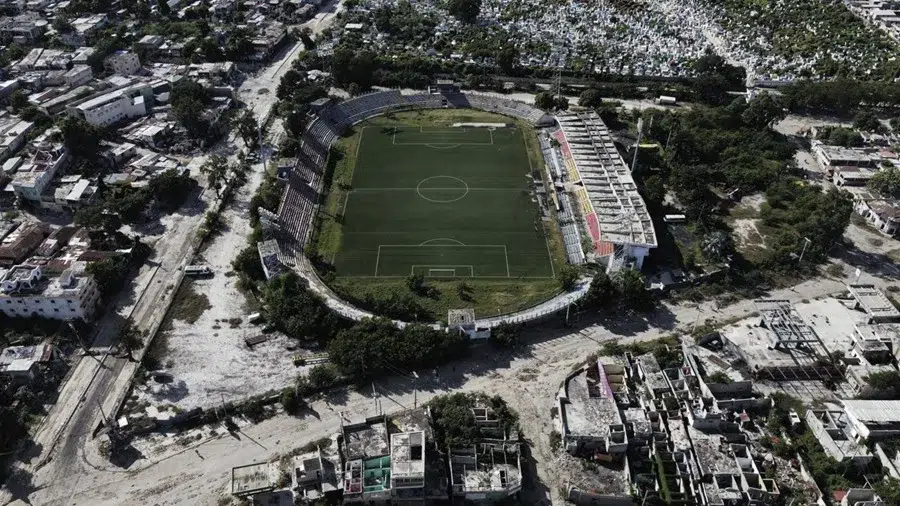
Port-au-Prince (EFE).- The president of El Salvador, Nayib Bukele, announced on Thursday that, following the takeover of Haiti’s main stadium, they will set up an operational base there, while at the same time threatening the gangs with an offensive.
In a message on X in Haitian Creole, Bukele reported that this operation by Salvadoran troops with the Haitian National Police (PNH), the Armed Forces of Haiti and the Task Force, an armed group under the command of the Haitian government, “managed to take control of the Sylvio Cator Stadium and secure the area.”
According to Bukele, “several human skulls inside the stadium” were found during the operation, and he noted that the operational base will make it possible to “continue advancing deeper into the territories controlled by the gangs.”
“Now, we are the ones who have the advantage on the ground,” he pointed out, and he warned gang members to “leave the area before the offensive begins.”
“Those who choose to stay and fight our forces will have to face the consequences,” he declared.
The takeover of the stadium
In a previous statement, the Haitian National Police had reported on the operation alongside the Task Force, which is in the service of the government and led by American businessman Erik Prince, thanks to which they had recovered both the stadium, where the Haitian national football team played its matches, and its surroundings.
After taking the area, the PNH handed over control to the armed forces of El Salvador, which have more than 2,000 soldiers in the country, and which will be “in charge of guaranteeing security and consolidating the recovered space,” the Police said in a brief statement.
El Salvador, which was already participating in the international deployment of the Gang Suppression Force (GSF, for its acronym in English) in the country, became more directly involved in the Haitian crisis after the October 18 ambush on the outskirts of Port-au-Prince against a vehicle in which four Salvadoran military personnel were traveling.
The Salvadoran contingent, which includes members of special forces, is the largest deployed since the end of the United Nations Stabilization Mission in Haiti (Minustah), which was in the country between 2004 and 2017.
The violence crisis
Since February 2024, the Sylvio Cator stadium, where the Haitian national team had played its home games until then, had been under the control of armed gangs.
The stadium is named after one of Haiti’s most renowned athletes, who won the silver medal in the long jump at the 1928 Amsterdam Olympic Games.
At least 1,167 people died and 459 were injured in Haiti between July and September of this year as a result of the violence the country is suffering, according to the quarterly report of the United Nations Integrated Office in Haiti (Binuh) released on Wednesday.
EFE: https://efe.com/mundo/2026-11-12/bukele-instalacion-base-operativa-estadio-haiti/
Bukele anuncia la instalación de una base operativa en el principal estadio de Haití
Puerto Príncipe (EFE).- El presidente de El Salvador, Nayib Bukele, anunció este jueves que, tras la toma de control del principal estadio de Haití, instalarán allí una base operativa, a la vez que amenazó a las pandillas con una ofensiva.
En un mensaje en X en criollo haitiano, Bukele informó que este operativo de las tropas salvadoreñas con la Policía Nacional de Haití (PNH), las Fuerzas Armadas de Haití y la Task Force, un grupo armado bajo el mando del Gobierno haitiano, «logró tomar el control del Estadio Sylvio Cator y asegurar la zona».
Según Bukele, durante la operación se encontraron «varios cráneos humanos dentro del estadio» y señaló que la base operativa permitirá «continuar avanzando más adentro en los territorios controlados por las pandillas».
«Ahora, somos nosotros quienes tenemos la ventaja en el terreno», apuntó y advirtió a los miembros de las pandillas que «abandonen la zona antes de que comience la ofensiva».
«Quienes elijan quedarse para combatir a nuestras fuerzas deberán someterse a las consecuencias», sentenció.
La toma del estadio
En un comunicado previo, la Policía Nacional haitiana había informado del operativo junto a la Task Force, al servicio del Gobierno y dirigida por el empresario estadounidense Erik Prince, gracias al cual habían recuperado tanto el estadio, donde disputaba sus partidos la selección haitiana de fútbol, como sus alrededores.
Después de tomar el área, la PNH entregó el control a las fuerzas armadas de El Salvador, que disponen de más de 2.000 soldados en el país, las que estarán «a cargo de garantizar la seguridad y consolidar el espacio recuperado», indicó la Policía en un breve comunicado.
El Salvador, que ya participaba en el despliegue internacional en el país de la Fuerza de Supresión de Pandillas (GSF, por su sigla en inglés), se involucró de manera más directa en la crisis haitiana tras la emboscada del 18 de octubre en la periferia de Puerto Príncipe contra un vehículo en el que viajaban cuatro militares salvadoreños.
El contingente salvadoreño, que incluye miembros de fuerzas especiales, es el más numeroso desplegado desde el final de la Misión de Estabilización de las Naciones Unidas en Haití (Minustah), que estuvo en el país entre 2004 y 2017.
La crisis de violencia
Desde febrero de 2024, el estadio Sylvio Cator, donde jugaba hasta entonces como local la selección haitiana, estaba bajo el dominio de las bandas armadas.
El estadio lleva el nombre de uno de los atletas haitianos más reconocidos, que consiguió la medalla de plata en salto de longitud en los Juegos Olímpicos de Ámsterdam 1928.
Al menos 1.167 personas murieron y 459 resultaron heridas en Haití entre julio y septiembre de este año a causa de la violencia que sufre el país, según el informe trimestral de la Oficina Integrada de las Naciones Unidas para Haití (Binuh) divulgado el miércoles.
EFE: https://efe.com/mundo/2026-11-12/bukele-instalacion-base-operativa-estadio-haiti/