
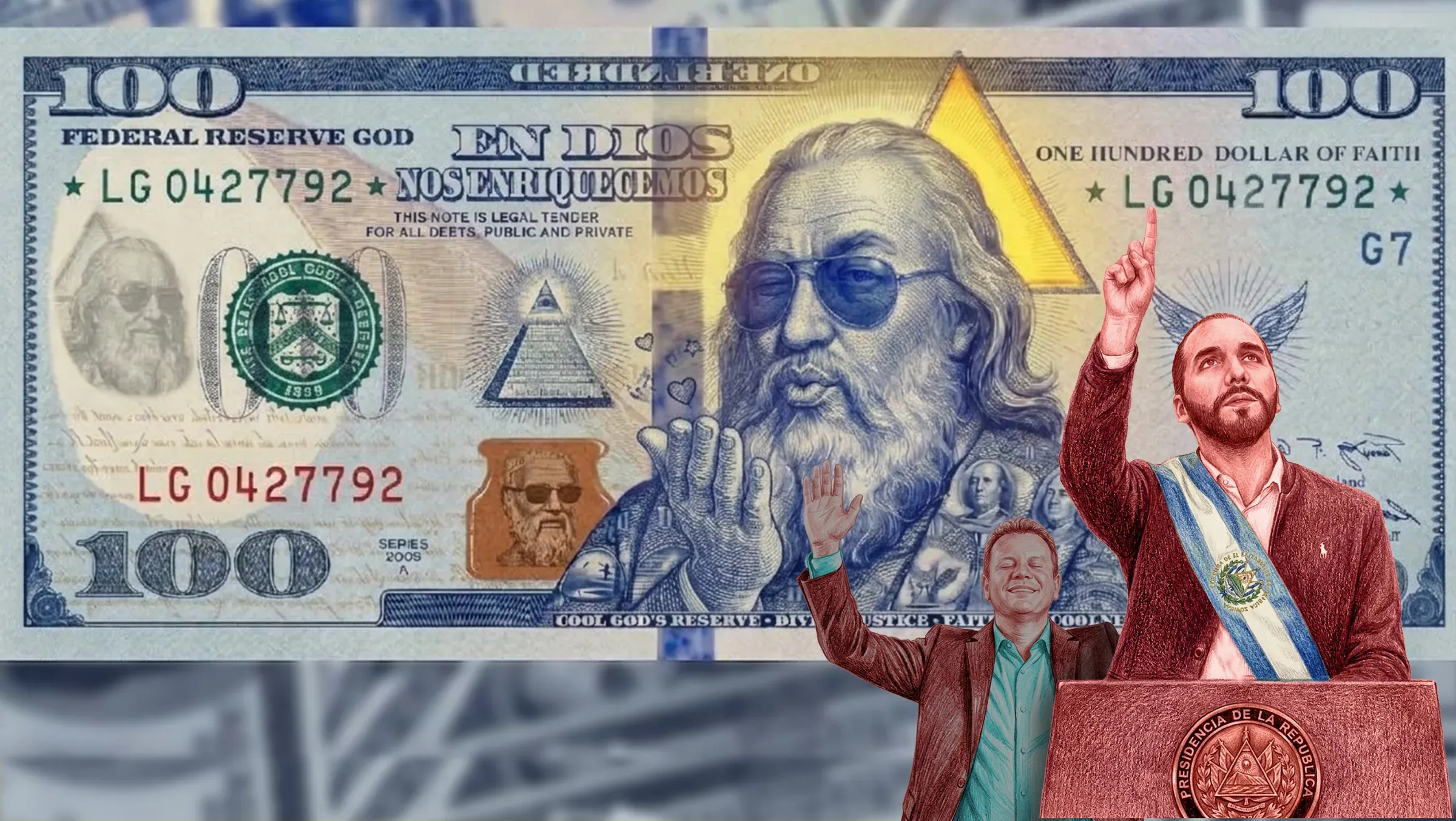
On January 19, 2026, a miracle occurred in the Historic Center of the Salvadoran capital.
At least, that is how the guests at the first National Prayer Breakfast for El Salvador presented it.
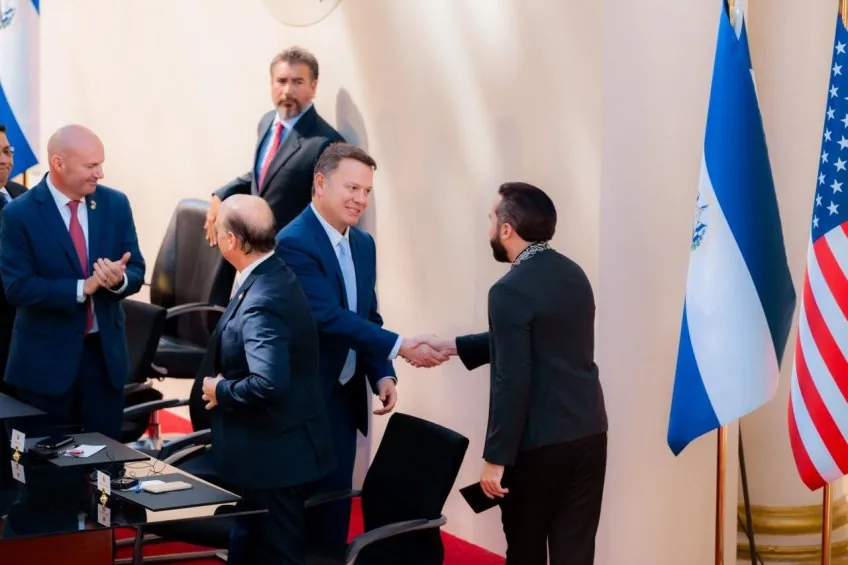
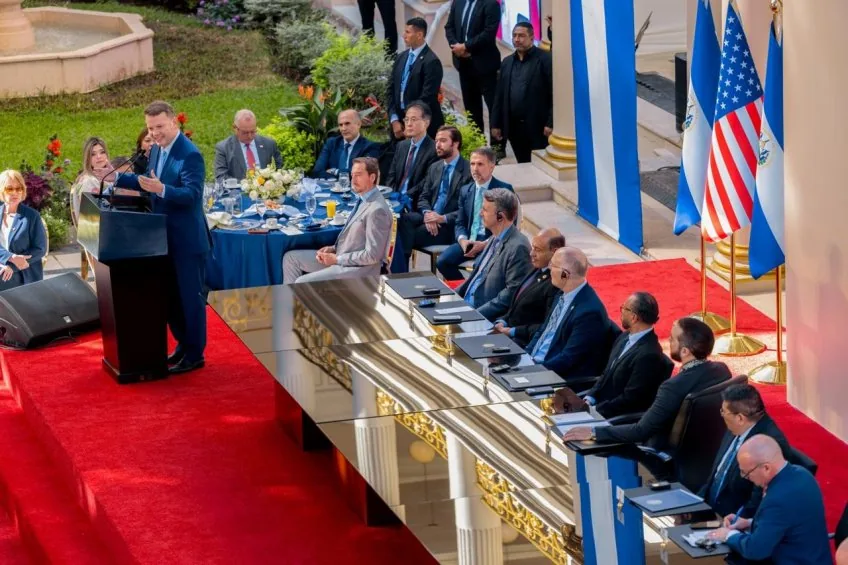
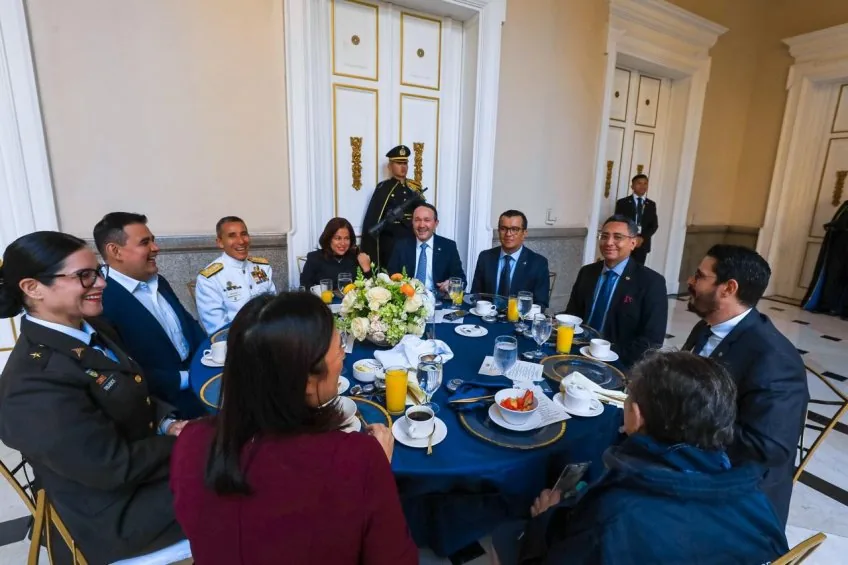
In the garden of the National Palace, Bukele shared the occasion with the president of the Legislative Assembly, his friend Ernesto Castro; with the president of the Supreme Court of Justice, Henry Mejía; and with a group of foreign guests, among whom stood out a former Guatemalan ambassador linked, along with his father, to a corruption scheme investigated by the now-defunct International Commission against Impunity in Guatemala (CICIG). The gathering had been achieved, to a large extent, thanks to the ability of Manuel Espina, that former ambassador who is capable of weaving networks between ultraconservative Christian sectors in the United States and governments and business sectors in the region. That morning, one of the objectives of the meeting was to pray for that president, recently accused of allowing torture to be committed systematically against 252 Venezuelan migrants in one of his prisons.
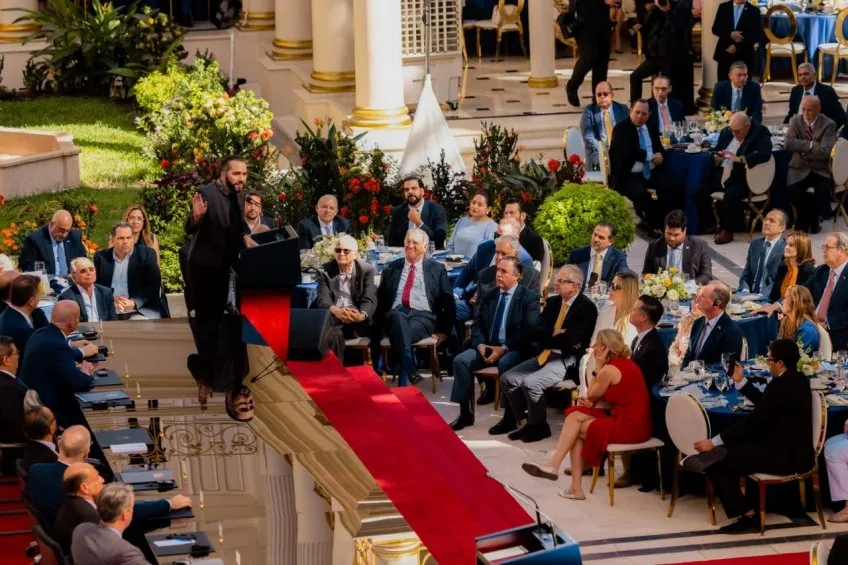
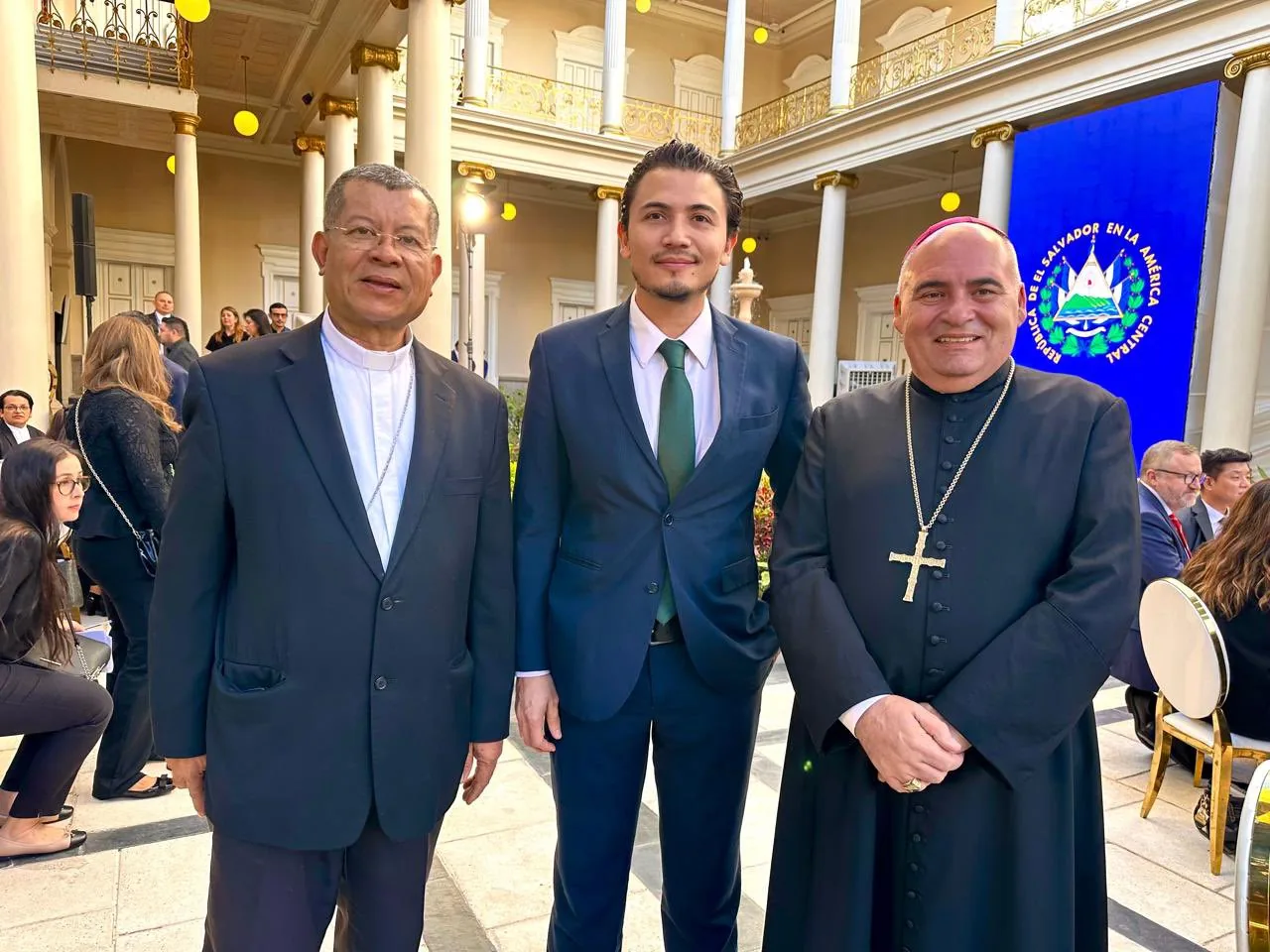
Representatives of the country’s main evangelical churches also attended the gathering. Since coming to power, Bukele has woven a network of pastors and churches in his favor and has even created a commissioner for religious affairs who was part of the departmental structure of Nuevas Ideas, the party led by his relatives and friends. Also at the event were the apostolic nuncio and representatives of the Episcopal Conference of the Catholic Church, among them Monsignor Fabio Colindres, the military bishop. There were also Salvadoran businesspeople and representatives of the Chamber of Industry of Guatemala.
None of those attendees came to the gathering to ask for the conversion of Bukele, whose unconstitutional hold on power is explained, to a large extent, by the control he has over the three branches of the State following the arbitrary and irregular removal of constitutional magistrates carried out by his party in May 2021. The gathering, in reality, unfolded amid prayers, testimonies, biblical quotations and public praise for the Salvadoran dictator.
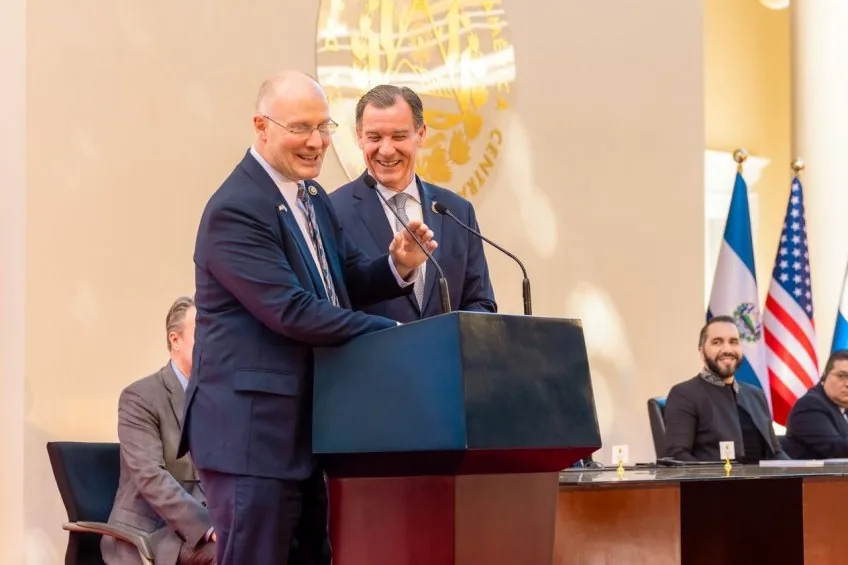
Also standing out among the foreign visitors was a bipartisan delegation of 14 U.S. legislators. And among them, the first to take the microphone were John Moolenaar, a Republican congressman from Michigan, and Tom Suozzi, a Democrat from New York. The two joked about their political differences and about how they manage them while being roomies in the same house in Washington. They said they managed it because their faith in Jesus Christ united them.
Moolenaar explained that this friendship was also nourished by sharing moments of prayer with other legislators. Then he said that a miracle had occurred in El Salvador. He addressed Bukele directly and attributed the changes he was seeing in the country to his leadership, but, above all, to the glory of God.
“Careful and faith-filled people are watching what has been happening in El Salvador under your leadership, Mr. President,” he said. “The Scriptures say that we should pray for those in authority so that we may live quiet and peaceful lives. And when I see what is happening here, it is something beautiful and a testament to your leadership and to the glory of God.”
The Family and the legislators of Christ Jesus
That Moolenaar and Suozzi have confirmed that they live together and that they meet weekly with other legislators to spend time together united in faith is not a fact that should go unnoticed. In the United States, one of the best-known expressions of that religious communal living has an address: C Street, a residential complex in Washington historically linked to The Fellowship Foundation, also known as The Family. The same complex in which Congressmen Suozzi and Moolenaar live, according to journalistic investigations.
For decades, the religious and fundamentalist organization has cultivated relationships with U.S. elites, members of Congress from both parties and elites abroad, under the pretext of bringing “God closer to power.” Its weight and influence even caught the attention of Netflix, which in 2019 released a miniseries based on the books that reveal the inner workings of the organization. Among them, the promotion of a law that punishes with life imprisonment anyone who is part of the LGBTIQ+ community in Uganda.
For decades, The Fellowship was linked to the organization of the U.S. National Prayer Breakfast, a tradition inaugurated in 1953 that over the years became a gathering for presidents, members of Congress and foreign leaders.
Over the last 14 years, one of the Central Americans who has best taken advantage of the contacts cultivated in those circles is former ambassador Manuel Espina.
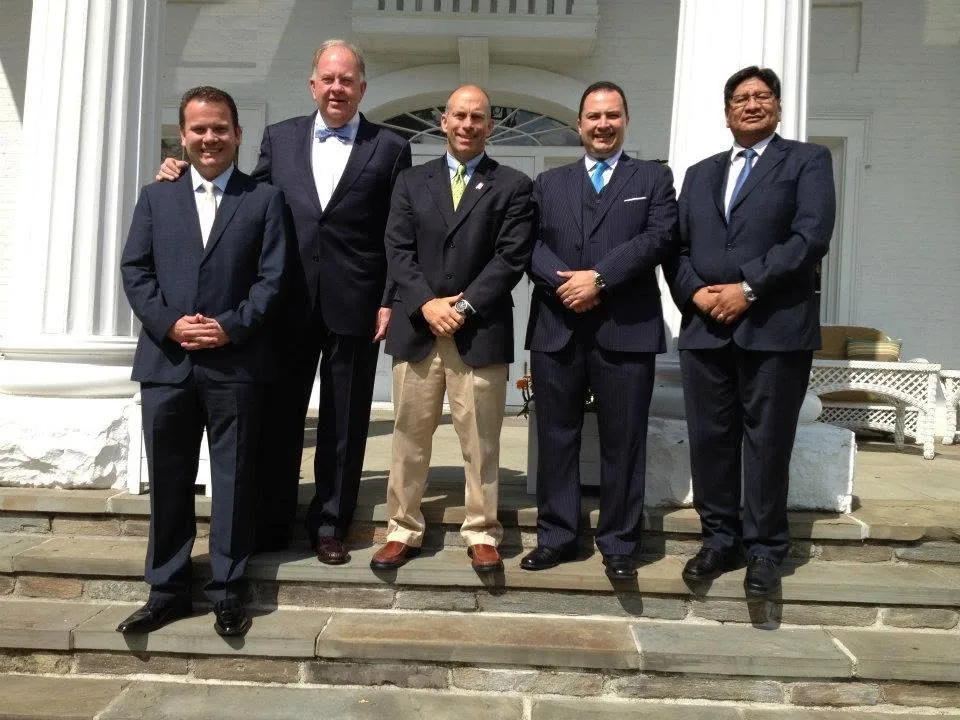
In 2004, when he was 31 years old, the “merchant” Espina co-founded Guatemala Próspera, an “apolitical, non-religious and non-profit association, made up of businesspeople whose primary objective is to be part of the change of our nation, through the teaching and application of principles and values,” according to its articles of incorporation.
Eight years later, in 2012, Espina and other representatives of the organization were invited to the U.S. National Prayer Breakfast, and then his life changed. “I grabbed my wife’s hand and said to her: ‘Wow! This vision of unity is not only a vision, but it must be transformed into a movement, into something bigger than just an event,’” he told Bukele and the audience present at the Palace.
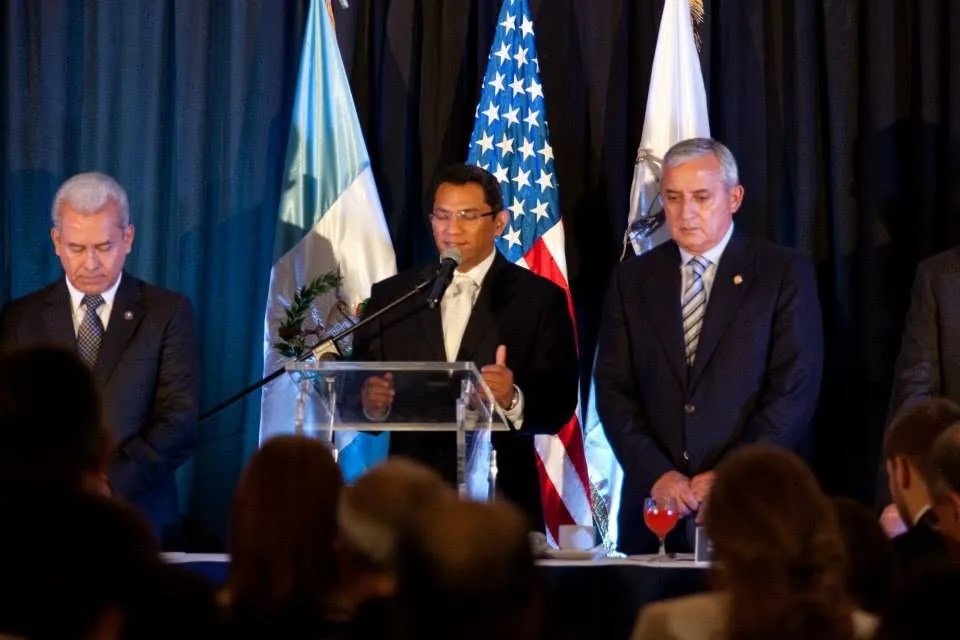
In 2013, emulating that event held in Washington, Espina inaugurated the first National Prayer Breakfast in Guatemala City. And since then, he has convened presidents, officials, businesspeople, pastors and delegations of U.S. officials to pray for Guatemala and for the officials in office at the time.
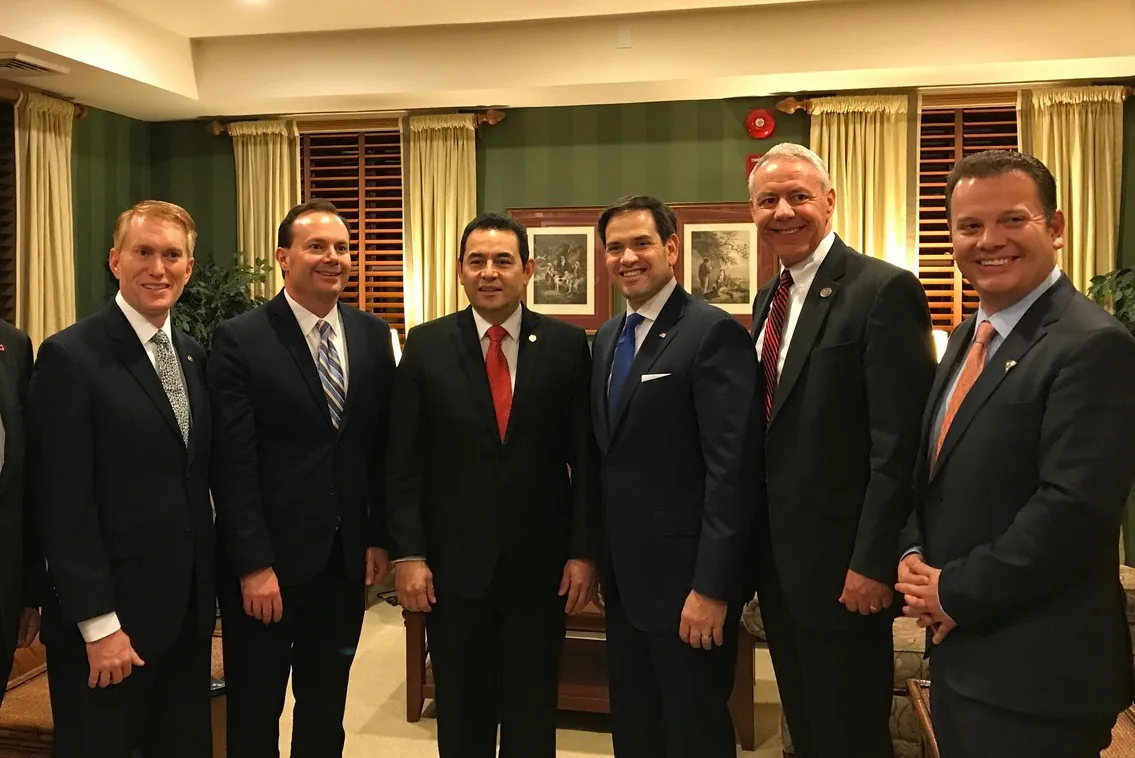
The legislators who came to San Salvador illustrate the network of relationships that Espina has cultivated for years in Washington. A photograph taken at the C Street residence before September 28, 2017, shows him alongside Republican Senator Mike Lee of Utah, then-Guatemalan President Jimmy Morales and Senators Marco Rubio, now U.S. Secretary of State, and James Lankford.
That closeness bore fruit. On May 4, 2018, Lee and Rubio, along with two other U.S. legislators, signed a letter addressed to Congress requesting that the State Department withhold six million dollars earmarked for the CICIG, which was investigating the Morales government. The funds remained frozen for months, until their release in August of that year. Lee, who attended the breakfast with Bukele, even publicly celebrated the withholding of the aid. A year later, on August 22, 2019, personally invited by Espina, he delivered the keynote speech at Guatemala’s fifth National Prayer Breakfast, where he shared the stage with Morales, whom he described that same day as a good friend.
Robert Aderholt, a Republican from Alabama and another of the attendees in San Salvador, has also shared that political-religious circuit with Espina since August 2013, when he took part in the first edition of the breakfast organized by Guatemala Próspera; and on August 18, 2022, Tracey Mann, a Republican congressman from Kansas, spoke at another edition alongside Kevin Roberts, president of the conservative Heritage Foundation, one of the main U.S. ultraconservative think tanks.
In Guatemala, attendees at these prayer breakfasts have included three former presidents: Otto Pérez Molina, convicted of corruption; Jimmy Morales, investigated for illicit campaign financing; and Alejandro Giammattei, sanctioned by the United States for his involvement in significant acts of corruption. Former Attorney General Consuelo Porras, sanctioned by Washington for obstructing anti-corruption investigations and protecting political allies, also took part.
Bernardo Arévalo, the president whose rise to power Porras and the Constitutional Court nearly blocked after his victory at the polls in 2023, has not participated in any of these gatherings. In the 2024 edition, his non-appearance even made the news. The first president to decline since Otto Pérez Molina. Perhaps it is because in Guatemala, the organization Espina leads has shown too much closeness to protagonists of the so-called “pact of the corrupt.” That year, the star guest was precisely Consuelo Porras, who just months earlier had tried to prevent Arévalo’s rise to power.
Porras, like Bukele, was praised and applauded.
Republican Congressman Gary Palmer of Alabama also traveled to Guatemala for that prayer breakfast, on a visit funded by Guatemala Próspera. His agenda, officially submitted to the U.S. House of Representatives, reveals that the religious gathering was part of a much broader itinerary: a dinner with Manuel Espina and the organization’s board of directors; meetings with the Chamber of Industry, FUNDESA and executives of Banco Industrial; and a visit to a Cementos Progreso plant. The program also included a dinner with President Bernardo Arévalo.
Those meetings took on another meaning the following year: in 2025, Continental Strategy, a lobbying firm of which Espina is a senior adviser, represented in Washington the Chamber of Industry; CEMCAL, a subsidiary of Cementos Progreso; and Coraline Capital, a subsidiary of Bicapital, the corporation that controls Banco Industrial. Together with the Sugar Producers’ Association, those four entities paid more than half a million dollars to Continental Strategy during that year to carry out lobbying efforts before the White House and the State Department.
Ben Cline, a Republican congressman from Virginia and co-chair of the 2026 U.S. National Prayer Breakfast, completes another side of the web: in San Salvador, he asked officials from the Executive, Legislative and Judicial branches to meet weekly to pray.
The coincidences do not prove that these legislators have advocated for the interests of Continental Strategy’s clients, but they do make it possible to observe a mechanism: the breakfasts and trips organized around Espina bring U.S. politicians together with the same business circles in the region that have subsequently hired the firm from which he lobbies in Washington.
“If the blind lead the blind…”
In January 2026, Espina, in alliance with the Bukele government, brought together at the National Palace the highest authorities of a regime questioned for reforms contrary to the Constitution and for violating fundamental rights through the state of exception.
The ceremony took place at an uncomfortable moment for Bukele in Washington. A report by Human Rights Watch and Cristosal on allegations of systematic torture and other abuses against the 252 Venezuelans sent by the Trump administration to Cecot, presented just two months earlier, continued to damage his image. The report led some 40 Democratic and Republican members of Congress to demand explanations from Secretary of State Marco Rubio and Secretary of Homeland Security Kristi Noem about the agreements between the two governments, including the payment of at least 4.7 million dollars to El Salvador.
Journalistic investigations had also revealed that those agreements involved the fate of MS-13 leaders detained in the United States, who had knowledge of the negotiations that Bukele’s officials held with the gangs to reduce homicides. Among them was Elmer Canales Rivera, el Crook, whose release from a Salvadoran prison and subsequent escape were facilitated by government officials, according to journalistic investigations and court records.
Diplomats, former diplomats and sources in the U.S. Congress and Senate consulted for this report agree that, by January 2026, that “noise” carried weight in Washington. The prayer breakfast organized by Espina offered the regime an opportunity to project another image: that of a president surrounded by U.S. members of Congress, conservative sectors and religious leaders who celebrated his leadership in the name of Christ.
When Moolenaar finished his remarks, his friend Tom Suozzi congratulated him with a colloquial expression in English. “Good job, buddy,” he told him.
Bukele, seated a few meters away, thanked him with a handshake.
Afterward, other members of Congress took their turns, among them Aderholt, who turned to the biblical scriptures to highlight the value of gathering in the name of God, before praising Bukele. One of the last speakers was Lou Correa, a son of Mexican migrants and a Democratic congressman from California. The presence of these two officials, along with that of Moolenaar, would prove particularly important for reconstructing another story linked to the former ambassador, one that unfolded far from San Salvador, in Washington and on a Honduran island.
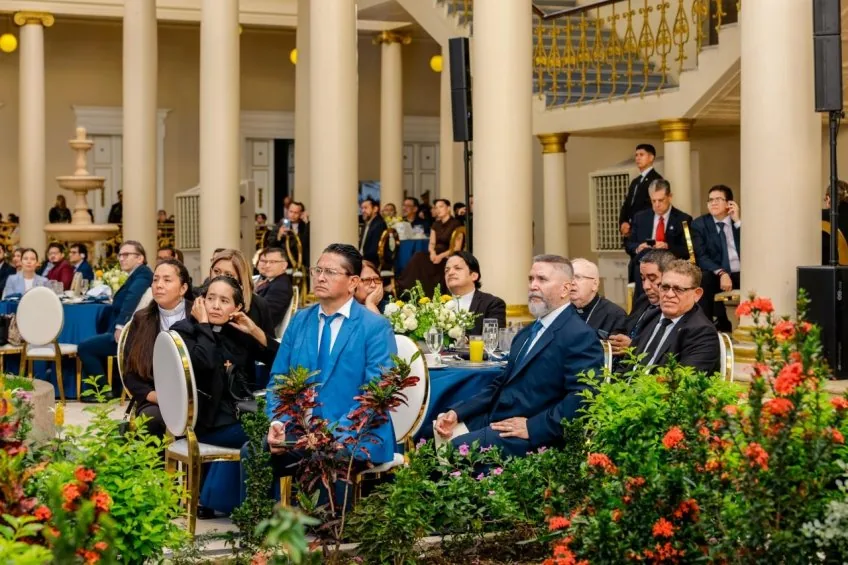
The Salvadoran government did not let the gathering go to waste. Its official propaganda channels spread the praise and the images of Bukele surrounded by U.S. members of Congress, pastors and national authorities to promote his image as an upstanding president.
A key bet for an especially important year: the constitutional reforms pushed by his party eliminated the ban on consecutive presidential reelection and allowed the elections to be moved up to 2027, extending the presidential term from five to six years. Bukele, who came to power in 2019 and won an unconstitutional reelection in 2024, was cleared to run again. And a victory would allow him to extend his stay in the Presidency until 2033. Thirteen consecutive years in power.
In contemporary Salvadoran history, such a long tenure inevitably recalls Maximiliano Hernández Martínez, the dictator who ruled between 1931 and 1944.
But that January morning in 2026, the discussion did not revolve around the concentration of power or the allegations against the regime. It revolved around miracles. And the man who had helped bring the protagonists together knew that language well.
Tell me who you pray with…
Manuel Alfredo Espina Pinto was born into a family that knew the power of the gospel from the inside. His father, Gustavo Adolfo Espina Salguero, was an evangelical pastor linked to the neo-Pentecostal churches El Shaddai and Fraternidad Cristiana, two of the strongest in Guatemala, a country that over the last 20 years has recorded one of the highest growth rates of the evangelical population in Latin America.
By the end of 1990, Manuel Espina’s father was already part of the Solidarity Action Movement (MAS), a party openly backed by neo-Pentecostal evangelical sectors. In that year’s elections, his father would become vice president during the government of Jorge Serrano Elías.
In 1993, Serrano Elías attempted a self-coup that failed, and after the attempt Espina Salguero presided over the country for several days, until he was disqualified for being found complicit in violations of the Constitution and ended up taking refuge in Costa Rica. By 1993, his son, the future Guatemalan ambassador in Washington, was just 20 years old.
Decades later, Manuel Espina would build a career of his own around religion, business leadership and diplomacy. When he became ambassador in Washington in 2017, traditional media outlets highlighted two things about him: being the son of a former vice president and being a businessman interested in real estate and the fashion industry.
In 2004, at age 31, he had founded Guatemala Próspera, an organization dedicated to leadership programs and values training. The foundation established ties with U.S. Christian figures, among them John C. Maxwell, a speaker known for his leadership training programs.
Espina built relationships with figures in the United States who would be key to his appointment in the government of Jimmy Morales. One of them was Jeff Sessions, Republican senator from Alabama and later attorney general during Trump’s first administration.
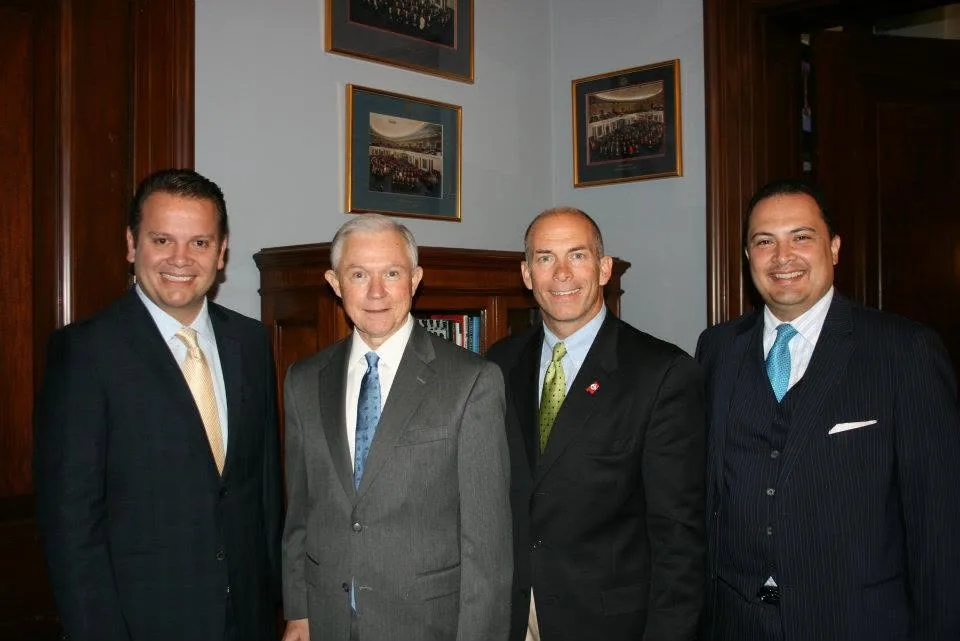
His closeness to those circles made him especially useful during the government of Morales, which was navigating murky waters as heir to the status quo and to the power groups that resisted the fight against corruption that erupted in 2015, with the fall of former President Otto Pérez Molina and his vice president, Roxana Baldetti.
When Espina was appointed ambassador, his appointment was questioned for lack of merit, but his detractors underestimated the power behind the networks he had established since 2012, when he began to draw closer to the prayer breakfasts and to ultraconservative circuits in the United States.
His arrival marked a decisive point for the Morales government, in which the CICIG, created through an agreement between Guatemala and the United Nations, was investigating corruption networks that reached businesspeople, officials, politicians and people close to power. Morales had gone from publicly supporting the commission to confronting it, especially after it announced investigations against his inner circle and his relatives. In parallel, the Commission had also already opened an investigation against the Espina family. Specifically, against his father, in a scheme of corruption and diversion of funds that included companies in which his son, now ambassador, had participated.
In August 2019, the commission and the Public Prosecutor’s Office presented the “Network of power, corruption and money laundering” case, an investigation into irregular movements of money in a network linked to political operative Gustavo Alejos and other influential figures.
One of the companies examined was 19-24, S. A. According to the investigation, that company received a transfer of 1.5 million dollars in September 2011, four days after it opened a savings account. The CICIG linked the management of the bank account in the company’s name to Gustavo Adolfo Espina Salguero and to his son, Manuel Espina. His father was accused of illicit association and money laundering.
At the time, the family rejected the allegations and maintained that the transfer corresponded to a legitimate real estate transaction. Manuel Espina was not criminally charged in that case, unlike his father, now deceased.
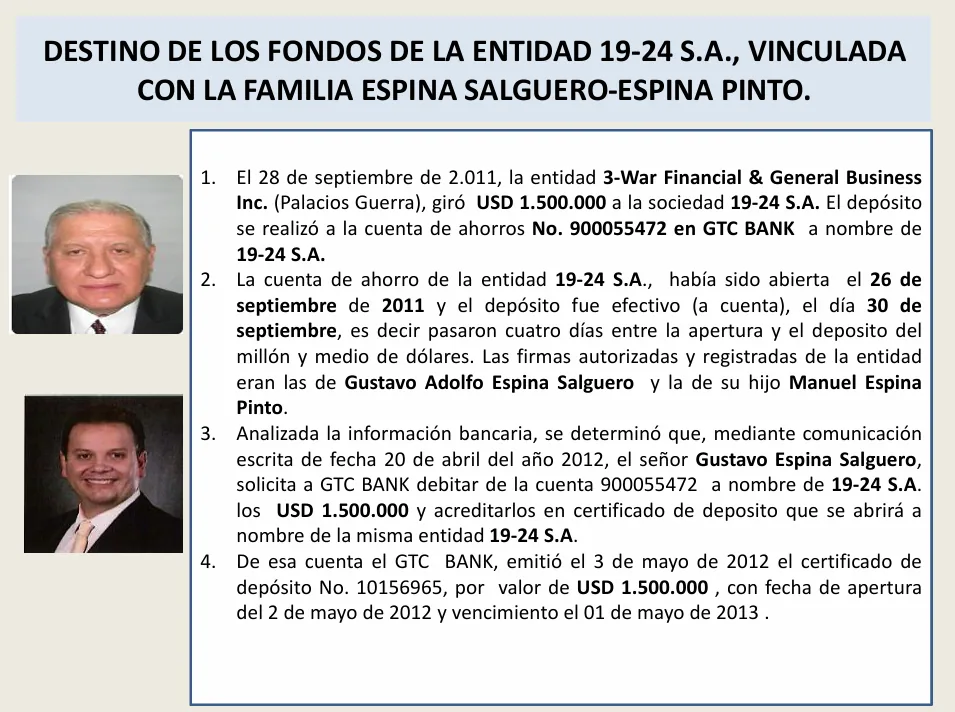
Accessible transcription of the text visible in the screenshot of the public report presented by the CICIG. The original image in Spanish is preserved in the figure.
DESTINATION OF THE FUNDS OF THE ENTITY 19-24 S.A., LINKED TO THE ESPINA SALGUERO-ESPINA PINTO FAMILY.
- 1. On September 28, 2011, the entity 3-War Financial & General Business Inc. (Palacios Guerra) transferred USD 1,500,000 to the company 19-24 S.A. The deposit was made to savings account No. 900055472 at GTC BANK in the name of 19-24 S.A.
- 2. The savings account of the entity 19-24 S.A. had been opened on September 26, 2011, and the deposit became effective (on account) on September 30; that is, four days passed between the opening and the deposit of the one and a half million dollars. The authorized and registered signatures of the entity were those of Gustavo Adolfo Espina Salguero and of his son Manuel Espina Pinto.
- 3. Upon analysis of the banking information, it was determined that, through a written communication dated April 20, 2012, Mr. Gustavo Espina Salguero requested that GTC BANK debit the USD 1,500,000 from account 900055472 in the name of 19-24 S.A. and credit it to a certificate of deposit to be opened in the name of the same entity 19-24 S.A.
- 4. From that account, GTC BANK issued, on May 3, 2012, certificate of deposit No. 10156965, in the amount of USD 1,500,000, with an opening date of May 2, 2012, and a maturity date of May 1, 2013.
Consulted about this case, former investigators from the now-defunct CICIG and from the FECI of that period, speaking on condition of anonymity, agree that Manuel Espina was not bound over for criminal proceedings, as his father was, because “there wasn’t time.” One month after the allegations against the Espina family were made public, in September 2019, the CICIG’s mandate came to an end.
The government of Jimmy Morales had launched an offensive to expel it and, ultimately, to prevent its continuation, while seeking support among conservative political and religious sectors in the United States. An investigation by El CLIP, the Center for Investigative Journalism at Columbia University, and allied media outlets documented how evangelical leaders linked to the White House Faith Office promoted rapprochement between Latin American governments and Israel. According to the investigations, Morales saw in the move of Guatemala’s embassy from Tel Aviv to Jerusalem, completed in May 2018, an opportunity to obtain Washington’s support against the CICIG.
Manuel Espina, who as ambassador had access to networks of pro-Israel legislators and religious leaders, stood out in those efforts. In June 2018, The Washington Post revealed that Espina organized a dinner with Jared Kushner, adviser and son-in-law to Donald Trump, and Latin American ambassadors to promote the move of other diplomatic missions to Jerusalem.
Espina served as ambassador until 2020, at the beginning of the decline of the anti-corruption fight, driven by the government of Jimmy Morales and by Attorney General Consuelo Porras, who remained in office until mid-2026.
To this day, Israel does not forget its allies. Asked about the former ambassador and about Guatemala Próspera, Alon Lavi, Israel’s ambassador to Guatemala, responds: “look, we have many contacts, and also with the evangelical church.”
Since 2020, Espina’s departure from the embassy has not ended his influence in Washington. On the contrary. He knew the codes of diplomacy and those of religious gatherings. He knew how to convene legislators and bring them closer to Central American presidents and businesspeople.
That ability is key in a specific business. The former ambassador went on to serve as an adviser and lobbyist for Continental Strategy, a U.S. firm specializing in representing interests before Congress, federal agencies and other decision-making spaces in Washington.
The firm was founded by Carlos Trujillo, former U.S. ambassador to the OAS under the Trump administration, and its collaborators include, among others, Alberto Martínez, former chief of staff to Marco Rubio, now Secretary of State.
At Continental Strategy, Espina’s profile highlights precisely that combination: diplomacy, government relations, international trade, ties to Congress and the organization of national prayer breakfasts. Espina no longer officially represents the Guatemalan State, but he was now working at a firm that Central American companies and business associations pay to get closer to U.S. power.
One of its most recent clients was involved in one of the most controversial disputes over investment and sovereignty in the region.
Pastors on a paradise island
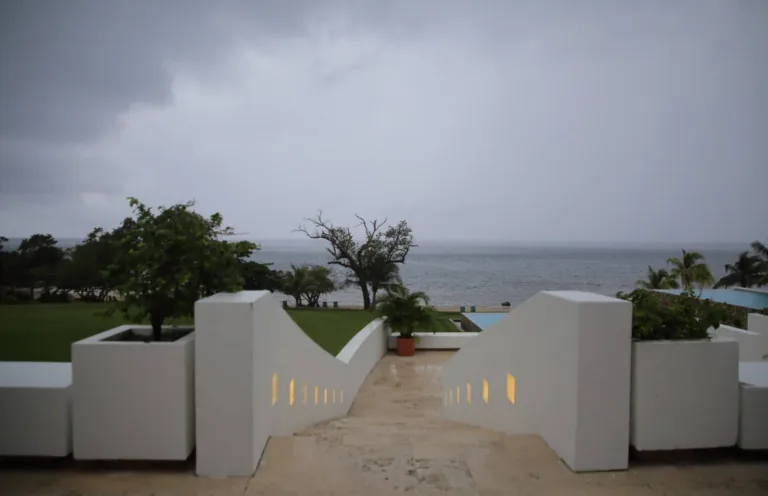
On February 9, 2026, weeks after the prayer breakfast in El Salvador, a group of evangelical pastors arrived on the island of Roatán, in Honduras, among whom Wuilmer Baca, of the Centro Cristiano Redención, stood out. Baca is a member of the Tegucigalpa Pastors Association and a leading figure in the marches for peace, massive rallies mobilized by conservative sectors of the country.
A video released by the Zede Próspera shows Baca reporting that they came to the island to “investigate in greater depth all the benefits, all the opportunities that exist in this project.”
The Zede Próspera is the controversial private city that seeks to establish a model of administrative, legal and fiscal autonomy on Roatán, previously known above all for its beaches, reefs and tourism. In it, a group of technocratic investors are even pursuing an epic quest: achieving immortality. Honduras Próspera Inc., the investor behind the project, has been in litigation with the Honduran State for four years, a dispute in which it is claiming millions of dollars following the repeal of the legislation that allowed its creation.
The company used the pastors’ testimonies to promote an initiative that has drawn strong political and social criticism. However, when we asked Erick Brimen, CEO of Próspera Inc, what relationship his company had with evangelical churches, his answer was brief: “As far as I know, none.”
A lot of people come here to find out
We asked him why pastors had come to the facilities and whether there were programs, donations or agreements with religious organizations. Brimen did not explain who convened them or what part the company played in the activity. He presented the tour as something customary among people interested in getting to know the Zede Próspera.
“A lot of people come here to find out,” he replied. According to him, those who come usually leave with a more favorable impression of the project. About the pastors’ visit, he added: “I imagine it must have been something similar.”
But the relationship between Próspera and Roatán’s evangelical leaders did not begin in February 2026. One of the figures who helped open doors for it was Tristán Monterroso Mason, a Christian pastor from the island who was part of the entity’s initial structure. According to the documents examined for this investigation, Monterroso held a shareholding of close to 3% and played an important role in outreach to communities and local leaders.
His status as a pastor and his relationships on the island made him a valuable intermediary for a project that needed more than investors and legal authorizations: it needed to find openness among the inhabitants of Roatán. Connections. A kind of Manuel Espina, but on an island in the middle of the Caribbean Sea.
When we mentioned his name, Brimen recognized him immediately. “Tristán, islander, Christian pastor. He is someone who is very passionate about the path of Jesus Christ,” he replied. “I think he is a spectacular person, his soul is very beautiful,” he added.
We asked him whether Monterroso could explain the project’s ties to evangelical churches. Brimen sought to separate that background from the February visit. “Nothing to do with Tristán. Tristán has not been directly involved with the project for many years,” he stated.
Brimen also acknowledged the importance of religious leaders in society. He called them “spiritual guides” and “intellectual guides,” people capable of studying complex matters and conveying them to communities.
Meanwhile, in Tegucigalpa, Pastor Gerardo Irias, president of the Evangelical Confraternity of Honduras—the most powerful church body in the country—explained that the widely criticized visit by the pastors was in response to the “invitation to a vacation” and that his brothers in Christ fell for it “out of naivety.”
“None of them knows anything about that, and they went and, you know, like every good Christian, they start making a video, but they didn’t know anything about what they were doing,” Irías says in their defense, asserting that a businessman invited them but that he does not remember the name.
Irías says that, although he has not looked for much information, he does not agree with the sale of Honduran heritage. “If the agreements are only to benefit a few, I think that is selling out the homeland. And I think we must be convinced that when something like a ZEDE is done, there must be outreach to the entire people. I think those things should happen in our country if they are to benefit the country, but not in the way they have been done up to this moment.”
Espina helps a namesake
On November 27, 2024, Honduras Próspera Inc. announced that Eric Brimen had completed a tour of Washington to seek political support for U.S. investments in Honduras. The company identified a meeting with Robert Aderholt, Republican congressman from Alabama, who defended the project as a response to the causes of Honduran migration. It also reported contacts with John Moolenaar, Republican from Michigan; Lou Correa, Democrat from California; and Greg Steube, Republican from Florida.
Three of those four members of Congress accompanied Manuel Espina in inaugurating the first prayer breakfast in El Salvador alongside Nayib Bukele.
Their positions on committees related to the federal budget, immigration policy, security and trade allowed them to take part in decisions with consequences for relations between the United States and Central America.
Honduras Próspera Inc. was seeking in the U.S. capital the influence needed to win political backing after, in September 2024, the Supreme Court of Justice of Honduras declared unconstitutional the regime that had allowed the ZEDEs to be created.
Six days after that statement, on December 3, 2024, Continental Strategy registered its engagement to represent Honduras Próspera Inc. before U.S. authorities.
Among the lobbyists linked to the account was former ambassador Manuel Espina.
Continental received 45,000 dollars during the last quarter of 2024, another 45,000 in the first quarter of 2025 and an additional 15,000 during the second quarter of that year. In total, 105,000 dollars. The lobbying records identified Congress, the Senate and the State Department as the targets of the lobbying efforts.
In July 2025, as the contract period declared by Continental was concluding, a House Appropriations Committee document specifically addressed the Zede Próspera. The text expressed concern over the Honduran government’s actions against U.S. investments and proposed requiring the State Department to submit a report on the judicial and governmental decisions related to the project and on Washington’s possible diplomatic responses.
One of the members of Congress who voted for the measure was John Moolenaar, the same one who, half a year later, would tell Bukele that in El Salvador his government had worked a miracle.
Continental Strategy’s work in Honduras did not end with the Zede Próspera. Months later, the firm began registering payments from the Honduran Council of Private Enterprise, COHEP, the country’s main business association. The records identify payments of 19,355 dollars during the last quarter of 2025, 90,000 dollars in the first quarter of 2026 and another 90,000 in the second. In total, 199,355 dollars.
Registered payments to Continental Strategy (USD)
- Honduras Próspera Inc., 2024-2025: USD 105,000
- COHEP, 2025-2026: USD 199,355
The shift was interesting given the background of both organizations. In June 2021, COHEP had published a critical legal analysis of the ZEDEs, in which it warned about the risks and legal uncertainty associated with that model.
Manuel Espina also appeared among the lobbyists linked to that account. The same firm that had represented Próspera went on to work for the main Honduran business association, which years earlier had questioned the ZEDE model.
What’s more, on April 11, 2026, COHEP, together with Honduras Próspera Inc. and other actors, held a high-level forum with the aim of “charting the future of tourism in Roatán.” Even so, Brimen qualifies the coincidence and explains that the rapprochement with business groups is not because of Espina and that “in general we have increasingly better relations with all groups.”
When we asked him about Continental and about Manuel Espina, Brimen explained that hiring lobbyists was a common practice in the United States. He acknowledged that Próspera had worked with several firms, but he did not specify who recommended Continental to them or what lobbying efforts Espina carried out.
When we mentioned to him that Espina also organized prayer breakfasts in Central America, Brimen responded that the similarity between the names Guatemala Próspera and Honduras Próspera was just a coincidence.
But our question did not seek to establish a business connection between the two organizations. It sought to understand the role of an intermediary linked to the lobbying for Honduras Próspera Inc., the relationships with U.S. members of Congress, businesspeople from Central America’s Northern Triangle and the religious gatherings between those same legislators and Central American presidents. In his profile at Continental Strategy, Espina even announces that he seeks to expand the prayer breakfast to Honduras.
Brimen did not explain that coincidence and ruled out that the rapprochement between Próspera and Honduran businesspeople had anything to do with Espina’s work.
“Not because Manuel Espina is working with COHEP… which I don’t know for a fact, but if you say so, I believe you,” he replied.
Then he insisted: “If the insinuation is that Manuel Espina… as far as I know, he has nothing to do with it.”
According to Brimen, the ZEDEs had been politicized and misunderstood. Over the years, he asserted, businesspeople and social leaders had gotten to know the project better and changed their perceptions.
“In general we have increasingly better relations […] with all groups,” he said.
The “instruments of God”
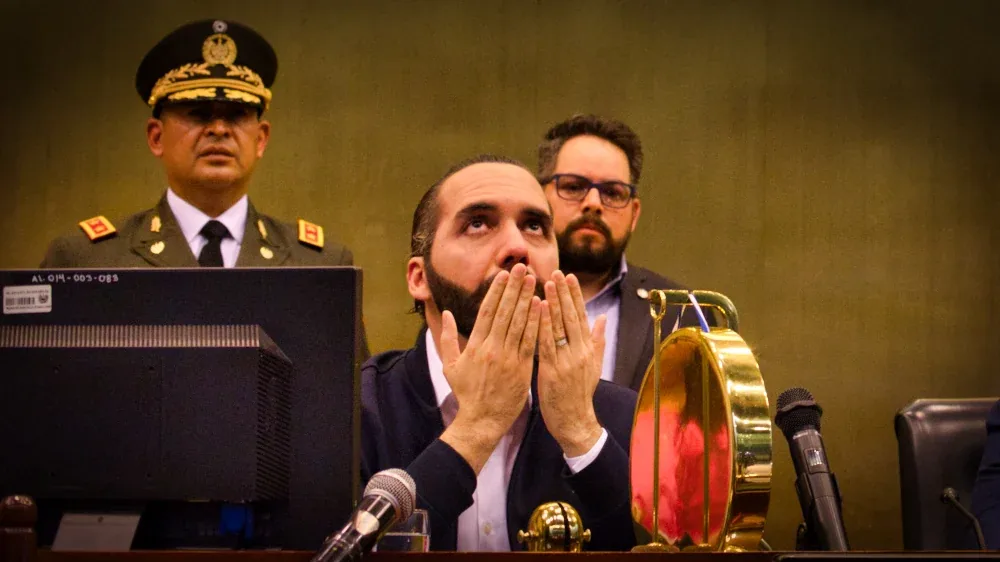
When it was Nayib Bukele’s turn to give his “testimony,” the president told a new version of the state of exception. For that select audience, the measure was the work of God on earth, a policy that he himself doubted but that arose, according to his account, thanks to prayer and to the “glory of God.”
On the last weekend of March 2022, when a wave of murders was being recorded across the country, Bukele recounted that he met with his security cabinet and said: “well, let’s say a prayer… we prayed, we asked for wisdom, guidance.”
That meeting really did take place and lasted until the early hours of Saturday, March 26. In parallel, in those same early hours, his government was authorizing the last releases of high-risk inmates from the maximum-security prison in Zacatecoluca. They were releases that responded to a pact that his government had maintained with these structures since at least the second month of his term.
According to what he said, the director of the Police, Mauricio Arriaza Chicas, was “one of the greatest instruments of God” in carrying out the state of exception. But he did not mention that Arriaza Chicas, from an Army facility and in the company of the Defense Minister and Attorney General Rodolfo Delgado, ordered mass arrests contrary to the rule of law, 24 hours before the measure was approved by the Legislative Assembly.
Many were arrests without evidence. Police officers and soldiers were assigned daily quotas. Young people, adults, mothers, elderly women, pregnant women. People from impoverished areas were detained due to “suspicions” or “anonymous calls” or because they “appeared nervous.”
Four years later, the state of exception had a tally of 93,000 arrests, according to government figures, with a prison population equivalent to about 2% of the country’s inhabitants. It had also amassed thousands of complaints of arbitrary detentions, torture, forced disappearances and more than 500 deaths in State custody.
- 93,000 arrests, according to government figures
- Approximate prison population: 2% of the inhabitants
- 500+ deaths in State custody
“I don’t know how to explain it, other than that it was the hand of God,” Bukele said, alluding to the fact that since they established the state of exception they had encountered no resistance or reprisals from the gangs.
“I don’t know how to explain it, other than that it was the hand of God”
He then noted that they had advised other countries and explained how their strategy worked. “…So far, no country has managed to replicate it, and I think the reason is that prayer and asking God to guide the plan must be included as a fundamental pillar,” he added.
Bukele had just explained to U.S. members of Congress that Salvadoran security was the result of divine intervention. Two weeks later, he would take that same version to Washington.
Brother Nayib
On February 5, 2026, Bukele attended, as a star speaker, the National Prayer Breakfast, the U.S. prayer breakfast from which Manuel Espina had drawn inspiration for his Central American gatherings.
This time, the Salvadoran president was not the host at the National Palace. He was one of Donald Trump’s guests, before an audience of legislators, religious leaders and representatives of more than a hundred countries.
Trump introduced him as one of his favorite presidents and one of the great allies of the United States. He praised his enormous prisons, to which his government had sent migrants detained on U.S. soil, and joked:
“(Bukele) is a tough guy. Very tough. Some of you are probably thinking: ‘And what is this man doing at a prayer breakfast?’”
If, after the event in San Salvador, there were still doubts about what a good instrument of God Bukele is, entering the National Prayer Breakfast put him on another level, with other shields.
He did not waste the opportunity. The transformation of El Salvador, he maintained, was not solely the product of human decisions. It had been possible because God “worked a miracle” through his government.
He spoke of battles that first had to be won on the spiritual plane, of the wisdom needed by those who wield power and of the Salvadoran gangs, which he even described as satanic.
It was the same account he had offered in San Salvador, only this time loaded with steroids and more biblical references. “There is another famous phrase in the Bible: ‘the horse is made ready for the day of battle, but it is God who gives the outcome.’ Victory lies with him,” he said, raising his index finger toward the sky. Applause.
The battle, however, is not over for him.
A month later, on March 11, an international group of five jurists presented a report on the Salvadoran state of exception. The experts concluded that there were reasonable grounds to believe that, under that policy, arbitrary imprisonments, torture, murders, forced disappearances, sexual violence and persecution were being committed.
In January, Bukele had presented the state of exception as a work of God. In February, Trump celebrated it in Washington. On March 11, five international jurists concluded that there were reasonable grounds to believe that, under that same policy, crimes against humanity were being committed.
Editor’s note: Attempts were made to obtain a reaction from Manuel Espina, Guatemala Próspera, Continental Strategy and legislators John Moolenaar, Tom Suozzi, Lou Correa, Robert Adhertot, Mike Lee, Tracey Mann, Gary Palmer and Ben Cline. As of press time, there were no responses.
Redacción Regional: https://redaccionregional.com/categoria/especiales/los-negocios-de-la-fe/#/cap/el-salvador
Nayib Bukele, el exembajador Espina y los “brothers in Jesus”
Por Daniel Valencia*
El 19 de enero de 2026, ocurrió un milagro en el Centro Histórico de la capital salvadoreña.
Al menos así lo presentaron los invitados al primer Desayuno Nacional de Oración por El Salvador.
En el jardín del Palacio Nacional, Bukele compartía junto al presidente de la Asamblea Legislativa, su amigo Ernesto Castro; con el presidente de la Corte Suprema de Justicia, Henry Mejía, y con un grupo de invitados extranjeros entre los que sobresalía un exembajador guatemalteco vinculado junto a su padre en una trama de corrupción investigada por la desaparecida Comisión Internacional contra la Impunidad en Guatemala (CICIG). El encuentro había sido logrado, en una gran medida, gracias a la capacidad de Manuel Espina, ese exembajador que es capaz de tejer redes entre sectores cristianos ultraconservadores de Estados Unidos y gobiernos y sectores empresariales de la región. Esa mañana, uno de los objetivos de la reunión era orar por ese presidente recientemente señalado por permitir que en una de sus cárceles se cometieran, de manera sistemática, torturas contra 252 migrantes venezolanos.
Al encuentro también asistieron representantes de las principales iglesias evangélicas del país. Desde su llegada al poder, Bukele ha tejido una red de pastores e iglesias a su favor y ha creado incluso un comisionado para asuntos religiosos que formó parte de la estructura departamental de Nuevas Ideas, el partido dirigido por sus familiares y amigos. En el acto estaba también el nuncio apostólico y representantes de la Conferencia Episcopal de la Iglesia católica, entre estos, monseñor Fabio Colindres, el obispo castrense. Había también empresarios salvadoreños y representantes de la Cámara de la Industria de Guatemala.
Ninguno de aquellos asistentes llegó a la cita para pedir una conversión de Bukele, cuya permanencia en el poder de manera inconstitucional se explica, en gran medida, al control que tiene de los tres poderes del Estado tras la destitución arbitraria e irregular de magistrados constitucionales ejecutada por su partido, en mayo de 2021. El encuentro, en realidad, transcurrió entre oraciones, testimonios, citas bíblicas y alabanzas públicas al dictador salvadoreño.
Entre los visitantes extranjeros destacaban además una misión bipartidista de 14 legisladores estadounidenses. Y entre estos, los primeros en tomar el micrófono fueron John Moolenaar, congresista republicano por Michigan y Tom Suozzi, demócrata por New York. Los dos bromearon sobre sus diferencias políticas y sobre cómo las administran siendo roomies en una misma casa en Washington. Dijeron que lo lograban porque los unía su fe en Jesucristo.
Moolenaar explicó que esa amistad también se alimentaba compartiendo espacios de oración con otros legisladores. Luego, dijo que en El Salvador había ocurrido un milagro. Se dirigió directamente a Bukele y atribuyó que los cambios que él estaba viendo en el país eran atribuibles a su liderazgo, pero, sobre todo, a la gloria de Dios.
“Las personas cuidadosas y llenas de fe están observando lo que ha estado ocurriendo en El Salvador bajo su liderazgo, señor Presidente —dijo —. Las Escrituras dicen que debemos orar por quienes están en autoridad para que podamos vivir vidas tranquilas y en paz. Y cuando veo lo que está sucediendo aquí, es algo hermoso y un testimonio de su liderazgo y de la gloria de Dios”.
The Family y los legisladores de Cristo Jesús
Que Moolenaar y Suozzi hayan confirmado que viven juntos y que se reúnen semanalmente con otros legisladores para convivir unidos a la fe no es un hecho que deba pasarse desapercibido. En Estados Unidos, una de las expresiones más conocidas de esa convivencia religiosa tiene una dirección: C Street, un complejo residencial en Washington vinculado históricamente con The Fellowship Foundation, también conocida como The Family. El mismo complejo en el que viven los congresistas Suozzi y Moolenaar, según investigaciones periodísticas.
La organización religiosa y fundamentalista ha cultivado durante décadas relaciones con las élites de Estados Unidos, congresistas de ambos partidos y élites en el extranjero, bajo la excusa de acercar “a Dios al poder”. Su peso e influencia incluso llamó la atención de la cadena Netflix, que en 2019 lanzó una miniserie basada en los libros que revelan los entresijos de la organización. Entre estos, la promoción de una ley que castiga con cadena perpetua a quien sea parte de la comunidad LGBTIQ+ en Uganda.
The Fellowship estuvo vinculada durante décadas con la organización del National Prayer Breakfast de Estados Unidos, una tradición inaugurada en 1953 y que con los años se convirtió en una cita para presidentes, congresistas y dirigentes extranjeros.
En los últimos 14 años, uno de los centroamericanos que mejor ha aprovechado los contactos que se cultivan en esos círculos es el exembajador Manuel Espina.
En 2004, cuando tenía 31 años, el “comerciante” Espina fundó junto a otros Guatemala Próspera, una “asociación apolítica, no religiosa y sin fines de lucro, conformada por empresarios cuyo objetivo primordial es formar parte del cambio de nuestra nación, a través de la enseñanza y aplicación de principios y valores”, según su acta de constitución.
Ocho años después, en 2012, Espina y otros representantes de la organización fueron invitados al National Prayer Breakfast de Estados Unidos y, entonces, la vida le cambió. “Le agarré la mano a mi esposa y le dije: ‘¡Wow! Esta visión de unidad no solamente es una visión, sino que se debe transformar en un movimiento, en algo más grande que solo un evento”, le contó a Bukele y al público presente en el Palacio.
En 2013, emulando aquel evento celebrado en Washington, Espina inauguró en Ciudad de Guatemala el primer Desayuno Nacional de Oración. Y desde entonces, ha convocado a presidentes, funcionarios, empresarios, pastores y delegaciones de funcionarios de Estados Unidos a orar por Guatemala y los funcionarios de turno.
Los legisladores que llegaron a San Salvador ilustran la red de relaciones que Espina ha cultivado durante años en Washington. Una fotografía tomada en la residencia de C Street antes del 28 de septiembre de 2017 lo muestra junto al senador republicano por Utah, Mike Lee, el entonces presidente guatemalteco Jimmy Morales y los senadores Marco Rubio, hoy secretario de Estado de Estados Unidos, y James Lankford.
Aquella cercanía produjo frutos. El 4 de mayo de 2018, Lee y Rubio firmaron, junto con otros dos legisladores estadounidenses, una carta dirigida al Congreso para solicitar que el Departamento de Estado retuviera seis millones de dólares destinados a la CICIG, que investigaba al gobierno de Morales. Los fondos permanecieron congelados durante meses, hasta su liberación en agosto de ese año. Lee, que asistió al desayuno con Bukele, incluso celebró públicamente la retención de la ayuda. Un año después, el 22 de agosto de 2019, invitado personalmente por Espina, pronunció el discurso principal del quinto Desayuno Nacional de Oración de Guatemala, donde compartió escenario con Morales, a quien ese mismo día describió como un buen amigo.
Robert Aderholt, republicano por Alabama, otro de los asistentes en San Salvador, también comparte ese circuito político-religioso con Espina desde agosto de 2013, cuando participó en la primera edición del desayuno organizado por Guatemala Próspera; y el 18 de agosto de 2022 Tracey Mann, congresista republicano en Kansas, intervino en otra edición junto con Kevin Roberts, presidente de la conservadora Heritage Foundation, uno de los principales tanques del pensamiento ultraconservador estadounidense.
En Guatemala, entre los asistentes a estos desayunos de oración han figurado tres expresidentes: Otto Pérez Molina, condenado por corrupción; Jimmy Morales, investigado por financiamiento electoral ilícito; y Alejandro Giammattei, sancionado por Estados Unidos por su participación en actos significativos de corrupción. También participó la ex fiscal general Consuelo Porras, sancionada por Washington por obstaculizar investigaciones anticorrupción y proteger a aliados políticos.
Bernardo Arévalo, el presidente al que Porras y la Corte de Constitucionalidad casi le bloquean el ascenso al poder tras el triunfo en las urnas de 2023, no ha participado de ninguno de estos encuentros. En la edición de 2024 incluso fue noticia su no comparecencia. El primer presidente que declina desde Otto Pérez Molina. Quizá sea porque en Guatemala, la organización que dirige Espina ha demostrado demasiadas cercanías con protagonistas del denominado “pacto de corruptos”. Ese año, la invitada estelar fue precisamente Consuelo Porras, que apenas meses antes había intentado impedir al ascenso de Arévalo al poder.
Porras, como Bukele, fue elogiada y aplaudida.
Para aquel desayuno de oración también viajó a Guatemala el congresista republicano por Alabama Gary Palmer, en una visita financiada por Guatemala Próspera. Su agenda, presentada oficialmente ante la Cámara de Representantes de Estados Unidos, revela que el encuentro religioso formaba parte de un itinerario mucho más amplio: una cena con Manuel Espina y la junta directiva de la organización; reuniones con la Cámara de Industria, FUNDESA y ejecutivos de Banco Industrial; y una visita a una planta de Cementos Progreso. El programa incluía, además, una cena con el presidente Bernardo Arévalo.
Esas reuniones adquirieron otro significado al año siguiente: en 2025, Continental Strategy, una firma de cabildeo de la que Espina es asesor sénior, representó en Washington a la Cámara de Industria; a CEMCAL, subsidiaria de Cementos Progreso; y a Coraline Capital, subsidiaria de Bicapital, la corporación que controla Banco Industrial. Junto con la Asociación de Azucareros, esas cuatro entidades pagaron más de medio millón de dólares a Continental Strategy durante ese año para realizar gestiones ante la Casa Blanca y el Departamento de Estado.
Ben Cline, congresista republicano en Virginia y copresidente del National Prayer Breakfast estadounidense de 2026, completa otra cara del entramado: en San Salvador pidió a funcionarios del Ejecutivo, el Legislativo y el Judicial reunirse semanalmente para orar.
Las coincidencias no demuestran que estos legisladores hayan gestionado los intereses de los clientes de Continental Strategy, pero sí permite observar un mecanismo: los desayunos y viajes organizados alrededor de Espina reúnen a políticos estadounidenses con los mismos círculos empresariales de la región que posteriormente han contratado a la firma desde la que él ejerce el cabildeo en Washington.
“Si el ciego guiaré al ciego…”
En enero de 2026, Espina, en alianza con el gobierno de Bukele, reunió en el Palacio Nacional a las máximas autoridades de un régimen cuestionado por reformas contrarias a la Constitución y por vulnerar derechos fundamentales mediante el régimen de excepción.
La ceremonia ocurrió en un momento incómodo para Bukele en Washington. Un informe de Human Rights Watch y Cristosal presentado apenas dos meses antes sobre las denuncias de torturas sistemáticas y otros abusos contra los 252 venezolanos enviados por la administración Trump al Cecot continuaba lacerando su imagen. El informe llevó a unos 40 congresistas demócratas y republicanos a exigir explicaciones al secretario de Estado, Marco Rubio, y a la secretaria de Seguridad Nacional, Kristi Noem, sobre los acuerdos entre ambos gobiernos, incluido el pago de al menos 4.7 millones de dólares a El Salvador.
Investigaciones periodísticas también habían revelado que esos acuerdos involucraban el destino de cabecillas de la MS-13 detenidos en Estados Unidos, conocedores de las negociaciones que funcionarios de Bukele mantuvieron con las pandillas para reducir los homicidios. Entre ellos figuraba Elmer Canales Rivera, el Crook, cuya salida de una prisión salvadoreña y posterior fuga fueron facilitadas por funcionarios del gobierno, según investigaciones periodísticas y expedientes judiciales.
Diplomáticos, exdiplomáticos y fuentes del Congreso y del Senado estadounidense consultados para este reportaje coinciden en que, para enero de 2026, ese “ruido” pesaba en Washington. El desayuno de oración organizado por Espina ofrecía al régimen una oportunidad para proyectar otra imagen: la de un presidente rodeado de congresistas estadounidenses, sectores conservadores y dirigentes religiosos que celebraban su liderazgo en nombre de Cristo.
Cuando Moolenaar terminó su intervención, su amigo Tom Suozzi lo felicitó con una expresión coloquial en inglés. “Good job, buddy”, le dijo.
Bukele, sentado a pocos metros, le agradeció con un apretón de manos.
Después, desfilaron otros congresistas, entre ellos Aderholt, quien recurrió a las escrituras bíblicas para destacar el valor de reunirse en nombre de Dios, antes de elogiar a Bukele. Uno de los últimos exponentes fue Lou Correa, un hijo de migrantes mexicanos y congresista demócrata por California. La presencia de estos dos funcionarios, junto a la de Moolenaar resultaría particularmente importante para reconstruir otra historia ligada con el exembajador y que se desarrolló lejos de San Salvador, en Washington y en una isla hondureña.
El gobierno salvadoreño no desaprovechó el encuentro. Sus canales de propaganda oficial difundieron los elogios y las imágenes de Bukele rodeado de congresistas estadounidenses, pastores y autoridades nacionales para promover su figura como un presidente de bien.
Una apuesta clave para un año especialmente importante: las reformas constitucionales impulsadas por su partido eliminaron la prohibición de reelección presidencial consecutiva y permitieron adelantar las elecciones a 2027, extendiendo el mandato presidencial de cinco a seis años. Bukele, que llegó al poder en 2019, y ganó una reelección inconstitucional en 2024, fue habilitado para competir nuevamente. Y una victoria le permitiría prolongar su permanencia en la Presidencia hasta 2033. Trece años consecutivos en el poder.
En la historia contemporánea salvadoreña, una permanencia tan larga remite inevitablemente a Maximiliano Hernández Martínez, el dictador que gobernó entre 1931 y 1944.
Pero aquella mañana de enero de 2026, la discusión no giró alrededor de la concentración del poder ni de las denuncias contra el régimen. Giró alrededor de los milagros. Y el hombre que había contribuido a reunir a los protagonistas conocía bien ese lenguaje.
Dime con quién oras…
Manuel Alfredo Espina Pinto nació en una familia que conoció el poder del evangelio desde adentro. Su padre, Gustavo Adolfo Espina Salguero, fue un pastor evangélico vinculado a las iglesias neopentecostales El Shaddai y Fraternidad Cristiana, dos de las más fuertes de Guatemala, un país que registra en los últimos 20 años uno de los crecimientos más altos de la población evangélica en Latinoamérica.
Para finales 1990, el padre de Manuel Espina ya formaba parte del Movimiento de Acción Solidaria (MAS), un partido respaldado de manera abierta por sectores evangélicos neopentecostales. Para las elecciones de ese año, su padre se convertiría en vicepresidente durante el gobierno de Jorge Serrano Elías.
En 1993, Serrano Elías intentó un autogolpe que fracasó y tras la intentona Espina Salguero presidió al país por varios días, hasta que fue inhabilitado por ser encontrado cómplice por violaciones a la Constitución y terminó refugiado en Costa Rica. Para 1993, su hijo, futuro embajador de Guatemala en Washington, tenía apenas 20 años.
Décadas después, Manuel Espina construiría una carrera propia alrededor de la religión, el liderazgo empresarial y la diplomacia. Cuando en 2017 se convirtió en embajador en Washington, medios de comunicación tradicionales destacaban de él dos cosas: ser el hijo de un exvicepresidente y ser un empresario interesado en bienes raíces y la industria de la moda.
En 2004, con 31 años, había fundado Guatemala Próspera, una organización dedicada a programas de liderazgo y formación en valores. La fundación estableció vínculos con referentes cristianos estadounidenses, entre ellos John C. Maxwell, un conferencista conocido por sus programas de formación de líderes.
Espina construyó relaciones con figuras de Estados Unidos que serían clave para su nombramiento en el gobierno de Jimmy Morales. Una de ellas fue Jeff Sessions, senador republicano por Alabama y posteriormente fiscal general durante el primer gobierno de Trump.
La cercanía con esos círculos lo volvió especialmente útil durante el gobierno de Morales, que navegaba en aguas turbias como heredero del status quo y de los grupos de poder que se resistían a la lucha contra la corrupción que eclosionó en 2015, con la caída del expresidente Otto Pérez Molina y de su vicepresidenta, Roxana Baldetti.
Cuando Espina fue nombrado embajador, su nombramiento fue cuestionado por falta de méritos, pero sus detractores desestimaban el poder detrás de las redes que había establecido desde 2012, cuando comenzó a acercarse a los desayunos de oración y a los circuitos ultraconservadores de Estados Unidos.
Su llegada marcaba un punto decisivo para el gobierno Morales en el que la CICIG, creada mediante un acuerdo entre Guatemala y Naciones Unidas, investigaba redes de corrupción que alcanzaban a empresarios, funcionarios, políticos y personas cercanas al poder. Morales había pasado de apoyar públicamente a la comisión a enfrentarla, sobre todo luego de que esta anunciara investigaciones en contra de su círculo íntimo y sus familiares. En paralelo, la Comisión también ya había abierto una investigación en contra de la familia Espina. En concreto, contra su padre, en una trama de corrupción y desvío de fondos que incluía a sociedades en la que su hijo, ahora embajador, tuvo participación.
En agosto de 2019, la comisión y el Ministerio Público presentaron el caso “Red de poder, corrupción y lavado de dinero”, una investigación sobre movimientos irregulares de dinero en una red vinculada al operador político Gustavo Alejos y otros personajes influyentes.
Una de las sociedades examinadas era 19-24, S. A. Según la investigación, esa empresa recibió en septiembre de 2011 una transferencia de 1.5 millones de dólares cuatro días después de que abriera una cuenta de ahorros. La CICIG vinculó el manejo de la cuenta bancaria a nombre de la sociedad con Gustavo Adolfo Espina Salguero y con su hijo, Manuel Espina. Su padre fue señalado por asociación ilícita y lavado de dinero.
En su momento, la familia rechazó los señalamientos y sostuvo que la transferencia correspondía a una operación inmobiliaria legítima. Manuel Espina no fue acusado penalmente en ese caso, a diferencia de su padre, ahora fallecido.
Transcripción accesible del texto visible en la captura del informe público presentado por la CICIG. La imagen original en español se conserva en la figura.
DESTINO DE LOS FONDOS DE LA ENTIDAD 19-24 S.A., VINCULADA CON LA FAMILIA ESPINA SALGUERO-ESPINA PINTO.
- 1. El 28 de septiembre de 2.011, la entidad 3-War Financial & General Business Inc. (Palacios Guerra), giró USD 1.500.000 a la sociedad 19-24 S.A. El depósito se realizó a la cuenta de ahorros No. 900055472 en GTC BANK a nombre de 19-24 S.A.
- 2. La cuenta de ahorro de la entidad 19-24 S.A., había sido abierta el 26 de septiembre de 2011 y el depósito fue efectivo (a cuenta), el día 30 de septiembre, es decir pasaron cuatro días entre la apertura y el deposito del millón y medio de dólares. Las firmas autorizadas y registradas de la entidad eran las de Gustavo Adolfo Espina Salguero y la de su hijo Manuel Espina Pinto.
- 3. Analizada la información bancaria, se determinó que, mediante comunicación escrita de fecha 20 de abril del año 2012, el señor Gustavo Espina Salguero, solicita a GTC BANK debitar de la cuenta 900055472 a nombre de 19-24 S.A. los USD 1.500.000 y acreditarlos en certificado de deposito que se abrirá a nombre de la misma entidad 19-24 S.A.
- 4. De esa cuenta el GTC BANK, emitió el 3 de mayo de 2012 el certificado de depósito No. 10156965, por valor de USD 1.500.000, con fecha de apertura del 2 de mayo de 2012 y vencimiento el 01 de mayo de 2013.
Consultados sobre este caso, exinvestigadores de la desaparecida CICIG y de la FECI de esa época que hablan con la condición de anonimato concuerdan en que Manuel Espina no fue ligado a proceso, como si lo fue su padre, porque “no dio tiempo”. Un mes después de que se hicieran públicos los señalamientos contra la familia Espina, en septiembre de 2019, llegó a su fin el mandato de la CICIG.
El gobierno de Jimmy Morales había emprendido una ofensiva para expulsarla y, finalmente, impedir su continuidad, mientras buscaba respaldo entre sectores políticos y religiosos conservadores de Estados Unidos. Una investigación de El CLIP, el Centro de Periodismo Investigativo de la Universidad de Columbia y medios aliados documentó cómo dirigentes evangélicos vinculados a la Oficina de la Fe de la Casa Blanca promovieron el acercamiento entre gobiernos latinoamericanos e Israel. Según las investigaciones, Morales vio en el traslado de la embajada de Guatemala de Tel Aviv a Jerusalén, concretado en mayo de 2018, una oportunidad para obtener el apoyo de Washington contra la CICIG.
En aquellas gestiones destacó Manuel Espina, que como embajador tenía acceso a redes de legisladores y dirigentes religiosos proisraelíes. En junio de 2018, The Washington Post reveló que Espina organizó una cena con Jared Kushner, asesor y yerno de Donald Trump, y embajadores latinoamericanos para promover el traslado de otras sedes diplomáticas a Jerusalén.
Espina ejerció como embajador hasta 2020, en el inicio de la caída de la lucha anticorrupción impulsada por el gobierno de Jimmy Morales y por la fiscal Consuelo Porras, que se mantuvo en el cargo hasta mediados de 2026.
A la fecha, Israel no olvida a sus aliados. Consultado sobre el exembajador y sobre Guatemala Próspera, Alon Lavi, el embajador de Israel en Guatemala, responde: “mirá, tenemos muchos contactos y también con la iglesia evangélica”.
Desde 2020, la salida de la embajada de Espina no terminó con su influencia en Washington. Al contrario. Conocía los códigos de la diplomacia y los de los encuentros religiosos. Sabía convocar a legisladores y acercarlos a presidentes y empresarios centroamericanos.
Esa capacidad es clave en un negocio específico. El antiguo embajador pasó a desempeñarse como asesor y lobista de Continental Strategy, una firma estadounidense especializada en representar intereses ante el Congreso, las agencias federales y otros espacios de decisión en Washington.
La firma fue fundada por Carlos Trujillo, exembajador estadounidense ante la OEA de la administración Trump y en ella colaboran, entre otros, Alberto Martínez, antiguo jefe de gabinete de Marco Rubio, hoy secretario del Departamento de Estado.
En Continental Strategy, el perfil de Espina destaca precisamente esa combinación: diplomacia, relaciones gubernamentales, comercio internacional, vínculos con el Congreso y organización de desayunos nacionales de oración. Espina ya no representa oficialmente al Estado guatemalteco, pero ahora trabajaba en una firma a la que empresas y gremiales de Centroamérica pagan para acercarse al poder estadounidense.
Uno de sus clientes más recientes estaba involucrado en una de las disputas más controvertidas sobre inversión y soberanía en la región.
Pastores en una isla paradisiaca
El 9 de febrero de 2026, semanas después del desayuno de oración en El Salvador, a la isla de Roatán, en Honduras, llegó un grupo de pastores evangélicos entre los que destacaba Wuilmer Baca, del Centro Cristiano Redención. Baca es miembro de la Asociación de Pastores de Tegucigalpa y protagonista de las marchas por la paz, multitudinarias concentraciones movilizadas por sectores conservadores del país.
Un video difundido por la Zede Próspera retrata a Baca informando que llegaron a la isla para “investigar más a profundidad sobre todos los beneficios, todas las oportunidades que hay en este proyecto”.
La Zede Próspera es la controvertida ciudad privada que busca establecer un modelo de autonomía administrativa, jurídica y fiscal en Roatán, antes conocida sobre todo por sus playas, arrecifes y turismo. En ella, un grupo de inversionistas tecnócratas incluso impulsan una epopeya: alcanzar la inmortalidad. Honduras Próspera Inc., la inversionista detrás del proyecto, mantiene un litigio desde hace cuatro años con el Estado hondureño en el que reclama millones de dólares tras la derogación de la legislación que permitió su creación.
La empresa aprovechó los testimonios de los pastores para promover una iniciativa que ha despertado fuertes cuestionamientos políticos y sociales. Sin embargo, cuando preguntamos a Erick Brimen, director ejecutivo de Próspera Inc, qué relación mantenía su empresa con las iglesias evangélicas, su respuesta fue breve: “Que yo sepa, ninguna”.
Mucha gente viene acá a enterarse
Le preguntamos por qué habían llegado pastores a las instalaciones y si existían programas, donaciones o convenios con organizaciones religiosas. Brimen no explicó quién los convocó ni qué participación tuvo la empresa en la actividad. Presentó el recorrido como algo habitual entre personas interesadas en conocer la Zede Próspera.
“Mucha gente viene acá a enterarse”, respondió. Según él, quienes llegan suelen marcharse con una impresión más favorable del proyecto. Sobre la visita de los pastores, añadió: “Me imagino que habrá sido algo similar”.
Pero la relación entre Próspera y los líderes evangélicos de Roatán no comenzó en febrero de 2026. Uno de los personajes que ayudó a abrirle puertas fue Tristán Monterroso Mason, un pastor cristiano isleño que formó parte de la estructura inicial de la entidad. Según los documentos examinados para esta investigación, Monterroso tuvo una participación accionaria cercana al 3 % y desempeñó un papel importante en los acercamientos con comunidades y liderazgos locales.
Su condición de pastor y sus relaciones en la isla lo convirtieron en un intermediario valioso para un proyecto que necesitaba algo más que inversionistas y autorizaciones legales: necesitaba encontrar apertura entre los habitantes de Roatán. Conexiones. Una especie de Manuel Espina, pero en una isla en medio del mar Caribe.
Cuando mencionamos su nombre, Brimen lo reconoció de inmediato. “Tristán, isleño, pastor cristiano. Él es alguien que es muy apasionado por el camino de Jesucristo”, respondió. “Creo que es una persona espectacular, su alma es muy bonita”, añadió.
Le preguntamos si Monterroso podía explicar los vínculos del proyecto con las iglesias evangélicas. Brimen quiso separar aquel antecedente de la visita de febrero. “Nada que ver con Tristán. Tristán lleva muchos años sin estar directamente involucrado con el proyecto”, aseguró.
Brimen reconoció, además, la importancia de los líderes religiosos en la sociedad. Los llamó “guías espirituales” y “guías intelectuales”, personas capaces de estudiar asuntos complejos y transmitirlos a las comunidades.
Mientras tanto, en Tegucigalpa, el pastor Gerardo Irias, presidente de la Confraternidad Evangélica de Honduras —el ente de iglesias más poderoso del país—, explicó que la ampliamente criticada visita de los pastores respondió a la “invitación a unas vacaciones” y que sus hermanos en Cristo cayeron “por inocentes”.
“Ninguno de ellos sabe nada de eso y ellos fueron y, usted sabe, como todo buen cristiano se pone a hacer un video, pero ellos no sabían nada de lo que estaban haciendo”, justifica Irías, quien asegura que un empresario les invitó, pero que no recuerda el nombre.
Irías cuenta que, aunque no ha buscado mucha información, no está de acuerdo con la venta del patrimonio hondureño. “Si los convenios son solo para beneficiar a unos cuantos, yo creo que eso es vender la patria. Y creo que debemos estar convencidos que cuando se hace algo como una ZEDE, debe haber socialización con el pueblo entero. Creo que esas cosas en nuestro país se deben dar si son para beneficiar el país, pero no de la manera que se han hecho hasta este momento”.
Espina ayuda a una homónima
El 27 de noviembre de 2024, Honduras Próspera Inc. anunció que Eric Brimen había completado una gira por Washington para buscar apoyo político a las inversiones estadounidenses en Honduras. La compañía identificó una reunión con Robert Aderholt, congresista republicano por Alabama, quien defendió el proyecto como una respuesta a las causas de la migración hondureña. También informó de contactos con John Moolenaar, republicano por Michigan; Lou Correa, demócrata por California; y Greg Steube, republicano por Florida.
Tres de esos cuatro congresistas acompañaron a Manuel Espina a inaugurar el primer desayuno de oración en El Salvador junto a Nayib Bukele.
Sus posiciones en comités relacionados con el presupuesto federal, la política migratoria, la seguridad y el comercio les permitían participar en decisiones con consecuencias para las relaciones entre Estados Unidos y Centroamérica.
Honduras Próspera Inc. buscaba en la capital de Estados Unidos las influencias necesarias para ganar respaldo político después de que, en septiembre de 2024, la Corte Suprema de Justicia de Honduras declarara inconstitucional el régimen que había permitido crear las ZEDE.
Seis días después de aquel comunicado, el 3 de diciembre de 2024, Continental Strategy registró su contratación para representar a Honduras Próspera Inc. ante las autoridades estadounidenses.
Entre los lobistas vinculados a la cuenta figuraba el exembajador Manuel Espina.
Continental recibió 45,000 dólares durante el último trimestre de 2024, otros 45,000 en el primero de 2025 y 15,000 adicionales durante el segundo trimestre de ese año. En total, 105,000 dólares. Los registros de cabildeo identificaron como destinatarios de las gestiones al Congreso, el Senado y el Departamento de Estado.
En julio de 2025, mientras concluía el período de contratación declarado por Continental, un documento del Comité de Asignaciones de la Cámara abordó específicamente a la Zede Próspera. El texto expresó preocupación por las acciones del gobierno hondureño contra las inversiones estadounidenses y propuso exigir al Departamento de Estado un informe sobre las decisiones judiciales y gubernamentales relacionadas con el proyecto y las posibles respuestas diplomáticas de Washington.
Uno de los congresistas que votó por el proyecto fue John Moolenaar, el mismo que, medio año más tarde, le diría a Bukele que en El Salvador su gobierno había hecho un milagro.
El trabajo de Continental Strategy en Honduras no terminó con la Zede Próspera. Meses después, la firma comenzó a registrar pagos del Consejo Hondureño de la Empresa Privada, el COHEP, la principal gremial empresarial del país. Los registros identifican pagos por 19,355 dólares durante el último trimestre de 2025, 90,000 dólares en el primero de 2026 y otros 90,000 en el segundo. En total, 199,355 dólares.
Pagos registrados a Continental Strategy (USD)
- Honduras Próspera Inc., 2024-2025: USD 105,000
- COHEP, 2025-2026: USD 199,355
El cambio resultaba interesante por los antecedentes de ambas organizaciones. En junio de 2021, el COHEP había publicado un análisis jurídico crítico de las ZEDE, en el que advertía sobre los riesgos y la incertidumbre legal asociados con ese modelo.
Manuel Espina también figuraba entre los lobistas vinculados con esa cuenta. La misma firma que había representado a Próspera pasó a trabajar para la principal gremial empresarial hondureña, que años atrás había cuestionado el modelo de las ZEDE.
Incluso, el 11 de abril de 2026, el COHEP junto a Honduras Próspera Inc. y otros actores, realizaron un foro de alto nivel con el objetivo de “trazar el futuro del turismo en Roatán”. Aun así, Brimen matiza la coincidencia y explica que el acercamiento con los grupos empresariales no es a causa de Espina y que “en general tenemos cada vez mejores relaciones con todos los grupos”.
Cuando le preguntamos por Continental y por Manuel Espina, Brimen explicó que contratar lobistas era una práctica habitual en Estados Unidos. Reconoció que Próspera había trabajado con varias firmas, pero no precisó quién les recomendó Continental ni qué gestiones realizó Espina.
Al mencionarle que Espina también organizaba desayunos de oración en Centroamérica, Brimen respondió que la semejanza entre los nombres de Guatemala Próspera y Honduras Próspera era solo una coincidencia.
Pero nuestra pregunta no buscaba establecer una conexión empresarial entre ambas organizaciones. Buscaba comprender el papel de un intermediario vinculado con el cabildeo de Honduras Próspera Inc., las relaciones con congresistas estadounidenses, empresarios del triángulo norte de Centroamérica y los encuentros religiosos entre esos mismos legisladores y presidentes centroamericanos. En su perfil en Continental Strategy, Espina incluso anuncia que busca expandir el desayuno de oración hacia Honduras.
Brimen no explicó esa coincidencia y descartó que el acercamiento entre Próspera y los empresarios hondureños tuviera relación con el trabajo de Espina.
“No porque Manuel Espina esté trabajando con el COHEP… que no me consta, pero si lo dices, te lo creo”, respondió.
Después insistió: “Si la insinuación es que Manuel Espina… que yo sepa, no tiene nada que ver”.
Según Brimen, las ZEDE habían sido politizadas y malentendidas. Con los años, aseguró, empresarios y dirigentes sociales habían conocido mejor el proyecto y modificado sus percepciones.
“En general tenemos cada vez mejores relaciones […] con todos los grupos”, dijo.
Los “instrumentos de Dios”
Cuando llegó el turno de que Nayib Bukele diera su “testimonio”, el mandatario contó una nueva versión del régimen de excepción. Para aquel selecto público, la medida fue obra de Dios en la tierra, una política de la que él mismo dudaba pero que surgió, según su relato, gracias a la oración y a la “gloria de Dios”.
En el último fin de semana de marzo de 2022, cuando se registraba una ola de asesinatos en todo el país, Bukele contó que se reunió con su gabinete de seguridad y dijo: “bueno, hagamos una oración… oramos, pedimos sabiduría, guía”.
Esa reunión realmente ocurrió y duró hasta la madrugada del sábado 26 de marzo. En paralelo, esa misma madrugada, su gobierno autorizaba las últimas salidas de reos de alta peligrosidad del penal de máxima seguridad de Zacatecoluca. Eran salidas que respondían a un pacto que su gobierno había mantenido con estas estructuras al menos desde el segundo mes de su mandato.
Según dijo, el director de la Policía, Mauricio Arriaza Chicas, fue “uno de los más grandes instrumentos de Dios” para llevar a cabo el régimen de excepción. Pero no contó que Arriaza Chicas, desde una sede del Ejército y en compañía del ministro de Defensa y del fiscal Rodolfo Delgado, ordenó capturas masivas contrarias al Estado de derecho, 24 horas antes de que la medida fuera aprobada por la Asamblea Legislativa.
Muchas eran capturas sin pruebas. A policías y militares se les asignaron cuotas diarias. Jóvenes, adultos, madres, ancianas, mujeres embarazadas. Personas de zonas empobrecidas fueron detenidas por “sospechas” o “llamadas anónimas” o porque se “mostraron nerviosos”.
Cuatro años después, el régimen llevaba un saldo de 93 mil capturas, según cifras del gobierno, con una población carcelaria equivalente a cerca del 2 % de los habitantes del país. También había cosechado miles de denuncias de detenciones arbitrarias, torturas, desapariciones forzadas y más de 500 muertes bajo custodia del Estado.
- 93,000 capturas, según cifras del gobierno
- Población carcelaria aproximada: 2 % de los habitantes
- 500+ muertes bajo custodia del Estado
“Yo no sé cómo explicarlo, más que porque fue la mano de Dios”, dijo Bukele, en alusión a que desde que instauraron el régimen no encontraron resistencias ni represalias por parte de las pandillas.
“Yo no sé cómo explicarlo, más que porque fue la mano de Dios”
Luego señaló que habían asesorado a otros países y explicado cómo funcionó su estrategia. “…Hasta ahora, ningún país ha logrado replicarlo y creo que la razón es porque se debe incluir como pilar fundamental la oración y pedirle a Dios que guíe el plan”, añadió.
Bukele acababa de explicar ante congresistas estadounidenses que la seguridad salvadoreña era resultado de la intervención divina. Dos semanas después, llevaría esa misma versión a Washington.
El hermano Nayib
El 5 de febrero de 2026, Bukele asistió como orador estelar al National Prayer Breakfast, el desayuno de oración estadounidense del que Manuel Espina había tomado inspiración para sus encuentros centroamericanos.
Esta vez, el mandatario salvadoreño no era el anfitrión en el Palacio Nacional. Era uno de los invitados de Donald Trump, ante una audiencia de legisladores, dirigentes religiosos y representantes de más de un centenar de países.
Trump lo presentó como uno de sus presidentes favoritos y uno de los grandes aliados de Estados Unidos. Elogió sus enormes prisiones, a las que su gobierno había enviado migrantes detenidos en territorio estadounidense, y bromeó:
“(Bukele) es un tipo duro. Muy duro. Probablemente algunos de ustedes estén pensando: ‘¿Y qué hace este hombre en un desayuno de oración?”.
Si después del evento en San Salvador todavía quedaban dudas del buen instrumento de Dios que es Bukele, ingresar al National Prayer Breakfast lo ponía en otro nivel, con otros escudos.
Él no desaprovechó la oportunidad. La transformación de El Salvador, sostuvo, no era solamente producto de decisiones humanas. Había sido posible porque Dios “obró un milagro” a través de su gobierno.
Habló de batallas que primero debían ganarse en el plano espiritual, de la sabiduría necesaria para quienes ejercen el poder y de las pandillas salvadoreñas, a las que incluso describió como satánicas.
Era el mismo relato que había ofrecido en San Salvador, solo que esta vez cargado de esteroides y más referencias bíblicas. “Hay otra frase célebre en la Biblia: ‘el caballo se alista para el día de la batalla, pero es Dios el que da el resultado’. La victoria reside en él”, dijo, levantando el índice hacia el cielo. Aplausos.
La batalla, sin embargo, para él no ha terminado.
Un mes después, el 11 de marzo, un grupo internacional de cinco juristas presentó un informe sobre el régimen de excepción salvadoreño. Los expertos concluyeron que existían motivos razonables para creer que, bajo esa política, se estaban cometiendo encarcelamientos arbitrarios, torturas, asesinatos, desapariciones forzadas, violencia sexual y persecución.
En enero, Bukele había presentado el régimen de excepción como una obra de Dios. En febrero, Trump lo celebró en Washington. El 11 de marzo, cinco juristas internacionales concluyeron que existían motivos razonables para creer que, bajo esa misma política, se estaban cometiendo crímenes de lesa humanidad.
Con reportes de Fernando Silva, Jovanna García y Jaime Quintanilla
Nota de la Redacción: Se intentó obtener una reacción de Manuel Espina, Guatemala Próspera, Continental Strategy y de los legisladores John Moolenaar, Tom Suozzi, Lou Correa, Robert Adhertot, Mike Lee, Tracey Mann, Gary Palmer y Ben Cline. Al cierre de esta publicación no hubo respuestas.
Redacción Regional: https://redaccionregional.com/categoria/especiales/los-negocios-de-la-fe/#/cap/el-salvador