
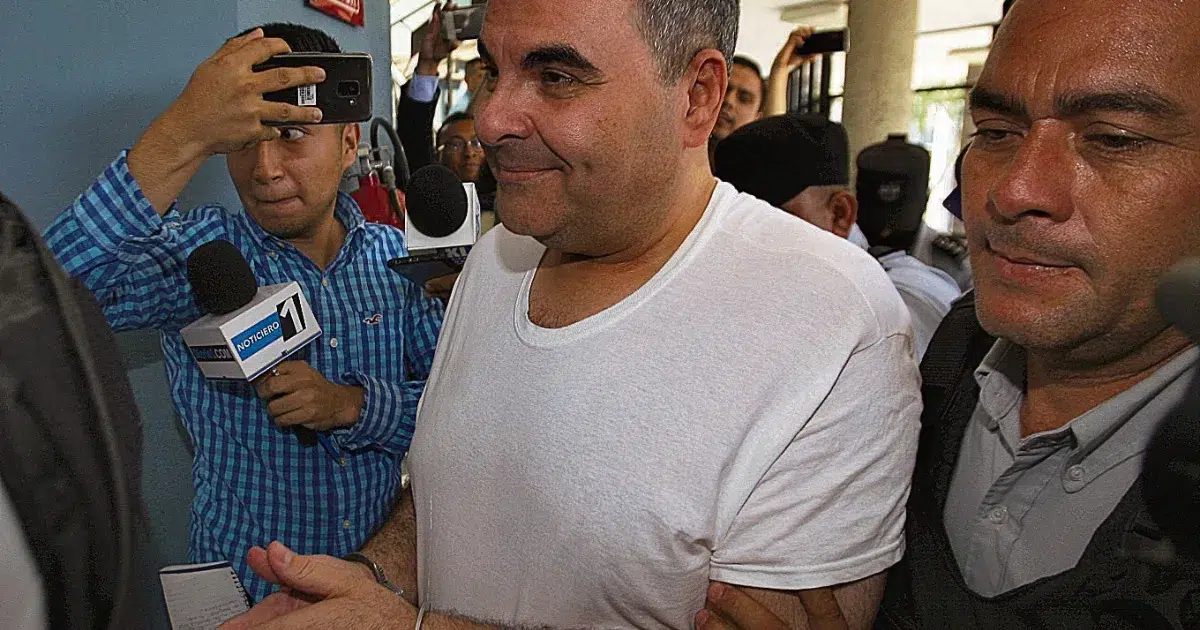
Former president of the Republic Elías Antonio Saca has a release order effective as of this October 27, 2026. Judicial sources confirmed this to LA PRENSA GRÁFICA, which implies that in the coming hours or days the former head of state may leave the La Esperanza Penal Center, better known as Mariona, after serving a 10-year prison sentence for acts of corruption.
Saca was sentenced on September 13, 2018, to ten years in prison and to pay $260 million in civil liability for the diversion and laundering of $301 million in public funds during his administration, between 2004 and 2009.
LA PRENSA GRÁFICA sought out the former head of state’s legal representation to find out whether the former president had already left the penal center, but his lawyer responded that he will not speak to the media.
Saca was arrested in the early morning hours of October 30, 2016, during the celebration of the wedding of one of his sons, in Antiguo Cuscatlán, La Libertad. Others implicated in the investigation were also detained during the event.
The prosecutorial investigation established that, during his government, money was diverted from the institutional accounts of Presidential House to private accounts, through checks without legal backing and operations intended to conceal the origin of the funds. The investigated structure allegedly moved around $301 million from the public treasury.
The case, called “Destape a la Corrupción,” included six of the former head of state’s associates, among them Élmer Charlaix, former private secretary of the Presidency; César Funes, former Secretary of Youth; Julio Rank, former Secretary of Communications; Francisco Rodríguez Arteaga, former financial manager of Presidential House; Jorge Herrera, former institutional treasurer; and Pablo Gómez, former assistant at the Institutional Financial Unit.
In August 2018, at the start of the trial, Saca accepted the facts attributed to him by the Prosecutor’s Office and submitted to an abbreviated procedure, obtaining the criminal-law benefit of a reduced sentence in exchange for his confession.
The Prosecutor’s Office requested a sentence of 10 years in prison, five for the illegal appropriation or use of public funds and five for money and asset laundering. Without the abbreviated procedure, the potential sentence for the crimes attributed to him would have had to be greater.
From sentencing to his release
The Second Sentencing Court of San Salvador imposed the sentence on September 13, 2018. The ruling made Saca the first Salvadoran convicted of corruption crimes linked to the exercise of the presidency of the Republic.
Former private secretary Élmer Charlaix also received 10 years in prison. Julio Rank and César Funes were sentenced to five years each, while Francisco Rodríguez Arteaga received six years, Jorge Herrera three, and Pablo Gómez 16 years. Gómez did not submit to the abbreviated procedure and faced an ordinary trial.
In addition to the prison sentences, the court established civil liabilities for the diverted funds. It ordered Saca to pay $260.7 million to the State in civil liability for the damage caused by the diversion of public funds. The civil liability of the seven convicted individuals totaled $300 million.
In December 2019, the Criminal Chamber of the Supreme Court of Justice (CSJ) upheld the obligation of those convicted to repay the funds to the State. The ruling also corrected an error in the calculation of the civil liability, adding $347,117.17 to the established amount.
The civil judgment for the diversion of public funds is separate from the one Saca subsequently received for illicit enrichment, in which an obligation to return more than $3.8 million was established.
A second conviction for bribery
In September 2019, Saca was convicted again, this time in the case known as “Transes.” The former head of state confessed to having handed over $10,000 to Ángela Iracema Avelar, an employee of the First Civil Chamber of the Supreme Court of Justice, to obtain information about the civil proceeding being pursued against him and against his former private secretary, Élmer Charlaix.
For this case, he received two years in prison through another abbreviated procedure. In 2020, the judicial authorities reviewed the computation of his sentence and established that the two years corresponding to the Transes case would be considered served with the time he had spent in pretrial detention for that proceeding. The decision prevented those two years from being added to the end of the 10-year sentence for the Destape a la Corrupción case.
The Prosecutor’s Office questioned that method of calculating the sentence, but in April 2021 the Mixed Chamber of Traffic and Penitentiary Oversight upheld the ruling that established the completion of the main sentence in October 2026.
Judgment for illicit enrichment
In January 2021, the First Civil Chamber of the First Section of the Center of San Salvador found Saca and his wife, Ana Ligia Mixco de Saca, liable for illicit enrichment, after determining that they had failed to justify part of the increase in their assets during the period in which he held the Presidency, between 2004 and 2009.
The ruling established that the former president had to repay $3.8 million to the State, while his wife had to return $589,608.42. The combined total exceeded $4.4 million. The judgment also barred Saca from holding public office for 10 years.
As of April 2026, LA PRENSA GRÁFICA documented that the former president had paid $5,845.75 of the $3.89 million he was required to repay to the State under this civil judgment. In that same period, his wife still had an obligation to return $589,608.42.
On April 14, 2026, the First Civil Chamber convened an asset liquidation hearing against both former officials to establish how much money they still owed and to determine whether the assets that remained under precautionary measures could cover the outstanding amounts.
This financial obligation corresponds to the illicit enrichment proceeding and not to the $260.7 million amount established in the civil judgment in the Destape a la Corrupción case.
Another civil proceeding over funds from Taiwan
Saca was also found civilly liable in a proceeding related to the diversion of funds from Taiwan, in which, among others, Juan Tennant Wright and Gerardo Antonio Balzaretti were prosecuted.
In November 2021, a court established a civil liability of $10 million for the three individuals involved. Of that amount, the former president was required to return $6 million, while the other two defendants had to pay $2 million each.
The ruling was linked to the proceeding over the irregular handling of funds from Taiwan, for which the Prosecutor’s Office had accused those involved of money laundering. In August 2022, Saca was notified of the final civil judgment.
This obligation is independent of the amounts set in the proceedings for the diversion of funds from Presidential House and for illicit enrichment.
Assets pass into the hands of the State
In March 2026, the Specialized Asset Forfeiture Court ordered that 25 properties, one vehicle, and eight financial products related to Saca be transferred to the administration and ownership of the State.
The assets were valued at approximately $9.6 million: $7.5 million corresponding to the properties and close to $2 million to the financial products.
The prosecutorial investigation determined that the former head of state used companies to divert, conceal, and transform public funds during his government. Part of the resources was allegedly allocated to the acquisition of properties in San Salvador, La Libertad, La Paz, and San Vicente.
Nor does completing the prison sentence automatically extinguish the financial liabilities established in the judgments.
So far, it is unknown how much Saca has returned to the State in total under the various civil judgments and what the current balance is of each of the financial obligations imposed against him.
La Prensa Gráfica: https://www.laprensagrafica.com/elsalvador/emiten-orden-de-libertad-para-expresidente-elias-antonio-saca-20261027-0015.html
Emiten orden de libertad para expresidente Elías Antonio Saca
Por Laura Jordán
El expresidente de la República Elías Antonio Saca cuenta con una orden de libertad a partir de este 27 de octubre de 2026. Así lo confirmaron fuentes judiciales a LA PRENSA GRÁFICA, lo que implica que el exmandatario puede salir en las próximas horas o días del Centro Penal La Esperanza, más conocido como Mariona, tras cumplir una condena de 10 años de prisión por actos de corrupción.
Saca fue condenado el 13 de septiembre de 2018 a diez años de cárcel y al pago de $260 millones en concepto de responsabilidad civil por el desvío y lavado de $301 millones de fondos públicos durante su administración, entre 2004 y 2009.
LA PRENSA GRÁFICA buscó a la representación legal del exmandatario para conocer si el expresidente ya salió del centro penal, pero su abogado respondió que no atenderá a medios de comunicación.
Saca fue capturado la madrugada del 30 de octubre de 2016 durante la celebración de la boda de uno de sus hijos, en Antiguo Cuscatlán, La Libertad. Otros de los señalados en la investigación también fueron detenidos durante el evento.
La investigación fiscal estableció que, durante su gobierno, se desvió dinero de las cuentas institucionales de Casa Presidencial hacia cuentas particulares, mediante cheques sin respaldo legal y operaciones destinadas a ocultar el origen de los fondos. La estructura investigada habría movilizado alrededor de $301 millones del erario público.
El caso, denominado “Destape a la Corrupción”, incluyó a seis colaboradores del exmandatario, entre los que figuran Élmer Charlaix, exsecretario privado de la Presidencia; César Funes, exsecretario de la Juventud; Julio Rank, exsecretario de Comunicaciones; Francisco Rodríguez Arteaga, exgerente financiero de Casa Presidencial; Jorge Herrera, extesorero institucional; y Pablo Gómez, exasistente de la Unidad Financiera Institucional.
En agosto de 2018, al inicio del juicio, Saca aceptó los hechos atribuidos por la Fiscalía y se sometió a un procedimiento abreviado, obteniendo el beneficio penal de reducir la pena a cambio de su confesión.
La Fiscalía solicitó una condena de 10 años de prisión, cinco por la apropiación o utilización ilegal de fondos públicos y cinco por lavado de dinero y activos. Sin el procedimiento abreviado, la pena potencial por los delitos atribuidos debía ser mayor.
De la condena a su liberación
El Tribunal Segundo de Sentencia de San Salvador impuso la condena el 13 de septiembre de 2018. La resolución convirtió a Saca en el primer salvadoreño condenado por delitos de corrupción vinculados con el ejercicio de la presidencia de la República.
El exsecretario privado Élmer Charlaix también recibió 10 años de prisión. Julio Rank y César Funes fueron condenados a cinco años cada uno, mientras que Francisco Rodríguez Arteaga recibió seis años, Jorge Herrera tres y Pablo Gómez 16 años. Gómez no se sometió al procedimiento abreviado y enfrentó un juicio ordinario.
Además de las penas de prisión, el tribunal estableció responsabilidades civiles por los fondos desviados. A Saca le ordenó pagar $260,7 millones al Estado en concepto de responsabilidad civil por el daño ocasionado con el desvío de fondos públicos. La responsabilidad civil de los siete condenados sumó $300 millones.
En diciembre de 2019, la Sala de lo Penal de la Corte Suprema de Justicia (CSJ) confirmó la obligación de los condenados de reintegrar los fondos al Estado. La resolución también corrigió un error en el cálculo de la responsabilidad civil, al agregar $347,117.17 al monto establecido.
La condena civil por el desvío de fondos públicos es distinta de la que posteriormente recibió Saca por enriquecimiento ilícito, en la que se estableció una obligación de devolución de más de $3.8 millones.
Una segunda condena por soborno
En septiembre de 2019, Saca volvió a ser condenado, esta vez por el caso conocido como “Transes”. El exmandatario confesó haber entregado $10,000 a Ángela Iracema Avelar, empleada de la Cámara Primera de lo Civil de la Corte Suprema de Justicia, para obtener información sobre el proceso civil que se seguía en su contra y contra su exsecretario privado, Élmer Charlaix.
Por este caso recibió dos años de prisión mediante otro procedimiento abreviado. En 2020, las autoridades judiciales revisaron el cómputo de su pena y establecieron que los dos años correspondientes al caso Transes se consideraran cumplidos con el tiempo que había permanecido en detención provisional por ese proceso. La decisión evitó que esos dos años se sumaran al final de la condena de 10 años por el caso Destape a la Corrupción.
La Fiscalía cuestionó esa forma de contabilizar la pena, pero en abril de 2021 la Cámara Mixta de Tránsito y de Vigilancia Penitenciaria confirmó la resolución que establecía el cumplimiento de la condena principal en octubre de 2026.
Condena por enriquecimiento ilícito
En enero de 2021, la Cámara Primera de lo Civil de la Primera Sección del Centro de San Salvador condenó a Saca y a su esposa, Ana Ligia Mixco de Saca, por enriquecimiento ilícito, tras determinar que no lograron justificar parte del incremento de su patrimonio durante el período en que él ejerció la Presidencia, entre 2004 y 2009.
La resolución estableció que el expresidente debía reintegrar al Estado $3,8 millones, mientras que su esposa debía devolver $589,608.42. La suma de ambos superó los $4.4 millones. La sentencia también inhabilitó a Saca para ejercer cargos públicos durante 10 años.
Hasta abril de 2026, LA PRENSA GRÁFICA documentó que el expresidente había abonado $5,845.75 de los $3.89 millones que debía reintegrar al Estado por esta condena civil. En ese mismo período, su esposa mantenía una obligación de devolución de $589,608.42.
El 14 de abril de 2026, la Cámara Primera de lo Civil instaló una audiencia de liquidación de bienes contra ambos exfuncionarios para establecer cuánto dinero continuaban debiendo y determinar si los bienes que permanecían bajo medidas cautelares podían cubrir las cantidades pendientes.
Esta obligación económica corresponde al proceso por enriquecimiento ilícito y no al monto de $260.7 millones establecido en la condena civil del caso Destape a la Corrupción.
Otro proceso civil por fondos de Taiwán
Saca también fue condenado civilmente en un proceso relacionado con el desvío de fondos provenientes de Taiwán, en el que fueron procesados, entre otros, Juan Tennant Wright y Gerardo Antonio Balzaretti.
En noviembre de 2021, un juzgado estableció una responsabilidad civil de $10 millones para los tres implicados. De ese monto, al expresidente le correspondió devolver $6 millones, mientras que los otros dos procesados debían pagar $2 millones cada uno.
La resolución se vinculó con el proceso por el manejo irregular de fondos provenientes de Taiwán, por el que la Fiscalía había acusado a los implicados de lavado de dinero. En agosto de 2022, Saca fue notificado de la sentencia civil en firme.
Esta obligación es independiente de las cantidades fijadas en los procesos por desvío de fondos de Casa Presidencial y enriquecimiento ilícito.
Bienes pasan a manos del Estado
En marzo de 2026, el Juzgado Especializado de Extinción de Dominio ordenó que 25 inmuebles, un vehículo y ocho productos financieros relacionados con Saca pasaran a la administración y titularidad del Estado.
Los bienes fueron valorados en aproximadamente $9.6 millones: $7.5 millones correspondientes a los inmuebles y cerca de $2 millones a los productos financieros.
La investigación fiscal determinó que el exmandatario utilizó sociedades para desviar, ocultar y transformar fondos públicos durante su gobierno. Parte de los recursos habría sido destinada a la adquisición de propiedades en San Salvador, La Libertad, La Paz y San Vicente.
El cumplimiento de la pena de prisión tampoco extingue automáticamente las responsabilidades económicas establecidas en las sentencias.
Hasta el momento, se desconoce cuánto ha devuelto Saca en total al Estado por las distintas condenas civiles y cuál es el saldo actual de cada una de las obligaciones económicas impuestas en su contra.
La Prensa Gráfica: https://www.laprensagrafica.com/elsalvador/emiten-orden-de-libertad-para-expresidente-elias-antonio-saca-20261027-0015.html