
ESN note: The original article refers to a group of 300 people who died, but the six occupational figures it lists add up to 320; it does not clarify whether the categories overlap. Separately, it cites a register of 454 deaths documented by Cristosal. The original text is preserved without correcting these figures or treating the statistical populations as equivalent.
Ingrid Escobar, a human rights defender and director of Legal Humanitarian Aid (SJH), denounced before the Inter-American Commission on Human Rights (IACHR) the death of her brother, Humberto Adonay Escobar Mónico, 38, in the custody of the Salvadoran State.
On May 22, 2025, Humberto was returning to the country with his life partner after crossing the border with Guatemala. A few kilometers after having cleared the immigration and police checkpoints, while transporting $900 worth of cosmetic products for a business venture the two of them had, Humberto was captured by soldiers on accusations that the family describes as false.
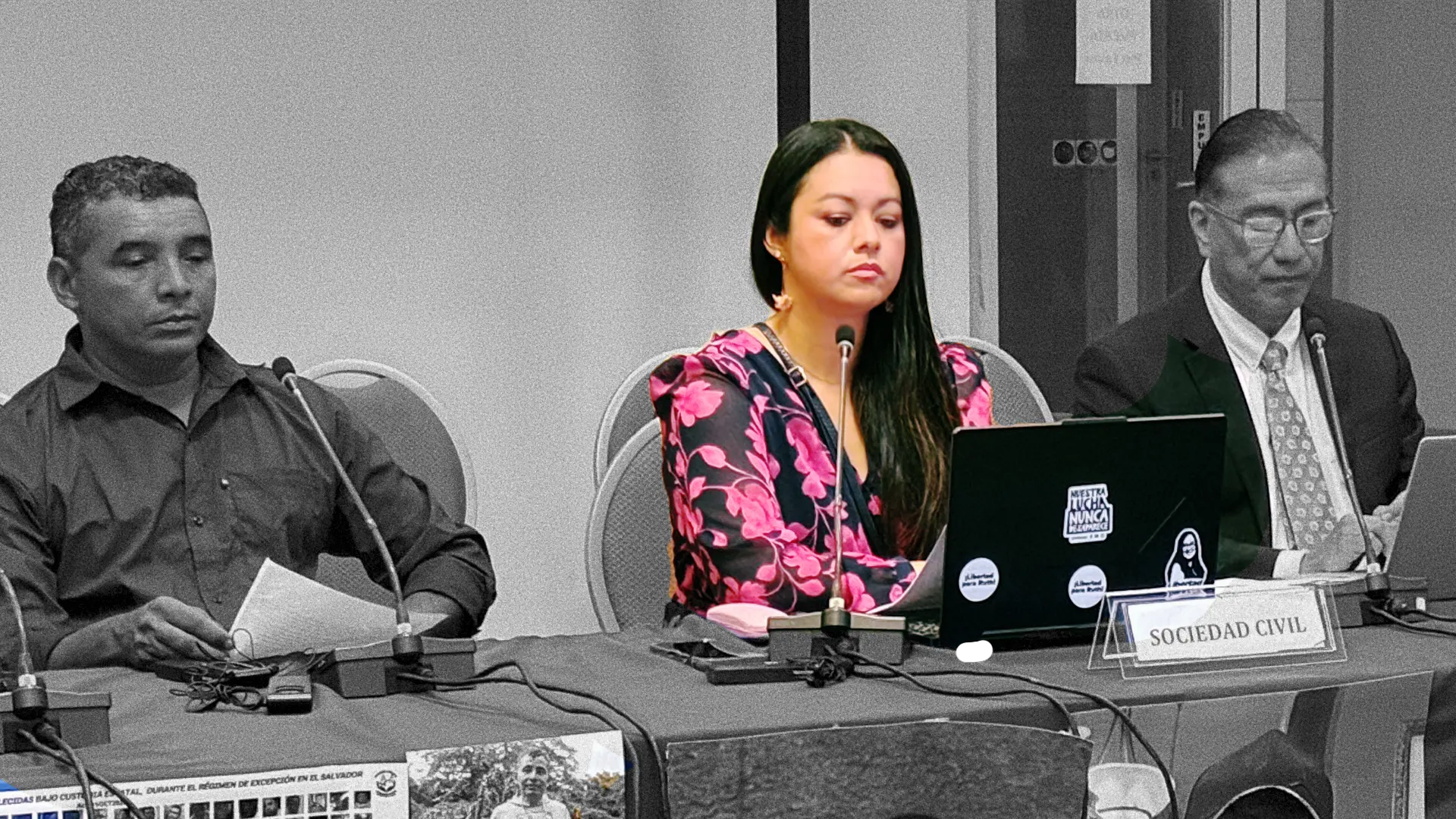
Before the IACHR commissioners, during a hearing held in Panama this past October 26, Escobar was categorical: “45 days after he entered prison, they killed him.”
A death notice published by Legal Humanitarian Aid stated that Humberto’s body was examined inside the parking lot of the Zacamil National Hospital at 11:35 p.m. on July 6, 2025, and that, according to the terse forensic report, “he died of pulmonary edema.”
Escobar recounted that at the funeral home, while the body was being prepared for the wake, the family discovered hematomas and contusions on Humberto’s face and chest. The human rights defender added that the Forensic Medicine Institute refused to hand over the autopsy results, while the Office of the Attorney General of the Republic has kept a silence that she openly describes as a cover-up.
Escobar’s suspicion is not unfounded. For four years, Legal Humanitarian Aid has been one of the most uncomfortable voices for Nayib Bukele’s government by putting names, figures, and faces to the human rights violations committed under the state of exception by police officers, soldiers, and prison guards. That is why the defender insisted before the IACHR that her brother’s death must be investigated to determine whether it was a homicide motivated by institutional revenge.
“It is fine to seek national security, but not at the cost of simply changing executioners. We are not going to remain silent. We demand truth, justice, reparation, and non-repetition. A halt to the barbarity in the custody of the State,” Escobar demanded at the public hearing, where she also denounced the cases of trade unionist José Leonidas Bonilla and merchant Santos Navarro, who were arbitrarily detained during the state of exception and died in the custody of the State due to a lack of medical care.
Escobar’s testimony was not the only one to expose the horrors of the Salvadoran prison system. Before the same commissioners, Pedro López Castellón recounted the case of his brother Rafael, a 53-year-old merchant with kidney and heart failure, who also died in the custody of the State and after facing the judicial system without due process being respected in his case.
On April 8, 2022, security forces raided, without a court order, the home and the mill facilities of his brother in Jucuapa, Usulután. In the same operation, and without any evidence whatsoever, they arrested him on the generic charge of belonging to gangs. Rafael barely held out for a month and a half in prison, deprived of his vital treatments, until he died on June 1 in a hospital. During that time, the State not only denied Rafael medical care, but also deliberately concealed his death from the family. Unaware that Rafael had already died, his relatives kept coming to the prison with packages of medicine, food, and hygiene items. The guards, without saying anything about Rafael’s death, kept receiving the packages as if he were still alive and assuring them that they would be delivered.
Pedro asserted before the IACHR that the family learned of Rafael’s death 68 days later, when they requested a criminal record certificate. It was at that moment that they discovered that Rafael’s body had been buried in a common grave in La Bermeja cemetery in San Salvador. After several procedures, the family managed to exhume his body on September 18, 2022, and give him a dignified burial.
“Rafael’s death was the result of a chain of abuses of intentional medical negligence, in custody, and of a total lack of humanity on the part of a system that snatched away the life of an innocent and sick man and that, on top of that, tried to disappear him into the anonymity of a common grave,” Pedro maintained.
These complaints by Escobar and López were part of the thematic hearing held during the IACHR’s 197th Period of Sessions. The session was convened to examine the conditions of persons deprived of liberty under the state of exception, an extraordinary measure that in practice became ordinary and that has remained in force since March 27, 2022. With this measure, the Salvadoran State suspended basic constitutional guarantees, indefinitely extended the time limits for administrative detention, nullified the right to a defense, and violated the inviolability of communications. All of this, according to the official discourse, in order to dismantle the gangs, although the hundreds of complaints indicate that it has also been used to persecute voices critical of the government, opponents, trade unionists, human rights defenders, and environmentalists. In the midst of it all, there are hundreds of cases of innocent people who were captured and unjustly accused of belonging to gangs.

Full video of the public hearing: Situation of persons deprived of liberty in the context of the state of exception
In the face of the gravity of the allegations at the IACHR’s public hearings, the Salvadoran State’s response was disdain and absence. No representative of the Bukele government or of any implicated public institution appeared, which drew reproach from the civil society organizations and from the commissioners themselves, who warned that the State’s absence not only frustrates a crucial opportunity for dialogue, but is an attempt to weaken international cooperation mechanisms and the scrutiny of human rights violations in the country.
During the hearing, the organizations reiterated that since the first months of the regime they have documented patterns of arbitrary detentions, enforced disappearances, torture and other ill-treatment, and denial of medical care. They also reported a total of 454 documented deaths in Salvadoran prisons.
“Deaths in custody are one of the most serious consequences of this pattern. A pattern that is systematic and widespread, with well-founded grounds to believe that they constitute crimes against humanity and entail the individual criminal responsibility of the highest spheres of power, including President Bukele himself,” said Carlota Roby, senior lawyer for Latin America at the Robert & Ethel Kennedy Human Rights Center.
David Morales, a lawyer with Cristosal, explained that by 2024, Cristosal had verified 1,178 cases of people detained under the regime and confirmed that most of them were arbitrarily detained and that the legal concept of flagrante delicto was fraudulently used to charge them with the crime of illicit associations. The people were subjected to mass initial hearings without defense guarantees, and the judges ordered detentions automatically.
“All persons deprived of liberty remain completely incommunicado, without access to family visits or visits from their defense lawyers, in breach of the penitentiary law,” the lawyer said.
Morales also said that his organization has documented 454 deaths in state custody, a lethal toll that includes 33 women and four minors. Far from being mere suspicions, Cristosal has documented compelling proof to show that in 87 cases there is evidence of physical violence, and in at least 31 of them they gained access to forensic reports issued by the State’s own institutions certifying trauma and mechanical asphyxia as causes of death. Added to this pattern of torture is forced starvation, since the independent forensic record identified clear signs of severe malnutrition in 42 of the bodies handed over to their families. Morales stated that in 78% of the death cases, the victims had no ties to gangs.
In 201 cases, according to documents from state entities, pulmonary or cerebral edema was recorded as the cause of death. This recurrence, according to Morales, raises the suspicion of a possible cover-up by the Forensic Medicine Institute, since edema is not the cause of death but rather a physiological alteration brought about by the actual cause, whether an illness, injuries, or trauma. He also said that the forensic examinations and autopsies do not meet the standards established in the Minnesota Protocol for investigating deaths.
In 121 of the cases, there is evidence of illnesses as the cause of death. Of these victims, 29% had a history of some prior illness, and 51% entered healthy and fell ill in prison.
“These deaths may be associated with the precarious medical care and provision of medicines, which has been denounced as another form of torture. All the characteristics described make it possible to state that many of the cases can be characterized as extrajudicial executions,” Morales said.
Of the total of 300 deceased persons, 72% were in their most productive stage of life. They were between 18 and 40 years old. Of these people, 111 were farmers, 47 merchants, 42 technicians, 72 employees, 24 construction workers, and 24 students. “This occupational profile denotes the regime’s viciousness against populations subjected to conditions of poverty and limited capacities to defend themselves against state repression,” Morales maintained.
Mass trials and the collapse of individualized justice
The organizations’ concern before the IACHR also includes the deliberate collapse of judicial guarantees. They pointed with alarm to the recent reforms to procedural laws that allow single hearings to try groups of up to 6,000 people at the same time, in fast-track proceedings where the only evidence from the Attorney General’s Office is usually reduced to the testimony of protected witnesses in exchange for impunity or lesser sentences.
Morales explained that the state of exception has been accompanied by four packages of reforms to the criminal law, approved by a Legislative Assembly that is controlled by the ruling party and that responds to the orders of the Bukele government. Those reforms include the toughening of penalties and the use of offender-based criminal law against detained persons. The Cristosal lawyer pointed out that these reforms have turned the Courts Against Organized Crime into courts of exception that apply an ad hoc, inquisitorial procedure to carry out mass trials.
The reforms have also implemented life imprisonment, which can be applied even to children and adolescents from the age of 12. These reforms allowed the Attorney General’s Office to form mass groupings to make way for collective trials.
“The largest publicly reported grouping exceeds 6,000 people,” he said.
With the reforms, the ruling party also degraded the rules of evidence and eliminated the judicial hearing that closes the investigative phase, avoiding the review of legality and automatically sending cases to the trial stage. This special procedure has replaced the public trials typical of ordinary proceedings with hearings that are called “Single” hearings and that remain open for up to two years, while the Attorney General’s Office charges segments of people previously linked to a mass grouping.
According to Cristosal, there are no serious investigations to determine the criminal structures of gangs, and the prosecution’s charges are based almost exclusively on statements by a faceless witness under the opportunity principle, who points to hundreds of people as gang members. “The right to a defense is totally undermined in this special proceeding,” Morales stated.
Morales indicated that since the mass trials began, in early 2026, most people are being sentenced to terms ranging from 20 years to life imprisonment. Attorney General Rodolfo Delgado told the Legislative Assembly that, as of October 16, 10,561 people had been convicted and that 79% received prison sentences of 15 to 45 years.
Roby added that in any system where the rule of law functions, the State has the obligation to present specific evidence linking a person to criminal conduct; however, in El Salvador this is not the case, and the accused are prosecuted under general criteria.
The organizations also presented statistics on the prison system indicating that, according to the latest data reported by the government, the prison population amounts to 120,956 people, of whom 93,162 correspond to detentions under the regime, which reflects an overall overcrowding rate of 170%, including the 40,000 spaces at the Terrorism Confinement Center, CECOT. However, since this Center is not fully occupied, overcrowding in the regular prisons reaches 344%. The figures also reflect that 2.1% of the population is deprived of liberty.
At the hearing, civil society dismantled the official narrative regarding Nayib Bukele’s recent announcement of a supposed plan to review the cases of more than 10,000 alleged gang collaborators and grant conditional release to half of them under the category of “occasional collaborators.” For the human rights defenders, this maneuver is opaque, and that is why it is not clear who will make up the committees that will review the cases. For that reason, they warned that release subject to measures does not constitute a legal acquittal or comprehensive reparation for the innocent people whose rights were violated. In light of this ambiguity, they formally requested that the IACHR demand accountability from the Salvadoran government and offer technical assistance to prevent a new judicial farce.
Mika Kanervavuori, of the Office of the UN High Commissioner for Human Rights, recalled that El Salvador committed to reviewing the state of exception within the framework of the Universal Periodic Review in order to facilitate the promotion and protection of the population’s fundamental freedoms and rights.
“After 56 consecutive extensions of the state of exception and taking into account the evolution of the security situation, this commitment should lead to promptly reviewing all exceptional measures and to ensuring that only those that meet the requirements imposed by international law remain in force, including those relating to the principles of necessity, proportionality, and temporality,” Kanervavuori maintained.
GatoEncerrado: https://gatoencerrado.news/2026/10/27/ingrid-escobar-denuncia-cidh-muerte-hermano-prision/
Ingrid Escobar denuncia ante la CIDH la muerte de su hermano en prisión
Por Beatriz Benítez
Edición: Ezequiel Barrera
Nota de ESN: El artículo original menciona un grupo de 300 personas fallecidas, pero las seis cifras ocupacionales que enumera suman 320; no aclara si las categorías se superponen. Por separado, cita un registro de 454 muertes documentadas por Cristosal. Se conserva el texto original sin corregir ni equiparar estos universos estadísticos.
Ingrid Escobar, defensora de derechos humanos y directora del Socorro Jurídico Humanitario (SJH), denunció ante la Comisión Interamericana de Derechos Humanos (CIDH) la muerte de su hermano, Humberto Adonay Escobar Mónico, de 38 años, bajo custodia del Estado salvadoreño.
El 22 de mayo de 2025, Humberto regresaba al país junto a su compañera de vida tras cruzar la frontera con Guatemala. Unos kilómetros después de haber superado los controles migratorios y policiales, transportando 900 dólares en productos cosméticos para un emprendimiento que ambos tenían, unos militares capturaron a Humberto bajo acusaciones que la familia califica como falsas.
Ante los comisionados de la CIDH, durante una audiencia celebrada en Panamá el pasado 26 de octubre, Escobar fue tajante: “45 días después de haber ingresado a prisión lo mataron”.
Una esquela publicada por el Socorro Jurídico señaló que el cadáver de Humberto fue reconocido en el interior del parqueo del Hospital Nacional Zacamil a las 11:35 de la noche del 6 de julio de 2025 y que, según el escueto dictamen forense, “falleció por edema pulmonar”.
Escobar relató que en la funeraria, mientras preparaban el cuerpo para la velación, la familia descubrió hematomas y contusiones en el rostro y el tórax de Humberto. La defensora de derechos humanos agregó que el Instituto de Medicina Legal se negó a entregar los resultados de la autopsia, mientras que la Fiscalía General de la República ha guardado un silencio que califica abiertamente como encubrimiento.
La sospecha de Escobar no es infundada. Durante cuatro años, el Socorro Jurídico Humanitario ha sido una de las voces más incómodas para el Gobierno de Nayib Bukele al ponerle nombres, cifras y rostros a las violaciones a derechos humanos cometidas bajo el régimen de excepción por policías, militares y custodios penitenciarios. Por eso, la defensora insistió ante la CIDH que la muerte de su hermano debe investigarse para determinar si fue un homicidio motivado por una venganza institucional.
“Está bien buscar seguridad nacional, pero no a costa de simplemente cambiar de verdugo. No nos vamos a callar. Exigimos verdad, justicia, reparación y no repetición. Un alto a la barbarie bajo la custodia del Estado”, exigió Escobar, en la audiencia pública donde también denunció los casos del sindicalista José Leonidas Bonilla y del comerciante Santos Navarro, quienes fueron detenidos arbitrariamente durante el régimen de excepción y murieron bajo custodia del Estado por falta de atención médica.
El testimonio de Escobar no fue el único en evidenciar los horrores del sistema penitenciario salvadoreño. Ante los mismos comisionados, Pedro López Castellón relató el caso de su hermano Rafael, un comerciante de 53 años con insuficiencia renal y cardíaca, quien también falleció bajo custodia del Estado y luego de enfrentar al sistema judicial sin que se le respetara el debido proceso.
El 8 de abril de 2022, las fuerzas de seguridad allanaron sin una orden judicial la vivienda y las instalaciones del molino de su hermano en Jucuapa, Usulután. En el mismo operativo, y sin prueba alguna, lo arrestaron bajo el cargo genérico de pertenecer a pandillas. Rafael apenas resistió un mes y medio en prisión, privado de sus tratamientos vitales, hasta que falleció el 1 de junio en un hospital. Durante ese tiempo, el Estado no solo negó la atención médica a Rafael, sino que también ocultó deliberadamente su muerte a la familia. Sin saber que Rafael ya había fallecido, sus parientes continuaron llegando a la prisión con paquetes de medicinas, alimentos y artículos de higiéne. Los custodios, sin decir nada sobre la muerte de Rafael, siguieron recibiendo los paquetes como si todavía estuviera con vida y asegurando que iban a ser entregados.
Pedro aseguró, ante la CIDH, que la familia se enteró del fallecimiento de Rafael 68 días después, cuando solicitó una constancia de antecedentes penales. Fue en ese momento cuando descubrieron que el cuerpo de Rafael fue enterrado en una fosa común en el cementerio La Bermeja de San Salvador. Tras varios trámites, la familia logró exhumar su cuerpo el 18 de septiembre de 2022 y dar una sepultura digna.
“La muerte de Rafael fue el resultado de una cadena de abusos de negligencia médica intencional, bajo custodia, y de una total falta de humanidad por parte de un sistema que le arrebató la vida a un hombre inocente y enfermo y que encima intentó desaparecerlo en el anonimato de una fosa común”, sostuvo Pedro.
Estas denuncias de Escobar y de López formaron parte de la audiencia temática celebrada durante el 197º periodo de sesiones de la CIDH. La sesión fue convocada para examinar las condiciones de las personas privadas de libertad bajo el régimen de excepción, una medida extraordinaria que en la práctica se volvió ordinaria y que continúa vigente desde el 27 de marzo de 2022. Con esta medida, el Estado salvadoreño suspendió garantías constitucionales básicas, extendió de forma indefinida los plazos de detención administrativa, anuló el derecho a la defensa y vulneró la inviolabilidad de las comunicaciones. Todo esto, según el discurso oficial, para desarticular a las pandillas, aunque los cientos de denuncias apuntan a que también se ha utilizado para perseguir a las voces críticas del gobierno, opositores, sindicalistas, defensores de derechos humanos y ambientalistas. En medio de todo, hay cientos de casos de personas inocentes que fueron capturadas y acusadas injustamente de pertenecer a pandillas.
Video completo de la audiencia pública: Situación de las personas privadas de libertad en el marco de estado de excepoción
Frente a la gravedad de los señalamientos en las audiencias públicas de la CIDH, la respuesta del Estado salvadoreño fue el desdén y la ausencia. Ningún representante del Gobierno de Bukele ni de ninguna institución pública señalada se presentó, lo que fue reprochado por las organizaciones de sociedad civil y por los mismos comisionados, quienes advirtieron que la ausencia del Estado no solo frustra una oportunidad crucial para el diálogo, sino que es un intento por debilitar los mecanismos de cooperación internacional y el escrutinio sobre las violaciones a los derechos humanos en el país.
Durante la audiencia, las organizaciones reiteraron que desde los primeros meses del régimen han documentado patrones de detenciones arbitrarias, desapariciones forzadas, torturas y otros malos tratos y negación de atención médica. Asimismo, reportaron un total 454 muertes documentadas en las cárceles salvadoreñas.
“Las muertes bajo custodia son una de las consecuencias más graves de este patrón. Un patrón que es sistemático y generalizado con motivos fundados para creer que constituyen crímenes de lesa humanidad e implican la responsabilidad penal individual de las más altas esferas del poder, incluido el propio presidente Bukele”, señaló Carlota Roby, abogada senior para América Latina de la Robert & Ethel Kennedy Human Rights Center.
David Morales, abogado de Cristosal, expuso que para 2024, Cristosal verificó 1,178 casos de personas detenidas bajo el régimen y confirmó que la mayoría fueron detenidas arbitrariamente y que se utilizó fraudulentamente la figura de flagrancia para imputar el delito de agrupaciones ilícitas. Las personas fueron sometidas a audiencias iniciales masivas sin garantías de defensa y los jueces decretaron detenciones en automático.
“Todas las personas privadas de libertad permanecen en incomunicación total, sin acceso a visitas familiares, ni de sus abogados defensores en incumplimiento de la ley penitenciaria”, indicó el abogado.
Morales además dijo que su organización ha documentado 454 muertes bajo custodia estatal, un saldo letal que incluye a 33 mujeres y cuatro menores de edad. Lejos de tratarse de simples sospechas, Cristosal ha documentado pruebas contundentes para señalar que en 87 casos hay evidencia de violencia física, y en al menos 31 de ellos accedieron a dictámenes forenses emitidos por las propias instituciones del Estado que certifican traumas y asfixias mecánicas como causas de muerte. A este patrón de torturas se suma la inanición forzada, ya que el registro forense independiente identificó signos evidentes de desnutrición severa en 42 de los cuerpos entregados a sus familias. Morales afirmó que en el 78 % de casos de muertes, las víctimas no tenían vínculos con pandillas.
En 201 casos, según los documentos de entidades estatales, se registró el edema pulmonar o cerebral como causa de muerte. Esta recurrencia, según Morales, genera la sospecha de un posible encubrimiento por parte del Instituto de Medicina Legal, pues el edema no es la causa de muerte sino una alteración fisiológica que es provocada por la causa real, ya sea una enfermedad, lesiones o traumatismos. Además, dijo que los reconocimientos y las autopsias forenses no cumplen con los estándares establecidos en el Protocolo de Minnesota para investigar las muertes.
En 121 de los casos existen evidencias de enfermedades como causa de muerte. El 29 % de estas víctimas tenían antecedentes de alguna enfermedad previa y el 51 % ingresaron sanos y enfermaron en prisión.
“Estas muertes pueden estar asociadas a la precaria atención médica y de provisión de medicamentos que ha sido denunciada como otra modalidad de tortura. Todas las características descritas permiten afirmar que muchos de los casos pueden perfilarse como ejecución extrajudicial”, dijo Morales.
Del total de 300 personas fallecidas, el 72 % se encontraban en su etapa más productiva. Tenían entre 18 y 40 años. 111 de estas personas eran agricultores, 47 comerciantes, 42 técnicos, 72 empleados, 24 trabajadores de la construcción y 24 estudiantes. “Este perfil ocupacional denota el ensañamiento del régimen contra poblaciones sometidas a condiciones de pobreza y limitadas capacidades de defenderse frente a la represión estatal”, sostuvo Morales.
Juicios masivos y el colapso de la justicia individualizada
La preocupación de las organizaciones ante la CIDH también incluye el colapso deliberado de las garantías judiciales. Señalaron con alarma las recientes reformas a las leyes procesales que permiten audiencias únicas para juzgar a grupos de hasta 6,000 personas al mismo tiempo, en procesos exprés donde la única prueba de la Fiscalía suele reducirse al testimonio de testigos protegidos a cambio de impunidad o de penas menores.
Morales expuso que el régimen de excepción ha sido acompañado de cuatro bloques de reformas a la ley penal, aprobados por una Asamblea Legislativa que está controlada por el partido oficialista y que responde a las órdenes del Gobierno de Bukele. Esas reformas incluyen el endurecimiento de las penas y el uso del derecho penal de autor contra las personas detenidas. El abogado de Cristosal señaló que estas reformas han convertido a los Tribunales Contra el Crimen Organizado en tribunales de excepción que aplican un procedimiento ad hoc, inquisitorio, para llevar adelante juicios masivos.
Las reformas han implementado, además, la pena perpetua que se puede aplicar incluso a niños, niñas y adolescentes a partir de los 12 años. Estas reformas permitieron a la Fiscalía conformar agrupamientos masivos para dar paso a juzgamientos colectivos.
“El agrupamiento mayor reportado públicamente es superior a las 6,000 personas”, señaló.
Con las reformas, el oficialismo también degradó las reglas de la prueba y eliminó la audiencia judicial de cierre de instrucción evitando el control de la legalidad y remitiendo automáticamente los casos a la etapa de juicio. Este procedimiento especial ha sustituido las vistas públicas propias de los procesos ordinarios por audiencias que se denominan “Únicas” y que permanecen abiertas hasta dos años, mientras la Fiscalía acusa segmentos de personas previamente vinculadas a un agrupamiento masivo.
De acuerdo con Cristosal, no existen investigaciones serias para determinar las estructuras criminales de pandillas y las acusaciones fiscales se basan casi exclusivamente en declaraciones de un testigo sin rostro bajo criterio de oportunidad, quien señala a cientos de personas como miembros de pandillas. “El derecho a la defensa está totalmente socavado en este proceso especial”, afirmó Morales.
Morales indicó que desde que iniciaron los juicios masivos, a principios del 2026, la mayoría de personas están siendo condenadas con penas que van de los 20 años hasta cadena perpetua. El fiscal general Rodolfo Delgado dijo ante la Asamblea Legislativa que, hasta el 16 de octubre, 10,561 personas habían sido condenadas y que un 79 % recibió penas de prisión desde los 15 a 45 años.
Roby añadió que en cualquier sistema donde el Estado de Derecho funcione, el Estado tiene la obligación de presentar pruebas específicas que vinculen a una persona con una conducta delictiva; sin embargo, en El Salvador no ocurre así y los acusados son procesados bajo criterios generales.
Las organizaciones también presentaron estadísticas sobre el sistema penitenciario que, según los últimos datos reportados por el gobierno, la población carcelaria asciende a 120,956 personas, de esos 93,162 corresponden a detenciones bajo el régimen, lo que refleja un índice de hacinamiento global del 170 %, incluyendo las 40,000 plazas del Centro de Confinamiento del Terrorismo, CECOT. Sin embargo, al no estar ocupado este Centro en su totalidad, el hacinamiento en las cárceles comunes alcanza el 344 %. Las cifras también reflejan que el 2,1 % de la población está privada de libertad.
En la audiencia, la sociedad civil desarmó la narrativa oficial frente al reciente anuncio de Nayib Bukele sobre un supuesto plan para revisar los casos de más de 10 mil presuntos colaboradores de pandillas y otorgar libertad condicional a la mitad de ellos bajo la categoría de “colaboradores ocasionales”. Para los defensores de derechos humanos, esta maniobra es opaca y por eso no queda claro quiénes integrarán los comités que revisarán los casos. Por esa razón, advirtieron que una libertad bajo medidas no constituye una absolución legal ni una reparación integral para los inocentes cuyos derechos fueron violados. Ante esta ambigüedad, solicitaron formalmente a la CIDH que exija cuentas al Gobierno salvadoreño y ofrezca asistencia técnica para impedir una nueva farsa judicial.
Mika Kanervavuori, de la Oficina del Alto Comisionado de la ONU para los Derechos Humanos, recordó que El Salvador se comprometió a revisar el régimen de excepción en el marco del Examen Periódico Universal con el fin de facilitar la promoción y protección de las libertades y derechos fundamentales de la población.
“Tras 56 prórrogas consecutivas del estado de excepción y teniendo en cuenta la evolución de la situación de seguridad, este compromiso debería conducir a revisar prontamente todas las medidas excepcionales y a garantizar que únicamente permanezcan vigentes las que satisfagan los requisitos que impone el derecho internacional, incluyendo los relativos a los principios de necesidad, proporcionalidad y temporalidad”, sostuvo.
GatoEncerrado: https://gatoencerrado.news/2026/10/27/ingrid-escobar-denuncia-cidh-muerte-hermano-prision/