
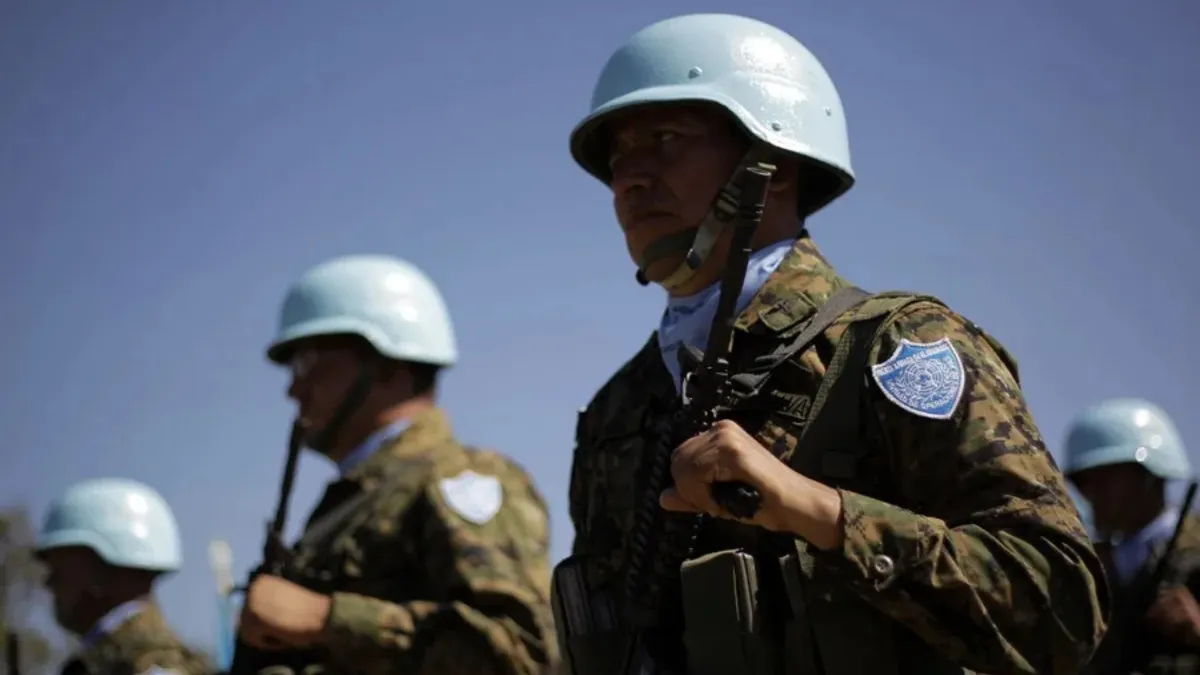
The arrival in Port-au-Prince of a military contingent from El Salvador to help in the search for four soldiers from that country who went missing after an ambush last Sunday has little chance of success due to the conditions in Haiti, a former military chief of that Caribbean country asserted this Friday.
“Foreign forces cannot achieve results in Haiti the way they have approached things. They must move away from the idea of war to solve this problem,” retired Colonel Himmler Rebu, who was commander of a special forces unit of the Haitian Army, said in a telephone interview with EFE.
The contingent from El Salvador, announced by President Nayib Bukele, arrived on Thursday in the Haitian capital to join the search operations for four Salvadoran service members who are part of the Gang Suppression Force (GSF, its English acronym) and who went missing after the attack in Santo, in the commune of Croix-des-Bouquets.
“They are not going to achieve results,” declared Rebu, who stressed that more than 72 hours have passed since the ambush without anything being known about the four Salvadoran aeronautical technicians, and added that the forces participating in the operation must know that “they cannot rescue them,” among other factors, because they are completely unfamiliar with the terrain they are arriving in.
Multinational operations
In recent decades, Haiti has seen several successive multinational military operations promoted by the UN for peacekeeping and the restoration of democracy, among them the 1994 operation, led by the United States, which restored then-President Jean-Bertrand Aristide to power, and the United Nations Stabilization Mission in Haiti (Minustah), which was in the country between 2004 and 2017.
However, the country of 12 million inhabitants remains mired in the violence of the armed gangs that control most of Port-au-Prince and to which the attack on the vehicle in which the Salvadoran soldiers were traveling is attributed.
“They have failed because they have not respected Haitian idiosyncrasies in the conflict, because they have not respected the rules tied to Haitian culture, to Haitian history,” added Rebu, who led an attempted coup d’état in April 1989 against then-President Prosper Avril.
A game of interests
Rebu states that the international community cannot solve a problem it does not understand and that, in the case of Haiti, the gangs, made up mostly of young people, “are people who receive weapons and ammunition” from an economic and political elite interested in making money in Haiti through various activities, legal or illegal, and that is why they do not want the country to stabilize.
“It is an international manipulation that we are living through; some Haitians are killing others, setting fire to others’ property without having an underlying problem between them. It is an international manipulation to destabilize Haiti, that is the background to the matter,” he added.
In his opinion, those interests that fuel the violence of the armed gangs also work against the electoral process through which, for several years now, there have been unsuccessful attempts to hold elections in the country.
After several postponements, in the middle of the year, this coming December 13 was set as the date for the first round of the presidential and legislative elections, but the Provisional Electoral Council (CEP) has already indicated that it is working on modifying the voting calendar.
“They are not going to elect a new president. The people who are in power are not interested in organizing elections because that will allow them to stay in power, that is how they think. Under current conditions, elections cannot be held, and if these conditions do not change, it will never be possible to hold elections,” he concluded.
“No los pueden rescatar”: exjefe militar de Haití advierte pocas posibilidades de éxito en misión para rescatar a los soldados salvadoreños desaparecidos
EFE .
La llegada a Puerto Príncipe de un contingente militar de El Salvador para ayudar en la búsqueda de cuatro soldados de ese país desaparecidos tras una emboscada el pasado domingo tiene pocas posibilidades de éxito por las condiciones de Haití, aseguró este viernes un exjefe militar de ese país caribeño.
“Fuerzas extranjeras no pueden tener resultados en Haití tal como ellos han planteado la cosa. Ellos deben salir de la idea de la guerra para resolver este problema”, dijo en una entrevista telefónica con EFE el coronel retirado Himmler Rebu, quien fue comandante de una unidad de fuerzas especiales del Ejército haitiano.
El contingente de El Salvador, anunciado por el presidente Nayib Bukele, llegó el jueves a la capital haitiana para sumarse a las operaciones de búsqueda de cuatro militares salvadoreños que hacen parte de la Fuerza de Supresión de Pandillas (GSF, por sus siglas en inglés), desaparecidos tras el ataque en Santo, en la comuna de Croix-des-Bouquets.
“No van a tener resultados”, sentenció Rebu, quien subrayó que han pasado más de 72 horas desde la emboscada sin que se sepa nada de los cuatro técnicos aeronáuticos salvadoreños, y añadió que las fuerzas que participan en la operación deben saber que “no los pueden rescatar”, entre otros factores, porque desconocen totalmente el terreno al que llegan.
Operaciones multinacionales
En las últimas décadas se han sucedido en Haití varias operaciones militares multinacionales impulsadas por la ONU para el mantenimiento de la paz y el restablecimiento de la democracia, entre ellas la de 1994, liderada por Estados Unidos, que restauró en el poder al entonces presidente Jean-Bertrand Aristide, y la Misión de Estabilización de las Naciones Unidas en Haití (Minustah), que estuvo en el país entre 2004 y 2017.
Sin embargo, el país de 12 millones de habitantes sigue sumido en la violencia de las bandas armadas que controlan la mayor parte de Puerto Príncipe y a las que se les atribuye el ataque contra el vehículo en el que se movilizaban los soldados salvadoreños.
“Han fracasado porque no han respetado la idiosincrasia haitiana en el conflicto, porque no han respetado las reglas ligadas a la cultura haitiana, a la historia haitiana”, agregó Rebu, quien lideró un intento de golpe de Estado en abril de 1989 contra el entonces presidente Prosper Avril.
Juego de intereses
Rebu afirma que la comunidad internacional no puede resolver un problema que no entiende y que, en el caso de Haití, las pandillas, conformadas en su mayoría por jóvenes, “son gente que recibe armas y municiones” de una élite económica y política interesada en hacer dinero en Haití con diversas actividades, legales o ilegales, y por eso no quieren que el país se estabilice.
“Es una manipulación internacional que estamos viviendo; unos haitianos están matando a otros, prendiendo fuego a los bienes de otros sin tener un problema de base entre ellos. Es una manipulación internacional para desestabilizar a Haití, ese es trasfondo de la cuestión”, agregó.
En su opinión, esos intereses que alimentan la violencia de las bandas armadas también juegan en contra del proceso electoral con el que desde hace varios años se intenta sin éxito la celebración de elecciones en el país.
Después de varios aplazamientos, a mediados de año se fijó el próximo 13 de diciembre como fecha para la primera vuelta de las elecciones presidenciales y legislativas, pero la Comisión Electoral Provisional (CEP) ya indicó que trabaja en la modificación del calendario de votación.
“No van a elegir nuevo presidente. La gente que está en el poder no está interesada en organizar elecciones porque eso les permitirá quedarse en el poder, ellos lo piensan así. En las condiciones actuales no se pueden realizar elecciones y si estas condiciones no cambian, nunca se van a poder realizar elecciones“, concluyó.