

El Salvador’s draft general budget for 2027 amounts to US$12,421 million, 17.7% more than the budget approved for 2026. The increase may seem like good news, but a larger budget does not by itself guarantee water, food, health or care. To know whether it will improve the lives of those who need support and of those who provide it, it is necessary to examine three issues: how much is actually allocated to care, whether the budgetary response corresponds to the climate crisis, and whether the resources can be turned into effective services.
From the perspective of feminist economics, care consists of the tasks that make daily life possible: preparing food, maintaining hygiene, tending to illnesses and accompanying those who need support. It includes paid services and unpaid work in households. When public services are lacking, families make up for that absence with money, time and effort. That burden falls above all on women and limits their opportunities to study, earn income, rest and participate in their community.
The budget annexes for ISDEMU, Health, Agriculture and Environment do not make it possible to verify that sufficient and coordinated resources exist to implement the National Care Policy or to respond to the burdens aggravated by the climate crisis. Although they contain funds related to both issues, these appear scattered and without a breakdown that would allow their sufficiency or their contribution to a comprehensive policy to be measured. This lack of traceability does not prove that there are no funded actions, but it does prevent them from being evaluated. The Government must publish the cost of its commitments and indicate which budget items will finance each action.
This analysis first examines the financing of the National Care Policy and ISDEMU’s budget; it then reviews the allocations for Health, Agriculture and Environment; and finally it addresses the execution of spending and the sources of financing. The objective is to determine whether the budget brings together sufficient, identifiable and executable resources to sustain life.
The care policy needs a budget
El Salvador has the National Policy on Co-responsibility for Care 2022-2030. Its goal is to guarantee the right to receive and provide care with quality, equality and without discrimination. It proposes expanding services and infrastructure, professionalizing care work and supporting the well-being of those who provide care. ISDEMU has technical and operational coordination responsibilities.
The policy establishes that each responsible institution must include in its annual budget the resources necessary to fulfill it. International cooperation can support this effort, but not replace it. Therefore, the Government must indicate which activities it will finance, how many people it will serve and how it will distribute resources among institutions and territories. A broadly named budget item may include care actions, but it is necessary to know how much money is actually allocated to them.
Crecer Juntos contributes to early childhood care. However, the care policy also includes girls, boys and adolescents aged 8 to 18; adults who need support; and caregivers, whether or not they receive a salary.
The National Care Study by ISDEMU and OPAMSS, published in July 2025, was exploratory and was carried out in 34 districts, 28 of them in the San Salvador Metropolitan Area. Among the people surveyed, 90% were women, 87% received no income for care work and 89% reported impacts on their physical and emotional well-being associated with these tasks.
ISDEMU maintains a limited budget
ISDEMU’s official annex proposes US$7,250,952 for 2027: exactly the same amount approved for 2026. Moreover, this is US$4,353,730 less than the US$11,604,682 approved in 2024, a nominal reduction of 37.5%. This drop must be analyzed together with the functions, coverage and staff that ISDEMU needs to guarantee rights. If prices rise, keeping the same allocation also reduces what the institution can buy and do.
For 2027, the budget allocates US$1,738,867 to Institutional Direction and Administration and US$5,512,085 to Management for the Comprehensive Development of Women. This second unit distributes US$573,745 for public policies on women’s rights; US$1,185,220 for specialized care; US$3,703,120 for autonomy and empowerment; and US$50,000 to comply with the ruling in the El Mozote case.
No specific budget item for the National Care Policy appears in this annex. This does not mean that there is no care action at all within other general items, but it makes it impossible to know how much money is allocated to the policy. Without a breakdown, it is not possible to know the resources available to coordinate it, expand services or support those who provide care.
ISDEMU does not concentrate all care financing. The policy distributes responsibilities among several institutions, so its budget does not represent all national spending in this area. Even so, it offers an important signal: the institution that must help coordinate the policy has limited resources and does not present a budget item that allows specific tracking of spending on care.
Women’s economic autonomy also depends on care. A training course or a productive project can open up opportunities, but it will be less useful if a woman must single-handedly look after a person who needs support. Care services, access to water and adequate transportation are necessary conditions for taking advantage of those opportunities. They must receive public funds and not depend on another woman’s unpaid work.
Women’s health requires resources and comprehensive care
The draft Health budget for 2027 maintains items aimed at women, but their changes must be examined together with the services they will make it possible to provide. The total budget of the Ministry of Health would go from US$1,345,468,319 approved for 2026 to US$1,493,139,321 proposed for 2027, a nominal increase of 10.98%. That overall increase is not distributed in the same way among the programs. The comparison distinguishes between approved and proposed allocations; neither of the two demonstrates how much will be executed or how many women will receive care.
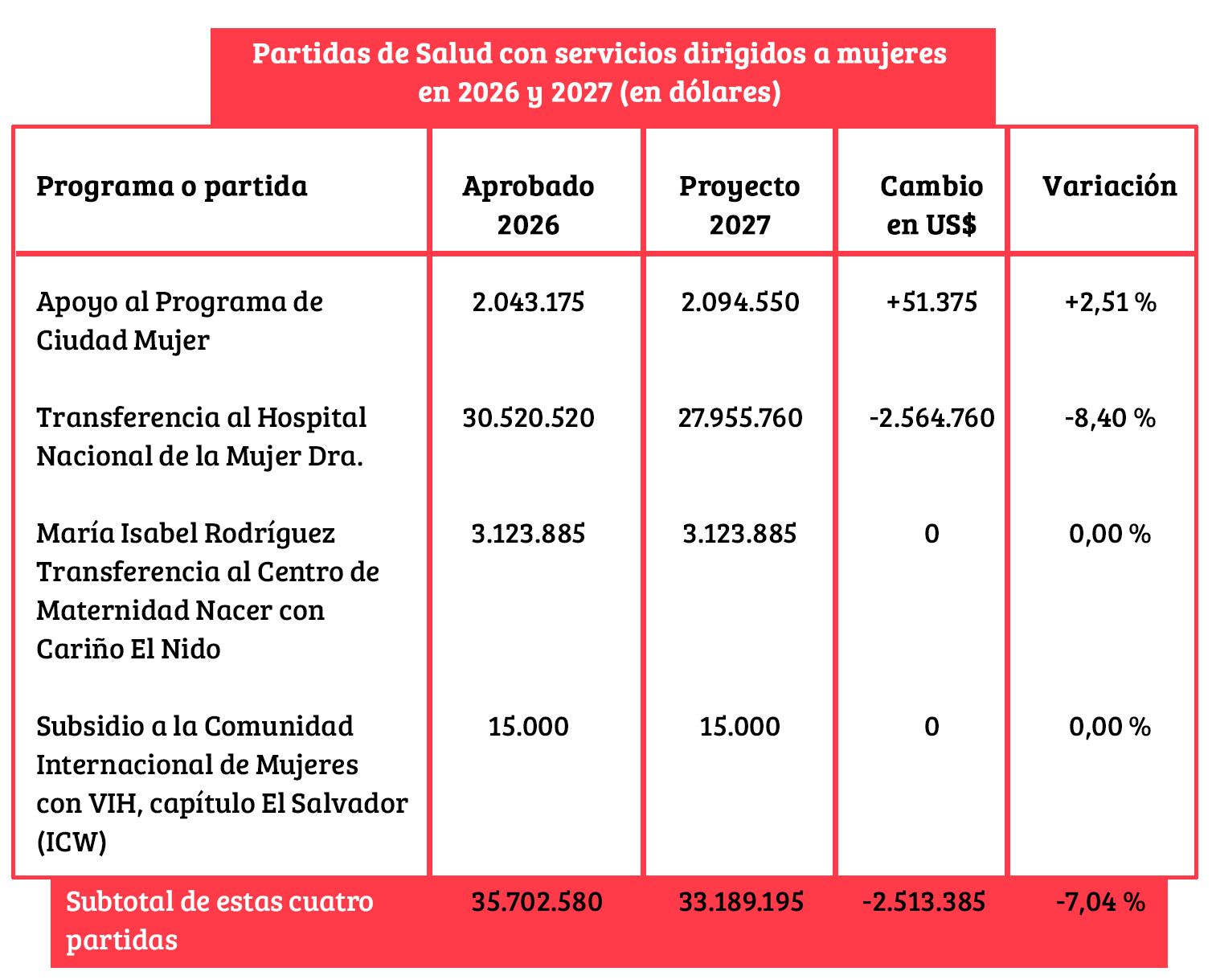
Health budget items with services aimed at women in 2026 and 2027 (in dollars)
Program or budget item | Approved 2026 | Draft 2027 | Change in US$ | Variation
- Support for the Ciudad Mujer Program | Approved 2026: 2,043,175 | Draft 2027: 2,094,550 | Change in US$: +51,375 | Variation: +2.51%
- Transfer to the Dr. María Isabel Rodríguez National Women’s Hospital | Approved 2026: 30,520,520 | Draft 2027: 27,955,760 | Change in US$: -2,564,760 | Variation: -8.40%
- Transfer of the Nacer con Cariño El Nido Maternity Center | Approved 2026: 3,123,885 | Draft 2027: 3,123,885 | Change in US$: 0 | Variation: 0.00%
- Subsidy to the International Community of Women with HIV, El Salvador chapter (ICW) | Approved 2026: 15,000 | Draft 2027: 15,000 | Change in US$: 0 | Variation: 0.00%
- Subtotal of these four budget items | Approved 2026: 35,702,580 | Draft 2027: 33,189,195 | Change in US$: -2,513,385 | Variation: -7.04%
The subtotal of these budget items would decrease by 7.04%, mainly because of the US$2,564,760 reduction in the transfer to the Women’s Hospital. Ciudad Mujer would receive an additional US$51,375, while El Nido and the support for women with HIV would keep their amounts. This comparison makes it possible to identify concrete changes, but it does not represent all health spending that benefits women, nor does it by itself make it possible to conclude how much the care they will receive will change.
To evaluate the reduction in the hospital transfer, it is also necessary to consider the new general line of US$148,816,017 for the acquisition of biologicals and joint purchases of medicines, supplies, reagents, oxygen and medical services. The annex does not separate how much will correspond to care for women. The Government must explain how it will distribute those resources and how it will guarantee the supply and continuity of the Women’s Hospital’s services. The evaluation must consider both its direct allocation and the support it will receive through centralized purchases.
There are other lines that bring together maternal health and care for children. Their amounts are relevant to the sustainability of life, although the budget does not break down how much is allocated exclusively to women. Within Creciendo Saludables Juntos, the promotion of human capital for girls, boys and their mothers would grow by just 0.53%, while the modernization of maternal and child services would decrease by 68.55%. The schedule of the construction works and the loan disbursements may influence these variations; therefore, their effects on the activities, coverage and quality of care must be explained.
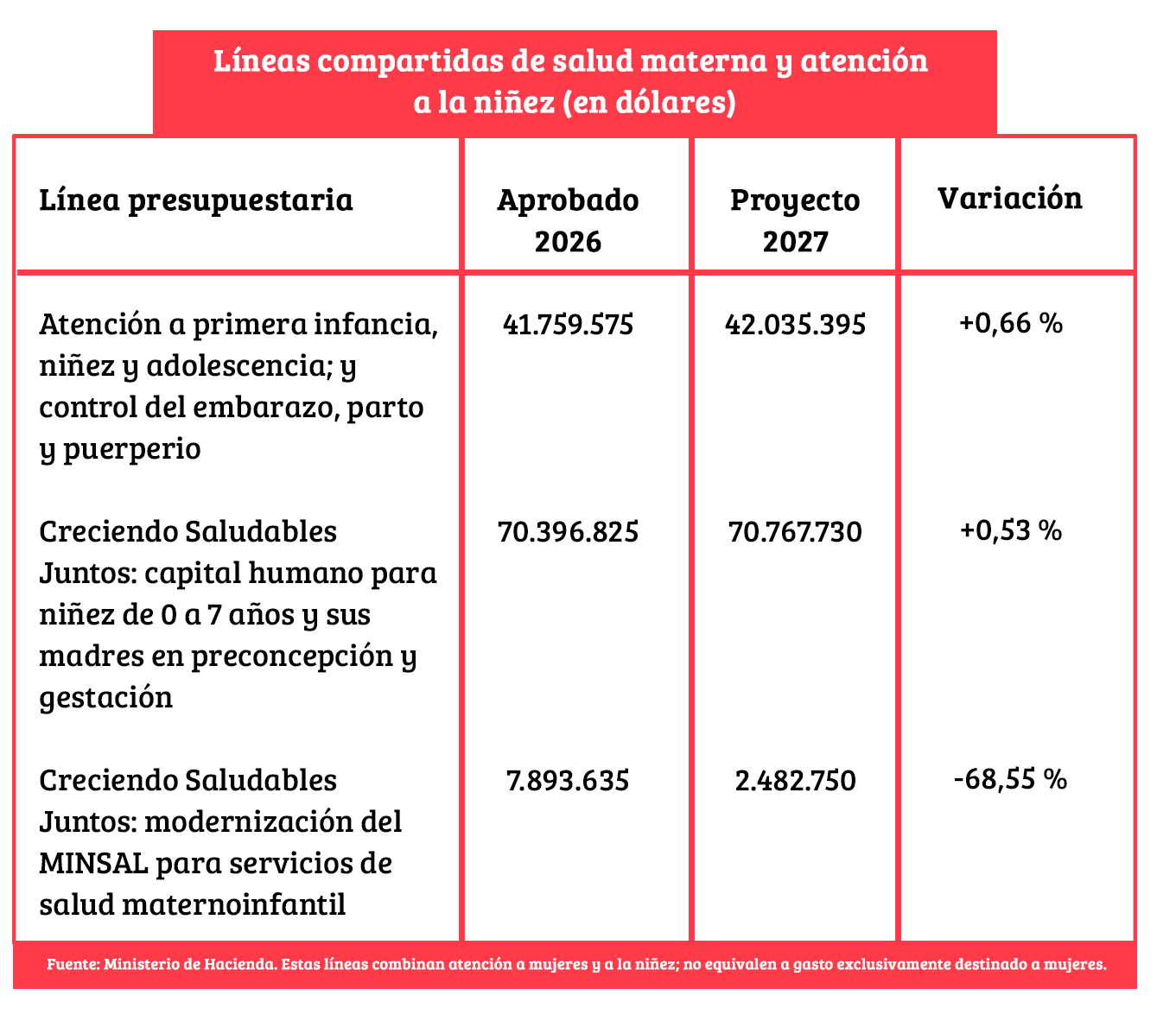
Shared lines for maternal health and care for children (in dollars)
Budget line | Approved 2026 | Draft 2027 | Variation
- Care for early childhood, childhood and adolescence; and monitoring of pregnancy, childbirth and the puerperium | Approved 2026: 41,759,575 | Draft 2027: 42,035,395 | Variation: +0.66%
- Creciendo Saludables Juntos: human capital for children aged 0 to 7 and their mothers during preconception and gestation | Approved 2026: 70,396,825 | Draft 2027: 70,767,730 | Variation: +0.53%
- Creciendo Saludables Juntos: modernization of MINSAL for maternal and child health services | Approved 2026: 7,893,635 | Draft 2027: 2,482,750 | Variation: -68.55%
In addition, the 2027 draft presents a separate line of US$32,260,800 to strengthen the Early Childhood Policy, whose purpose includes maternal and child health. It does not appear as an independent line in the annex approved for 2026. Its incorporation must be accompanied by targets and a clear distribution of resources among the populations served. This amount is included in the Early Childhood Development, Childhood and Adolescence unit; it must not be counted twice when adding up that unit’s budget.
From the perspective of feminist economics, these allocations must be evaluated against women’s needs throughout their lives, including those who perform care work. In the ISDEMU and OPAMSS study, 27% of the people consulted reported chronic illnesses and 89% reported physical and emotional impacts associated with caregiving. Maternity care services are necessary, but the response must also cover prevention, chronic illnesses, care for women with HIV, rehabilitation and psychological support. Ciudad Mujer can contribute to this comprehensive care; to evaluate it, we need to know its coverage, the services available and the needs that remain unmet.
The Health budget must be coordinated with respite services and support in the home and the community that allow women caregivers to rest and have time of their own. Addressing their physical and emotional impacts while the overload persists leaves unresolved one of the problems that the diagnosis identifies. The financing of the National Care Policy must reduce that burden and guarantee women’s right to receive care, in addition to recognizing the work they do to sustain life.
Without water or food, there is no care
The budget debate is taking place amid risks that already demand a response. On October 7, 2026, the Legislative Assembly declared a national emergency for six months due to the meteorological and agricultural drought associated with El Niño. The following day, the World Meteorological Organization reported that there was a probability close to 100% that El Niño would continue until February 2027. This does not mean that there is a 100% probability of drought in every Salvadoran territory or throughout the entire year. It does demand preparedness and monitoring of local forecasts.
The lack of water makes it necessary to devote more time to obtaining it and makes cooking, washing and maintaining hygiene more difficult. Agricultural losses can reduce incomes and make food more expensive or scarce. Heat can also increase care needs. These problems affect households that already sustain care with little support. The climate crisis increases their tasks and can worsen both the lack of income and the lack of time.
The official annexes show a worrying difference. While the general budget would grow by 17.7%, the Agriculture budget would increase by only 0.16% and the Environment budget by 7.45%. In addition, both ministries would have cuts in budget items directly related to climate risks.
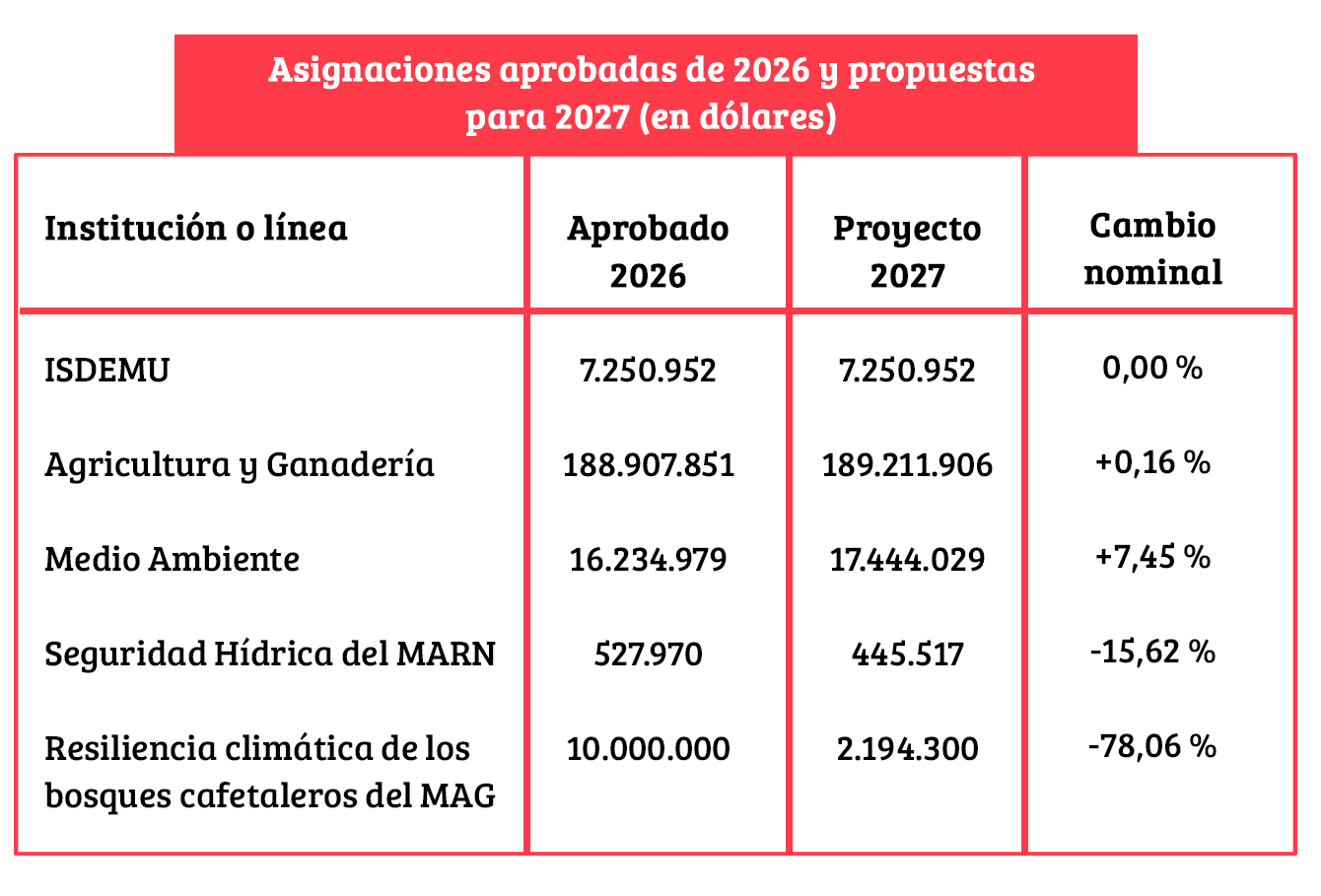
Allocations approved for 2026 and proposed for 2027 (in dollars)
Institution or line | Approved 2026 | Draft 2027 | Nominal change
- ISDEMU | Approved 2026: 7,250,952 | Draft 2027: 7,250,952 | Nominal change: 0.00%
- Agriculture and Livestock | Approved 2026: 188,907,851 | Draft 2027: 189,211,906 | Nominal change: +0.16%
- Environment | Approved 2026: 16,234,979 | Draft 2027: 17,444,029 | Nominal change: +7.45%
- MARN Water Security | Approved 2026: 527,970 | Draft 2027: 445,517 | Nominal change: -15.62%
- MAG climate resilience of coffee forests | Approved 2026: 10,000,000 | Draft 2027: 2,194,300 | Nominal change: -78.06%
MARN’s Water Security budget item would lose US$82,453, that is, 15.6%. By contrast, the Observatory of Hazards and Natural Resources would go from US$1,645,610 to US$2,276,135, an increase of 38.3%. Monitoring hazards is necessary, but resources are also needed to protect water and serve the population. The Government must explain how it will maintain water security functions with less money.
In Agriculture, the program to strengthen the resistance of coffee forests to climate change would fall from US$10 million to US$2,194,300, a reduction of 78.1%. The loan schedule could explain part of the change, but the Government must clarify how it will affect the activities and their results. Furthermore, supporting coffee does not cover the needs of all food crops or of all rural households. The plan against the drought must include various productive activities and families who do not own land.
MARN’s budget does not include all climate spending, nor does Agriculture’s budget bring together all financing related to food. The institutions responsible for water, health and civil protection also participate. Therefore, the Government must publish a joint table showing the resources, the territories served and the costs of the response, without counting the same transfers twice. The cuts noted do not by themselves make it possible to calculate how much money is lacking across the whole country, but they do call into question the coherence of priorities in the face of already recognized risks.
Approving resources is not enough: they must be turned into services
It is not enough to approve resources: they must also be used well. The official 2025 closing report records a budget of US$200 million for the Crecer y Aprender Juntos unit, but only US$30.5 million was executed, equivalent to 15.3%. By contrast, basic education executed 100% of its funds and preschool education, 99.9%.
This case shows that a written allocation does not guarantee that the service reaches the population. However, low execution does not always amount to a deliberate cut: it may be due to problems with management, procurement, disbursements or construction schedules. It is necessary to investigate the causes and correct them. Families must know when they will receive the service and what support they will have while a construction project or a program remains pending.
A care system needs infrastructure, but also salaried staff, supplies, maintenance and continuous services. These day-to-day expenses sustain care and must not automatically be considered unproductive. The evaluation must verify whether people receive timely and dignified care, and whether those who provide care regain time. The execution rate is important, but by itself it does not show how many people receive the service or its quality.
Fiscal justice must sustain life
Fiscal justice links two questions: who contributes money to the State and who benefits from public spending. A care policy requires that those with greater economic capacity contribute more and that the budget reduce inequalities. Consumption taxes weigh more heavily on households that devote almost all their income to basic needs. The unequal distribution of unpaid work must also be considered.
ECLAC and UN Women propose obtaining more resources through more progressive taxes, combating evasion and reviewing tax benefits according to their economic and social effects. Investing in care can create formal employment and make it easier for more women to access paid work, which can also increase public revenue. These benefits must be studied in El Salvador, without automatically copying calculations from other countries. International cooperation can support services, but a permanent obligation needs stable public financing.
Paying the public debt reduces the money available for other needs. The draft allocates US$2,846.9 million to debt in 2027, equivalent to 22.9% of total spending. That is US$413.3 million more than in the budget approved for 2026, an increase of 17%. However, debt would represent a slightly smaller share of the total budget because the latter would grow faster. It is important to distinguish between the increase in dollars and the weight of debt within the budget.
The fiscal debate must clarify how essential services will be protected and what changes in revenue will make it possible to expand them. Reducing public spending by shifting needs onto families does not eliminate the costs: it increases unpaid work, household expenses and loss of income. These effects must be taken into account when evaluating the budget. Caring for people also requires protecting water sources and the commons on which their well-being depends.
What must be demanded before approving the budget
Before approving the budget, we must demand from the Legislative Assembly a financing plan for the National Care Policy with defined costs for 2027. The plan must set coverage and quality targets, as well as reduce the workload of those who provide care. Each responsible institution must report how much money it will receive and which activities it will finance. It must also include respite services, care in the community and in the home, support for autonomy and decent working conditions for care staff. Its expansion must have a financing roadmap through 2030.
The climate response needs available resources to guarantee safe water, the production of and access to food, preventive health care and continuity of care during emergencies. It must include landless families, low-income households and people who need specific support. Access must be guaranteed without discrimination for the different forms of family, LGBTIQ+ people, rural communities, Indigenous peoples and the Afro-descendant population. Women’s organizations and service users must participate in the design and monitoring of these measures.
During execution, the Government must publish how much it allocates, modifies, commits and pays, what services it provides and why any cut or delay occurs. This demand responds to the findings of the analysis: ISDEMU does not identify a specific budget item for the National Care Policy; several allocations linked to women’s health decrease; and there are cuts in lines related to water security and climate resilience. The budget’s credibility will depend on it being possible to follow the money to the services and their results. Families, and especially women, cannot continue to cover, with unpaid work, the gap between a public promise and the care they actually receive. The 2027 budget must assume that responsibility with identifiable resources, timely execution and verifiable results.
Revista La Brújula: https://revistalabrujula.com/2026/10/15/proyecto-de-presupuesto-general-de-la-nacion-2027-una-mirada-desde-la-economia-feminista/
Proyecto de presupuesto general de la Nación 2027: una mirada desde la Economía Feminista.
Julia Evelyn Martínez
El proyecto de presupuesto general de El Salvador para 2027 asciende a US$12.421 millones, un 17,7 % más que el aprobado para 2026. El aumento puede parecer una buena noticia, pero un presupuesto mayor no garantiza por sí solo agua, alimentos, salud ni cuidados.Para saber si mejorará la vida de quienes necesitan apoyo y de quienes lo brindan, es necesario examinar tres asuntos: cuánto se destina realmente a los cuidados, si la respuesta presupuestaria corresponde a la crisis climática y si los recursos podrán convertirse en servicios efectivos.
Desde la economía feminista, los cuidados son las tareas que hacen posible la vida diaria: preparar alimentos, mantener la higiene, atender enfermedades y acompañar a quienes necesitan apoyo. Incluyen servicios pagados y trabajo no remunerado en los hogares. Cuando faltan servicios públicos, las familias cubren esa ausencia con dinero, tiempo y esfuerzo. Esa carga recae sobre todo en las mujeres y limita sus oportunidades de estudiar, obtener ingresos, descansar y participar en su comunidad.
Los anexos presupuestarios de ISDEMU, Salud, Agricultura y Medio Ambiente no permiten verificar que existan recursos suficientes y coordinados para aplicar la Política Nacional de Cuidados ni para responder a las cargas que agrava la crisis climática. Aunque contienen fondos relacionados con ambos temas, estos aparecen dispersos y sin un desglose que permita medir su suficiencia o su contribución a una política integral. Esta falta de trazabilidad no demuestra que no haya acciones financiadas, pero sí impide evaluarlas. El Gobierno debe publicar el costo de sus compromisos y señalar qué partidas financiarán cada acción.
Este análisis examina primero el financiamiento de la Política Nacional de Cuidados y el presupuesto de ISDEMU; después revisa las asignaciones de Salud, Agricultura y Medio Ambiente; y finalmente aborda la ejecución del gasto y las fuentes de financiamiento. El objetivo es determinar si el presupuesto articula recursos suficientes, identificables y ejecutables para sostener la vida.
La política de cuidados necesita presupuesto
El Salvador cuenta con la Política Nacional de Corresponsabilidad de los Cuidados 2022-2030. Su meta es garantizar el derecho a recibir y brindar cuidados con calidad, igualdad y sin discriminación. Propone ampliar los servicios y la infraestructura, profesionalizar el trabajo de cuidados y apoyar el bienestar de quienes cuidan. ISDEMU tiene responsabilidades de coordinación técnica y operativa.
La política establece que cada institución responsable debe incluir en su presupuesto anual los recursos necesarios para cumplirla. La cooperación internacional puede apoyar este esfuerzo, pero no sustituirlo. Por eso, el Gobierno debe indicar qué actividades financiará, a cuántas personas atenderá y cómo distribuirá los recursos entre instituciones y territorios. Una partida de nombre amplio puede incluir acciones de cuidados, pero es necesario saber cuánto dinero se destina realmente a ellas.
Crecer Juntos contribuye a la atención de la primera infancia. Sin embargo, la política de cuidados también incluye a niñas, niños y adolescentes de 8 a 18 años; personas adultas que necesitan apoyo; y personas cuidadoras, reciban o no un salario.
El Estudio Nacional de los Cuidados de ISDEMU y OPAMSS, publicado en julio de 2025, fue exploratorio y se realizó en 34 distritos, 28 de ellos del Área Metropolitana de San Salvador. Entre las personas encuestadas, el 90 % eran mujeres, el 87 % no recibía ingresos por el trabajo de cuidados y el 89 % informó afectaciones en su bienestar físico y emocional asociadas a estas tareas.
ISDEMU mantiene un presupuesto limitado
El anexo oficial de ISDEMU, propone US$7.250.952 para 2027: exactamente la misma cantidad aprobada para 2026. Además, son US$4.353.730 menos que los US$11.604.682 aprobados en 2024, una reducción nominal del 37,5 %. Esta caída debe analizarse junto con las funciones, la cobertura y el personal que ISDEMU necesita para garantizar derechos. Si los precios suben, mantener la misma asignación también reduce lo que la institución puede comprar y hacer.
Para 2027, el presupuesto asigna US$1.738.867 a Dirección y Administración Institucional y US$5.512.085 a Gestión para el Desarrollo Integral de las Mujeres. Esta segunda unidad distribuye US$573.745 para políticas públicas sobre derechos de las mujeres; US$1.185.220 para atención especializada; US$3.703.120 para autonomía y empoderamiento; y US$50.000 para cumplir la sentencia del caso El Mozote.
En este anexo no aparece una partida específica para la Política Nacional de Cuidados. Esto no significa que no exista ninguna acción de cuidados dentro de otras partidas generales, pero impide saber cuánto dinero se destina a la política. Sin un desglose, no es posible conocer los recursos disponibles para coordinarla, ampliar servicios o apoyar a quienes cuidan.
ISDEMU no concentra todo el financiamiento de los cuidados. La política reparte responsabilidades entre varias instituciones, por lo que su presupuesto no representa todo el gasto nacional en esta materia. Aun así, ofrece una señal importante: la institución que debe ayudar a coordinar la política tiene recursos limitados y no presenta una partida que permita dar seguimiento específico al gasto en cuidados.
La autonomía económica de las mujeres también depende de los cuidados. Una capacitación o un proyecto productivo puede abrir oportunidades, pero será menos útil si una mujer debe atender sola a una persona que necesita apoyo. Los servicios de cuidados, el acceso al agua y el transporte adecuado son condiciones necesarias para aprovechar esas oportunidades. Deben recibir fondos públicos y no depender del trabajo sin pago de otra mujer.
La salud de las mujeres requiere recursos y atención integral
El proyecto de Salud para 2027 mantiene partidas dirigidas a las mujeres, pero sus cambios deben examinarse junto con los servicios que permitirán prestar. El presupuesto total del Ministerio de Salud pasaría de US$1.345.468.319 aprobados para 2026 a US$1.493.139.321 propuestos para 2027, un aumento nominal del 10,98 %. Ese incremento general no se distribuye de la misma manera entre los programas. La comparación distingue asignaciones aprobadas y propuestas; ninguna de las dos demuestra cuánto se ejecutará ni cuántas mujeres recibirán atención.
Partidas de Salud con servicios dirigidos a mujeres en 2026 y 2027 (en dólares)
Programa o partida | Aprobado 2026 | Proyecto 2027 | Cambio en US$ | Variación
- Apoyo al Programa de Ciudad Mujer | Aprobado 2026: 2.043.175 | Proyecto 2027: 2.094.550 | Cambio en US$: +51.375 | Variación: +2,51 %
- Transferencia al Hospital Nacional de la Mujer Dra. María Isabel Rodríguez | Aprobado 2026: 30.520.520 | Proyecto 2027: 27.955.760 | Cambio en US$: -2.564.760 | Variación: -8,40 %
- Transferencia del Centro de Maternidad Nacer con Cariño El Nido | Aprobado 2026: 3.123.885 | Proyecto 2027: 3.123.885 | Cambio en US$: 0 | Variación: 0,00 %
- Subsidio a la Comunidad Internacional de Mujeres con VIH, capítulo El Salvador (ICW) | Aprobado 2026: 15.000 | Proyecto 2027: 15.000 | Cambio en US$: 0 | Variación: 0,00 %
- Subtotal de estas cuatro partidas | Aprobado 2026: 35.702.580 | Proyecto 2027: 33.189.195 | Cambio en US$: -2.513.385 | Variación: -7,04 %
El subtotal de estas partidas disminuiría un 7,04 %, principalmente por los US$2.564.760 menos en la transferencia al Hospital de la Mujer. Ciudad Mujer recibiría US$51.375 adicionales, mientras El Nido y el apoyo a mujeres con VIH conservarían sus montos. Esta comparación permite identificar cambios concretos, pero no representa todo el gasto sanitario que beneficia a las mujeres ni permite concluir por sí sola cuánto cambiará la atención que recibirán.
Para evaluar la reducción de la transferencia hospitalaria también hay que considerar la nueva línea general de US$148.816.017 para adquisición de biológicos y compras conjuntas de medicamentos, insumos, reactivos, oxígeno y servicios médicos. El anexo no separa cuánto corresponderá a la atención de mujeres. El Gobierno debe explicar cómo distribuirá esos recursos y cómo garantizará el abastecimiento y la continuidad de los servicios del Hospital de la Mujer. La evaluación debe considerar tanto su asignación directa como los apoyos que recibirá mediante compras centralizadas.
Hay otras líneas que reúnen salud materna y atención a la niñez. Sus montos son relevantes para la sostenibilidad de la vida, aunque el presupuesto no desglosa cuánto se destina exclusivamente a mujeres. Dentro de Creciendo Saludables Juntos, la promoción del capital humano para niñas, niños y sus madres crecería apenas un 0,53 %, mientras la modernización de servicios maternoinfantiles disminuiría un 68,55 %. El calendario de las obras y los desembolsos del préstamo puede influir en estas variaciones; por eso deben explicarse sus efectos sobre las actividades, la cobertura y la calidad de la atención.
Líneas compartidas de salud materna y atención a la niñez (en dólares)
Línea presupuestaria | Aprobado 2026 | Proyecto 2027 | Variación
- Atención a primera infancia, niñez y adolescencia; y control del embarazo, parto y puerperio | Aprobado 2026: 41.759.575 | Proyecto 2027: 42.035.395 | Variación: +0,66 %
- Creciendo Saludables Juntos: capital humano para niñez de 0 a 7 años y sus madres en preconcepción y gestación | Aprobado 2026: 70.396.825 | Proyecto 2027: 70.767.730 | Variación: +0,53 %
- Creciendo Saludables Juntos: modernización del MINSAL para servicios de salud maternoinfantil | Aprobado 2026: 7.893.635 | Proyecto 2027: 2.482.750 | Variación: -68,55 %
Además, el proyecto de 2027 presenta una línea separada de US$32.260.800 para fortalecer la Política para la Primera Infancia, cuyo propósito incluye salud maternoinfantil. No aparece como línea independiente en el anexo aprobado para 2026. Su incorporación debe acompañarse de metas y de una distribución clara de recursos entre las poblaciones atendidas. Este monto está incluido en la unidad de Desarrollo Infantil Temprano, Niñez y Adolescencia; no debe contarse dos veces al sumar el presupuesto de esa unidad.
Desde la economía feminista, estas asignaciones deben evaluarse frente a las necesidades de las mujeres durante toda la vida, incluyendo a quienes realizan trabajo de cuidados. En el estudio de ISDEMU y OPAMSS, el 27 % de las personas consultadas reportó enfermedades crónicas y el 89 % informó afectaciones físicas y emocionales asociadas a cuidar. Las atenciones de maternidad son necesarias, pero la respuesta también debe cubrir prevención, enfermedades crónicas, atención a mujeres con VIH, rehabilitación y apoyo psicológico. Ciudad Mujer puede contribuir a esta atención integral; para evaluarla necesitamos conocer su cobertura, los servicios disponibles y las necesidades que siguen pendientes.
El presupuesto de Salud debe articularse con servicios de relevo y apoyos en el hogar y la comunidad que permitan a las cuidadoras descansar y disponer de tiempo propio. Atender sus afectaciones físicas y emocionales mientras persiste la sobrecarga deja sin resolver uno de los problemas que el diagnóstico identifica. El financiamiento de la Política Nacional de Cuidados debe reducir esa carga y garantizar el derecho de las mujeres a recibir cuidados, además de reconocer el trabajo que realizan para sostener la vida.
Sin agua ni alimentos no hay cuidados
El debate presupuestario ocurre en medio de riesgos que ya exigen respuesta. El 7 de octubre de 2026, la Asamblea Legislativa declaró por seis meses una emergencia nacional debido a la sequía meteorológica y agrícola asociada a El Niño. Al día siguiente, la Organización Meteorológica Mundial informó que había una probabilidad cercana al 100 % de que El Niño continuara hasta febrero de 2027. Esto no significa que exista un 100 % de probabilidad de sequía en cada territorio salvadoreño ni durante todo el año. Sí exige preparación y seguimiento de los pronósticos locales.
La falta de agua obliga a dedicar más tiempo a conseguirla y dificulta cocinar, lavar y mantener la higiene. Las pérdidas agrícolas pueden reducir los ingresos y volver los alimentos más caros o escasos. El calor también puede aumentar las necesidades de atención. Estos problemas afectan a hogares que ya sostienen los cuidados con pocos apoyos. La crisis climática aumenta sus tareas y puede agravar tanto la falta de ingresos como la falta de tiempo.
Los anexos oficiales muestran una diferencia preocupante. Mientras el presupuesto general crecería un 17,7 %, el de Agricultura aumentaría apenas un 0,16 % y el de Medio Ambiente, un 7,45 %. Además, ambos ministerios tendrían recortes en partidas relacionadas directamente con los riesgos climáticos.
Asignaciones aprobadas de 2026 y propuestas para 2027 (en dólares)
Institución o línea | Aprobado 2026 | Proyecto 2027 | Cambio nominal
- ISDEMU | Aprobado 2026: 7.250.952 | Proyecto 2027: 7.250.952 | Cambio nominal: 0,00 %
- Agricultura y Ganadería | Aprobado 2026: 188.907.851 | Proyecto 2027: 189.211.906 | Cambio nominal: +0,16 %
- Medio Ambiente | Aprobado 2026: 16.234.979 | Proyecto 2027: 17.444.029 | Cambio nominal: +7,45 %
- Seguridad Hídrica del MARN | Aprobado 2026: 527.970 | Proyecto 2027: 445.517 | Cambio nominal: -15,62 %
- Resiliencia climática de los bosques cafetaleros del MAG | Aprobado 2026: 10.000.000 | Proyecto 2027: 2.194.300 | Cambio nominal: -78,06 %
La partida de Seguridad Hídrica del MARN perdería US$82.453, es decir, un 15,6 %. En cambio, el Observatorio de Amenazas y Recursos Naturales pasaría de US$1.645.610 a US$2.276.135, un aumento del 38,3 %. Vigilar las amenazas es necesario, pero también se necesitan recursos para proteger el agua y atender a la población. El Gobierno debe explicar cómo mantendrá las funciones de seguridad hídrica con menos dinero.
En Agricultura, el programa para fortalecer la resistencia de los bosques cafetaleros ante el cambio climático bajaría de US$10 millones a US$2.194.300, una reducción del 78,1 %. El calendario del préstamo podría explicar parte del cambio, pero el Gobierno debe aclarar cómo afectará las actividades y sus resultados. Además, apoyar al café no cubre las necesidades de todos los cultivos alimentarios ni de todos los hogares rurales. El plan contra la sequía debe incluir distintas actividades productivas y a las familias que no poseen tierra.
El presupuesto del MARN no incluye todo el gasto climático, ni el de Agricultura reúne todo el financiamiento relacionado con los alimentos. También participan las instituciones responsables del agua, la salud y la protección civil. Por eso, el Gobierno debe publicar un cuadro conjunto que muestre los recursos, los territorios atendidos y los costos de la respuesta, sin contar dos veces las mismas transferencias. Los recortes señalados no permiten calcular por sí solos cuánto dinero falta en todo el país, pero sí ponen en duda la coherencia de las prioridades ante riesgos ya reconocidos.
Aprobar recursos no basta: deben convertirse en servicios
No basta con aprobar recursos: también deben utilizarse bien. El informe oficial de cierre de 2025 registra un presupuesto de US$200 millones para la unidad Crecer y Aprender Juntos, pero solo se ejecutaron US$30,5 millones, equivalentes al 15,3 %. En cambio, educación básica ejecutó el 100 % de sus fondos y educación parvularia, el 99,9 %.
Este caso muestra que una asignación escrita no garantiza que el servicio llegue a la población. Sin embargo, una baja ejecución no siempre equivale a un recorte deliberado: puede deberse a problemas de gestión, compras, desembolsos o calendarios de obras. Es necesario investigar las causas y corregirlas. Las familias deben saber cuándo recibirán el servicio y qué apoyo tendrán mientras una obra o un programa siga pendiente.
Un sistema de cuidados necesita infraestructura, pero también personal con salario, insumos, mantenimiento y servicios continuos. Estos gastos diarios sostienen la atención y no deben considerarse automáticamente improductivos. La evaluación debe comprobar si las personas reciben atención oportuna y digna, y si quienes cuidan recuperan tiempo. El porcentaje de ejecución es importante, pero por sí solo no muestra cuántas personas reciben el servicio ni su calidad.
La justicia fiscal debe sostener la vida
La justicia fiscal une dos preguntas: quién aporta dinero al Estado y quién se beneficia del gasto público. Una política de cuidados requiere que quienes tienen mayor capacidad económica contribuyan más y que el presupuesto reduzca las desigualdades. Los impuestos al consumo pesan más sobre los hogares que destinan casi todos sus ingresos a necesidades básicas. También debe considerarse la distribución desigual del trabajo no remunerado.
CEPAL y ONU Mujeres proponen obtener más recursos mediante impuestos más progresivos, combatir la evasión y revisar los beneficios tributarios según sus efectos económicos y sociales. Invertir en cuidados puede crear empleo formal y facilitar que más mujeres accedan a trabajos remunerados, lo que también puede aumentar los ingresos públicos. Estos beneficios deben estudiarse en El Salvador, sin copiar automáticamente cálculos de otros países. La cooperación internacional puede apoyar los servicios, pero una obligación permanente necesita financiamiento público estable.
El pago de la deuda pública reduce el dinero disponible para otras necesidades. El proyecto destina US$2.846,9 millones a la deuda en 2027, equivalentes al 22,9 % del gasto total. Son US$413,3 millones más que en el presupuesto aprobado para 2026, un aumento del 17 %. Sin embargo, la deuda representaría una proporción ligeramente menor del presupuesto total porque este crecería más rápido. Es importante distinguir entre el aumento en dólares y el peso de la deuda dentro del presupuesto.
El debate fiscal debe aclarar cómo se protegerán los servicios esenciales y qué cambios en los ingresos permitirán ampliarlos. Reducir el gasto público trasladando necesidades a las familias no elimina los costos: aumenta el trabajo no remunerado, los gastos del hogar y la pérdida de ingresos. Estos efectos deben tomarse en cuenta al evaluar el presupuesto. Cuidar a las personas también exige proteger las fuentes de agua y los bienes comunes de los que depende su bienestar.
Qué debe exigirse antes de aprobar el presupuesto
Antes de aprobar el presupuesto, debemos exigir a la Asamblea Legislativa un plan de financiamiento para la Política Nacional de Cuidados con costos definidos para 2027. El plan debe fijar metas de cobertura y calidad, así como reducir la carga de trabajo de quienes cuidan. Cada institución responsable debe informar cuánto dinero recibirá y qué actividades financiará. También debe incluir servicios de relevo, atención en la comunidad y en el hogar, apoyos para la autonomía y condiciones laborales dignas para el personal de cuidados. Su ampliación debe contar con una ruta de financiamiento hasta 2030.
La respuesta climática necesita recursos disponibles para garantizar agua segura, producción y acceso a alimentos, prevención en salud y continuidad de los cuidados durante las emergencias. Debe incluir a las familias sin tierra, los hogares con bajos ingresos y las personas que necesitan apoyos específicos. El acceso debe garantizarse sin discriminación para las distintas formas de familia, las personas LGBTIQ+, las comunidades rurales, los pueblos originarios y la población afrodescendiente. Las organizaciones de mujeres y las personas usuarias deben participar en el diseño y la vigilancia de estas medidas.
Durante la ejecución, el Gobierno debe publicar cuánto asigna, modifica, compromete y paga, qué servicios presta y por qué se produce cualquier recorte o retraso. Esta exigencia responde a los hallazgos del análisis: ISDEMU no identifica una partida específica para la Política Nacional de Cuidados; varias asignaciones vinculadas con la salud de las mujeres disminuyen; y existen recortes en líneas relacionadas con la seguridad hídrica y la resiliencia climática. La credibilidad del presupuesto dependerá de que sea posible seguir el dinero hasta los servicios y sus resultados. Las familias, y especialmente las mujeres, no pueden continuar cubriendo con trabajo no remunerado la distancia entre una promesa pública y la atención que realmente reciben. El presupuesto 2027 debe asumir esa responsabilidad con recursos identificables, ejecución oportuna y resultados verificables.
Revista La Brújula: https://revistalabrujula.com/2026/10/15/proyecto-de-presupuesto-general-de-la-nacion-2027-una-mirada-desde-la-economia-feminista/