
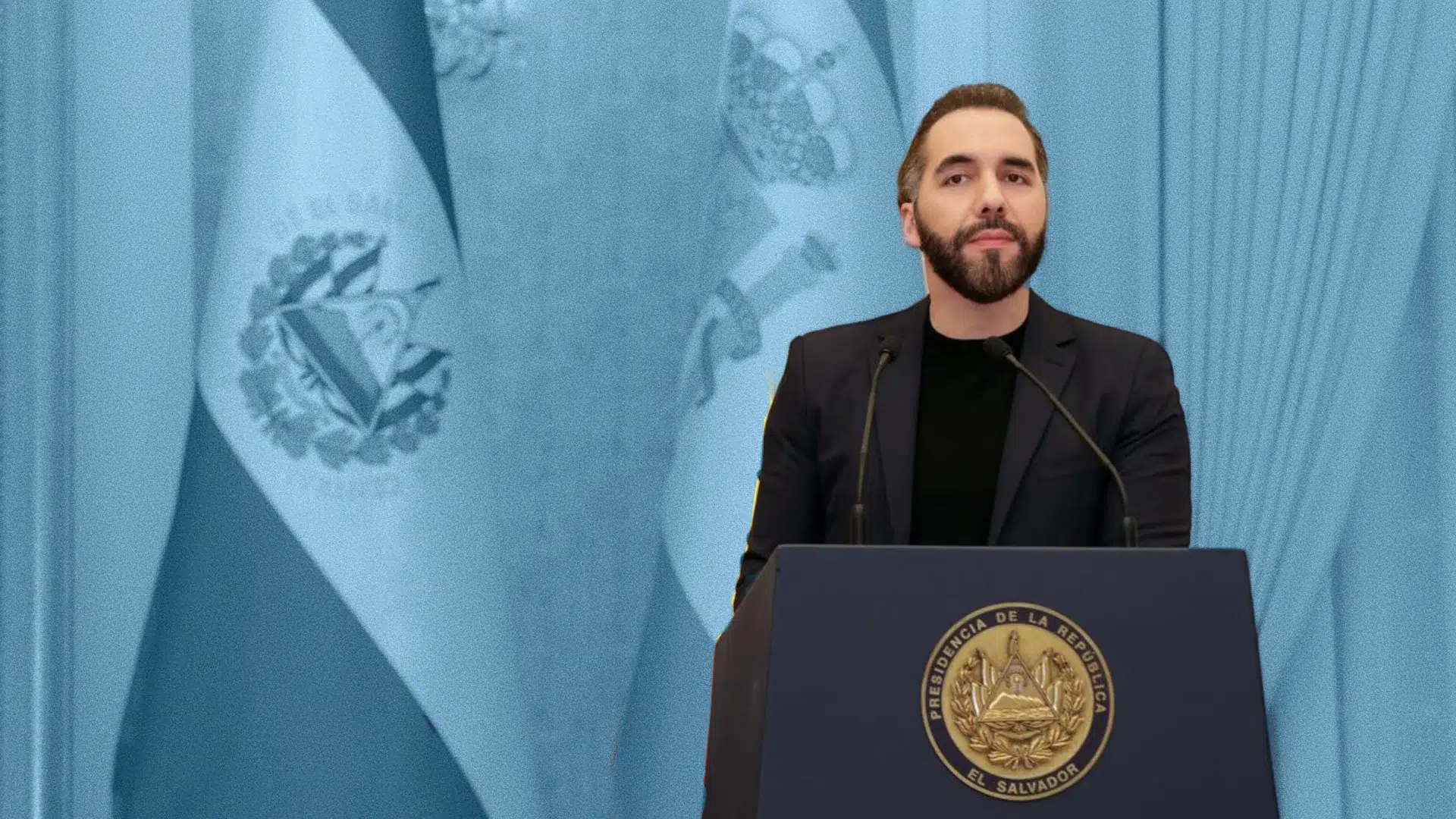
Nayib Bukele asserted that his Government is evaluating whether to implement a “plan” to grant early release to approximately 50% of the people imprisoned for alleged collaboration with gang structures. He stated this during a press conference this past October 13, in response to the insistence of a journalist who had to raise her voice to question him in the face of blocking by Presidential House staff.
The journalist asked the president to explain the posts by his brother Ibrahim Bukele, who stated on his X profile that there is “an independent team reviewing case by case” the files of people detained and deceased in state custody, during the more than four and a half years that the state of exception has been in force.
Bukele clarified that his brother does not hold any formal role on any commission and asserted that his Government has established a criterion to measure the “level of collaboration” with the gangs, although he offered no details and did not explain what that criterion is. He only gave the example that collaborating to bury a corpse, which, according to him, deserves “almost life imprisonment,” is not the same as serving as a lookout (“poste”) under coercion.
“If he collaborated by warning that the Police were coming, a young man, they would put him at the edge of the passageway and he would warn when the Police were coming (…) He is guilty, sure, but how guilty is he?” Bukele stated.
Based on this premise, the president hinted that he is planning a prison-release benefit for thousands of alleged gang collaborators.
“We have a plan, and I mentioned it the other time, I think it would benefit more or less 50% of the prisoners in El Salvador, who have collaborated with gangs, with an early release; that is, he is guilty, but release him conditionally. That is, release him with monitoring, with conditional release,” he revealed at the conference that had been convened to announce the signing of a memorandum of understanding for a private investment of 2,900 million dollars in energy and water infrastructure by the Spanish group Cox.

These statements by Bukele mark a turning point in his “war against the gangs” discourse that he and his officials have maintained since the establishment of the state of exception on March 27, 2022. Since that date, the crime of illicit associations has been the main tool of the Office of the Attorney General of the Republic (FGR) to imprison more than 93,162 alleged “terrorists,” according to the arguments used to justify the 55 extensions of the state of exception to date.
Although Bukele and his Minister of Security, Gustavo Villatoro, had already acknowledged a “margin of error” in the arrests in the past and announced the release of thousands of innocent people, the government maintained a warlike and inflexible narrative against those arrested, asserting that they were guilty even without having been convicted at trial.
Various reports by civil society organizations point out that the detentions have been carried out arbitrarily and without prior investigation. The Police and the Army, under orders from the Executive, stigmatize and detain people for having tattoos, even if they are artistic; for having dark skin or for living in impoverished communities. As a result, thousands of those arrested have spent years in pretrial detention, without trial, and among them are innocent people. The situation is aggravated by total isolation, since currently no person deprived of liberty in El Salvador, neither those detained under the state of exception nor those detained for common crimes, has the right to family visits or visits from their lawyers.
Bukele acknowledged that there are differences between those who participated directly in serious crimes—such as complicity in homicides—and those who were forced to carry out surveillance tasks, who are known in gang slang as “postes.”
“We come from a country where collaborating with the gangs was not so unusual,” he said to justify the arrests under the state of exception, and added that, according to his own calculation, if the State set out to arrest everyone who had ever collaborated with these structures, “we would have to arrest 20% of the population.”
The president added that this possible conditional release of the alleged “gang collaborators” will be evaluated by a “commission” or “system” not yet detailed in legal terms. Setting up a commission to review the cases of the people arrested is a recommendation that human rights organizations have made repeatedly, above all because the civilian population’s “collaboration” with the gangs was almost always through coercion and under death threats, and not voluntary.
“What we want is that, taking into account that we come from a country where violence was the day-to-day and living among the gangs, which were the true government of this country and the true dictatorship of this country, these people lived under that yoke and it is not the same to be part of those who imposed that yoke on the population or to simply survive within that reality.”
Under these “special conditions,” which human rights organizations pointed out for decades in various reports, Bukele argued that it is possible to “make an exception for a large number” of the people detained.
Abraham Ábrego, legal director of the organization Cristosal, told GatoEncerrado that Bukele’s proposal reflects an authoritarian scheme, because the responsibility for determining guilt, the seriousness of participation or granting precautionary measures lies with the judges and the judicial system, and not with the Executive Branch.
Likewise, he said that Bukele did not talk about the innocent people, but rather maintains the legal status of guilty for the possible beneficiaries, instead of reviewing whether there was a judicial error requiring the revocation of the conviction and the recognition of innocence. Ábrego emphasizes that granting conditional release does not constitute a true correction nor does it restore justice, since the person continues to appear as guilty before the law.
Ábrego warns that the Attorney General’s Office currently groups thousands of people together in mass trials and a collective responsibility is imposed that nullifies the individualization of the evidence and the defense.
Since early 2026, Salvadoran courts have begun convicting people detained during the state of exception in mass trials, with a single public defender representing up to 300 people and under total secrecy. According to Zaira Navas, also a lawyer with Cristosal, as of October 2026, some 5,000 people have been tried in this way. And, with no evidence beyond the word of a hidden witness who receives benefits in exchange for collectively accusing hundreds of people, sentences of 30, 45 and even 60 years in prison are being handed down.
To carry out a transparent screening, Ábrego supports the recommendation of the GIPES report to create a case review commission that is independent, transparent and includes civil society participation, which would require legal reforms. As a historical precedent, he cites the experience of Peru after the regime of Alberto Fujimori, where an independent commission reviewed case by case the files of people prosecuted for terrorism and promoted their release and reparation after verifying the lack of evidence.
Ábrego believes that Bukele’s statements mark a turning point in the Government’s narrative, by moving from denying the existence of arbitrary detentions or defending mass convictions to openly talking about early release schemes. This probably means the erosion of the legitimacy of the regime and of the Government’s image; and it reflects more of a position of weakness, which they seek to change in an electoral pre-campaign context.
GatoEncerrado: https://gatoencerrado.news/2026/10/14/bukele-anuncia-un-plan-para-liberar-a-colaboradores-de-pandillas/
Bukele anuncia plan para liberar de forma anticipada a supuestos colaboradores de las pandillas capturados en el régimen
Por Beatriz Benítez
Nayib Bukele aseguró que su Gobierno evalúa implementar un “plan” para otorgar una liberación anticipada a aproximadamente el 50 % de las personas recluidas por presunta colaboración con las estructuras de pandillas. Así lo declaró durante una conferencia de prensa, del pasado 13 de octubre, en respuesta a la insistencia de una periodista que debió levantar la voz para interpelarlo ante los bloqueos del personal de Casa Presidencial.
La periodista pidió al mandatario que explicara las publicaciones de su hermano Ibrahim Bukele, quien afirmó en su perfil en X que existe “un equipo independiente revisando caso por caso” los expedientes de las personas detenidas y fallecidas bajo custodia estatal, durante los más de cuatro años y medio de vigencia del régimen de excepción.
Bukele aclaró que su hermano no ejerce ningún rol formal en ninguna comisión y aseguró que su Gobierno ha establecido un criterio para medir el “nivel de colaboración” con las pandillas, aunque no ofreció detalles ni explicó cuál es ese criterio. Solo ejemplificó que no es lo mismo colaborar para enterrar un cadáver, lo cual, según él, merece “casi cadena perpetua”, que fungir como vigilante (“poste”) bajo coerción.
“Si colaboró en avisar que ahí venía la Policía, un muchacho, que lo ponían en la orilla del pasaje y él avisaba cuando venía la Policía (…) Es culpable, pues, pero ¿qué tan culpable es?”, declaró Bukele.
A partir de esta premisa, el mandatario insinuó que planea un beneficio de excarcelación para miles de supuestos colaboradores de las pandillas.
“Nosotros tenemos un plan, y yo lo mencioné la otra vez, creo que beneficiaría más o menos a un 50 % de los presos que hay en El Salvador, que han colaborado con pandillas, con una liberación anticipada; o sea, es culpable, pero liberarlo condicionalmente. O sea, liberarlo con monitoreo, con liberación condicional”, reveló en la conferencia que había sido convocada para anunciar la firma de un memorándum de entendimiento para una inversión privada de 2,900 millones de dólares en infraestructura de energía y agua por parte del grupo español Cox.
Estas declaraciones de Bukele marcan un punto de inflexión en su discurso de “guerra contra las pandillas” que él y sus funcionarios han mantenido desde la instauración del régimen de excepción, el 27 de marzo de 2022. A partir de esa fecha, el delito de agrupaciones ilícitas ha sido la principal herramienta de la Fiscalía General de la República (FGR) para encarcelar a más de 93,162 supuestos “terroristas”, según los argumentos para justificar las 55 prórrogas del régimen que van hasta la fecha.
A pesar de que Bukele y su ministro de Seguridad, Gustavo Villatoro, ya reconocieron en el pasado un “margen de error” en las capturas y anunciaron la liberación de miles de personas inocentes, el gobierno mantenía una narrativa bélica e inflexible contra las personas capturadas, asegurando que eran culpables incluso sin haber sido vencidas en un juicio.
Diversos informes de organizaciones de sociedad civil señalan que las detenciones se han realizado de forma arbitraria y sin investigación previa. La Policía y el Ejército, bajo las órdenes del Ejecutivo, estigmatizan y detienen a personas por tener tatuajes, aunque sean artísticos; por tener la piel morena o por vivir en comunidades empobrecidas. Como resultado, miles de los capturados han pasado años en detención provisional, sin juicio, y entre ellos hay inocentes. La situación se agrava por el aislamiento total, ya que en la actualidad ninguna persona privada de libertad en El Salvador, ni las detenidas por el régimen de excepción ni por delitos comunes, tiene derecho a visitas familiares o de sus abogados.
Bukele reconoció que hay diferencias entre quienes participaron directamente en delitos graves —como la complicidad en homicidios— de aquellos que fueron obligados a realizar labores de vigilancia, conocidos en la jerga de las pandillas como “postes”.
“Venimos de un país donde colaborar con las pandillas no era tan inusual”, dijo para justificar las capturas en el régimen, y agregó que según su propio cálculo, si el Estado se propusiera capturar a todos los que alguna vez colaboraron con estas estructuras, “tuviéramos que arrestar al 20 % de la población”.
El gobernante añadió que esta posible liberación condicional de los supuestos “colaboradores de las pandillas” será evaluada por una “comisión” o “sistema” aún no detallado jurídicamente. La instalación de una comisión que revise los casos de las personas capturadas es una recomendación que organizaciones de derechos humanos han hecho en reiteradas ocasiones, sobre todo porque la “colaboración” de la población civil con las pandillas casi siempre fue por coacción y bajo amenazas de muerte, y no de forma voluntaria.
“Lo que queremos es de que tomando en cuenta que venimos de un país donde la violencia era el día a día y convivir entre las pandillas, que eran el verdadero gobierno de este país y la verdadera dictadura de este país, estas personas vivían bajo ese yugo y no es lo mismo ser parte de los que aplicaban ese yugo a la población o simplemente sobrevivir dentro de esa realidad”.
Bajo estas “condiciones especiales”, que las organizaciones de derechos humanos señalaron durante décadas en diferentes informes, Bukele argumentó que se puede “hacer una excepción con una gran cantidad” de las personas detenidas.
Abraham Ábrego, director legal de la organización Cristosal, dijo a GatoEncerrado que el planteamiento de Bukele refleja un esquema autoritario, porque a quien le corresponde determinar la culpabilidad, la gravedad de participación o conceder medidas cautelares es a los jueces y al sistema judicial, y no al Poder Ejecutivo.
Asimismo, dijo que Bukele no habló de las personas inocentes, sino que mantiene el estatus legal de culpables para los posibles beneficiados, en lugar de revisar si existió un error judicial que exija la revocación de la condena y el reconocimiento de inocencia. Ábrego enfatiza que otorgar una liberación condicional no constituye una verdadera corrección ni restituye la justicia, ya que la persona sigue figurando como culpable ante la ley.
Ábrego advierte que actualmente la Fiscalía agrupa a miles de personas en juicios masivos y se impone una responsabilidad colectiva que anula la individualización de las pruebas y la defensa.
Desde inicios de 2026, los tribunales salvadoreños empezaron a condenar a personas detenidas durante el régimen en juicios masivos, con un solo defensor público representando hasta a 300 personas y bajo reserva total. Según Zaira Navas, también abogada de Cristosal, hasta octubre de 2026, unas 5,000 personas han sido juzgadas de esta manera. Y, sin mayores pruebas que la palabra de un testigo oculto que recibe beneficios a cambio de acusar colectivamente a cientos de personas, se están dictando condenas de 30, 45 y hasta 60 años de cárcel.
Para ejecutar una depuración transparente, Ábrego respalda la recomendación del informe del GIPES de crear una comisión de revisión de casos que sea independiente, transparente y con participación de la sociedad civil, la cual requeriría reformas legales. Como antecedente histórico, cita la experiencia de Perú tras el régimen de Alberto Fujimori, donde una comisión independiente revisó caso por caso los expedientes de personas procesadas por terrorismo y promovió su liberación y reparación tras comprobar la falta de pruebas.
Ábrego considera que las declaraciones de Bukele marcan un punto de inflexión en la narrativa del Gobierno, al pasar de negar la existencia de detenciones arbitrarias o defender condenas masivas a hablar abiertamente de esquemas de libertad anticipada. Esto probablemente significa el desgaste de la legitimidad del régimen y de la imagen del Gobierno; y refleja una posición más de debilidad, que buscan cambiar en un contexto de precampaña electoral.
GatoEncerrado: https://gatoencerrado.news/2026/10/14/bukele-anuncia-un-plan-para-liberar-a-colaboradores-de-pandillas/