
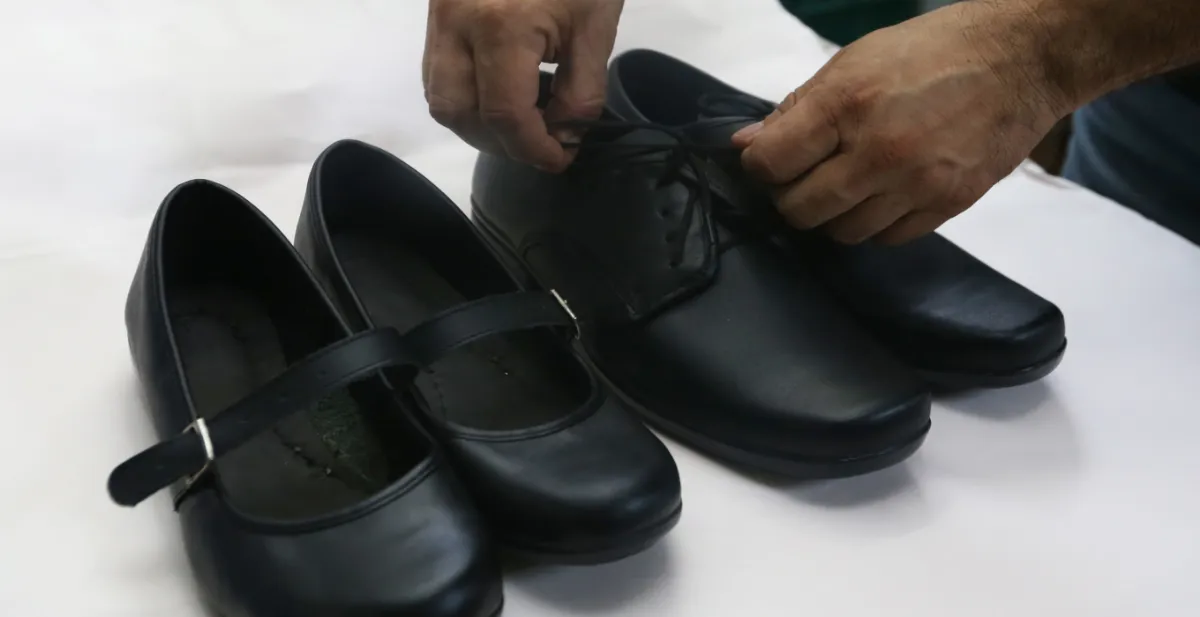
The Ministry of Education (MINED) turned to local suppliers of school shoes after the footwear it imported for this year became damaged within a few days of use, according to microentrepreneurs.
On March 27 of this year, LA PRENSA GRÁFICA reported that MINED awarded $44, 959,498.78 in 18 contracts to companies for uniform fabrics, footwear and school supplies. In the case of the shoes, the institution paid $16.7 million to the Brazilian company Calçados Beira Rio.
According to the suppliers, who spoke with this newspaper on condition of anonymity for fear of reprisals, school staff and distributors told them that the footwear delivered by the Education ministry was ruined within a few days, which is why the ministry turned to them to resolve the situation.
“The shoes only lasted the kids 15 days, they broke, and (at MINED) they panicked and contacted us to ask us how many shoes we had in the warehouse so that we would hand them over and go drop them off at customs in San Bartolo (Ilopango),” the sources said.
The suppliers already had a contract with MINED, signed in October of last year, to begin production for this year. In January they were ready to deliver the product to the schools, but they asserted that they were never given the green light to take them to the schools.
“In January we were ready to go deliver (the shoes), but they never gave us the order to go drop them off at the schools; they told us to wait, that we couldn’t even go do the sizing, that they didn’t want to see us at the schools, because they wanted to be the ones out there delivering the Brazilian shoe, along with the computers, the supplies and the uniforms, all in a little box,” the sources said.
To make the shoes, the microentrepreneurs follow a technical manual provided by the ministry that details the type of upper, which must be leather and whose thickness, color fastness, etc., they check; in addition, they verify the type of lining for the toe of the shoe, the sides and the heel, the type of thread, the sole, the insole, among other details.
“We deliver quality shoes, because that is how they ask us for them. The Brazilian shoe they bought is synthetic; it gets ruined easily,” they said.
NO PAYMENT
When the local producers took the shoes to customs, they thought payment would be immediate, since they had checked the website of El Salvador’s Electronic Public Procurement System (COMPRASAL) and verified that the Government had paid the Brazilian company for the shoes in cash; however, as of yesterday they were still waiting for payment and had no news about it.
“They pay us for shoes made of leather with a durability of 2 years. They pay us $15.26 for basic education shoes and $17.25 for high school shoes, and they have paid Brazil the same price, and in cash, and with an advance, while they keep us waiting (for payment),” they said.
“I delivered the product I had; it wasn’t much, but I met my commitment. I delivered it, but they haven’t paid me; we have no information about when they are going to pay us. I am one of the suppliers affected by the purchases (of shoes) that were made abroad,” the sources added.
This Tuesday, October 13, LA PRENSA GRÁFICA emailed MINED’s communications area and asked when they will pay the footwear suppliers, whether all the footwear imported from Brazil was damaged and whether the product had a warranty. As of press time, there had been no response to the request.
Some of the microentrepreneurs let staff go because, due to the nonpayment, they do not have the resources to meet payroll, and some of the people affected are women who are heads of household.
“The school project allows us to employ women who gradually learn the trade, first in an artisanal way; then they are trained at an industrial level. We had several employees; we had to tell them not to come anymore,” they said.
La Prensa Gráfica: https://www.laprensagrafica.com/elsalvador/mined-recurre-a-proveedores-de-zapatos-locales-tras-rapido-desgaste-de-calzado-importado-20261013-0063.html
MINED recurre a proveedores de zapatos locales tras rápido desgaste de calzado importado
Por Graciela Aguilar
El Ministerio de Educación (MINED) recurrió a proveedores locales de zapatos escolares luego que el calzado que importó para este año se averió a los pocos días de uso, según dijeron microempresarios.
El 27 de marzo de este año, LA PRENSA GRÁFICA consignó que el MINED adjudicó $44, 959,498.78 en 18 contratos a empresas para telas de uniformes, calzado y útiles escolares. En el caso de los zapatos, la institución pagó $16.7 millones a la empresa brasileña Calçados Beira Rio.
Según los proveedores, que conversaron con este periódico bajo anonimato por temor a represalias, personal de las escuelas y distribuidores les comentaron que el calzado que entregó Educación se arruinó a los pocos días, por lo que el ministerio recurrió a ellos para solventar la situación.
“Los zapatos solo les duraron 15 días a los cipotes, se rompieron y (en el MINED) entraron en pánico y nos contactaron para preguntarnos cuántos zapatos teníamos en bodega para que se los entregáramos y que fuéramos a dejarlos a la aduana en San Bartolo (Ilopango)”, señalaron las fuentes.
Los proveedores ya tenían un contrato con el MINED, firmado en octubre del año pasado, para comenzar con la producción para este año. En enero estaban listos para entregar el producto en las escuelas, pero aseguraron que nunca les dieron luz verde para llevarlos a las escuelas.
“Nosotros en enero estábamos listos para ir a entregar (los zapatos), pero nunca nos dieron la orden de ir a dejarlos a las escuelas, nos dijeron que nos esperáramos, que no podíamos ni ir a tallar, que no nos querían ver en los centros escolares, porque querían salir ellos entregando el zapato brasileño, junto a las computadoras, los útiles y los uniformes todo en una cajita”, indicaron las fuentes.
Para confeccionar los zapatos, los microempresarios siguen un manual técnico entregado por el ministerio en el que se detalla el tipo de corte, que debe ser de cuero, del que revisan espesor, solidez del color, etcétera; además, verifican el tipo de forro de la punta del zapato, de los laterales, del talón, el tipo de hilo, la suela, la plantilla, entre otros detalles.
“Nosotros entregamos zapatos de calidad, porque así nos los piden. El zapato brasileño que compraron es sintético, se arruina fácilmente”, indicaron.
SIN PAGO
Cuando los productores locales llevaron los zapatos a la aduana pensaron que el pago sería inmediato, pues revisaron el sitio web del Sistema Electrónico de Compras Públicas de El Salvador (COMPRASAL) y verificaron que el Gobierno pagó de contado el zapato a la empresa brasileña, sin embargo hasta ayer aún esperaban el pago y no tenían noticias al respecto.
“A nosotros nos pagan los zapatos elaborados de cuero con una duración de 2 años. Los zapatos de educación básica nos lo pagan a $15.26 y el de bachillerato a $17.25 y lo han pagado al mismo precio a Brasil y de contado y con anticipo y a nosotros nos tienen esperando (por el pago)”, señalaron.
“Yo entregué el producto que tenía, era poco, pero cumplí. Lo entregué, pero no me han pagado, no tenemos información de cuándo nos van a pagar. Soy de los proveedores afectados con las compras (de zapatos) que se hicieron afuera”, añadieron las fuentes.
LA PRENSA GRÁFICA escribió este martes 13 de octubre un correo electrónico al área de comunicaciones del MINED y consultó cuándo pagarán a los proveedores de calzado, si todo el calzado que se importó de Brasil estaba averiado y si el producto tenía garantía. Al cierre de esta nota no hubo respuesta a la solicitud.
Algunos de los microempresarios prescindieron de personal debido a que, por el impago, no tienen los recursos para pagar planilla y parte de las personas afectadas son mujeres cabezas de hogar.
“El proyecto escolar nos permite emplear mujeres que van aprendiendo el oficio, primero de manera artesanal; luego se les capacita a nivel industrial. Contábamos con varios empleados, tuvimos que decirles que ya no vinieran”, indicaron.
La Prensa Gráfica: https://www.laprensagrafica.com/elsalvador/mined-recurre-a-proveedores-de-zapatos-locales-tras-rapido-desgaste-de-calzado-importado-20261013-0063.html