
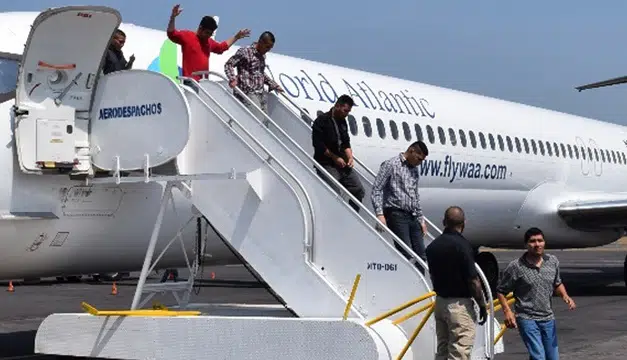
President Donald Trump’s administration has deported 25,447 people to third countries from January 20, 2025, through August 31, 2026, according to data compiled by The Deportation Project, an investigation coordinated by the journalism organization Forbidden Stories along with 24 media outlets from different countries. Many of the agreements with third countries had not been made public, and in some cases the number of people deported, their destination, and under what conditions were unknown.
The administration created the Office of Remigration to specifically negotiate third-country deportation agreements, as The Washington Post revealed. It falls under the Bureau of Population, Refugees, and Migration (PRM) and is led by Christian Ehrhardt, a career State Department official. The name of the office is already controversial because the term “remigration” has been popularized by white nationalists in Europe who seek the expulsion of racial minorities and immigrants, according to the Global Project Against Hate and Extremism (GPAHE), an organization that monitors extremist movements.
What are third-country deportations?
A third-country deportation happens when the United States expels a person but doesn’t send them to the country where they are a citizen or where they were born. For example, a Cuban may end up in El Salvador; a Nicaraguan may be sent to Colombia, Honduras, or Ecuador. A Latin American person may even end up in countries in Africa or Asia.
The practice isn’t new and is legal with limits we’ll explain shortly, but experts consulted by Factchequeado identify a drastic change during Trump’s second term: the expansion of these agreements, the number of countries involved, the exponential increase in deported men of working age with no criminal records, as well as women and children who already had established lives in the United States.
Mexico, the main destination among third countries
Mexico has received about 79% of the people sent to third countries. According to data from Third Country Deportation Watch, an initiative of Human Rights First and Refugees International, about 20,000 people were sent to that country between January 20, 2025, and August 15, 2026.
These organizations monitor the U.S. government’s third-country transfer agreements and document cases that show the human cost of this policy.
The Trump administration has allocated some $410 million to facilitate agreements with 31 countries through the end of last June, according to internal government documents reviewed by The Washington Post. In addition to Mexico, the agreements include countries such as Panama, Costa Rica, Guatemala, and Honduras, as well as countries in Africa and Asia, such as Ghana, Cameroon, Rwanda, Eswatini, South Sudan, and the Central African Republic.
The agreement depends on the receiving country, the person’s situation, and the relationship between governments. “No case is the same, and it’s also more complex than we think,” Jesus de la Torre, associate director for Global Migration at the Hope Border Institute, whose work focuses on the border between Mexico and Texas, told Factchequeado.
Although Mexico is the country that has received the most deportees, we’ve also already told you in previous articles that Mexicans themselves have been deported to third countries in the region despite Mexico’s proximity to the United States. Guatemala received 2,284 Mexicans in 2026; Honduras reported 365 and Costa Rica 11, according to data from the same organization.
De la Torre said his organization accompanies people in the Mexico border area who have urgent needs, such as medical care for immigrants with chronic illnesses or pregnant women. They offer psychological support and assistance with documentation, paperwork, consulate connections, and legal representation. Many people, he noted, depend solely on humanitarian organizations to meet basic needs because the United States expels them with nothing.
On security risks, he mentioned cases of serious violence being experienced by people deported to Mexico: “We’re seeing that many of them are being kidnapped, many of them are suffering high-impact violence,” he said. He explained that some people sent to a third country end up considering returning to their countries of origin, even when they had fled them for security reasons, because they can’t find support networks or conditions to rebuild their lives in that third country.
Human Rights First and Refugees International documented, for example, the case of a Nigerian woman with protection in the United States who was sent to Ghana and, in less than 24 hours, Ghana sent her back to Nigeria.
Legal deportations, but with limits
Third-country deportations are not prohibited by U.S. law, but a person cannot be sent to a country where there is a risk of persecution, torture, or mistreatment. That protection is known as the principle of “non-refoulement.”
In simple terms, non-refoulement means you can’t send anyone to a place where they could be harmed, even if that place isn’t their country of origin. The principle is linked to mechanisms such as “withholding of removal,” provided for under the Immigration and Nationality Act (INA), which protects someone from being sent to a country where it is “more likely than not” that they will face persecution, in addition to U.S. obligations under the Convention Against Torture (CAT), which prohibit sending a person to a country where they could be tortured.
The law also doesn’t allow sending someone to a third country if there is a risk that that country will later transfer them to another place where they would face those dangers. This is called “chain refoulement.”
Additionally, the U.S. government must respect due process during a deportation. The person must have an opportunity to know where they will be sent, what will happen to them, and to say whether the country they will be sent to poses a danger.
This last point was at the center of a legal dispute that went to court.
The ruling that declared Trump’s policy illegal
In March 2025, four people filed a class-action lawsuit against this Trump policy, represented by attorneys from three organizations. They pointed to the way the government is carrying out these transfers.
The lawsuit challenged a Department of Homeland Security (DHS) guidance document that allowed sending people to third countries without guaranteeing notice and a sufficient opportunity to contest the destination before the transfer. In some cases, the guidance provided for as little as 24 hours’ notice before the transfer, and as few as 6 hours in circumstances deemed urgent. The memorandum, titled “Guidance Regarding Third Country Removals,” was signed on March 30, 2025, by former DHS Secretary Kristi Noem.
In February 2026, federal judge Brian Murphy, in Massachusetts, ruled in favor of the plaintiffs, determining that the new DHS policy violated due process because it allowed sending people to third countries without giving them sufficient opportunity to defend themselves. He ordered the government to provide advance written notice of the destination country and to allow the person to file a claim if they feared persecution or torture there before the transfer. In certain cases, it also established a 15-day window to request the reopening of immigration proceedings.
On September 19, 2026, the First Circuit Court of Appeals, based in Boston, Massachusetts, largely upheld that decision and declared the new DHS directives illegal. The court didn’t say that third-country deportations are prohibited or that all of them are illegal, but rather that the government cannot deport people to third countries without guaranteeing due process.
Judge Murphy had also ordered the government to follow a specific order — a legal sequence — before resorting to a third country. The Court of Appeals struck that part of the ruling because the four plaintiffs had not shown that the government had applied that practice against them personally. For that reason, the court said they could not seek that protection for the entire group.
Meanwhile, the ruling is in effect and the DHS can continue carrying out deportations to third countries, as long as it complies with these requirements set by the ruling:
- Provide written notice, in a language the person understands, of the specific country to which they will be sent.
- Directly ask the person whether they fear anything in that country: the person must have the opportunity to express whether they are afraid of being sent to that country, but the government cannot rely solely on the person bringing it up on their own.
- If they express fear, an asylum officer must evaluate whether it is “more likely than not” that they would face persecution or torture there.
Judge Murphy’s order also established that if a person expresses fear of being sent to the third country, their claim must be evaluated and, in certain cases, they have 15 days to request the reopening of their immigration proceedings and present their case before an immigration judge. That window doesn’t automatically stop the deportation, but it allows them to request a judicial review of the case.
No notice and no time to defend themselves: the risks attorneys are denouncing
Julie Bourdoiseau, an attorney at the Center for Gender & Refugee Studies, told Factchequeado that one of the concerns is that some people didn’t know their destination until shortly before the transfer. “The bare minimum is to at least ask them: are you afraid to go back? Do a screening,” she says, referring to conducting a basic screening interview before expelling someone. This means asking key questions, for example: “Are you afraid of being sent to this country?” “Are you in any danger there?” These serve to detect in time whether the person is in a vulnerable situation.
Bourdoiseau works especially with cases from Honduras and represented 18 Venezuelan immigrants deported by the Trump administration in 2025 to El Salvador and held at the Terrorism Confinement Center (CECOT), a maximum-security prison in the country. Most of her clients had no criminal records.
In her work, she said, she has seen U.S. immigration authorities returning, deporting, or expelling a greater number of people without criminal records who had been living in the country for many years, with children and family already in the country; she also said she has seen more men aged 18 to 45, of working age; and even women with children who don’t speak Spanish or speak it as a second language, because they were born in the United States and their first language is English.
Bourdoiseau points out that some of the countries to which immigrants are expelled, such as Honduras, have high levels of violence and insecurity, leaving them more exposed. She even speaks of risks of being trafficked or sexually exploited after deportation.
In her investigation into Honduras, Bourdoiseau found that several people deported to that country arrived “in total shock” because they didn’t know they would end up there. In 2025, she said, at least 36 immigrants deported to Honduras ended up murdered after the United States sent them to the country they had fled because of threats. “The risks are extremely high,” she warned.
Other migrants have been taken to Africa. In the Central African Republic, for example, the case was documented of Daniela Fuentes, a Cuban trans woman deported from the United States to a country where she had no family ties or support networks and where she faced risks related to her gender identity.
Families separated: after arriving in the third country
De la Torre also told Factchequeado about cases of people who arrived in Mexico after being deported and who left family members behind in the United States. One of these was that of a Venezuelan woman sent to Mexico while pregnant as her children remained in the United States.
Deported immigrants depend on humanitarian aid because most don’t know anyone in that third country and have no family ties to fall back on.
Some people may need medical care, psychological support, help finding housing, food, and documents, legal assistance, and consulate connections.
Experts recommend having an attorney and a family plan, and knowing that if they are detained and will be deported, they have the right to say whether they are afraid of returning to their country because of persecution or threats; they also have the right to know where they will be sent, as we’ve already explained regarding what the law says and what the court ruling established.
“It’s very important for people to have legal representation,” De la Torre said.
Bourdoiseau recommended that people maintain contact with organizations and attorneys in the United States after a deportation to a third country, to document their situation and avoid disappearing from the radar of the institutions that can help them. “Sometimes what happens is there’s no monitoring, so they’re returned or expelled or deported and no one knows what happens after that,” she said.
On the risk of enforced disappearances and possible crimes against humanity
Susan Akram, a law professor at Boston University, told Factchequeado that certain practices linked to third-country deportations could rise to the level of crimes against humanity, if they are part of a systematic attack against the civilian population.
The central concern is enforced disappearances: when someone is detained or transferred, held incommunicado, and authorities deny information about their whereabouts. In Akram’s words: “Persons who are detained, transported, or held incommunicado are considered to have disappeared when they are isolated from the outside world, lack access to legal protection, and are vulnerable to any treatment by their captors.”
For this to constitute a crime against humanity, the standard is high and requires systematic practice: “If used routinely and systematically, enforced disappearances entail state responsibility and the possibility of criminal prosecution under the Rome Statute.”
The other obligation that Akram identifies as violated in certain cases of people deported by the United States is the principle of “non-refoulement” (which we’ve already explained). For example, The Deportation Project and The Washington Post documented the case of a woman fleeing mutilation in Togo who was sent by the United States to Ghana and later transferred to Togo, the country she had fled and where her attorneys had warned she was in danger.
“The most important and fundamental violation is that of the principle of ‘non-refoulement,’ the obligation of all states not to send anyone to a place where they risk suffering torture or cruel, inhuman, or degrading treatment,” Akram emphasizes.
On avenues for redress, Akram says there are legal, financial, and injunctive remedies, including orders to return to the United States, but with an important limitation: “While many courts have already ordered such remedies, they have not yet declared any third-country removal agreement illegal in and of itself.”
How to report a case or seek help
If you have a family member who has been affected or need to document a case of forced transfer to a third country, the most direct way to file complaints or receive guidance from the organizations that coordinate this initiative is to contact their legal and advocacy teams:
- Refugees International: You can review their research and contact channels on the official Refugees International website.
- Human Rights First: They coordinate legal documentation and flight monitoring. You can contact them through Human Rights First.
- FFI Emergency Line: If the person is still being held in the U.S. pending transfer, you can call the Freedom for Immigrants National Detention Hotline by dialing 9233# free of charge from immigration detention facilities.
- If you are at the border between Mexico and the United States, you can contact Jesus de la Torre’s organization, Global Migration at the Hope Border Institute; they work in partnership with various organizations.
Factchequeado: https://factchequeado.com/teexplicamos/20260923/deportaciones-terceros-paises-trump-migrantes-estados-unidos-dhs/
Estados Unidos deportó a más de 25,000 personas a terceros países: qué son estos traslados y por qué una corte declaró ilegal la política del DHS
Por Wendy Selene Pérez
El gobierno del presidente Donald Trump ha deportado a 25,447 personas a terceros países desde el 20 de enero de 2025 al 31 de agosto de 2026, según datos recopilados por The Deportation Project, una investigación coordinada por la organización periodística Forbidden Stories junto con 24 medios de distintos países. Muchos de los acuerdos con terceros países no habían sido publicados y en algunos casos se desconocía la cantidad de personas deportadas, su destino y bajo qué condiciones.
La administración creó la Oficina de Remigración para negociar específicamente los acuerdos con terceros países de deportación, según reveló The Washington Post. Depende de la Oficina de Población, Refugiados y Migración (PRM) y está dirigida por Christian Ehrhardt, funcionario de carrera del Departamento de Estado. El nombre de ese departamento ya es controversial porque el término “remigración” ha sido popularizado por nacionalistas blancos en Europa que buscan la expulsión de minorías raciales e inmigrantes, describe el Global Project Against Hate and Extremism (GPAHE), una organización que monitorea movimientos extremistas.
¿Qué son las deportaciones a terceros países?
Una deportación a un tercer país ocurre cuando Estados Unidos expulsa a una persona, pero no la envía al país del que es ciudadana o donde nació. Por ejemplo, un cubano puede terminar en El Salvador; un nicaragüense puede ser enviado a Colombia, Honduras o Ecuador. Incluso una persona latinoamericana puede terminar en países de África o Asia.
La práctica no es nueva y es legal con límites que ahora te contaremos, pero especialistas consultados por Factchequeado identifican un cambio drástico durante el segundo mandato de Trump: expansión de estos acuerdos, cantidad de países involucrados, el aumento exponencial de hombres deportados en edad laboral sin antecedentes penales, además de mujeres y niños que tenían ya una vida establecida en Estados Unidos.
México, el principal destino entre los terceros países
México ha recibido a cerca del 79% de las personas enviadas a terceros países. Según datos de Third Country Deportation Watch, una iniciativa de Human Rights First y Refugees International, cerca de 20,000 personas fueron enviadas a ese país entre el 20 de enero de 2025 y el 15 de agosto de 2026.
Esas organizaciones monitorean los acuerdos de transferencia a terceros países del gobierno estadounidense y documentan casos que muestran el coste humano de esta política.
La administración Trump ha destinado unos 410 millones de dólares para facilitar acuerdos con 31 países hasta finales de junio último, según documentos internos del gobierno revisados por The Washington Post. Además de México, los acuerdos incluyen a países como Panamá, Costa Rica, Guatemala y Honduras, y países de África y Asia, como Ghana, Camerún, Ruanda, Esuatini, Sudán del Sur y República Centroafricana.
El acuerdo depende del país receptor, la situación de la persona y la relación entre gobiernos. “Ningún caso es igual y además es más complejo de lo que pensamos”, explicó a Factchequeado Jesús de la Torre, director asociado para Migración Global del Hope Border Institute, cuyo trabajo está enfocado en la frontera entre México y Texas.
A pesar de que México es el país que ha recibido mayor número de deportados, también ya te hemos contado en notas anteriores que los propios mexicanos han sido deportados a terceros países de la región pese a la cercanía con Estados Unidos. Guatemala recibió a 2,284 mexicanos en 2026; Honduras informó de 365 y Costa Rica de 11, según datos de la misma organización.
De la Torre dijo que su organización acompaña a personas en el área de la frontera con México que tienen necesidades urgentes, como atención médica a inmigrantes con enfermedades crónicas o mujeres embarazadas. Ofrecen apoyo psicológico y acompañamiento para resolver temas de documentación, trámites, conexión con consulados, representación legal. Muchas personas, mencionó, dependen solo de organizaciones humanitarias para cubrir necesidades básicas porque Estados Unidos las expulsa sin nada.
Sobre los riesgos de seguridad, mencionó casos de violencia grave que están viviendo las personas deportadas a México: “Estamos viendo que muchas de ellas están siendo secuestradas, muchas de ellas están sufriendo violencia de alto impacto”, dijo. Y explicó que algunas personas enviadas a un tercer país terminan considerando regresar a sus países de origen, incluso cuando habían huido de ellos por razones de seguridad, porque no encuentran redes de apoyo ni condiciones para rehacer su vida en ese tercer país.
Human Rights First y Refugees International documentaron, por ejemplo, el caso de una mujer nigeriana con protección en Estados Unidos que fue enviada a Ghana y, en menos de 24 horas, Ghana la devolvió a Nigeria.
Deportaciones legales, pero con límites
Las deportaciones a terceros países no están prohibidas por la ley estadounidense, pero una persona no puede ser enviada a un país donde exista un riesgo de persecución, tortura o malos tratos. Esa protección se conoce como el principio de “no devolución”.
En términos sencillos, la no devolución es que no puede mandar a nadie a un lugar donde pueda sufrir un daño, incluso si ese lugar no es su país de origen. El principio está vinculado a mecanismos como la “retención de deportación”, prevista en la sección de extranjeros y nacionalidad de la Ley de Inmigración y Nacionalidad (INA), que protege a alguien de ser enviado a un país donde sea “más probable que no” que enfrente persecución, además de las obligaciones de Estados Unidos bajo la Convención contra la Tortura (CAT), que prohíben el envío de una persona a un país donde podría ser torturada.
La ley tampoco permite enviar a alguien a un tercer país si existe el riesgo de que ese país, después, lo traslade a otro lugar donde sí enfrente esos peligros. A esto se le llama “devolución en cadena”.
Además, el gobierno estadounidense debe respetar el debido proceso durante una deportación. La persona debe tener una oportunidad de saber a dónde será enviado, qué ocurrirá con él y decir si el país a donde lo mandarán representa un peligro.
El último punto fue el centro de una disputa judicial que llegó a la corte tras un litigio.
El fallo que declaró ilegal la política de Trump
En marzo de 2025, cuatro personas presentaron una demanda colectiva contra esta política de Trump, representadas por abogados de tres organizaciones. Señalaron la forma en la que el gobierno está llevando a cabo estos traslados.
La demanda cuestionó una guía del Departamento de Seguridad Nacional (DHS) que permitía enviar a personas a terceros países sin garantizar un aviso y una oportunidad suficiente para impugnar el destino antes del traslado. En algunos casos, la guía contemplaba avisos de apenas 24 horas antes del traslado, y hasta 6 horas en circunstancias consideradas urgentes. En inglés, el memorando es “Guidance Regarding Third Country Removals” y fue firmado el 30 de marzo de 2025 por Kristi Noem, ex secretaria del DHS.
En febrero de 2026, el juez federal Brian Murphy, en Massachusetts, le dio la razón a los demandantes, determinó que esa nueva política del DHS violaba el debido proceso porque permitía enviar a personas a terceros países sin darles suficiente oportunidad de defenderse. Ordenó que el gobierno debía avisar por escrito, con anticipación, cuál sería el país de destino y permitir que la persona presentara un reclamo si temía ser perseguida o torturada allí antes del traslado. En determinados casos, también establecía un plazo de 15 días para solicitar la reapertura del proceso migratorio.
El 19 de septiembre de 2026, la Corte de Apelaciones del Primer Circuito, con sede en Boston, Massachusetts, confirmó en gran parte esa decisión y declaró que las nuevas directrices del DHS son ilegales. La corte no dijo que las deportaciones a terceros países estén prohibidas o todas son ilegales, sino que el gobierno no puede deportar a terceros países si no garantiza el debido proceso.
El juez Murphy también había ordenado que el gobierno siguiera un orden, una secuencia legal, antes de recurrir a un tercer país. La Corte de Apelaciones quitó esa parte del fallo porque los 4 demandantes no habían demostrado que el gobierno hubiera aplicado esa práctica contra ellos personalmente. Por eso, dijo que no podían pedir esa protección para todo el grupo.
Mientras, el fallo está vigente y el DHS puede seguir realizando deportaciones a terceros países, siempre y cuando cumpla estos puntos que ordena la sentencia:
- Avisar por escrito, en un idioma que la persona entienda, cuál es el país específico al que será enviada.
- Preguntarle de manera directa si teme algo en ese país: la persona debe tener la oportunidad de expresar si tiene miedo de ser enviada a ese país, pero el gobierno no puede depender solo de que la persona lo mencione de manera espontánea.
- Si expresa temor, un oficial de asilo debe evaluar si es “más probable que no” que enfrente persecución o tortura ahí.
La orden del juez Murphy también estableció que si una persona expresa temor de ser enviada al tercer país, su reclamo debe ser evaluado y, en determinados casos, cuenta con 15 días para solicitar la reapertura de su proceso migratorio y presentar su situación ante un juez de inmigración. Ese plazo no detiene en automático la deportación, pero permite pedir una revisión judicial del caso.
Sin aviso y sin tiempo para defenderse: los riesgos que denuncian los abogados
Julie Bourdoiseau, abogada del Center for Gender & Refugee Studies, explicó a Factchequeado que una de las preocupaciones es que algunas personas no sabían cuál sería su destino hasta poco antes del traslado. “Por lo mínimo es que por lo menos les pregunten: ¿tienes miedo de regresar? Que hagan un screening”, dice, refiriéndose a realizar una entrevista básica de detección antes de expulsar a alguien. Esto significa hacer preguntas clave, por ejemplo: “¿tienes miedo de ser enviado a este país?”, “¿corres algún peligro ahí?”. Sirven para detectar a tiempo si la persona está en una situación de vulnerabilidad.
Bourdoiseau trabaja especialmente con casos de Honduras y representó a 18 inmigrantes venezolanos deportados por el gobierno de Trump en 2025 a El Salvador y recluidos en el Centro de Confinamiento del Terrorismo (CECOT), una prisión de máxima seguridad del país. La mayoría de sus clientes no tenía antecedentes penales.
En su trabajo, dijo, ha visto que las autoridades de inmigración de Estados Unidos están retornando, deportando o expulsando a un mayor número de personas sin antecedentes penales que tenían muchos años viviendo en el país, ya con hijos y familia en el país; también dijo que ha visto más hombres de 18 a 45 años, en edades laborales; e incluso mujeres con niños que no hablan español o lo hablan como su segunda lengua, porque nacieron en Estados Unidos y su primer idioma es el inglés.
Bourdoiseau señala que algunos de los países a los que son expulsados los inmigrantes, como Honduras, registran niveles altos de violencia e inseguridad y eso los deja más expuestos. Habla incluso de riesgos de ser traficados o explotados sexualmente, luego de la deportación.
En su indagación sobre Honduras, Bourdoiseau, encontró que varias personas deportadas a ese país llegaron “en choque total” porque no sabían que terminarían ahí. En 2025, dijo, al menos 36 inmigrantes deportados a Honduras terminaron asesinados después de que Estados Unidos los envió al país del que habían huido por amenazas. “Los riesgos son altísimos”, advirtió.
Otros migrantes han sido llevados a África. En República Centroafricana, por ejemplo, se documentó el caso de Daniela Fuentes, una mujer cubana trans deportada desde Estados Unidos a un país donde no tenía vínculos familiares ni redes de apoyo y donde enfrentaba riesgos relacionados con su identidad de género.
Familias separadas: después de llegar al tercer país
De la Torre contó también a Factchequeado casos de personas que llegaron a México después de ser deportadas y que dejaron familiares en Estados Unidos. Uno de estos fue el de una mujer venezolana enviada a México estando embarazada mientras sus hijos permanecían en Estados Unidos.
Los inmigrantes deportados dependen de la ayuda humanitaria porque la mayoría no conocen a nadie en ese tercer país ni tienen lazos familiares que los arropen.
Algunas personas pueden necesitar atención médica, apoyo psicológico, ayuda para conseguir vivienda, alimentos y documentos, asistencia legal, conexión con consulados.
Especialistas recomiendan tener un abogado y un plan familiar, y saber que si son detenidos y serán deportados tienen el derecho de decir si tienen miedo de regresar a su país por persecución o amenazas, también tienen derecho a saber a dónde serán enviados, como ya te explicamos qué dice la ley y qué señala el fallo de la corte.
“Es muy importante que la gente tenga una representación legal”, dijo De la Torre.
Bourdoiseau recomendó que las personas mantengan contacto con organizaciones y abogados en Estados Unidos después de una deportación a un tercer país, para documentar su situación y evitar que desaparezcan del radar de las instituciones que pueden ayudarles. “A veces lo que pasa es que no hay un monitoreo, entonces son retornados o expulsados o deportados y no se sabe lo que pasa después”, dijo.
Sobre el riesgo de desapariciones forzadas y posibles crímenes de lesa humanidad
Susan Akram, profesora de Derecho de la Universidad de Boston, explicó a Factchequeado que ciertas prácticas ligadas a las deportaciones a terceros países podrían alcanzar el nivel de crímenes de lesa humanidad, si forman parte de un ataque sistemático contra la población civil.
La preocupación central son las desapariciones forzadas: cuando alguien es detenido o trasladado, queda incomunicado y las autoridades niegan información sobre su paradero. En palabras de Akram: “Se considera que las personas detenidas, transportadas o mantenidas incomunicadas han desaparecido cuando se las aísla del mundo exterior, carecen de acceso a protección jurídica y son vulnerables a cualquier trato por parte de sus captores”.
Para que esto configure un crimen de lesa humanidad, el estándar es alto y exige sistematicidad: “Si se utilizan de forma rutinaria y sistemática, las desapariciones forzadas conllevan la responsabilidad del Estado y la posibilidad de enjuiciamiento penal conforme al Estatuto de Roma”.
La otra obligación que Akram señala como violada en ciertos casos de deportados por Estados Unidos es el principio de “no devolución” (que ya te explicamos). Por ejemplo, The Deportation Project y The Washington Post documentaron el caso de una mujer que huía de la mutilación en Togo, fue enviada por Estados Unidos a Ghana y posteriormente trasladada a Togo, el país del que había huido y donde sus abogados habían advertido que era un peligro para ella.
“La violación más importante y fundamental es la del principio de ‘no devolución’, la obligación de todos los Estados de no enviar a nadie a un lugar donde corra el riesgo de sufrir tortura o tratos crueles, inhumanos o degradantes”, enfatiza Akram.
Sobre las vías de reparación, Akram dice que hay recursos legales, económicos y cautelares, incluyendo órdenes de retorno a Estados Unidos pero con un límite importante: “Si bien muchos tribunales ya han ordenado dichas reparaciones, aún no han declarado ilegal ningún acuerdo de expulsión de un tercer país en sí mismo”.
Cómo reportar un caso o buscar ayuda
Si tienes un familiar afectado o necesitas documentar un caso de traslado forzoso a un tercer país, la vía más directa para canalizar denuncias o recibir asesoría de las organizaciones que coordinan esta iniciativa es contactar a sus equipos legales y de incidencia:
- Refugees International: Puedes revisar sus investigaciones y canales de contacto en la web oficial de Refugees International.
- Human Rights First: Coordinan la documentación legal y el monitoreo de vuelos. Puedes contactarlos a través de Human Rights First.
- Línea de Emergencia de FFI: Si la persona aún sigue retenida en EE. UU. en vías de ser trasladada, puedes llamar a la Línea Nacional de Detención de Freedom for Immigrants marcando gratuitamente el 9233# desde las prisiones migratorias.
- Si estás en la frontera entre México y Estados Unidos, puedes contactar a la organización de Jesús de la Torre, Migración Global del Hope Border Institute, ellos trabajan en alianza con diversas organizaciones.
Factchequeado: https://factchequeado.com/teexplicamos/20260923/deportaciones-terceros-paises-trump-migrantes-estados-unidos-dhs/