
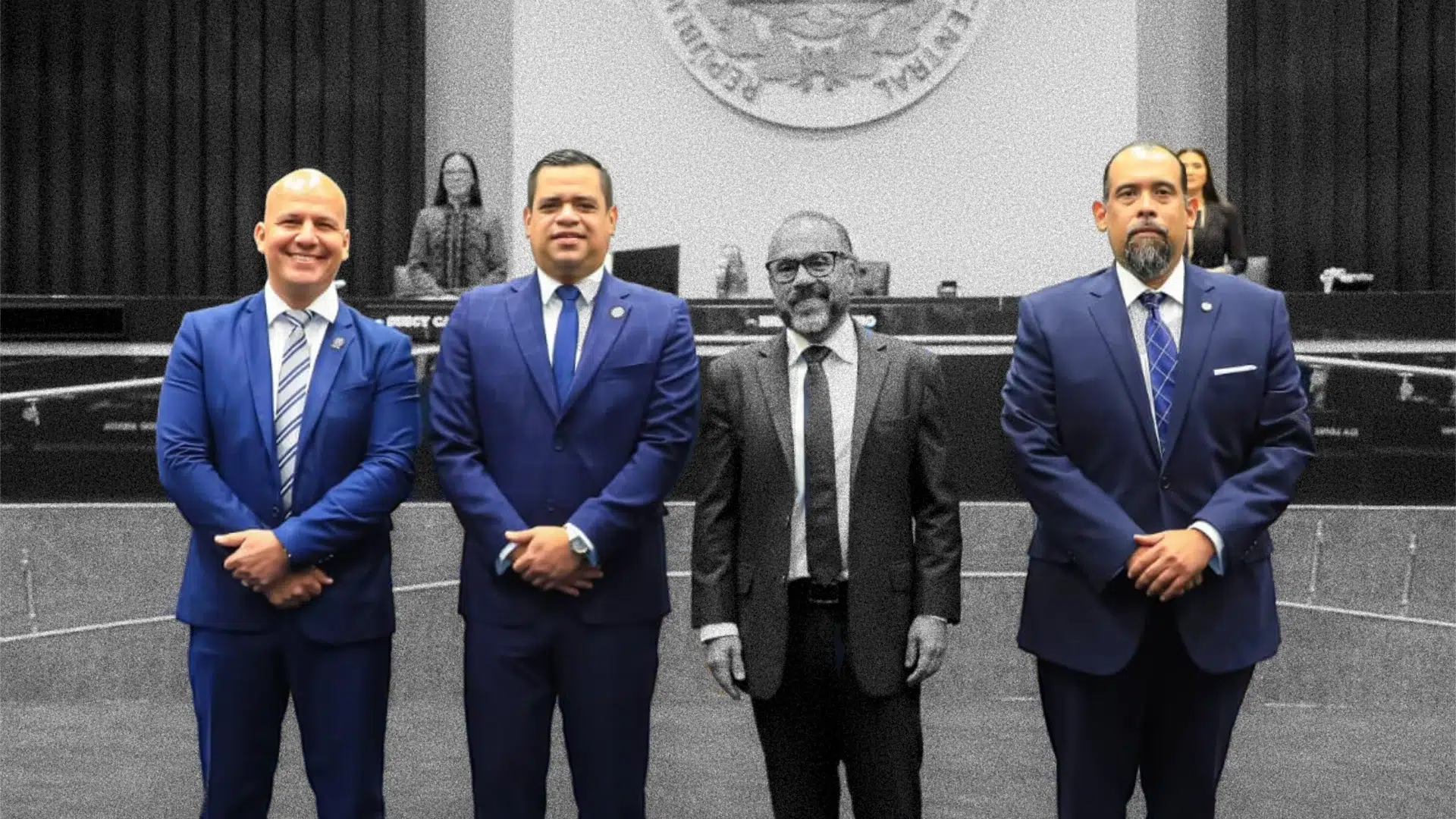
The Legislative Assembly, dominated by Nuevas Ideas, reelected the magistrates of the Court of Accounts of the Republic to remain in office for another three years, beginning this August 28, 2026 and ending August 27, 2029. The move comes as no surprise — it follows the systematic pattern of subjecting oversight institutions to the interests of Nayib Bukele’s government. By renewing their mandate, the ruling party once again hands over the keys to oversight of public funds to officials who have shown subordination to the Executive.
Walter Salvador Sosa Funes will continue as president of the institution, backed by Julio Guillermo Bendek Panameño and José Rodrigo Flores Ramos, who will remain as first and second magistrates.
Sosa Funes has held the position since February 7, 2025, following a reshuffling of pieces on the ruling caucus’s political chessboard that moved Roxana Soriano — a trusted party figure — to the helm of the Supreme Electoral Tribunal (TSE).
Bendek landed at the Court of Accounts in August 2020 as second magistrate, sponsored at the time by former PDC lawmaker Rodolfo Parker during the 2019–2021 legislature. Three years later, in August 2023, when the Assembly was already controlled by Nuevas Ideas, Bendek was recycled and promoted to first magistrate. It was in that same election that the ruling party appointed Flores Ramos as second magistrate and Soriano as president.
The reelection of these three officials was proposed by the Nuevas Ideas party and backed by its allies, PCN and PDC. The opposition caucuses Arena and Vamos voted against.
Lawmaker Raúl Chamagua, tasked with introducing the ratification proposal, failed to explain why the ruling caucus reaffirmed its vote for the same magistrates and discarded the other 14 candidates evaluated by the Political Commission.
For his part, Assembly President Ernesto Castro settled the matter by claiming that, after analyzing the interviews, the ruling caucus concluded that the Court needed “continuity to keep operating as they have during these recent terms.” Castro also justified Sosa Funes’s continuation on the grounds that he had served only a year and a half as president, having replaced Roxana Soriano in February 2025 when she was reassigned to lead the TSE.
A Court that hides audits
During his interview before the Political Commission, Sosa justified his management by claiming that, after succeeding Soriano, he found ministry audits bogged down since 2020. According to his account, to make headway he launched an “emergency oversight plan,” allowing the institution to audit the 16 ministries and four autonomous institutions through the 2024 fiscal year. He also stated that he completed the plan to audit municipalities in the period leading up to April 30 of this year. In his appearance before the lawmakers, Sosa pledged that, if he continued in office, he would extend this rapid audit sweep to cover 2025.
During the interview phase, Arena lawmaker Marcela Villatoro questioned the official about why the institution keeps the final audit reports for 2024 and 2025 hidden, even though Article 46 of the Court of Accounts Law expressly mandates that audit reports shall be public.
Sosa acknowledged that the reports should be public but hid behind a legal pirouette. He argued that, before opening the audits to the public, the institution must “harmonize” the Court of Accounts Law with the Personal Data Protection Law and the Access to Public Information Law. This bureaucratic alibi, he suggested, seeks to prevent the disclosure of “sensitive information” about audited officials.
“In other words, I have an audit report — I’m not just going to publish it like that. I have to harmonize the laws. What for? So as not to publish sensitive information about the officials,” he said.
However, Eduardo Escobar, director of the organization Acción Ciudadana, pointed out that the law provides for public versions that allow sensitive information to be redacted without blocking the entire document.
“It’s not a plausible argument to say that audits aren’t disclosed because of personal data issues. We’re talking about how they oversee public administration and the use of public funds, and that doesn’t have to be under seal,” Escobar declared.
It is for reasons like these that Acción Ciudadana’s “Active Transparency 2025” report places the Court of Accounts among the worst-rated oversight bodies, having met only 8% of its proactive disclosure obligations, according to monitoring conducted between April and June 2025 on information that should have been published or updated between October and December 2024.
A questioned (re)election
Before the public roll-call vote in the plenary, lawmaker Villatoro also questioned the candidates’ behavior during the interviews. In her view, it was regrettable that the candidates praised the government and spoke of it in glowing terms. According to the lawmaker, this compromises the independence of their decisions.
For Acción Ciudadana, the current Assembly’s procedure for this election once again suffered from the same opacity as second-degree elections before Bukelism took control of the legislature.
Eduardo Escobar told GatoEncerrado that the ruling caucus was responsible for a “lack of evaluation of profiles, lack of deliberation, lack of questioning and inquiry into current and past professional performance” of the candidates, resulting in a procedure completed “without established selection criteria.”
“When it comes to sitting officials, the evaluation has to be more rigorous and detailed (…), because they have to be challenged and questioned about why they should continue in office, especially knowing that in some cases there are deficiencies in their management,” Escobar pointed out.
GatoEncerrado: https://gatoencerrado.news/2026/08/27/nuevas-ideas-recicla-magistrados-corte-de-cuentas-opacidad/
Nuevas Ideas recicla a los magistrados de la Corte de Cuentas que ocultan los informes sobre el manejo de fondos públicos
Por Beatriz Benítez
La Asamblea Legislativa, dominada por Nuevas Ideas, reeligió a los magistrados de la Corte de Cuentas de la República para que continúen en el cargo por tres años más, que inician este 28 de agosto de 2026 y que finalizan el 27 de agosto de 2029. La maniobra no sorprende, sino que responde al patrón sistemático de someter las instituciones de control a los intereses del Gobierno de Nayib Bukele. Al renovarles el mandato, el oficialismo vuelve a entregar las llaves de la fiscalización de los fondos públicos a funcionarios que han mostrado subordinación al Ejecutivo.
Walter Salvador Sosa Funes mantendrá la presidencia de la institución, secundado por Julio Guillermo Bendek Panameño y José Rodrigo Flores Ramos, quienes seguirán en la primera y segunda magistratura.
Sosa Funes ocupa el cargo desde el 7 de febrero de 2025, tras un movimiento de piezas que la bancada oficialista hizo en el tablero de su ajedrez político, en el que desplazó a Roxana Soriano — una persona de confianza del partido — para colocarla al frente del Tribunal Supremo Electoral (TSE).
Bendek desembarcó en la Corte de Cuentas en agosto de 2020 como segundo magistrado, apadrinado en ese entonces por el exdiputado del PDC, Rodolfo Parker, durante la legislatura 2019-2021. Tres años después, en agosto de 2023, cuando la Asamblea ya era controlada por Nuevas Ideas, Bendek fue reciclado y ascendido a la primera magistratura. Fue en esa misma elección cuando el oficialismo nombró a Flores Ramos como segundo magistrado y a Soriano como presidenta.
La reelección de estos tres funcionarios fue propuesta por el partido Nuevas Ideas y respaldada por los aliados PCN y PDC. Las fracciones opositoras Arena y Vamos votaron en contra.
El diputado Raúl Chamagua, encargado de introducir la propuesta de ratificación, omitió explicar por qué la bancada oficialista refrendó su voto por los mismos magistrados y desechó a los otros 14 aspirantes evaluados por la Comisión Política.
Por su parte, el presidente de la Asamblea, Ernesto Castro, zanjó el trámite alegando que, al analizar las entrevistas, la bancada oficialista llegó a la conclusión de que la Corte necesitaba “continuidad para seguir manejando tal como lo han hecho durante estos últimos períodos”. Castro también justificó la permanencia de Sosa Funes bajo el argumento de que apenas sumaba un año y medio en la presidencia, tras relevar a Roxana Soriano desde febrero de 2025, cuando fue reubicada para dirigir el TSE.
Una Corte que oculta las auditorías
Durante su entrevista en la Comisión Política, Sosa justificó su gestión alegando que, tras suceder a Soriano, encontró auditorías de ministerios empantanadas desde 2020. Según su relato, para lograr avances impulsó un “plan de fiscalización de emergencia”, así la institución pudo auditar a los 16 ministerios y cuatro instituciones autónomas hasta el ejercicio fiscal de 2024; también afirmó que terminó el plan de fiscalizar a las municipalidades en el periodo previo al 30 de abril de este año. En su comparecencia ante los diputados, Sosa se comprometió a que, de continuar en el cargo, extendería este veloz barrido fiscalizador a la gestión de 2025.
En la fase de entrevistas, la diputada de Arena, Marcela Villatoro, cuestionó al funcionario sobre por qué la institución mantiene ocultos los informes finales de auditoría de 2024 y 2025, a pesar de que el artículo 46 de la Ley de la Corte de Cuentas mandata expresamente que los informes de auditoría tendrán carácter público.
Sosa reconoció que los informes deben de ser públicos, pero se escudó en una pirueta legal. Argumentó que, antes de abrir las auditorías a la ciudadanía, la institución debe “armonizar” la Ley de la Corte de Cuentas con la Ley de Protección de Datos Personales y la Ley de Acceso a la Información Pública. Esta coartada burocrática, según insinuó, busca evitar la divulgación de “información sensible” de los funcionarios fiscalizados.
“Es decir, yo tengo un informe de auditoría, no lo voy a publicar así nomás, sino que tengo que armonizar las leyes. ¿Para qué?, para no publicar información sensible de los funcionarios”, dijo.
Sin embargo, el director de la organización Acción Ciudadana, Eduardo Escobar, recordó que la ley contempla el recurso de las versiones públicas para tachar información sensible sin bloquear el documento completo.
“No es un argumento plausible decir que no se revelan las auditorías por temas de datos personales. Estamos hablando de cómo vigilan la gestión pública y el uso de fondos públicos, y eso no tiene que estar bajo reserva”, sentenció Escobar.
Por este tipo de cosas es que el informe de Acción Ciudadana “Transparencia Activa 2025”, señala que la Corte de Cuentas se encuentra entre los entes de control peor evaluados, al cumplir solo con el 8 % de la publicación de información oficiosa, de acuerdo al monitoreo realizado entre abril y junio de 2025 sobre la información que debía publicarse o actualizarse durante octubre y diciembre de 2024.
Una (re)elección cuestionada
Previo a la votación nominal y pública en pleno, la diputada Villatoro también cuestionó el comportamiento de los aspirantes durante las entrevistas. A su juicio, fue lamentable que los candidatos expresaran elogios y hablaran maravillas del Gobierno. Según la diputada, eso comprometen la independencia de sus decisiones.
Para Acción Ciudadana, el procedimiento de la actual Asamblea para esta elección volvió a adolecer de la misma opacidad que tenían las elecciones de segundo grado antes de que el bukelismo tomara control del Poder Legislativo.
Eduardo Escobar explicó a GatoEncerrado que la bancada oficialista incurrió en una “falta de evaluación de los perfiles, falta de ponderación, falta de cuestionamiento e indagación sobre el desempeño profesional presente y pasado” de los aspirantes, lo que derivó en un trámite consumado “sin criterios establecidos de selección”.
“Cuando se trata de funcionarios en ejercicio, tiene que ser una evaluación más rigurosa y detallada (…), porque se le tiene que increpar y cuestionar por qué debería continuar en el cargo, y más sabiendo que en algunos casos hay deficiencias en la gestión’, señaló Escobar.
GatoEncerrado: https://gatoencerrado.news/2026/08/27/nuevas-ideas-recicla-magistrados-corte-de-cuentas-opacidad/