
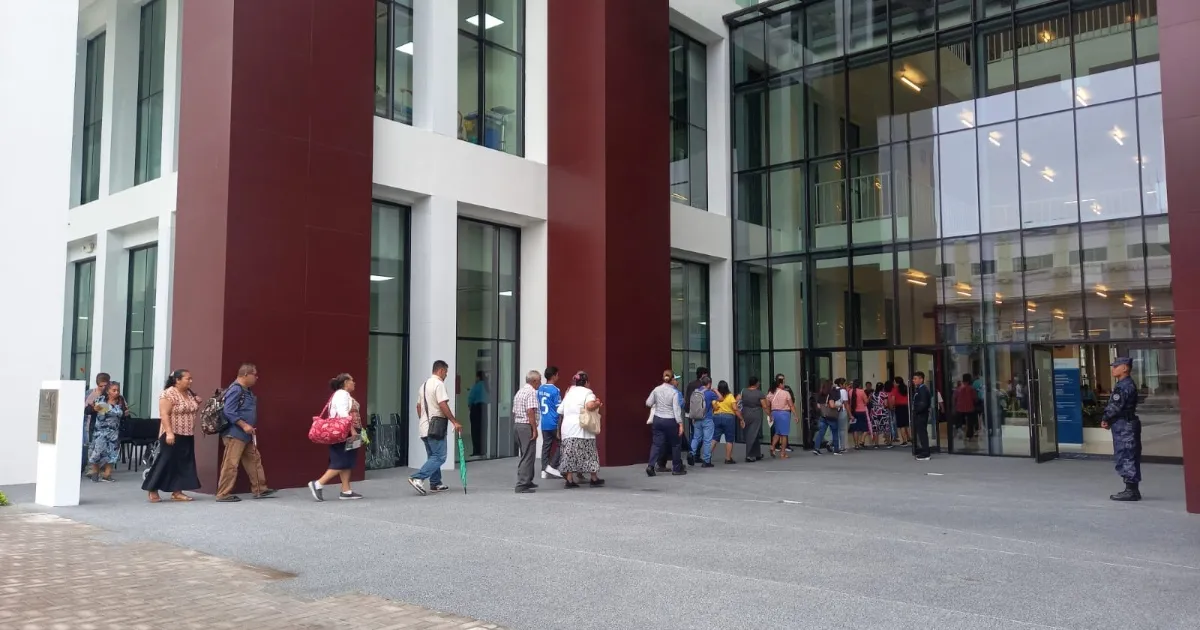
In the first half of 2026, the National Hospital Network (RNH) has had four times the budget of the former Hospital Rosales, which it replaced as a tertiary-level hospital following the reconstruction of the infrastructure and the passage of a new law that allows it to operate outside the regulations and oversight of the Ministry of Health, according to budget execution records posted by the Finance Ministry on the Fiscal Transparency portal.
For 2026, the Legislative Assembly approved a budget allocation of $177 million for the network. By contrast, in 2025, Hospital Rosales’s allocation was $47.5 million.
The latter was attached to the Ministry of Health and received its resources through ministry transfers. The RNH, meanwhile, is attached to Presidential House but receives its transfers from the Finance Ministry.
According to what the Finance Ministry has posted on Fiscal Transparency, between January and June of this year it transferred $112.4 million to the National Hospital Network. That transfer actually exceeds the initially approved amount, since the programmed budget stipulated that the Finance Ministry was to transfer $88.5 million in the first half of the year. The amount transferred is $33.9 million higher.
Likewise, that $112.4 million is $90.4 million more than the $22 million Hospital Rosales had accrued in the first half of 2025 — the last year it operated before its closure in December, when mass layoffs took place and patients were transferred to other hospitals.
Accountability
How the RNH has used the resources, however, is not entirely clear, since in the budget execution records it repeats the pattern of other institutions created in the last five years, such as the Directorate of Municipal Works (DOM), which do not report the amount of budget accrued, only the amount committed.
According to Article 57 of the regulations of the Organic Law on State Financial Administration, committed funds are those originating “from a duly documented administrative act, through which the competent authority decides to carry out a budgetary expenditure and identifies the natural or legal person with whom the relationship giving rise to the commitment is established, as well as the goods or services to be received or, where applicable, expenditures without consideration.”
In other words, a fund is considered committed when the institution signs a contract (“a duly documented act”) and the amount to be used to pay for a good, service, remuneration, or other financial transaction is thereby established.
Of the $112.4 million that the Finance Ministry reports having transferred to the RNH, the network has recorded that it already has $108.7 million committed: $87.5 million for comprehensive medical management and $21.1 million for the institution’s administrative operations.
Then, broken down by category, the $108.7 million the network says it has committed is distributed as follows: $27.5 million in remuneration, $66 million for the procurement of goods and services, $15 million for fixed-asset investments, and $56,629 for financial and other expenses.
Economists have previously explained that even if an institution does not report its accrued expenditures and these appear as zero, that does not mean the funds are not being used — it means they are not being reported transparently.
“What the Finance Ministry does is transfer funds. How they’re used is up to the institution. What is an expenditure for the Finance Ministry (the transfer of resources) is income for the institution,” economists explained, on condition of anonymity, regarding these budget movements when the DOM began recording zero accrued expenditures.
That lack of transparency was questioned by lawmaker Marcela Villatoro (ARENA), who noted that to evaluate whether an institution is efficient, it is necessary to know how it uses its allocated resources and the results of its work.
“We all want Hospital Rosales to work. For people to be able to go and receive medical care. We need to see whether (the funds) have been used so that people have better conditions.” Marcela Villatoro, ARENA lawmaker
“Let’s remember that because it’s a new hospital, it has to make different types of purchases. The problem is that they don’t publish what the money has been spent on, where the budget line is, and what was purchased. If there’s no clarity on where every cent has gone, it gives rise to the kind of speculation that raises doubts about whether anything is being done to benefit people or whether the money is being spent without improving the health of Salvadorans,” she added.
Villatoro also recalled that the Ministry of Health used to publish statistics on medical care at public hospitals, providing data such as the number of patients treated per hospital, deaths, and other figures. This information, however, is not available in the case of the RNH, which, while it has a website, does not have a transparency portal.
“It should be public. That way we can know whether it’s functional, whether it’s helping the health of Salvadorans, or whether it’s just publicity,” declared Villatoro.
This outlet used the contact channels the RNH has made available on its website to arrange a consultation with its authorities and discuss details of its budget. But as of press time, there was no response from the institution.
For now, the RNH operates only on the site formerly occupied by Hospital Rosales, following work on various areas of the old hospital and the construction of a new building with consultation rooms, operating rooms, and other medical facilities.
La Prensa Gráfica: https://www.laprensagrafica.com/elsalvador/red-nacional-de-hospitales-ya-recibio-90-millones-mas-que-hospital-rosales-en-su-ultimo-ano-20260821-0073.html
Red Nacional de Hospitales ya recibió $90 millones más que Hospital Rosales en su último año
Por Denni Portillo
La Red Nacional de Hospitales (RNH) ha dispuesto en el primer semestre del año 2026 de cuatro veces más presupuesto que el antiguo Hospital Rosales, al cual reemplazó como centro hospitalario de tercer nivel, tras la reconstrucción de la infraestructura y la aprobación de una nueva ley que le permite operar fuera de las disposiciones y controles del Ministerio de Salud, según los registros de ejecución presupuestaria que el Ministerio de Hacienda consigna en el portal de Transparencia Fiscal.
Para el año 2026, la Asamblea aprobó que la red tuviera una asignación presupuestaria de $177 millones. En contraste, en el año 2025, la asignación del Hospital Rosales fue de $47.5 millones.
Este último estaba adscrito al Ministerio de Salud y recibía los recursos por medio de transferencias del ministerio. Mientras, la RNH está adscrita a Casa Presidencial pero recibe sus transferencias desde el Ministerio de Hacienda.
Según Hacienda ha consignado en Transparencia Fiscal, entre enero y junio de este año ha transferido $112.4 millones a la Red Nacional de Hospitales. Dicha transferencia es, inclusive, superior a la aprobada inicialmente, puesto que el presupuesto programado estipuló que Hacienda debía transferir $88.5 millones en el primer semestre del año. El monto transferido es $33.9 millones mayor.
Asimismo, esos $112.4 millones son $90.4 millones que los $22 millones que el Hospital Rosales había devengado en el primer semestre del año 2025; el último en que funcionó antes de su cierre, en diciembre, cuando se produjeron despidos masivos y pacientes fueron trasladados a otros hospitales.
Rendición de cuentas
Cómo han sido utilizados los recursos por la RND, sin embargo, no es del todo claro, puesto que, en los registros de ejecución presupuestaria, esta repite el patrón de otras instituciones creadas en los últimos cinco años, como la Dirección de Obras Municipales (DOM), que no reportan el monto de presupuesto devengado, sino únicamente el comprometido.
Según el artículo 57 del reglamento de la Ley Orgánica de la Administración Financiera del Estado, los fondos comprometidos son los originados “por un acto administrativo debidamente documentado, mediante el cual la autoridad competente decide la realización de un gasto presupuestario y se identifica la persona natural o jurídica con quien se establece la relación que da origen al compromiso, así como los bienes o servicios a recibir o, en su caso, los gastos sin contraprestación”.
Dicho de otra forma, un fondo se considera comprometido cuando la institución firma un contrato (“un acto debidamente documentado”) y entonces queda establecido el monto a utilizar para pagar un bien, servicio, una remuneración u otra operación financiera.
De los $112.4 millones que Hacienda declara haber transferido a la RNH, esta ha consignado que ya tiene $108.7 millones comprometidos: $87.5 millones para gestión médica integral y $21.1 millones para el funcionamiento administrativo de la institución.
Luego, si la clasificación se hace por rubros, los $108.7 millones que la red asegura tener comprometidos se reparten así: $27.5 millones en remuneraciones, $66 millones para adquisición de bienes y servicios, $15 millones para inversiones en activos fijos, y $56,629 para gastos financieros y otros.
Con anterioridad, economistas han explicado que, aunque una institución no reporte su devengado y este aparezca a cero, eso no significa que no se están utilizando los fondos; sino que los mismos no se están reportando con transparencia.
“Hacienda lo que realiza es una transferencia de fondos. El cómo se utiliza depende de la institución. Lo que para Hacienda es un gasto (la transferencia de recursos), para la institución es un ingreso”, explicaron economistas, bajo condición de anonimato, sobre estos movimientos presupuestarios cuando la DOM comenzó a registrar devengados a cero.
Esa falta de transparencia fue cuestionada por la diputada Marcela Villatoro (ARENA), quien señaló que para evaluar si una institución es eficiente, es necesario conocer cómo utiliza los recursos asignados y los resultados de su trabajo.
“Todos queremos que funcione el Hospital Rosales. Que la gente pueda llegar y reciba atención médica. Hay que ver si se ha usado (el recurso) para que la gente tenga mejores condiciones”. Marcela Villatoro, diputada de ARENA
“Recórdemos que por ser un hospital nuevo, tiene que hacer diferentes tipos de compras. El problema es que no publican en qué se ha gastado el dinero, adónde está la partida y qué se adquirió. Si no hay claridad de dónde ha ido cada centavo, se da lugar a este tipo de especulaciones que dejan en duda de si se hace algo por beneficiar a la gente o gastando el dinero sin mejorar la salud de los salvadoreños”, agregó.
Asimismo, Villatoro recordó que el Ministerio de Salud solía publicar estadísticas sobre las atenciones médicas en los hospitales públicos, para conocer datos como la cantidad de pacientes atendidos por hospital, los decesos ocurridos, u otros. Esta información, sin embargo, no es conocida en el caso de la RNH, que si bien tiene un sitio web disponible, no cuenta con portal de transparencia.
“Debería ser público. Así podemos saber si es funcional, si está ayudando a la salud de los salvadoreños, o si es solo publicidad”, sentenció Villatoro.
Este medio hizo uso de los canales de contacto que la RNH ha puesto a disposición en su portal web para gestionar un espacio de consulta con sus autoridades y poder abordar detalles de su presupuesto. Pero hasta el cierre de esta nota, no había respuesta de la institución.
De momento, la RNH opera únicamente en el lugar que ocupó anteriormente el Hospital Rosales, luego de la intervención en diferentes áreas del antiguo hospital y de la construcción de un nuevo edificio con consultorios, quirófanos y otras instalaciones médicas.
La Prensa Gráfica: https://www.laprensagrafica.com/elsalvador/red-nacional-de-hospitales-ya-recibio-90-millones-mas-que-hospital-rosales-en-su-ultimo-ano-20260821-0073.html