
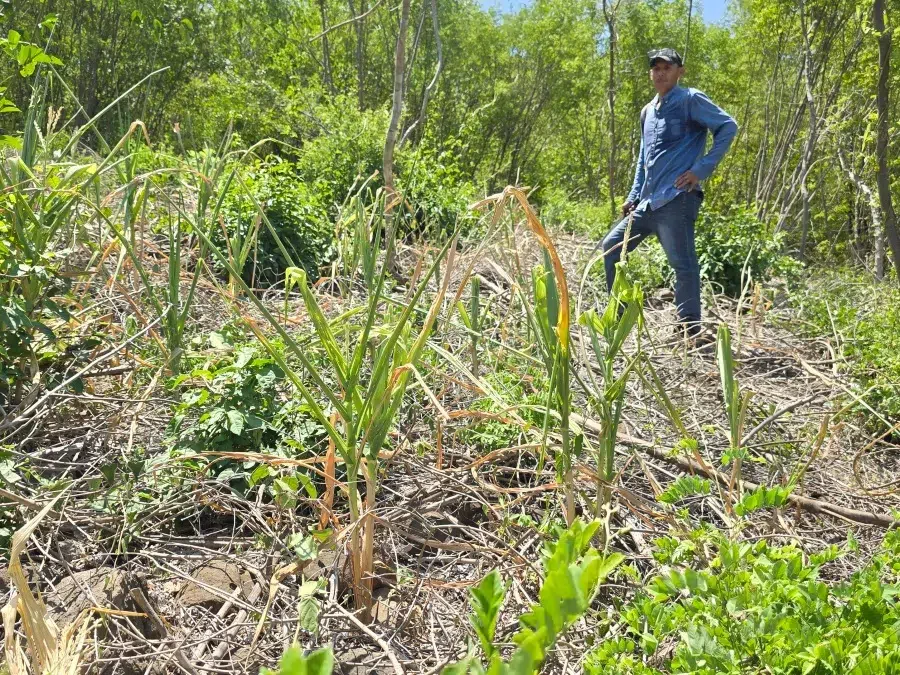
Many Salvadoran families who depend exclusively on farming and lack the resources to afford an irrigation system are suffering the effects of drought in the eastern region — which for them means not just economic losses, but also a threat to their families’ food supply.
In the community of Agua Fría 2, in the canton of Hato Nuevo in San Miguel, Juan González and his family are facing the effects of El Niño firsthand. This farmer typically cultivates between three and four manzanas of land, mainly with corn and sorghum for his family’s consumption, but says the drought destroyed his crops. “I planted and harvested everything hoping to get something out of it, but it didn’t work out. The drought is affecting all the farmers,” he says.
El Salvador is already under the effects of the El Niño phenomenon, which causes reduced rainfall and drought across the country. Last week, the Ministry of Environment and Natural Resources (MARN) confirmed the third drought since June. Between August 7 and 19, 32 weather stations recorded up to 13 days without rain, and 65.5% of them were in the eastern region.
Marcos Calderón, head of the Department of Agronomic Sciences at the Eastern Multidisciplinary Faculty of the University of El Salvador (UES), says the impact is greater in the eastern part of the country because it lies within the Central American Dry Corridor and because of the area’s high temperatures. In San Miguel, particularly in the central and southern areas of the department, a shortage of rainfall is affecting crops essential to the population’s food supply, he adds.
Calderón explains that “the soils don’t have the moisture needed for crop development.” Corn, for example, can survive without water for approximately eight days, but after that the plant enters water stress, reducing the quality and fill of the grain.
According to the specialist’s estimates, climate conditions could reduce basic grain production by up to 50%, which could also cause market prices to rise.
“Basic grains like corn, beans, and rice are going to get more expensive, because crop areas aren’t going to thrive due to El Niño itself and production won’t be completed, with losses of up to 50%,” says Calderón.
“And today, where from?”
The possible price increase will also mean an additional worry for families who farm for their own subsistence. Juan González explains that during a normal rainy season he can harvest up to 40 quintales of corn, of which he sets aside about 26 to feed his family for several months and sells the rest to cover other needs.
González, who lives with his partner and their four children — two adults and two minors — says they will now be forced to buy the grains they won’t be able to produce this year. That means $35 per quintal of corn — an expense they’ll have to take on as their income shrinks. On top of that are expenses related to their children’s schooling, such as school supplies, activities, and snacks. They also pay between $0.50 and $1 at nearby houses to charge phones and the computers the children use, because they don’t have electricity.
“Before, if the school asked us for help or to buy something for the kids, I’d sell a quintal of corn and that would take care of it. But today, where from?” he laments. “The older kids understand. I tell them things are really tough, but the little one — you always have to pack his juice and little things for his snack,” he says.
This year’s crop losses also mean an investment the González family won’t be able to recover. They estimate they invested more than $500 in land preparation, fertilizer, and tractor rental. On another plot, where he and another farmer planted two manzanas of sorghum, the investment came to approximately $1,200, which they also won’t be able to recover because of the drought.
Other small farmers in San Miguel are living the same reality. José Reyes, from the canton of La Puerta in San Miguel Centro, normally plants three manzanas of corn and one of plantain. This year he lost approximately $600 after planting sorghum that failed to grow due to the lack of water. The shortage of rain has also begun to affect his home’s well. “We haven’t prepared anything because without water, what’s the point? It hasn’t been easy,” says Reyes, who decided not to risk his money again on the postrera planting season.
“The postrera is the planting season farmers put their faith in, because they understand the rainy season doesn’t start in May anymore. By August, though, it’s usually steady — but right now the rains haven’t evened out and, worse still, it hasn’t rained. That’s why this planting season is being affected just like the primera,” says Marcos Calderón, the agronomist from the UES.
Just as with the González family, Reyes’s problem doesn’t end with the loss of his harvest. He will also have to buy the food he previously produced for his household. “We’re going to have to buy everything. When we grow it ourselves, it goes a long way — we eat and we can sell. But now we’re going to have that extra expense,” he says.
Alejandro González, a farmer from the canton of El Jalacatal, has also lost crops. He says he plants around five manzanas, mainly to ensure his family has food, but the lack of rain prevented the corn from developing. “The corn is gone — it didn’t grow, it stayed small. Now it’s just a matter of waiting and trusting in God to get through,” he says.
The crop losses are even making these families consider selling some of their livestock to buy food. Juan González has nine cows whose milk production has also dropped due to the pasture shortage, he explains. This has caused the price he gets for milk to fall, while the animals produce less.
“The cows used to feed themselves on their own, but now, where from? The drought has affected us in every way,” he says.
The UES specialist believes the government will have to intervene to ease the effects of the drought on the markets. “Those who managed to grow something are going to hold onto their little bit and sell it at a higher price, and people will buy it because they’re not going to starve. That’s where the government needs to step in and look for alternatives like importing those grains into the country,” the expert says.
He also recommends that farmers pay attention to MARN forecasts and considers it important to develop water collection systems for future dry spells, since farmers with irrigation systems have a better chance of saving their crops — but the cost of these systems makes them difficult to access.
“Todo lo cultivé y coseché con la esperanza de poder sacar algo, pero no se dio”: Sequía amenaza alimentación de pequeños agricultores en la zona oriental
Por Emanuel Boquín
Muchas familias salvadoreñas que dependen exclusivamente de la agricultura, y que no cuentan con los recursos para costearse un sistema de riego, están sufriendo los efectos de la sequía en la zona oriental, que para ellos no solo significa pérdidas económicas, también una amenaza para la alimentación de sus hogares.
En la comunidad Agua Fría 2, del cantón Hato Nuevo de San Miguel, Juan González y su familia están enfrentando los efectos de El Niño de manera directa. Este agricultor acostumbra a cultivar entre tres y cuatro manzanas de terreno, principalmente con maíz y maicillo, destinados al consumo de su familia, pero afirma que la sequía terminó con sus cultivos. “Todo lo cultivé y coseché con la esperanza de poder sacar algo, pero no se dio. La sequía está afectando a todos los agricultores”, relata.
El Salvador ya está bajo los efectos del fenómeno de El Niño, el cual provoca una reducción de lluvias y sequías en el país. La semana pasada, el Ministerio de Medio Ambiente y Recursos Naturales (MARN) confirmó la tercera sequía desde junio. Entre el 7 y el 19 de agosto, 32 estaciones meteorológicas acumularon hasta 13 días sin lluvias y el 65.5 % de ellas eran de la zona oriental.
Marcos Calderón, jefe del Departamento de Ciencias Agronómicas de la Facultad Multidisciplinaria Oriental de la Universidad de El Salvador, indica que el impacto es mayor en el oriente del país porque se encuentra dentro del corredor seco centroamericano y por las altas temperaturas de la zona. En San Miguel, particularmente en las áreas centro y sur del departamento, se registra una escasez de lluvias que afecta cultivos esenciales para la alimentación de la población, agrega.
Calderón explica que “los suelos no cuentan con la humedad necesaria para el desarrollo de los cultivos”. Por ejemplo, el maíz puede resistir sin agua durante un aproximado de ocho días, pero después de ese periodo la planta entra en estrés hídrico, disminuyendo la calidad y el llenado del grano.
Según las estimaciones del especialista, las condiciones climáticas podrían reducir hasta en 50 % la producción de granos básicos, lo que también puede ocasionar un aumento de precios en el mercado.
“Se van a encarecer los granos básicos como maíz, frijol y arroz, porque las áreas de cultivos no van a prosperar por el mismo efecto de El Niño y no se complete la producción, perdiendo hasta el 50%”, dice Calderón.
“¿Y hoy, de dónde?”
El posible aumento de precios también significará una preocupación adicional para familias que cultivan para su propia subsistencia. Juan González explica que durante una época de lluvias normal puede obtener hasta 40 quintales de maíz, de los cuales reserva alrededor de 26 para alimentar a su familia durante varios meses y el resto lo vende para cubrir otras necesidades.
González, que vive junto a su pareja y sus cuatro hijos, dos de ellos mayores de edad y dos menores, dice que ahora se verán obligados a comprar los granos que este año no podrán producir. Será un gasto de $35 por un quintal de maíz que deberán asumir mientras sus ingresos disminuyen. A esto se suman las obligaciones relacionadas con los estudios de sus hijos, como útiles, actividades escolares y refrigerios. También pagan entre $0.50 y $1 en casas cercanas para cargar teléfonos y las computadoras que utilizan los niños, porque ellos no tienen servicio de energía eléctrica.
“Si antes en la escuela nos pedían apoyo o comprar algo de los niños, yo vendía un quintal de maíz y con eso resolvemos, pero ¿y hoy de dónde?”, se lamenta. “Los niños más grandecitos entienden. Yo les digo que la situación está bien difícil, pero al niño pequeño hay que ponerle siempre su jugo y cositas para el refrigerio”, señala.
La pérdida de los cultivos este año también implica para la familia González una inversión que no podrán recuperar. Calculan que para la preparación de la tierra, la compra de abono y el alquiler del tractor invirtieron más de $500. En otra parcela, donde junto con otro agricultor sembraron dos manzanas de maicillo, la inversión alcanzó aproximadamente $1,200, que tampoco podrán recuperar por la sequía.
Otros pequeños agricultores de San Miguel están viviendo esa misma realidad. José Reyes, del cantón La Puerta, San Miguel Centro, siembra normalmente tres manzanas de maíz y una de plátano. Este año perdió aproximadamente $600 luego de sembrar maicillo que no logró desarrollarse por la falta de agua. La escasez de lluvias también ha comenzado a afectar el pozo de su vivienda. “No hemos preparado nada porque sin agua, ¿para qué? No ha sido fácil”, expresa Reyes, quien decidió no arriesgar nuevamente su dinero en la siembra de postrera.
“La siembra de postrera, es a la que los agricultores le ponen fe porque entienden que el invierno ya no entra en mayo. En cambio, en agosto ya está parejo, pero ahorita no ha emparejado el invierno y, peor aun, no ha llovido; por eso esta siembra está siendo afectada como la de primera”, dice Marcos Calderón, el agrónomo de la UES.
Así como le sucede a la familia González, el problema para Reyes no termina con la pérdida de la cosecha. También tendrá que comprar los alimentos que anteriormente producía para su hogar. “Todo va a tocar comprarlo. Si lo sembramos nosotros, nos rinde, comemos y podemos vender, pero ahora vamos a tener ese gasto extra”, señala.
Alejandro González, agricultor del cantón El Jalacatal, también ha perdido cultivos. Dice que siembra alrededor de cinco manzanas, principalmente para garantizar el consumo familiar, pero la falta de lluvia impidió que el maíz se desarrollara. “Se ha perdido el maíz, no creció, se quedó pequeño. Solo es momento de esperar y confiar en Dios para salir adelante”, dice.
La pérdida de las cosechas incluso hace pensar a estas familias en la posibilidad de vender parte de su ganado para poder comprar alimentos. Juan González cuenta nueve vacas, cuya producción de leche también se ha reducido como consecuencia de la escasez de pasto, explica. Esto ha provocado que el precio que recibe por la leche haya bajado, mientras los animales producen menos.
“Las vacas ellas solas se sostenían con el alimento, pero ahora, ¿y de dónde? Nos ha afectado en todos los sentidos la sequía”, manifiesta.
El especialista de la UES considera que el Gobierno tendrá que intervenir para paliar los efectos de la sequía en los mercados. “Los que lograron cultivar van a guardar su poquito y lo van sacar más caro, y la gente lo va a comprar porque no se va a morir de hambre. Ahí es donde el Gobierno debe meter mano y buscar alternativas como importar esos granos al país”, considera el experto.
También recomienda a los agricultores mantenerse atentos a los pronósticos del MARN y considera importante desarrollar sistemas de captación de agua para enfrentar futuros periodos secos, puesto los productores con sistemas de riego tienen mayores posibilidades de salvar sus cultivos, pero los costos de estos mecanismos dificultan su acceso.