
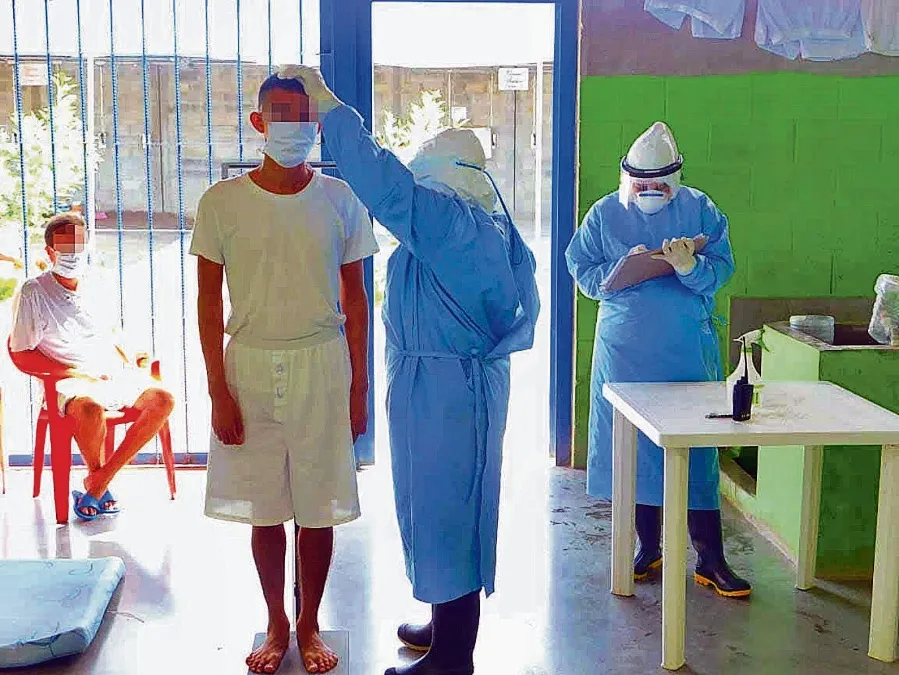
The General Directorate of Centros Penales (DGCP) declared the data on how many inmates have been diagnosed with chronic illnesses from 2020 through June 2026 as information under seal. The institution denied access, stating that the information is part of the records of the Penitentiary Information System (SIPE), whose data has been kept hidden since 2021.
The request, submitted last July 16, also sought diagnoses (hypertension, diabetes, cancer, kidney failure, among others), the number of inmates per diagnosis, medical treatments, and referrals to hospitals during the period in question.
The request also asked for the number of inmates in the custody of Centros Penales, their legal status, whether they fall under the state of exception, the official capacity of each facility, its occupancy rate, and the current population. However, the DGCP denied access based on Article 19 of the Access to Public Information Law (LAIP), which classifies certain data as information under seal.
Until 2022, the Ministry of Justice and Public Security still published information related to the penitentiary system in its annual reports. After that, statistical information from Centros Penales was no longer available.
These restrictions have been flagged more frequently since the state of exception was implemented in March 2022. Most of the complaints are reflected in cases received by organizations regarding the lack of information about the situation of people detained in this context. These include difficulties in learning the whereabouts of detainees, their conditions of confinement, their health status, and the circumstances of deaths in state custody.
During the security measure, Legal Humanitarian Aid reported difficulties accessing information about the deceased and documented cases of inmates who died from chronic illnesses or lack of medical care.
In 2023, La Prensa Gráfica had access to SIPE records, although the information was not provided directly by Centros Penales. The data at the time revealed 18,756 inmates with chronic illnesses. Among the most commonly recorded conditions were tuberculosis, hypertension, diabetes, and HIV.
It was also learned that the facilities with the largest number of sick inmates were Izalco, with 3,457; Apanteos, with 2,678; and La Esperanza, or Mariona, with 2,534. Another 5,100 inmates were distributed among the prison farms of Zacatecoluca and Usulutan.
Overcrowding makes care difficult
Infectious disease specialists have warned that overcrowding is a “key factor” in the spread of respiratory diseases in prisons, and about the high tuberculosis rates, which they believe are currently higher.
“The disease affects people with weakened immune systems, such as diabetics and those suffering from kidney, liver, chronic, or lung infections,” they warn.
For their part, organizations and family members say they have turned to the Office of the Human Rights Ombudsman (PDDH) to have the institution take steps to learn about the health status of detainees and make it possible to deliver medications to them. However, they say, they have not always received a response.
In 2024, the Security Ministry acknowledged in its annual report for the period between June 2023 and May 2024 that it had “difficulties providing timely medical treatments for inmates.” The institution attributed the problem to the increase in the prison population, which raised the consumption of medications and supplies, and pointed to a lack of pharmacy staff in the clinics.
The same report indicated that the Ministry turned to public institutions, nongovernmental organizations, and private companies to meet the needs of incarcerated patients. It also noted the need to increase the budget for medications and supplies and to hire staff for prison pharmacies.
One of these institutions was the Ministry of Health, which for its part has released information on the care of inmates. In its annual reports for 2022–2025, it recorded 422,327 medical services for this population.
For the period from June 2024 to May 2025, MINSAL reported 62,284 services, of which 28,243 were general medicine consultations, 723 were nursing consultations, and 15,864 were specialty consultations. National hospitals also reported 17,451 hospital services.
MINSAL’s annual reports also recorded follow-up care for inmates with noncommunicable diseases, including arterial hypertension, diabetes mellitus, and chronic kidney disease. Regarding infectious diseases, the data detailed that between June 2024 and May 2025, 684 inmates were diagnosed with HIV and 1,455 with tuberculosis.
La Prensa Gráfica: https://www.laprensagrafica.com/elsalvador/centros-penales-se-niega-a-revelar-datos-sobre-reos-salvadorenos-con-enfermedades-cronicas-20260810-0043.html
Centros Penales se niega a revelar datos sobre reos salvadoreños con enfermedades crónicas
Por Laura Jordán
La Dirección General de Centros Penales (DGCP) declaró como reservada la información de cuántas personas privadas de libertad han sido diagnosticadas con enfermedades crónicas desde el año 2020 hasta junio de 2026. La institución negó el acceso al señalar que la información forma parte de los registros del Sistema de Información Penitenciaria (SIPE), cuya información se mantiene oculta desde 2021.
La solicitud realizada el 16 de julio pasado también requería los diagnósticos (hipertensión, diabetes, cáncer, insuficiencia renal, entre otras), cantidad de reos por diagnóstico, tratamientos médicos y remisiones a hospitales en el periodo mencionado.
También se pidió la cantidad de privados de libertad bajo custodia de Centros Penales, su situación jurídica, pertenencia al régimen de excepción, la capacidad oficial de cada centro, su porcentaje de ocupación la población actual. Sin embargo, la DGCP denegó el acceso con base en el artículo 19 de la Ley de Acceso a la Información Pública (LAIP), que clasifica algunos datos como información reservada.
Hasta 2022, el Ministerio de Justicia y Seguridad Pública todavía publicaba información relacionada con el sistema penitenciario en sus memorias de labores. Posteriormente, la información estadística de Centros Penales dejó de estar disponible.
Estas restricciones se han señalado con mayor frecuencia desde la implementación del régimen de excepción, en marzo de 2022. La mayor parte de denuncias se ha visto reflejada en los casos que reciben organizaciones sobre la falta de información sobre la situación de las personas detenidas en este contexto. Estas incluyen dificultades para conocer el paradero de personas detenidas, sus condiciones de reclusión, su estado de salud y las circunstancias de las muertes ocurridas bajo custodia estatal.
Durante la medida de seguridad, el Socorro Jurídico Humanitario reportaba dificultades de acceso a información sobre las personas fallecidas y documentaba casos de privados de libertad que murieron por enfermedades crónicas o falta de atención médica.
En 2023, La Prensa Gráfica tuvo acceso a registros del SIPE, aunque esa información no fue entregada directamente por Centros Penales. Los datos de aquel entonces revelaban 18,756 privados de libertad con enfermedades crónicas. Entre los padecimientos más registrados estaban tuberculosis, hipertensión, diabetes y VIH.
Además, se conoció que los centros con mayor cantidad de personas enfermas eran Izalco, con 3,457; Apanteos, con 2,678; y La Esperanza o Mariona, con 2,534. Otros 5,100 privados de libertad estaban distribuidos entre las granjas penitenciarias de Zacatecoluca y Usulután.
Hacinamiento vuelve difícil la atención
Médicos infectólogos han advertido al respecto que el hacinamiento es un “factor clave” en la propagación de enfermedades respiratorias en las cárceles y sobre los altos índices de tuberculosis que, consideran, son mayores actualmente.
La enfermedad afecta a personas con defensas bajas, como los diabéticos, los que padecen infecciones renales, hepáticas, crónicas o pulmonares”, alertan.
Por su parte, organizaciones y familiares sostienen que han recurrido a la Procuraduría para la Defensa de los Derechos Humanos (PDDH) para que la institución realice gestiones para conocer el estado de salud de los detenidos y que sea posible llevarles medicamentos. No obstante, detallan, no siempre han obtenido respuesta.
En 2024, Seguridad reconoció en su informe de labores correspondiente al período entre junio de 2023 y mayo de 2024 que tenía “dificultades para cubrir oportunamente los tratamientos médicos de los privados de libertad”. La institución atribuyó el problema al aumento de la población penitenciaria, que elevó el consumo de medicamentos e insumos, y señaló la falta de personal encargado de farmacia en las clínicas.
El mismo informe indicó que el Ministerio recurrió a instituciones públicas, organizaciones no gubernamentales y empresas privadas para cubrir las necesidades de los pacientes privados de libertad. También señaló la necesidad de aumentar el presupuesto para medicamentos e insumos y de contratar personal para las farmacias de los centros penitenciarios.
Una de estas instituciones fue el Ministerio de Salud que, por su parte, ha divulgado información sobre la atención de personas privadas de libertad. En las memorias de labores correspondientes a los años 2022-2025 registró 422,327 atenciones médicas a esta población.
Para el período junio de 2024 a mayo de 2025, el MINSAL reportó 62,284 atenciones, de las cuales 28,243 fueron consultas de medicina general, 723 de enfermería y 15,864 de especialidades. Los hospitales nacionales reportaron además 17,451 atenciones hospitalarias.
Las memorias del MINSAL también registraron seguimiento a privados de libertad con enfermedades no transmisibles, entre ellas hipertensión arterial, diabetes mellitus y enfermedad renal crónica. En cuanto a enfermedades infecciosas, los datos detallaron que entre junio de 2024 y mayo de 2025 fueron diagnosticados 684 privados de libertad con VIH y 1,455 con tuberculosis.
La Prensa Gráfica: https://www.laprensagrafica.com/elsalvador/centros-penales-se-niega-a-revelar-datos-sobre-reos-salvadorenos-con-enfermedades-cronicas-20260810-0043.html