
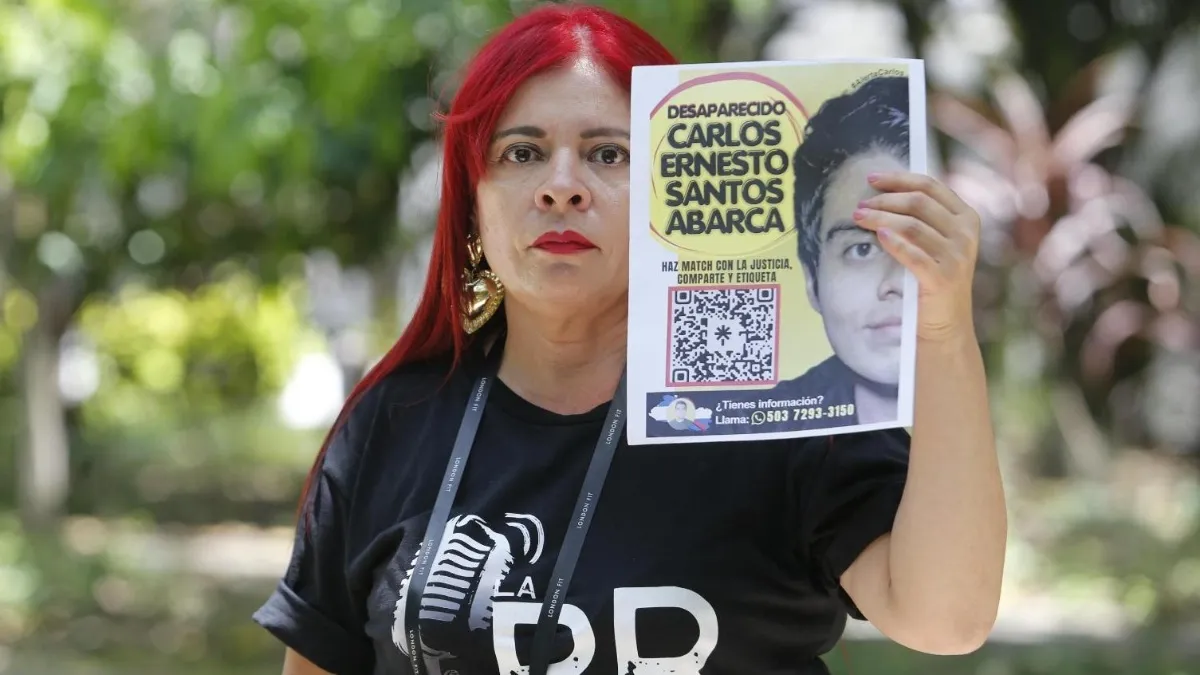
Under the slogan “Match with justice,” Eneida Abarca is once again taking to the streets to continue the search campaign for her son, Carlos Ernesto Santos Abarca, who disappeared on January 1, 2022, in the Monserrat neighborhood of San Salvador.
With help from students at the University of El Salvador (UES), the mother searching for her son has launched posters featuring a QR code that details all the information about Carlos’s case, the most important steps taken so far, and the leads she herself has found during the investigation.
“This is the second time we’ve distributed posters with QR codes at the University of El Salvador as part of the search campaign for Carlos. The tool — the QR code — has become widespread, and we took as an example the fact that in Mexico it’s also being used in the search for missing persons,” Eneida explained yesterday.
The mother said this effort also aims to raise awareness among the student population about the phenomenon of disappearances in El Salvador. “It’s about raising visibility and awareness among young people, so they know the problem continues and that the Salvadoran State keeps information on disappearance figures confidential,” she said.
Eneida Abarca stressed that her idea is for students and other people who access the QR code to see the effects that a crime like the disappearance of persons has on victims’ families, since it is a phenomenon that affects them for a long time, until truth and justice are obtained.
She explained that after finishing the distribution at the UES, they will take the campaign to other universities and other departments around the country.
“When you access the code, there’s also a section where you can help with the search, whether by providing leads or sharing the code itself,” she added.
Abarca noted that she still has not gotten any positive answers from the Salvadoran government regarding Carlos’s disappearance, as authorities have so far not told her whether the case is still moving forward or whether they have new leads on his whereabouts.
“This month, on August 21, Carlos would be turning 27, and we’re not going to stop until we find him,” she added.
In El Salvador, according to official information, between January 1, 2015, and June 18, 2025, 9,465 cases of missing persons were reported, although it is not specified how many people were found alive and how many cases remained active as of that date.
Recently, the Inter-American Commission on Human Rights (IACHR) urged States not to forget their responsibility to search for missing persons and reiterated that “families can participate in the investigation and other activities,” but that this does not exempt the institutions that must carry out this task from their obligations.
La Prensa Gráfica: https://www.laprensagrafica.com/elsalvador/realizan-campana-con-codigo-qr-por-desapacion-de-carlos-ernesto-santos-abarca-20260807-0093.html
Realizan campaña con código QR por desaparición de Carlos Ernesto Santos Abarca
Por David Bernal
Bajo el lema “Haz match con la justicia”, Eneida Abarca sale nuevamente a las calles para mantener la campaña de búsqueda de su hijo, Carlos Ernesto Santos Abarca, quien desapareció el 1 de enero de 2022 en la colonia Monserrat de San Salvador.
La madre buscadora, con ayuda de estudiantes de la Universidad de El Salvador (UES), ha lanzado afiches con un código QR donde se detalla toda la información del caso de Carlos, los pasos más importantes que han dado hasta el momento y las pistas que ella misma ha encontrado durante la investigación.
“Esta es la segunda vez que realizamos una difusión de afiches con QR en la Universidad de El Salvador, como parte de la campaña de búsqueda de Carlos. Se ha masificado la herramienta (el QR) y tomamos como ejemplo el hecho que en México también se está utilizando en la búsqueda de personas desaparecidas”, explicó ayer Eneida.
La madre dijo que esta acción también busca generar conciencia en la población estudiantil sobre el fenómeno de las desapariciones en El Salvador. “Se trata de visibilizar y sensibilizar a los jóvenes, para que sepan que la problemática continúa y que el Estado salvadoreño mantiene la reserva de información en las cifras de desaparecidos”, expuso.
Eneida Abarca remarcó que su idea es que los estudiantes y el resto de personas que tienen acceso al QR puedan ver los efectos que un delito como la desaparición de personas tiene sobre las familias de las víctimas, pues es un fenómeno que impacta por mucho tiempo, hasta que se logra obtener verdad y justicia.
Explicó que después de terminar con la difusión en la UES llevarán la campaña a otras universidades y otros departamentos del país.
“En el código, cuando se accede, también hay un apartado para poder colaborar con la búsqueda, ya sea a través de pistas o la difusión del mismo”, añadió.
Abarca señaló que sigue sin obtener respuestas positivas del Gobierno salvadoreño en la desaparición de Carlos, pues hasta el momento las autoridades no le han informado si el proceso continúa o si tienen nuevas pistas de su paradero.
Este mes, el 21 de agosto, Carlos estaría cumpliendo 27 años de vida y no vamos a parar hasta lograr dar con él”, añadió.
En El Salvador, según información oficial, entre el 1 de enero de 2015 y el 18 de junio de 2025 se reportaron 9,465 casos de personas desaparecidas, aunque no se especifica cuántas personas fueron encontradas con vida y cuántos casos seguían activos hasta esa fecha.
Recientemente la Comisión Interamericana de Derechos Humanos (CIDH) instó a los Estados a no olvidar su responsabilidad de la búsqueda de personas desaparecidas y reiteró que “las familias pueden participar en la investigación y más actividades”, pero eso no exime las obligaciones de las instituciones que deben brindar esta tarea.
La Prensa Gráfica: https://www.laprensagrafica.com/elsalvador/realizan-campana-con-codigo-qr-por-desapacion-de-carlos-ernesto-santos-abarca-20260807-0093.html