
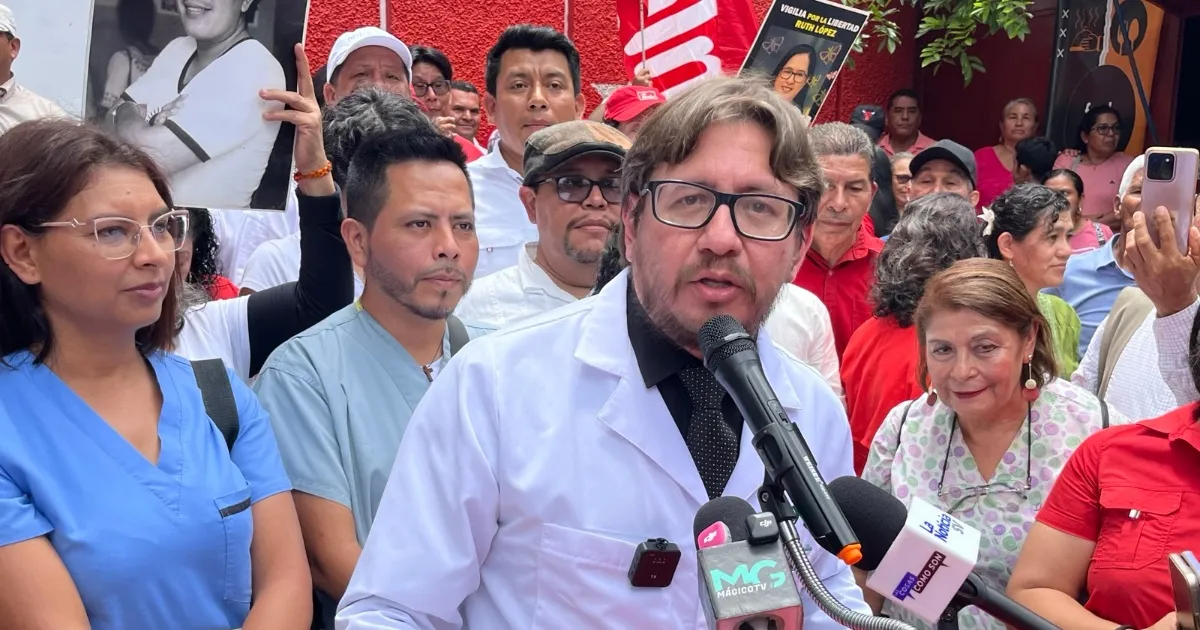
The presidential pre-candidacy of physician and union leader Rafael Aguirre has drawn questions from both the ruling party and sectors of the opposition. His critics point out that his participation under the FMLN banner helps legitimize an election they consider unconstitutional, fractures the social movement, and ties him to a party still burdened by corruption allegations from its previous governments, as well as to figures like José Luis Merino, whom various sectors accuse of maintaining political ties to President Nayib Bukele.
Aguirre, however, rejects those criticisms and refuses to delve into the baggage of the party he is running with, convinced that the electoral route constitutes “the last peaceful alternative” for driving change in the country. He says he made that decision after concluding that the complaints, proposals, and mobilization through the Union of Medical Workers of the Salvadoran Social Security Institute (SIMETRIS) and the National Coordinator for the Defense of the Health of the Salvadoran People (CONADESSA) were no longer enough to impact the national reality.
At what point did you think you could run for elected office?
Look, since about November of last year, different political parties had been approaching me. I received an invitation from Vamos, from ARENA, and, from February on, also an invitation from the FMLN.
Up to that point, whether for a legislative seat or mayor, I really had no intention of actively participating in party politics. What had interested us was the path of building civil society, movements, organizing, the citizen movement.
But a lot of things started happening. In December came the mass firing of our colleagues at Rosales Hospital. That shook us. We were in a meeting with the fired Social Security workers when, on December 23, we got the news that more than 2,000 people were going to be fired from Rosales. After that, we found out about the rest of the firings at UPIS, the Social Security pensioners’ unit, and that got us thinking: “Well, what else can we do?”
Because the peaceful protests, the press conferences, the talks, the forums we’d set up as CONADESA were telling us: “Hey, this isn’t working.” I mean, privatization isn’t being stopped; we’re not stopping the firings.
And secondly, you know that right now, under the state of exception, any kind of protest is penalized and criminalized. The moment I were to go shut down a hospital, I know that, right then, we’d have the police on us and they have full authority to throw us in jail.
So I didn’t want to be my colleagues’ executioner either over a bad decision we might make.
That’s what made me start thinking about what else we could do, obviously by peaceful means.
You received proposals from Vamos and ARENA. Why didn’t you go with them?
Because they had only been for a legislative seat or for mayor, and those positions definitely do nothing for the working class, nothing for the citizen movement. What good is a seat in the legislature to me? Look at the three opposition lawmakers. Showing up to talk and throw “hate,” so to speak—I already do that from the platform I’m on. And the point is, as a lawmaker or as mayor, I save myself, but who else goes with me as a lawmaker or mayor? Just me. That’s not the point.
How did you end up with the FMLN?
My removal process started on March 23. Around April 14, I had a conversation with attorney Bethy Arana, and during the chat, I told her: “Well, the only thing left for me now is to be president of the Republic; that way we cut this thing off clean.” And she was the one who said: “No, look, you’d be good as a lawmaker.” “But no, as a lawmaker I don’t get anything done,” I told her. I had to aim for something bigger. And the point isn’t whether we win or not. The point is to show that the working class, that the citizen movement, is still alive—that if they aren’t speaking out, it’s really out of fear.
So we were talking about that and she tells me: “Well, let me go talk to someone, I’m going to talk to Manuel Flores (secretary general of the FMLN).” I understand she talked to Manuel and he told her to offer me the vice presidency. I told her: “I’ll think about it.” I left it at that; I never brought up the subject again.
The legal proceedings against me began, but a month ago they fired Dr. Roxana Quintanilla, who is my second grievance secretary on the board of directors (of SIMETRISS). So that marked a turning point for me. “Ah, no. Now they’re going to start plucking us clean. Now they’re going to start coming after us.”
Seeing how scattered the political situation was, how colleagues from the other organizations were losing steam, I started thinking and weighing my options.
A week after the doctor was fired, the Poder Ciudadano movement approached me. It’s a group of NGOs that brings together around 200 groups and associations of working-class people, peasants, workers, and teachers, and they come to me and say: “Look, doctor, we know you were offered the vice presidency and you turned it down, but we want to offer you the presidency of the Republic.”
“We’re going to sit down and talk with the Frente, because it’s through them that we’re offering you the candidacy, and depending on that, I don’t know whether you’d be willing to seriously consider it or not.”
That was when I met with Manuel Flores for the first time, in person, along with the leadership of the Poder Ciudadano movement. So, seeing that formality—that it wasn’t just a verbal offer—that’s when I decided to make the decision.
Did you discuss this in CONADESA?
What I did afterward was ask them within CONADESA: “Look, I have an offer right now.” I went to the leadership of the Bloque de Resistencia y Rebeldía Popular (BRP), I went to the leadership of MDCT, of UNT; I went to all the leaderships to tell them about the proposal on the table, but that it wasn’t coming from the Frente, it was coming from the Poder Ciudadano movement.
There was a lot of skepticism from the people who’ve spoken out. “No, look, doctor, behind that is (José Luis Merino),” and they started naming names and saying the president (Bukele) is pulling the strings, and a bunch of things. And I said: “But how can we actually prove that?”
How can we really establish whether there is or isn’t a guarantee of what we can do? I mean, they’re attacking us. Erick Zelaya had already gone into exile, other colleagues had already gone into exile, colleagues who were falling ill, getting fired, depressed, and so on. What else can we do?
I told them: “If you give me a proposal of three objectives we can achieve in the next six months, that I’ll dedicate myself to body, soul, and heart to achieve, right now I’ll tear up the offer, I’ll get rid of it, and we keep working in the social movement.” Everyone stayed quiet. Nobody could give me an answer.
So I say, there are no objectives laid out. They just told me, “Let’s keep building, doctor.” Well yes, we have to keep building, but then we need a stronger ally, we need a stronger ally or a louder megaphone, something more to stop all this. That’s when I make the definitive decision.
Many people view your participation with the FMLN with suspicion because of the corruption of its governments and its ties to José Luis Merino and the Bukele government. How do you respond?
We come from the citizen movement. I’ve had nothing to do with that corruption, with the Frente’s past. The people who were involved have to answer for that.
Constitutionally I’m required to find a political party. Now, why the Frente? Well, I look at its membership. It’s a historic, organized membership, it has a well-designed structure, people who give everything they’ve got—which is exactly what we need as a citizen movement.
So, regardless of its past, I’m going to make my mark from the moment I registered onward. What happened before—yes, the people involved have to answer for that, but I don’t have to carry the blame for the past, I don’t have to justify things that happened when I wasn’t in the FMLN.
Have you raised with the FMLN the doubts about party members’ ties to the current government?
Without my needing to bring it up, they’ve mentioned it. They’ve explained the situations and denied it completely. The problem is I can’t go around investigating. I don’t think my role right now is to be a social investigator; rather, I have to focus on what I can offer the membership so they accept me as their candidate, and then on how to work on the national plan.
You’ve mentioned the Poder Ciudadano movement as the driving force behind your candidacy. I’ve looked for information on that organization and there are practically no public references. Who approached you, and who makes up that movement?
The people who approached me directly were engineer Luis Muñoz, attorney José Lara Rafailán, and Maybelline Pineda. They’re the ones who’ve appeared publicly around this process and who represent the movement.
What organizations make it up?
As for the organizations that make it up, I’d have to ask them for the full list; I wouldn’t want to name names that might later turn out to be inaccurate.
What relationship do these people have with the FMLN, such that they could negotiate a presidential candidate?
I understand there were already conversations between both sides. I assume it was in those meetings that they found out I’d been offered the vice presidency (by Manuel Flores).
Since they also knew I’d expressed interest only in a presidential candidacy, they figured that could be an alternative. But that’s my interpretation.
Several organizations that were part of CONADESA (BRP, MDTC, and UNT) published statements distancing themselves from your candidacy because they believe participating in the election legitimizes a process that is unconstitutional. Where does that leave CONADESA after this decision?
CONADESA has never been an organization with legal standing. It’s a de facto coalition. It receives no outside funding; it runs on the voluntary contributions of its members.
For that very reason, any organization is free to stay or leave when it sees fit. Rather than talk about a rupture, I’d say some organizations have decided to distance themselves.
However, others continue supporting CONADESA’s work. For example, the organization of fired Rosales Hospital workers, made up of more than 400 people. The fired Social Security workers, representing more than a hundred workers, also remain. The Herbert Anaya Human Rights Collective remains, as do rank-and-file members of organizations like the Bloque de Resistencia and the MDCT.
Maybe some leaders decided to step away, but many of the rank and file continue working with us.
What do you think about those who say your candidacy legitimizes an unconstitutional election?
Yesterday (a week and a half ago) I was on a program where there was a legal expert, and she was saying this: the problem is that all the “corrections” — in quotes — have already been made to the Constitution so that indefinite reelection is now a reality. So now, whether it’s this election, the one in 2033, all the way to 2080, they’re all going to be unconstitutional.
I’m not legitimizing anyone. I’m not the one violating the Constitution of the Republic. I’m exercising my constitutional right to run for office. If I meet the requirements, I can do it.
La Prensa Gráfica: https://www.laprensagrafica.com/elsalvador/rafael-aguirre-no-tengo-por-que-justificar-situaciones-que-ocurrieron-cuando-yo-no-estaba-en-el-fmln-20260727-0097.html
Rafael Aguirre: “No tengo por qué justificar situaciones que ocurrieron cuando yo no estaba en el FMLN”
Por Claudia Palacios
La precandidatura presidencial del médico y dirigente sindical Rafael Aguirre ha despertado cuestionamientos tanto del oficialismo como de sectores de la oposición. Sus críticos señalan que su participación bajo la bandera del FMLN contribuye a legitimar una elección que consideran inconstitucional, fractura al movimiento social y lo vincula con un partido que aún carga con los señalamientos de corrupción de sus anteriores gobiernos, así como con figuras como José Luis Merino, a quien distintos sectores señalan de mantener cercanía política con el presidente Nayib Bukele.
Aguirre, sin embargo, rechaza esas críticas y se niega a profundizar en las sobras del partido por el que compite, convencido de que la vía electoral constituye “la última alternativa pacífica” para impulsar cambios en el país. Afirma que tomó esa decisión después de concluir que las denuncias, las propuestas y la movilización desde el Sindicato de Médicos Trabajadores del Instituto Salvadoreño del Seguro Social (SIMETRIS) y la Coordinadora Nacional para la Defensa de la Salud del Pueblo Salvadoreño (CONADESSA) ya no eran suficientes para incidir en la realidad nacional.
¿En qué momento pensó usted que podría optar a un cargo de elección popular?
Fíjese que a mí desde el año pasado, noviembre más o menos, se me habían estado acercando diferentes partidos políticos. Recibí invitación por parte de Vamos, por parte de Arena y, de febrero en adelante, también invitación por parte del partido FMLN.
Hasta ese momento, de diputaciones, de alcalde, realmente no tenía yo una intención de participar activamente en la vida político-partidaria. Era la vía de la construcción de la sociedad civil, de los movimientos, de la organización, del movimiento ciudadano, lo que nos había interesado.
Pero empezaron a suceder muchas cosas. En diciembre ocurre el despido masivo de los compañeros del Hospital Rosales. Eso conmovió. Nosotros estábamos en la reunión de los despedidos del Seguro Social, cuando el 23 de diciembre se nos da la noticia que más de 2000 personas iban a ser despedidas del Rosales. Después de eso nos enteramos del resto de despedidos que hubieron de la UPIS, la unidad de pensionados del Seguro Social y eso nos pone que pensar: ‘Bueno, ¿qué más podemos hacer?’
Porque la protesta pacífica, la conferencia de prensa, los conversatorios, los foros que habíamos establecido como CONADESA nos dicen: “Hey, esto no está funcionando.” O sea, no se está deteniendo la privatización, no estamos deteniendo los despidos.
Y en segundo lugar, usted sabe que en este momento que estamos bajo el régimen de excepción, cualquier tipo de protesta es penalizada y es criminalizada. Yo en el momento que fuera a cerrar un hospital, yo sé que, en ese momento, tenemos a la policía y tienen toda la potestad de llevarnos presos.
Entonces, yo no quería tampoco ser el verdugo de mis compañeros por una mala decisión que se tomara.
Eso es lo que me hace a mí empezar a pensar qué otra cosa podíamos hacer, obviamente de forma pacífica.
Usted recibió propuestas de Vamos y Arena ¿por qué no optó por ellos?
Porque solo habían sido de diputación o de alcalde y definitivamente esos cargos no benefician en nada a la clase trabajadora, no benefician en nada al movimiento ciudadano. ¿De qué me sirve una diputación? Mire los tres diputados de la oposición. Llegar a hablar y a tirar “hate” (odio), por así decirlo, eso ya lo hago desde la palestra donde estoy. Y el punto es que, como diputado o como alcalde me salvo yo, ¿quién más va conmigo de diputado o de alcalde? Solo voy yo. No es el punto.
¿Cómo llega al FMLN?
A mí me inicia en el proceso de destitución el 23 de marzo. Ahí por el 14 de abril tuve una plática con la licenciada Bethy Arana y, entre la plática, le digo: “bueno, ya lo único que me va quedando es que sea presidente de la República, ahí sí de plano cortamos esta cosa de tajo”. Y ella fue que me opinó: “no, mira, tú estás bien para diputado”. “Pero no, de diputado no hago nada”, le digo yo. Yo tenía que plantearme algo más. Y el punto no es si ganar o no. El punto es demostrar que la clase trabajadora, que el movimiento ciudadano tiene vida todavía, que si no se manifiesta realmente es por miedo.
Entonces estábamos platicando de eso y me dice ella: “bueno, déjame, voy a hablar con alguien, voy a hablar con Manuel Flores (secretario general del FMLN)”. Entiendo que habló con Manuel y él le dijo que me ofreciera la vicepresidencia. Le dije: ´”lo voy a pensar”. Yo hasta ahí lo dejé, nunca más volví a tocar el tema.
Inicié el proceso jurídico en mi contra, pero hace un mes despiden a la doctora Roxana Quintanilla, que es mi segunda secretaria de conflicto de la junta directiva (de SIMETRISS). Entonces, eso ya me marcó. “Ah, no. Aquí ya van a empezar a desplumarnos. Ya nos van a empezar a atacar a nosotros”.
Viendo cómo está la dispersión de de la situación política, cómo los compañeros de las otras organizaciones estaban desinflándose, ya empiezo yo a pensar y a valorar.
Una semana después del despido de la doctora se me acerca a mí el movimiento Poder Ciudadano. Es un grupo de oenegés que aglutina alrededor de 200 grupos y asociaciones de clase obrera, campesinos, clase trabajadora, maestros, y se me acercan y me dicen: “Mire, doctor, nosotros sabemos que se le ha ofrecido la vicepresidencia y usted la rechazó, pero nosotros queremos ofrecerle la presidencia de la República”.
Vamos nosotros a sentarnos a platicar con el Frente, porque es con ellos que nosotros le ofrecemos la candidatura y dependiendo de eso, no sé si usted le parecería o no considerarlo en serio.
Fue entonces que me reuní por primera vez me reuní con Manuel Flores, personalmente, junto con la dirigencia del movimiento Poder Ciudadano. Entonces, al ver esa formalidad, que no era un ofrecimiento de palabra nada más, fue que yo ya ya decido tomar la decisión.
¿Ustedes discutieron eso en CONADESA?
Lo que hice posteriormente fue preguntarles en el el seno de CONADESA: “Miren, tengo un ofrecimiento en este momento”. Yo me acerqué a la dirigencia de Bloque de Resistencia y Rebeldía Popular (BRP), me acerqué a la dirigencia de MDCT, de UNT, me acerqué a todas las dirigencias a comentarles la proposición que había, pero que no venía del Frente, que venía del Movimiento Poder ciudadano.
Hubo mucho escepticismo, que son de las personas que se han manifestado. “No, mire, doctor, que ahí detrás está (José Luis Merino)” y empezaron a mencionar nombres y empezaron a decir que hay hilos del presidente (Bukele) y un montón de cosas. Y le dije yo: “Pero ¿cómo cómo facientemente podemos comprobar eso?”.
Cómo podemos nosotros realmente establecer si hay o no una garantía de qué poder hacer. O sea, nos están atacando. Ya Erick Zelaya ya se había exiliado, ya otros compañeros se habían exiliado, compañeros que estaban cayendo enfermos, despedidos, deprimidos, etcétera. ¿Qué más podemos hacer?.
Les dije: “Si ustedes me regalan un planteamiento de tres objetivos que podemos nosotros alcanzar en los próximos seis meses, a los cuales yo me voy a dedicar en cuerpo, alma y corazón para alcanzarlos, en este momento rompo la propuesta, me deshago de eso y seguimos en el trabajo del del movimiento social”. Todos callados. Nadie me supo responder nada.
Entonces digo yo, no hay objetivos planteados. Solo me dijeron, “Sigamos en la construcción, doctor”. Pues sí, hay que seguir en la construcción, pero entonces necesitamos un aliado más fuerte, necesitamos un aliado o un megáfono más fuerte, algo más que detenga todo esto. Ahí es donde yo me decido definitivamente.
Muchas personas ven con recelo su participación con el FMLN por la corrupción de sus gobiernos y su vinculación con José Luis Merino y el gobierno de Bukele ¿Cómo responde usted?
Nosotros venimos desde el movimiento ciudadano. Yo no he tenido nada que ver con esa corrupción, con el pasado del Frente. Eso tienen que responderlo las personas que estuvieron vinculadas.
Constitucionalmente a mí me obligan a buscar un partido político. Ahora, ¿por qué el Frente? Pues yo hablo de su militancia. Es una militancia histórica, organizada, tiene una estructura bien diseñada, unas personas que dan el todo por el todo, que es lo que necesitamos nosotros como movimiento ciudadano.
Entonces, independientemente de su pasado, yo voy a marcar desde el momento en que yo me he inscrito en adelante. Lo que pasó, eso sí tienen que dar cuenta las personas involucradas, pero no tengo por qué yo acarrear culpas del pasado, no tengo por qué justificar situaciones que ocurrieron cuando yo no estaba en el FMLN.
¿Ha planteado al FMLN las dudas sobre las vinculaciones de personas del partido con el gobierno actual?
Sin necesidad de plantearlo, ellos lo han comentado. Han explicado las situaciones y lo han negado completamente. El problema es que yo no me puedo poner a indagar. Creo yo que no es mi rol en este momento ser investigador social, sino que tengo que enfocarme en qué poder ofrecerle a la militancia para que me acepten como su candidato y después cómo trabajar el plan de nación.
Usted ha mencionado al Movimiento Poder Ciudadano como el gestor de su candidatura. He buscado información sobre esa organización y prácticamente no hay referencias públicas. ¿Quiénes se acercaron a usted y quiénes integran ese movimiento?
Las personas que se acercaron directamente fueron el ingeniero Luis Muñoz, el licenciado José Lara Rafailán y Maybelline Pineda. Ellos son quienes han aparecido públicamente alrededor de este proceso y quienes representan al movimiento.
¿Qué organizaciones lo integran?
En cuanto a las organizaciones que lo integran, tendría que solicitarles el listado completo, no quisiera mencionar nombres que después puedan resultar inexactos.
¿Qué relación tienen estas personas con el FMLN, como para negociar un candidato presidencial?
Entiendo que ya existían conversaciones entre ambas partes. Supongo que fue en esas reuniones donde se enteraron que se me había ofrecido (por parte de Manuel Flores) la vicepresidencia.
Como también sabían que yo había manifestado interés únicamente en una candidatura presidencial, consideraron que esa podía ser una alternativa. Pero esa es una interpretación mía.
Varias organizaciones que integraban CONADESA (BRP, MDTC y UNT) publicaron comunicados en los que se desvinculan de su candidatura porque consideran que participar en la elección legitima un proceso que inconstitucional. ¿Cómo queda CONADESA después de esta decisión?
CONADESA nunca ha sido una organización con personería jurídica. Es una articulación de hecho. No recibe financiamiento externo; funciona gracias al aporte voluntario de quienes la integran.
Por esa misma razón, cualquier organización es libre de permanecer o retirarse cuando lo considere conveniente. Más que hablar de una ruptura, diría que algunas organizaciones han decidido tomar distancia.
Sin embargo, otras continúan apoyando el trabajo de CONADESA. Por ejemplo, la organización de trabajadores despedidos del Hospital Rosales, integrada por más de 400 personas. También continúan los despedidos del Seguro Social, que agrupan a más de cien trabajadores. Permanece el Colectivo de Derechos Humanos Herbert Anaya y también bases de organizaciones como el Bloque de Resistencia y el MDCT.
Tal vez algunos dirigentes decidieron apartarse, pero muchas de las bases continúan colaborando con nosotros.
¿Qué piensa sobre quienes señalan que su candidatura legitima una elección inconstitucional?
Ayer (hace una semana y media) estaba en un programa donde había una experta en ciencias jurídicas y manifestaba esto: el problema es que ya se hicieron todas las correcciones, entre comillas, en la Constitución para que ya la reelección indefinida sea un hecho. Entonces, ahora sea esta elección, la del 2033, hasta el 2080, todas van a ser inconstitucionales.
Yo no estoy legitimando a nadie. No soy yo el que está violentando la Constitución de la República. Yo estoy aplicando mi derecho constitucional a correr por la candidatura. Si cumplo con los requisitos, puedo hacerlo.
La Prensa Gráfica: https://www.laprensagrafica.com/elsalvador/rafael-aguirre-no-tengo-por-que-justificar-situaciones-que-ocurrieron-cuando-yo-no-estaba-en-el-fmln-20260727-0097.html