
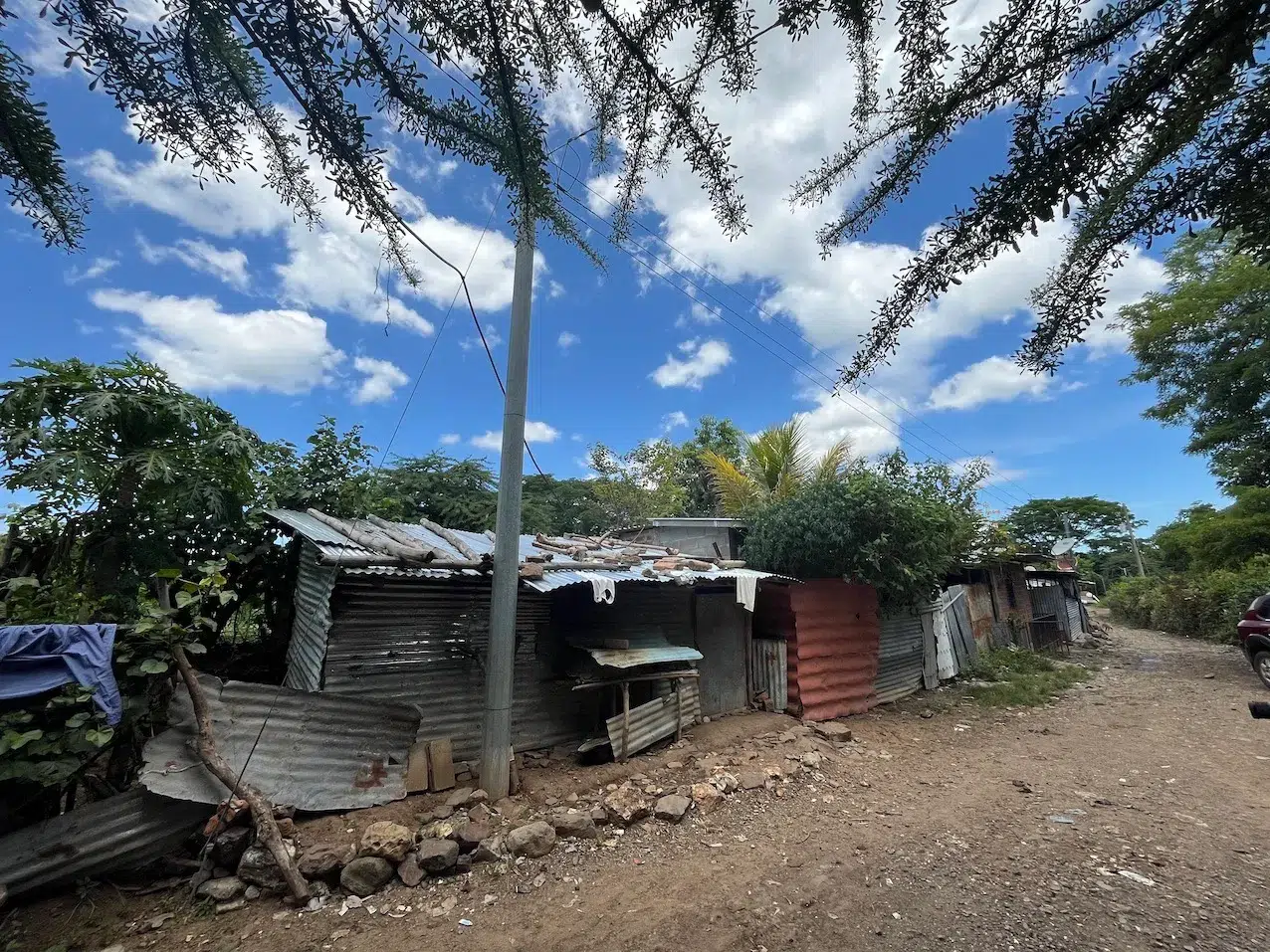
In San Isidro, Cabañas, the reopening of metallic mining is reviving old tensions and wounds that had yet to heal. Communities like El Tren report attempted evictions, the felling of more than 15,000 trees, and the risk of losing their water sources. Added to this is the arsenic contamination detected in the well of the El Junquillo settlement, which supplies water to 240 families for 2 hours once a week.
Peter Natarén, a resident and spokesperson from Cabañas, led a group of journalists to the El Tren community in San Isidro, where they are being threatened due to possible mining operations in the area. Additionally, there are plans to clear a forest in the area — some 15,000 trees would be felled to widen the access road to the zone where mining extraction is planned.
Mining exploration had already been carried out in the area by Pacific Rim, one of the mining companies that tried to operate when the mining ban was not yet the law of the Republic.
“We’re standing right now on land in San Isidro that’s a target for mining companies, because in the past, Pacific Rim did exploration here — a Canadian mining company that spent several years doing exploration work,” said Natarén, standing in front of the forest they plan to cut down.
Cabañas: A Mining Powerhouse
To understand the issue, it is necessary to provide some context: Pacific Rim began operating in El Salvador in 2002 with exploration permits, but in 2004, it was denied an exploitation permit. Furthermore, the permits that had been granted were suspended; the government at the time argued that mining exploitation would contaminate El Salvador’s already scarce water resources. Faced with this situation, the mining company filed a lawsuit in 2009 with the International Centre for Settlement of Investment Disputes (ICSID), which operates under the World Bank. The government had denied the company permits for mining exploitation in El Dorado, Cabañas.
The arbitration lasted seven and a half years; in the middle of this process, Pacific Rim was acquired in 2013 by the Australian company OceanaGold. In 2016, the ICSID ruled in favor of the Salvadoran state and ordered the company to pay El Salvador $8 million to cover the legal costs of the international litigation.
One year after the ruling, the Legislative Assembly, following a fierce civil struggle, approved the Law Prohibiting Metallic Mining in El Salvador, meaning mining would be banned in 100% of the Republic. However, that achievement would last only 7 years, because in 2024, one day before Christmas Eve, the ruling-party majority Legislative Assembly approved a new “General Law on Metallic Mining,” which repealed the “Law Prohibiting Metallic Mining.”
“Now History Is Repeating Itself”
Peter Natarén pointed out that the threat of mining is once again ringing in the ears of the communities, since with the approval of the new mining law “history is repeating itself,” referring to companies seeking to carry out mining operations in Cabañas.
The plots of land in San Isidro “are targets because they’ve already been explored,” Natarén explained during the tour.
“Pacific Rim already knew from its reports that there was gold here, and they were demanding that the Salvadoran state, at the time, give them the exploitation licenses. They were at that stage; they had already passed the exploration phase. So the organized people of this area fought, didn’t allow that to happen, and managed to build a consensus in this country that led different sectors, including the politicians themselves, to determine that this industry was not viable,” the community leader recalled.
Natarén noted that these lands are currently being acquired by companies with foreign financing. “Many of the properties that have already been bought are being financed by Banco Atlántida of Honduras. There is a lot of mining in Honduras, there are many interests from sectors that, beyond what they do in those territories, have also murdered a great deal of leadership, unfortunately, where the projects are located.”
15,000 Trees Will Be Felled
In the area, it has been said that the entire forest would be cleared — more than 15,000 trees that line the main road along the old highway to Llano de la Hacienda and the El Tren community.
During the tour of the area, Diario Co Latino spoke with a worker who was doing maintenance on the teak trees; however, she said she was unaware of the threats of a possible eviction and the destruction of the forest. She noted that her boss, the owner of the land where part of the forest stands, has told them that the teak trees could be harvested in about 10 years, since they are currently not ready to be cut.
The teak trees are approximately 20 years old, having been planted around that time; but since then, no more have been planted — they have only been maintained. What has been planted are mango and lemon trees.
Comparing Google Maps images with on-site surveys conducted by the National Registry Center (CNR) shows how the vegetation has been disappearing due to felling. However, it should be clarified that the clearing of brush that obstructs pedestrian or vehicular passage is an essential task to ensure mobility.
Bukele Promised Wealth, but His Solution Is Eviction
It should be clarified that the road is a national road — that is, it belongs to the state — and along its edges are families who settled there 30, 40, and even 50 years ago, because they had nowhere else to go. The owners of the lands near the zone explored by Pacific Rim have asked the Cabañas Este Mayor’s Office to evict them. “Those families have nowhere to go, and that’s the first problem: the poor lose out, and it’s the opposite of (Nayib) Bukele’s deceptive narrative, that the poor were the ones who were going to win once mining was activated in this country (because they could sell their houses).”
During a national broadcast on December 2, 2024, Nayib Bukele maintained that the footprint of mines in El Salvador is less than 1% of the territory: “It’s not like there’s going to be a mine right next to my house. Believe me, if you live next to the mine, they’re going to buy your house for a ton of money… No one is going to be angry about living next to the mine, because they’ll be able to buy your house and you could even buy 10 houses with that money. The biggest beneficiaries are those who live next to the possible future mining projects,” he said.
In contrast, the El Tren community has not been offered money for their homes — they have been offered eviction. In fact, around 20 to 30 families were threatened with possible eviction by the company “Inversiones El Dorado S.A de C.V.,” as was reported late last month.
The representative of the El Tren community in San Isidro, Abelina Acosta, who is also one of the affected residents, said she has received warnings to keep quiet about the eviction proceedings against her.
Juan Francisco González Iraheta, also a leader of the El Tren community, added that Inversiones El Dorado has accused them of taking over the lands where they live; the leader explained that it was the mayors who gave them those places to live.
One resident who has been in the area since 1985 and did not want to be identified told Diario Co Latino that the eviction issue could gain more prominence after the elections. However, neither she nor the community has been heard, since they previously even requested a public water tap to supply themselves with drinking water and not have to drink from the river or buy it privately.
The resident recounted that staff from the Ministry of Environment and Natural Resources (MARN) even came to the area to confront them over alleged environmental contamination in the zone. They have also been denied permits to build wells, so the community has refrained from speaking out or seeking help from the authorities. The resident herself used to participate in public demonstrations on environmental issues in the area and in San Salvador, but she has stopped doing so for her own safety and because of the illnesses she suffers from.
Reciprocal Trade Agreement
U.S. companies could be the main parties interested in these lands, since El Salvador and the United States signed a reciprocal trade agreement.
In the Official Gazette of February 7, 2026, the “Agreement between the Republic of El Salvador and the United States of America on Reciprocal Trade” was published. Article 6.2: Investment states that El Salvador will allow and facilitate “investment by the United States in its territory to explore, carry out mining activities, extract, refine, process, transport, distribute, and export critical minerals and energy resources, as well as to provide energy generation, telecommunications, transportation, and infrastructure services.”
This means mining operations could become a reality in the future. “Once the companies set up here, it’s going to be difficult for many families to fight against those companies,” Natarén stressed, highlighting the residents’ efforts to avoid being evicted and to prevent metallic mining from taking hold.
“If the state is truly defending its inhabitants, it would have to find a solution for these families; the mayor’s office has told them there is no solution, there’s nowhere to send them, there’s no land, there’s no money to pay them for their houses. That is the first implication of the law allowing mining that the Assembly voted for — these people are going to be the first victims,” Natarén stressed.
“It Won’t Just Affect Us — This Will Be Nationwide”
Another resident of the area stated that she is not interested in selling her property and will, on the contrary, fight to keep her land, since with the mining projects the neighboring plots are being bought up. “It won’t just affect us as owners (of the land surrounding the mining explorations); this is going to be nationwide, and what a shame that people can’t understand that it’s harm at the national level with all the toxic material.” “We are fighting against mining; we’re going to do everything we can,” she concluded.
Starting from where the urban area of San Isidro ends, along the old highway to Llano de la Hacienda, about 300 meters away are the houses of the El Tren Community; then, 500 meters further, is the old river, which supplies water to the nearby homes.
Water That Tastes Like Arsenic
This area of Cabañas is characterized by having minerals in its soil — it can even be seen in the surface rocks. Digging a well in the area could meet a basic water need, but the risk of it containing chemicals is high, as happened to the El Junquillo community in San Isidro, Cabañas Este.
In 2006, the well was drilled with the cooperation of Plan International and was inaugurated in 2008; in addition, the Community Association for the Administration of the Potable Water System of the El Amate Canton, Ríos de Agua Fría (ACASAPRAF), was formed. People celebrated that they would have water, but it was not until 2023 that a nongovernmental organization conducted tests on the water.
According to a study conducted by the Specialized Quality Control Laboratory in March 2023 on the 118-meter-deep El Junquillo well, it revealed the presence of arsenic at 0.026 mg/L, when the limit for safe consumption is 0.01 mg/L. Again, in March 2025, another study was done, which confirmed the presence of arsenic, but this time at a higher level, registering 0.045 mg/L.
Marvin Pineda, secretary of the community development association (ADESCO) ACASAPRAF, pointed out that even so, the water continues to be distributed, and many people drink it as normal water “because it’s the only source — there’s no other; the surface sources that exist don’t even supply enough to bathe in.” Furthermore, river water is not fit for human consumption, he said.
In 2022, the community, through the organization SABES El Salvador, arranged for the construction of a filter, but when it was about to be inaugurated, the well “collapsed” — that is, “it was drying up” — and so the filter and the plant could not be put into operation. For now, they have this project set aside, waiting for a solution.
In 2023, Marvin was serving as president of the ADESCO and, as an alternative to the problem, arranged for a hydrogeological study to drill a new well in the Flor Amarilla settlement, El Amate canton, San Isidro, Cabañas, which is far from the current one contaminated by arsenic.
The study is the community’s main document for negotiating the drilling with other NGOs and entities. Pro-Vida has drawn up a project to carry out the drilling, but they would cover 80% of the total project cost, while the community would need to raise the remaining 20%, which would be $57,000, since it involves a deeper well than the current one and with carbon steel piping.
In February of this year, the community met with PRO-VIDA and representatives of the Mayor’s Office, and they contacted “Somos Río Lempa” (We Are the Lempa River), an initiative co-led by Catholic Relief Services (CRS) and the Environmental Investment Fund of El Salvador (FIAES). This organization liked the project, but they set one condition: the preparation of a technical file for the entire system the community has in place, which Plan International did in 2006–2008 when the well was going to be drilled; however, those files are only kept for a certain amount of time, so they no longer have them.
Given this situation, according to Marvin Pineda, the current municipal administration would approve funds to prepare the technical file, which would cost around $25,000. But the municipality would need a supporting document signed by “Somos Río Lempa,” in which they commit to a specific investment — this, to avoid audit problems down the line.
Another proposal on the table is with Cáritas El Salvador, since they have the possibility of helping them with a project to drill the existing well even deeper to see if more water can be found, and to rehabilitate the plant with the filter that is currently sitting unused. As a community, they tried to arrange a meeting between Cáritas and the municipality, but to date, it has not materialized.
Regarding this last proposal, they do not know whether it would worsen the arsenic problem, since a large amount of this chemical may be concentrated in one layer of the well.
“For example, I used to have tilapia, and about two years ago they died on me, and other neighbors’ fish died too, but right now I’ve had small tilapia for about 2 years and they haven’t died. I think the arsenic layer has stayed up top — as the well dries up, then when the water level rises, maybe it reaches the arsenic layer, and that’s where it gets contaminated,” Marvin explained.
The filter is currently on hold; it has an approximate value of $50,000 (including pipes, tools, etc.). All of this information is provided with the aim of raising awareness among the relevant authorities, since day after day they go without water, and it is currently supplied once a week for between 1 and a maximum of 3 hours in the 4 settlements: Amate, El Junquillo, La Loma, and Flor Amarilla. On average, they supply 240 families. They are asking for help to prevent the situation from worsening to water being supplied for only two hours every 15 days.
Mining, the Final Blow to the Territories
The mining issue would further complicate the whole situation in the territories, since the surface rivers that run through the area could be contaminated; necessity itself has forced residents to get water from that source for household chores, due to the lack of drinking water. A resident near the old river pointed out that the old river is her main source of supply, and if mining operations go forward, “contamination would be inevitable.”
The resident did not want to be identified for fear of reprisals, but she called on the public to show unity and oppose mining. “Let’s not say, ‘It doesn’t affect me because it’s over there in Cabañas,’ or that it’s only going to affect the people who live nearby — no, this is nationwide, it’s going to affect all of us.”
Diario CoLatino: https://www.diariocolatino.com/san-isidro-bajo-amenaza-ambiental-mineria-desalojos-tala-de-arboles-y-agua-contaminada-con-arsenico/
San Isidro bajo amenaza ambiental: minería, desalojos, tala de árboles y agua contaminada con arsénico
Por Samuel Amaya
En San Isidro, Cabañas, la reapertura de la minería metálica revive viejas tensiones y heridas que aún no sanaban. Comunidades como El Tren denuncian intentos de desalojo, la tala de más de 15 mil árboles y el riesgo de perder sus fuentes de agua. A ello se suma la contaminación por arsénico detectada en el pozo del caserío el Junquillo que abastece de agua por 2 horas una vez a la semana a 240 familias.
Peter Natarén, un habitante y vocero de Cabañas lideró a un grupo de periodistas hacia la comunidad El Tren en San Isidro, donde están siendo amenazados debido a posibles trabajos mineros en la zona. Además, en la zona se pretende arrasar con un bosque, serían 15 mil árboles los que se talarían para ampliar la calle de acceso a la zona donde se pretende hacer extracción minera.
En la zona, ya se había hecho exploración minera por parte de Pacific Rim, una de las empresas mineras que intentaba operar cuando la prohibición de la minería no era ley de la República.
“Justo estamos en un terreno en San Isidro, objetivos para las empresas mineras, porque en el pasado acá se hizo exploración de parte de Pacific Rim, que era una empresa minera de Canadá, que estuvo por varios años haciendo exploraciones”, dijo Nataren frente al bosque que pretenden talar.
Cabañas: una potencia minera
Para entender la problemática, es necesario contextualizar que Pacific Rim comenzó a operar en El Salvador en 2002 con permisos de exploración; pero luego en 2004, se le denegó el permiso de explotación. Además, suspendió los permisos otorgados, el Gobierno de aquel entonces alegó que la explotación minera sería contaminante a los de por sí, escasos recursos acuíferos de El Salvador. Ante tal situación, la empresa minera en 2009 interpuso una demanda ante el Centro Internacional de Arreglo de Diferencias relativas a Inversiones (CIADI), el cual, depende del Banco Mundial. El gobierno le negó los permisos para la explotación minera en El Dorado, Cabañas.
El arbitraje duró siete años y medio, en medio de este proceso, Pacific Rim fue adquirida en 2013 por la empresa australiana Oceana Gold. El CIADI falló en 2016 a favor del Estado salvadoreño y ordenó indemnizar a El Salvador con $8 millones para cubrir los costos procesales del litigio internacional.
Un año después del fallo, la Asamblea Legislativa, luego de una férrea lucha civil, aprobó la Ley de Prohibición de la Minería Metálica en El Salvador, con lo que, la minería estaría prohibida en el 100% de la República. Sin embargo, esa hazaña duraría 7 años, pues en 2024, un día antes de Nochebuena, la Asamblea Legislativa de mayoría oficialista, aprobó una nueva “Ley General de Minería Metálica”, con la que se derogaría la “Ley de Prohibición de la Minería Metálica”.
“Ahora se repite la historia”
Peter Nataren señaló que la amenaza de la minería vuelve a estar en los oídos de las comunidades, ya que con la aprobación de la nueva ley de minería “se repite la historia”, en referencia a empresas que buscan hacer trabajos mineros en Cabañas.
Los terrenos en San Isidro “son objetivos porque ya están explorados”, informó Nataren durante el recorrido.
“Ya se sabe de parte de Pacific Rim en sus informes que aquí había oro y ellos estaban exigiendo al Estado salvadoreño, en ese momento, que les dieran las licencias para explotación. Estaban en esa etapa, ya habían pasado la etapa de exploración. Entonces, la gente organizada de esta zona luchó, no permitió que eso sucediera y logró que el consenso en este país llevara a distintos sectores, incluso, los mismos políticos, a determinar que no era viable esta industria”, recordó el líder comunitario.
Nataren señaló que estos terrenos, actualmente están siendo adquiridos por empresas que tienen financiamiento extranjero. “Muchos de los terrenos que ya se compraron están siendo financiados por el Banco Atlántida de Honduras. En Honduras hay mucha minería, hay muchos intereses de sectores que más allá de lo que hacen en esos territorios también han asesinado muchísimo liderazgo, lamentablemente, donde están los proyectos”.
15 mil árboles serán talados
En la zona, se ha dicho que se talaría todo el bosque, más de 15 mil árboles que rodea la calle principal de la carretera antigua al Llano de la Hacienda y de la Comunidad El Tren.
En la zona del recorrido, Diario Co Latino habló con una trabajadora que se encontraba dando mantenimiento a los árboles de teca; sin embargo, ella dijo desconocer sobre las amenazas de un posible desalojo y destrucción del bosque. Ella señaló que su jefe, el dueño del terreno donde se encuentra parte del bosque, les ha manifestado que los árboles de teca podrían sacarse en unos 10 años, aproximadamente, ya que actualmente, no están listos para cortarse.
Los árboles de teca tienen aproximadamente 20 años desde que se plantaron; pero desde entonces ya no volvieron a sembrar más, solo les han dado mantenimiento. Lo que sí se ha sembrado, son árboles de mango y de limón.
Al comparar las imágenes de Google Maps de los recorridos in situ realizados por el Centro Nacional de Registros (CNR), se evidencia cómo la vegetación ha ido desapareciendo por la tala. Sin embargo, es necesario aclarar que el chapodado de arbustos que obstaculizan el paso peatonal o vehicular constituye una labor indispensable para garantizar la movilidad.
Bukele prometió riqueza, pero soluciona con desalojo
Es de aclarar que la calle es nacional, es decir, del Estado y a sus orillas hay familias que llegaron a asentarse desde hace 30, 40 y hasta 50 años, debido a que no tenían a donde ir. Los dueños de los terrenos cerca de la zona explorada por Pacific Rim le han pedido a la Alcaldía de Cabañas Este que los desaloje. “Esas familias no tienen donde irse y ese es el primer problema, pierden los pobres y es lo contrario con la narrativa engañosa de (Nayib) Bukele, que los pobres eran los que iban a ganar con la minería una vez activada en ese país (porque podían vender sus casas)”.
Durante una cadena nacional el 2 de diciembre de 2024, Nayib Bukele, sostuvo que la huella de las minas en El Salvador es menos del 1% del territorio, “no es que a la par de mi casa, va a ver una mina, créame, si usted vive a la par de la mina, le van a comprar la casa en montón de dinero… Nadie se va a enojar por vivir a la par de la mina, porque le van a poder comprar la casa y hasta podría comprar 10 casas con ese dinero, los más beneficiados son los que viven a la par de los posibles futuros proyectos mineros”, dijo.
En contraste, a la comunidad El Tren, no le han ofrecido dinero por sus viviendas, le han ofrecido desalojo. De hecho, alrededor de 20 a 30 familias fueron amenazadas ante posibles desalojos por parte de la empresa “Inversiones El Dorado S.A de C.V.”, según se informó a finales del mes pasado.
La representante de la comunidad El Tren en San Isidro, Abelina Acosta y una de las habitantes afectadas, relató que ha recibido advertencias para guardar silencio sobre el proceso de desalojo en su contra.
Juan Francisco González Iraheta, también líder de la comunidad El Tren, agregó que Inversiones El Dorado los ha acusado de apropiarse los terrenos donde habitan; el líder informó que fueron los alcaldes quienes les dieron esos lugares para habitar.
Una de las habitantes que está en la zona desde 1985 y que no quiso ser identificada, dijo a Diario Co Latino que posiblemente después de las elecciones, podría tomar más protagonismo el tema del desalojo. Sin embargo, a ella, así como a la comunidad, no las han escuchado, ya que con anterioridad, incluso, pidieron una cantarera (un chorro) para abastecerse de agua potable y no consumir del río ni comprarla a privado.
La habitante relató que incluso, personal del Ministerio de Medio Ambiente y Recursos Naturales (MARN) llegó a la zona para reclamarles por presunta contaminación ambiental en la zona. También, les han negado los permisos para construir pozos; por lo que, la comunidad se ha limitado en pronunciarse o buscar ayuda a las autoridades; incluso, la habitante antes, participaba en expresiones públicas sobre el tema medioambientales en la zona y en San Salvador, pero lo ha dejado de hacer por su propia seguridad y por las enfermedades que padece.
Acuerdo de comercio recíproco
Las empresas norteamericanas, podrían ser las principales interesadas en estos terrenos, ya que El Salvador y Estados Unidos firmaron un acuerdo comercial recíproco.
En el Diario Oficial del 7 de febrero de 2026, se publicó el “Acuerdo entre la República de El Salvador y los Estados Unidos de América sobre Comercio Recíproco” en el Artículo 6.2: Inversión : señala que El Salvador permitirá y facilitará “la inversión de los Estados Unidos en su territorio para explorar, realizar actividades mineras, extraer, refinar, procesar, transportar, distribuir y exportar minerales críticos y recursos energéticos, así como para proveer servicios de generación de energía, telecomunicaciones, transporte e infraestructura”.
Por lo que, los trabajos mineros podrían estar presentes en un futuro. “Una vez se instalen las empresas acá va a ser difícil para muchas familias luchar contra esas empresas”, destacó Nataren, quien destacó el esfuerzo de los habitantes para evitar ser desalojados y que no se desarrolle la minería metálica.
“El Estado si es en defensa de sus habitantes tendría que buscar una solución para estas familias; la alcaldía les ha dicho que no hay solución, no hay donde mandarlos, no hay tierra, no hay dinero para pagarles las casas. Esa es la primera implicación de la ley que permite la minería que votó la Asamblea, esta gente van a ser las primeras víctimas”, destacó Nataren.
“No solo nos afectarán a nosotros, esto va ser a nivel nacional”
Otras de las habitantes de la zona afirmó que no está interesada en vender la propiedad y por el contrario, luchará por mantener sus tierras; ya que con los proyectos mineros, se están comprando los terrenos aledaños. “No solo nos afectarán a nosotros como propietarios (de los terrenos, de los alrededores de las exploraciones mineras), esto va ser a nivel nacional y qué lástima que la gente no pueda entender que es un daño a nivel nacional con todo el material toxico”. “Nosotros estamos luchando en contra de la minería; vamos a hacer hasta lo que se pueda”, concluyó.
Desde que finaliza el caso urbano de San Isidro, por la carretera antigua al Llano de la Hacienda a unos 300 metros, se encuentran las casas de la Comunidad El Tren, luego a 500 metros; se encuentra el río viejo, el cual, abastece de agua a las viviendas cercanas.
Agua con sabor a arsénico
Esa zona de Cabañas se caracteriza por tener minerales en sus suelos, incluso, se puede evidenciar con las piedras superficiales; abrir un pozo en la zona podría suplir una necesidad básica de agua, pero el riesgo que contenga químicos es alto, tal y como le pasó a la comunidad El Junquillo, en San Isidro, Cabañas Este.
En 2006, se perforó el pozo con la cooperación de Plan Internacional y se inauguró en 2008, además, surgió la Asociación Comunal Administradora del Sistema de Agua Potable del cantón El Amate Ríos de Agua Fría (ACASAPRAF). La gente celebró que tendrían agua, pero fue hasta 2023, que una organización no gubernamental realizó estudios a las aguas.
Según un estudio realizado por el Laboratorio Especializado en Control de Calidad en marzo de 2023 al pozo de 118m de El Junquillo, reveló la presencia de arsénico en un 0.026 mg/L, cuando el límite para que pueda consumirs es 0.01 mg/L. Nuevamente, en marzo de 2025, se volvió a hacer un estudio, en él se reiteró la presencia de arsénico, pero esta vez, con mayor representatividad, ya que arrojó 0.045 mg/L.
Marvin Pineda, secretario de la Adesco, ACASAPRAF, señaló que, aún así, se sigue distribuyendo el agua, y muchas personas la consumen como agua normal, “porque es la única fuente, no hay otra; las fuentes superficiales que hay no abastecen ni para bañarse”; además, las aguas de los ríos no son apta para el consumo humano, dijo.
En 2022, la comunidad, a través de la organización SABES El Salvador, gestionó la construcción de un filtro, pero cuando se iba a inaugurar, el pozo “colapsó”, es decir, “se estaba quedando seco” y por lo cual, el filtro con la planta no se pudo echar a andar. De momento, este proyecto lo tienen resguardado, esperando una solución.
En 2023, Marvin fungía como presidente la ADESCO y como alternativa a la problemática, gestionó un estudio hidrogeológico para perforar un nuevo pozo en el caserío Flor Amarilla, cantón El Amate, San Isidro, Cabañas, el cual, está alejado del actual contaminado por arsénico.
El estudio es el principal documento de la comunidad para gestionar con otras ONG y entidades, la perforación. Pro-Vida ha formulado un proyecto para hacer la perforación, pero pondrían el 80% del total del proyecto, mientras que la comunidad gestionaría el restante 20% que serían $57 mil ya que se trata de un pozo más profundo que el actual y con tubería de acero al carbón.
En febrero de este año, la comunidad se reunió con PRO-VIDA y con representantes de la Alcaldía y ellos, contactaron a “Somos Río Lempa”, una iniciativa coliderada por Catholic Relief Services (CRS) y el Fondo de Inversión Ambiental de El Salvador (FIAES). A esta organización, les pareció el proyecto, pero han puesto una condición: realizar una carpeta técnica de todo el sistema que tienen en la comunidad; la cual la hizo Plan Internacional en 2006-2008 cuando se iba a perforar el pozo; pero, esos archivos, los tienen un cierto tiempo; por lo que actualmente, no los tienen.
Ante esta situación, según Marvin Pinera, la actual administración municipal aprobaría fondos para realizar la carpeta técnica, la cual rondaría cerca de los $25 mil. Pero la comuna necesitaría un documento de respaldo firmado por “Somos Río Lempa”, donde se comprometan a hacer X inversión; esto, para evitar problemas de auditorías a futuro.
Otra de las propuestas que está sobre la mesa es con Cáritas El Salvador, ya que ellos, tienen la posibilidad de ayudarles con un proyecto para perforar aún más el pozo ya existente para ver si se encuentra más agua y rehabilitar la planta con el filtro que actualmente tienen en desuso. Como comunidad, buscaron entablar una reunión entre Cáritas y la comuna, pero hasta la fecha, no se ha concretado.
Sobre esta última propuesta, desconocen si se agravaría el problema del arsénico; ya que posiblemente es en una capa del pozo que concentra gran cantidad de este químico.
“Por ejemplo, yo tenía tilapia y hace como dos años se me murieron y a otros vecinos también se les murieron los pescados, pero ahorita, yo tengo cerca de 2 años de tener tilapia pequeña y no se han muerto. Yo creo que la capa de arsénico ha quedado arriba, como el pozo se va secando, entonces, cuando el pozo sube, quizá logra tocar la capa de arsénico y es ahí donde se contamina”, destacó Marvin.
El filtro actualmente está en pausa, tiene un valor aproximado de $50 mil (incluyendo tuberías, herramientas etc). Toda esta información proporcionada es con el objetivo de concientizar a las autoridades correspondientes ya que día con día se quedan sin agua y actualmente la suministran 1 vez a la semana entre 1 a hora a 3 horas máximo en los 4 caseríos: Amate, el Junquillo, La Loma y Flor Amarilla. En promedio, abastecen a 240 familias. Piden la ayuda para evitar que el agua se suministre dos horas cada 15 días.
Minería, el golpe de gracia a los territorios
Con el tema de la minería se complicaría aún más toda la situación en los territorios, ya que se podría contaminar el río superficial que pasan por la zona, donde la misma necesidad ha hecho que los habitantes se abastezcan de esa fuente para los quehaceres del hogar, debido a la falta de agua potable. Una habitante, cerca del río viejo, señaló que el río viejo es su principal centro de abastecimiento y al desarrollar los trabajos mineros “la contaminación sería inevitable”.
La habitante que no quiso ser identificada por temor a represalias, pero hizo un llamado a la ciudadanía a mostrar unidad y oponerse a la minería. “No digamos, a mí no me afecta porque es allá en Cabañas o que va a ser nada más a las personas que viven en los alrededores y no, esto es a nivel nacional, nos va a afectar a todos”.
Diario CoLatino: https://www.diariocolatino.com/san-isidro-bajo-amenaza-ambiental-mineria-desalojos-tala-de-arboles-y-agua-contaminada-con-arsenico/