
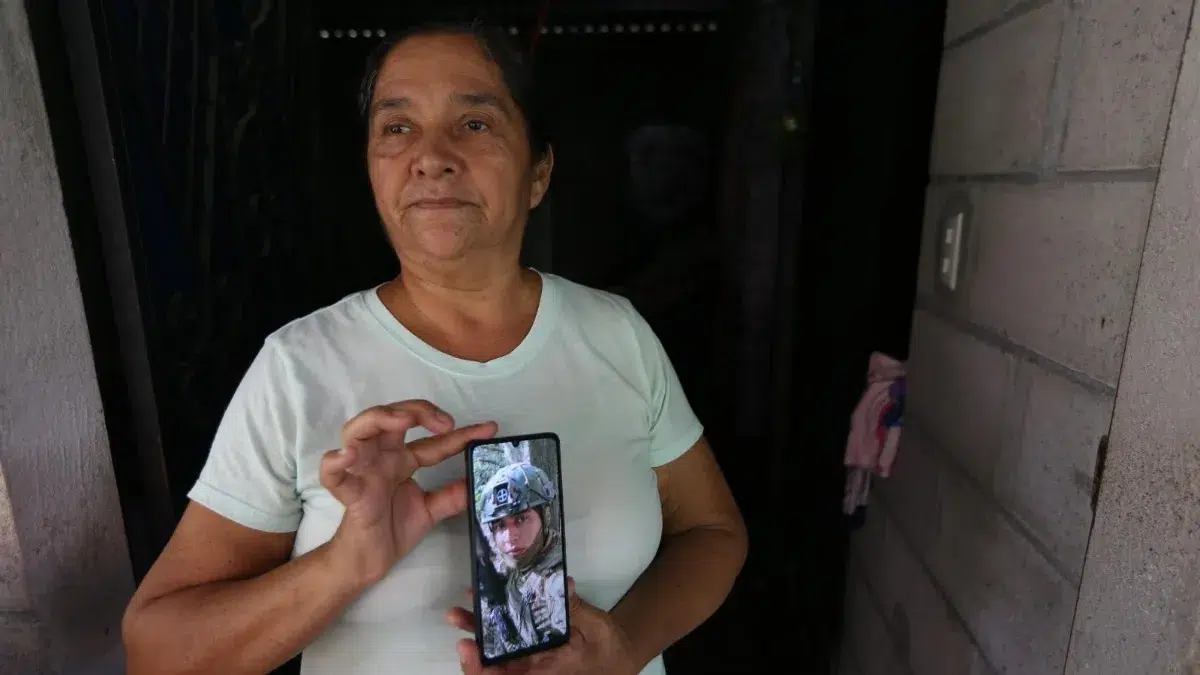
María Ester waits at her home in the cantón of Tecoluco Abajo in San Pedro Perulapán, Cuscatlán, in the same house where just a few months ago she was still living with Héctor Iván and Kevin Vladimir, both with the surname Escobar Hernández, who between December 2025 and February 2026 decided to accept a job offer in Russia without knowing they would end up fighting in a war that wasn’t theirs and that they would leave their mother with the anguish of hoping to see them again, even if just one last time.
The Escobar Hernández brothers are part of a group of Salvadorans who were convinced to participate in a “military recruitment program of the Russian Ministry of Defense,” which, according to the document they were made to sign, allows foreigners to travel to and work in Russia to provide support in the country, which has been at war with Ukraine since February 2022.
María Ester says both her sons had previously served in El Salvador’s military but left the Armed Forces because their pay was too low. One day a man named Carlos Gallegos contacted them and offered them a formal job in Russia — an offer that, according to their mother, they saw as “the opportunity to have a better future.”
According to the contract obtained by LA PRENSA GRÁFICA, the Salvadorans were offered a $20,000 welcome bonus, a monthly salary of $2,800, healthcare, life insurance, death benefits, two weeks of paid vacation every six months, financial incentives for each completed task, and the possibility for both them and their relatives to obtain Russian citizenship.
But neither María Ester nor her sons have received any of what was promised. On the contrary, on May 28, 2026, she was informed that Kevin Vladimir, 26, had died and that his body was in a morgue in Moscow. Meanwhile, she has had no communication with Héctor Iván since March 16 of this year.
“They were offered many things, but when they arrived there the conditions were precarious. They knew there was combat, but they never imagined they would be abandoned like that, or that they wouldn’t be allowed to leave,” says María Ester, referring to the fact that both her sons and the rest of the Salvadorans who traveled were stripped of their passports, documents, and cell phones upon entering Russia.
After learning of Kevin Vladimir’s death, both María Ester and other family members sought the support of a Salvadoran government institution to repatriate his body, but to this day they have received no help.
El Salvador’s Ministry of Foreign Affairs told them it cannot do anything until it receives confirmation from the Russian government of their compatriots’ presence there. This news outlet called and sent an email to the state agency to learn the details of the situation, whether they know of more cases, and whether they can help the families, but received no response before this story went to press.
A call was also placed to the Russian diplomatic representation in El Salvador, and a staff member said only that “there is no official plan (for military recruitment) for diplomatic reasons. Those who want to go, go on their own.” He then asked that the remaining questions be sent via WhatsApp, which was done, but no further responses were received.
Without state support
Yazmín is going through the same situation. Her husband and her brother-in-law traveled to Russia motivated by the job offer they received from Carlos Gallegos, through a company calling itself International Solutions, and Marly Montoya, through a travel agency called Latin Travel.
Her husband left on December 7, 2025, and was told he would be working as a “bodyguard.” But upon arrival, he was made to sign another contract that was in Russian and committed him to staying in the country for one year.
“My husband called me on January 10 (2026). He told me he’d been sent to the battlefield and that he was injured. I begged him to come back, that we’d figure out how to pay for everything here, but he said they were going to send him to Donetsk (in Ukraine) and that he didn’t have his documents,” Yazmín says.
After that call, Yazmín sprang into action and, together with relatives of other Salvadorans who are also in Russia, began mobilizing. She delivered a letter to the Presidency of the Republic and another to the International Committee of the Red Cross. She sought counsel from the Office of the Human Rights Ombudsman (PDDH), filed a habeas corpus petition with the Constitutional Chamber of the Supreme Court of Justice, and opened a case with the Foreign Ministry. But none of them have ruled in her favor.
“At the Foreign Ministry they told me that if they had signed a contract voluntarily, there was nothing they could do. Why do they choose to turn a blind eye? It’s true that no one forced them, but they were deceived. We wish the government would at least bring all of us affected families together and help us understand what we can do to get them home,” Yazmín added.
They’ve also been hit financially. The promise of a salary for her husband has gone unfulfilled, and she has had to find an evening shift job to support her two daughters, ages eight and 13. She learned that her brother-in-law had also been wounded by a bomb and had undergone surgery on his head, but even so he has not been sent back.
LA PRENSA GRÁFICA obtained Carlos Gallegos’s phone number, but it appears to be out of service. As for his company, International Solutions, there is no trace of it in El Salvador’s private security agency records.
As for Marly Montoya and her travel agency, it was confirmed that she is Colombian, and two calls were placed to her number in that country on July 16, but she did not answer. She did respond to the messages and questions sent via WhatsApp, but claimed she has no connection to the company that recruited the Salvadorans and that she only provides “logistical assistance” with “services related to tourism and travel.”
This outlet obtained documentation in which Marly Montoya is identified as the trip’s “coordinator” and as the person “responsible for tickets, insurance, and documentation.” She also advises the Salvadorans to say they are traveling as “tourists” and confirms they have round-trip tickets.
“We understand the families’ concern. However, Latin Travel does not have information on individuals allegedly linked to military activities, as the company does not participate in those processes. When we receive inquiries related to matters outside our services, we do not have information we can provide. We are always willing to cooperate with the competent authorities within the framework of the law. The information we have on our clients will always pertain to the tourism services provided,” Montoya added, regarding the calls she has also received from family members seeking help.
Rubén Vásquez, who appears in the contracts as the “agency’s lawyer,” was also contacted, but he did not answer calls or messages to a cell phone with a Salvadoran number either.
As a last resort, Yazmín and other relatives of the Salvadorans taken to Russia went to the Attorney General’s Office (FGR) and filed a complaint against those responsible for the recruitment — a process similar to the one pursued by Salvadorans who were taken to the Democratic Republic of the Congo, in Africa, during 2025.
The goal is for the Public Prosecutor’s Office to investigate possible human trafficking as well as ideological falsehood, but time keeps passing and in the meantime they still have no information on their relatives’ whereabouts, so they are asking the Salvadoran state to intercede with Russian authorities to find answers before more of them die.
“What I’m asking for is the repatriation of the bodies. Send me at least the remains of the one in Moscow and find the other one, if he’s still alive. We don’t care about anything else anymore,” María Ester concludes, regarding her situation.
Piden ayuda para repatriar a salvadoreños atrapados en la guerra de Rusia
David Bernal
María Ester espera en su casa, en el cantón Tecoluco Abajo de San Pedro Perulapán, en Cuscatlán, en la misma vivienda donde hace unos meses todavía convivió con Héctor Iván y Kevin Vladimir, ambos de apellidos Escobar Hernández, quienes entre diciembre de 2025 y febrero de 2026 decidieron aceptar una oferta laboral en Rusia sin saber que terminarían peleando en una guerra que no era suya y que dejarían a su madre con la angustia de volver a verlos, aunque sea una última vez.
Los hermanos Escobar Hernández son parte de un grupo de salvadoreños que fueron convencidos de participar en un “programa de contratación militar del Ministerio de Defensa de Rusia”, el cual, según el documento que les hicieron firmar, permite que extranjeros viajen y trabajen en Rusia para brindar apoyo en ese país, que se encuentra en guerra contra Ucrania desde febrero de 2022.
María Ester cuenta que sus dos hijos habían sido antes militares en El Salvador, pero que dejaron la Fuerza Armada porque su salario era muy bajo. Un día los contactó un hombre llamado Carlos Gallegos, quien les ofreció un trabajo formal en Rusia a cambio de una oferta que, según su madre, vieron como “la oportunidad de tener un futuro mejor”.
Según el contrato al que tuvo acceso LA PRENSA GRÁFICA, a los salvadoreños les ofrecían un bono de bienvenida de $20 mil, un salario mensual de $2 mil 800, asistencia sanitaria, seguro de vida, seguro de defunción, dos semanas de vacaciones pagadas cada seis meses, incentivos financieros por cada tarea completada y la posibilidad de que tanto ellos como sus familiares obtuvieran la nacionalidad rusa.
Pero ni María Ester ni sus hijos han recibido algo de lo prometido. Por el contrario, el 28 de mayo de 2026 a ella le avisaron que Kevin Vladimir, de 26 años, había fallecido y que su cuerpo estaba depositado en una morgue en Moscú. Mientras que con Héctor Iván no tiene comunicación desde el 16 de marzo de este año.
“A ellos les ofrecieron muchas cosas, pero al llegar allá las condiciones eran precarias. Sabían que había un combate, pero no se imaginaron que los abandonarían de esa forma, ni tampoco que no les permitirían salir”, cuenta María Ester, en relación a que tanto sus hijos como el resto de salvadoreños que viajaron fueron despojados de su pasaporte, sus documentos y sus celulares al entrar a Rusia.
Tras conocer la muerte de Kevin Vladimir, tanto María Ester como otros miembros de su familia buscaron el apoyo de una institución gubernamental salvadoreña para poder repatriar su cuerpo, pero hasta hoy no han recibido ayuda.
El Ministerio de Relaciones de Exteriores de El Salvador les dijo que no pueden hacer nada hasta recibir una confirmación del gobierno ruso de la presencia de los compatriotas allá. Este medio llamó y envió un correo a esta dependencia estatal para conocer los pormenores de la situación, si conocen de más casos y si pueden ayudar a las familias, pero no hubo respuestas hasta el cierre de esta nota.
También se llamó a la representación diplomática de Rusia en El Salvador y un encargado se limitó a decir que “no existe ningún plan oficial (de contratación militar) por razones diplomáticas. Los que quieren ir van por su cuenta”. Luego pidió enviar el resto de las preguntas que se tenían vía WhatsApp, lo cual se hizo, pero no se obtuvo más respuestas.
Sin apoyo estatal
Yazmín pasa por la misma situación. Su esposo y su cuñado viajaron a Rusia motivados por la oferta laboral que les hizo llegar Carlos Gallegos, a través de una empresa que se hace llamar International Solutions, y Marly Montoya, a través de la agencia de viajes Latin Travel.
Su esposo partió el 7 de diciembre de 2025 y le dijeron que iba para desempeñarse como “escolta”. Pero al llegar allá le hicieron firmar otro contrato que estaba en ruso y que lo comprometía a permanecer en ese país por un año.
Mi esposo me llamó el 10 de enero (2026). Me dijo que había sido enviado al campo de batalla y que estaba herido. Le pedí que se regresara, que acá veríamos cómo pagar todo, pero me dijo que lo enviarían a Donetsk (en Ucrania) y que no tenía sus documentos”, cuenta Yazmín.
Tras esa llamada Yazmín puso manos a la obra y en conjunto con familiares de otros salvadoreños que también están en Rusia comenzaron a movilizarse. Llevó una carta a la Presidencia de la República y otra al Comité Internacional de la Cruz Roja. Pidió asesoría ante la Procuraduría para la Defensa de los Derechos Humanos (PDDH), presentó un habeas corpus ante la Sala de lo Constitucional de la Corte Suprema de Justicia y abrió un caso en Relaciones Exteriores. Pero en ninguna han resuelto a su favor.
En Cancillería me dijeron que si ellos habían firmado un contrato de forma voluntaria no podían hacer nada. ¿Por qué deciden hacerse los ciegos? Es cierto que no los obligaron, pero fueron engañados. Quisiéramos que el gobierno al menos nos reuniera, a todos los afectados, y nos ayudar a entender qué podemos hacer para que vuelvan a casa”, agregó Yazmín.
Económicamente también están golpeados. La promesa del salario a su esposo no se ha cumplido y ella ha tenido que conseguir un trabajo de tarde-noche para sostener a sus dos hijas, de ocho y 13 años de edad. De su cuñado supo que también había sido herido por una bomba y que fue sometido a una operación en su cabeza, pero ni así lo han retornado.
LA PRENSA GRÁFICA consiguió el número telefónico de Carlos Gallegos, pero este aparece fuera de servicio. De su empresa, International Solutions, no hay rastros en materia de agencias de seguridad privada en El Salvador.
En cuanto a Marly Montoya y su agencia de viajes, se confirmó que ella es colombiana y se le realizaron dos llamadas a su número en ese país el 16 de julio, pero no respondió. Sí contestó a los mensajes y las preguntas que se le enviaron por WhatsApp, pero afirmó que ella no tiene ninguna relación con la empresa que reclutó a los salvadoreños y que únicamente presta “asistencia logística” con “servicios relacionados con turismo y viajes”.
Este medio tuvo acceso a documentación donde Marly Montoya es identificada como “coordinadora” del viaje y como “responsable de boletos, seguros y documentación”. También les recomienda a los salvadoreños que digan que viajan como “turistas” y les confirma que tienen boletos de ida y vuelta.
“Comprendemos la preocupación de las familias. Sin embargo, Latin Travel no dispone de información sobre personas presuntamente vinculadas a actividades militares, ya que la empresa no participa en esos procesos. Cuando recibimos consultas relacionadas con asuntos ajenos a nuestros servicios, no contamos con información que podamos proporcionar. Siempre estamos dispuestos a colaborar con las autoridades competentes dentro del marco de la ley. La información que tenemos de nuestros clientes siempre será respecto a los servicios turísticos prestados”, agregó Montoya, respecto a las llamadas que también le han hecho familiares para recibir ayuda.
También se contactó a Rubén Vásquez, quien aparece en los contratos como “abogado de la agencia”, pero tampoco atendió llamadas ni mensajes en un teléfono celular con número de El Salvador.
Como último recurso, Yazmín y otros familiares de los salvadoreños llevados a Rusia acudieron a la Fiscalía General de la República (FGR) y presentaron una denuncia contra los responsables de las contrataciones, un proceso similar al que han hecho salvadoreños que fueron llevados a la República Democrática del Congo, en África, durante 2025.
El objetivo es que el ministerio público investigue una posible trata de personas y también falsedad ideológica, pero el tiempo pasa y mientras tanto siguen sin obtener información del paradero de sus parientes, por lo que piden al Estado salvadoreño que interceda ante las autoridades rusas para encontrar respuestas antes que otros de ellos también mueran.
“Lo que pido es la repatriación de los cuerpos. Que me manden al menos el cadáver del que está en Moscú y que encuentren al otro, si aún sigue vivo. Ya no nos interesa nada más que eso”, concluye María Ester, sobre su situación.