
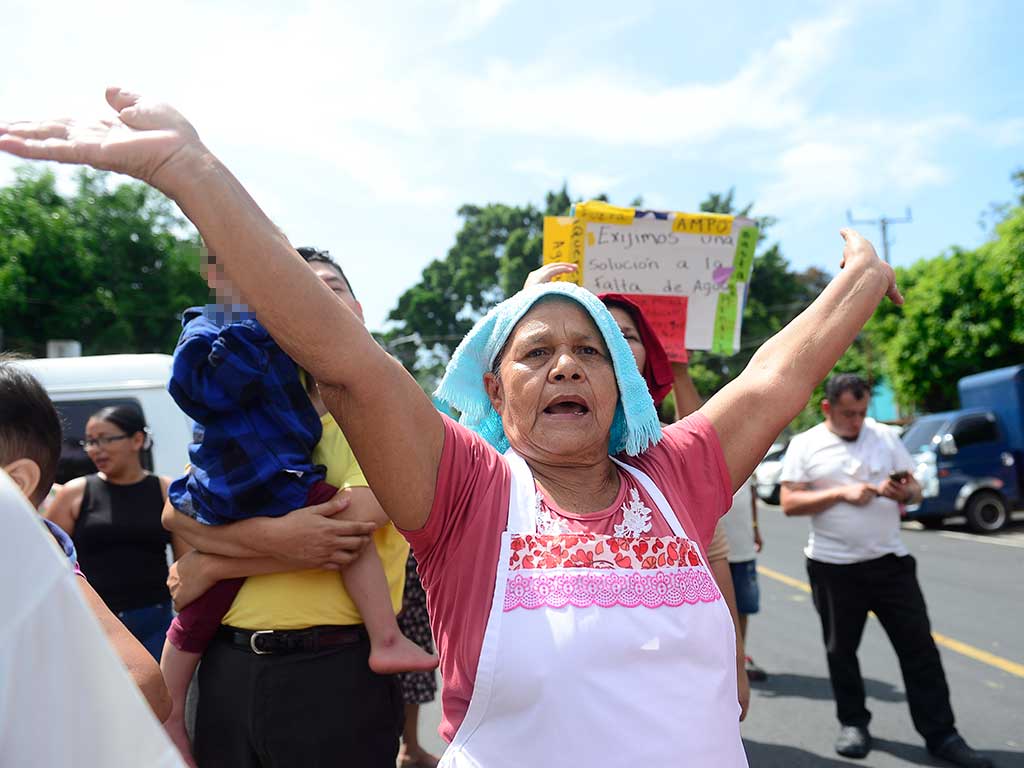
Residents of the Valle Verde 1 and 2 communities held a demonstration Friday in front of the Valle Verde school to protest the persistent lack of drinking water that, they say, has affected hundreds of families for years and has begun to impact student attendance, sanitary conditions in homes, and public health.
During the event, mothers, community leaders, and residents demanded a definitive solution to the problem and questioned the service provided by AMPO, the company responsible for water supply in the area, while calling for more active intervention by the National Administration of Aqueducts and Sewers (ANDA).
It should be noted that water service in the area is provided by the company Administradora de Pozos, S.A. de C.V. (AMPO).
With chants of “AMPO out” and appeals to President Nayib Bukele and First Lady Gabriela de Bukele, the residents said the water shortage forces them to rely on rainwater, tanker truck deliveries, and purchasing water for drinking and household use.
“Children are constantly getting sick. We’re collecting rainwater, there are lots of mosquitoes, and we don’t know what else to do,” said Zulema García during the demonstration.
The protest was held in front of the community school because, according to the organizers, the lack of water in homes has made it difficult for some students to attend classes regularly.
Families say they pay bills without receiving consistent service
Nuria Majano, a resident of the area, said the service is irregular and that, despite this, they continue to receive bills.
“We get a little bit of water every ten days and the bill comes in high. We pay around $9.71, but on top of that we have to buy water to drink and for basic needs,” she noted.
According to the resident, a family can spend between $10 and $12 a week buying water, not counting the additional cost of hiring tanker trucks when they are available.
Majano maintained that the situation directly affects students, since many households lack enough water for personal hygiene or to wash school uniforms.
“Water is a right, and that right is being violated for the children,” she said.
Norma González agreed that the crisis especially affects children and asked for support from national authorities.
“Children have the right to play, get dirty, and wash their hands. Sometimes we ourselves deny them things because it’s hard to keep buying water or hauling it. It’s not fair,” she said.
“The situation gets worse every day”
Oseas Menéndez, a community representative, said residents have spent years hearing promises about transitioning the system to ANDA without any concrete solution to date.
“They told us they were pulling out in July and were in the process of transitioning to ANDA, but we haven’t seen anything clear. Another month has passed and we’re still in the same situation,” he said.
The leader explained that Valle Verde 1 and 2 includes approximately 60 streets and that tanker truck deliveries have decreased in recent months.
“Before, eight or nine tanker trucks would come. Now we’ve counted as few as three a day. Sometimes water arrives every ten days and it’s no longer enough for the whole community,” he said.
Menéndez noted that many families have improvised systems to collect rainwater using metal sheets, barrels, and storage containers.
“For us, rain is a relief. If three days go by without rain, the worry returns because the water runs out,” he said.
He also said residents have requested fumigation campaigns due to the proliferation of mosquitoes, but claim they have received no response.
Mothers report difficulties sending their children to school
During the event, several mothers described how the water shortage has complicated their children’s school routines.
Katia Fuentes said some parents struggle to keep uniforms clean and ensure adequate hygiene conditions so students can attend classes.
The resident also noted that the accumulation of water in containers and limitations on carrying out cleaning tasks encourage the proliferation of insects and cause concern among families.
For her part, Abigail Hernández, a community representative, called on the First Lady and the Ministry of Education to intervene and address the situation.
“I call on Gabriela de Bukele and the Minister of Education because the children are being affected. Many miss classes because their parents don’t have water to wash uniforms or meet basic needs,” she said.
Residents insisted their demand stems from a community need and not from political interests.
“We’re not politicizing anything here. What we’re asking for is a solution for the families and for the children,” Hernández said.
On June 25, Eduardo Alejandro Orellana Cuenca, legal representative of Administradora de Pozos, S.A. de C.V. (AMPO), the company that has provided service in the area since 2006, announced a possible transition of the system to the state.
According to Orellana Cuenca, the complete lack of water reported by residents in recent weeks stems from an unforeseen and unpredictable technical event: the burning out of the submersible pump, motor, and wiring of well number 1, which supplies 60% of the development.
In statements to this outlet, he said the damage was caused by severe fluctuations and “electrical surges” in the power grid in the Apopa area. Repairing the system, according to the company Hidrotec, requires an immediate investment of $40,000, funds the private distributor does not have due to debts carried over from the COVID-19 pandemic and a large backlog of user arrears totaling $57,000.
El Diario de Hoy: https://www.eldiariodehoy.com/noticias/nacionales/valle-verde-crisis-agua/85921/2026/
Habitantes de Valle Verde denuncian que crisis de agua afecta asistencia escolar y salud
César Najarro
Con reportes de Jessica Orellana
Residentes de las comunidades Valle Verde 1 y 2 realizaron este viernes una concentración frente al Centro Escolar Valle Verde para denunciar la persistente falta de agua potable que, según afirman, afecta desde hace años a cientos de familias y ha comenzado a impactar la asistencia de los estudiantes, las condiciones sanitarias de los hogares y la salud de la población.
Durante la actividad, madres de familia, líderes comunitarios y habitantes exigieron una solución definitiva al problema y cuestionaron el servicio brindado por la empresa AMPO, responsable del suministro en la zona, mientras reclamaron una intervención más activa de la Administración Nacional de Acueductos y Alcantarillados (ANDA).
Cabe recordar que en la zona el servicio de agua corresponde a la empresa Administradora de Pozos, S.A. de C.V. (AMPO).
Con consignas como «Fuera AMPO» y llamados al presidente Nayib Bukele y a la primera dama Gabriela de Bukele, los habitantes señalaron que la escasez de agua los obliga a depender de la lluvia, del abastecimiento mediante pipas y de la compra de agua para consumo y uso doméstico.
«Los niños se están enfermando constantemente. Estamos agarrando agua de lluvia, hay muchos zancudos y ya no hallamos qué hacer», expresó Zulema García durante la concentración.
La protesta se realizó frente a la escuela de la comunidad debido a que, según los organizadores, la falta de agua en los hogares ha provocado dificultades para que algunos estudiantes asistan regularmente a clases.
Familias aseguran que pagan recibos sin recibir servicio constante
Nuria Majano, residente de la zona, afirmó que el servicio llega de forma irregular y que, pese a ello, continúan recibiendo facturación.
«Cada diez días nos cae un poquito de agua y el recibo viene alto. Pagamos alrededor de $9.71, pero además tenemos que comprar agua para tomar y para las necesidades básicas», señaló.
Según la habitante, una familia puede gastar entre $10 y $12 semanales en la compra de agua, sin contar el costo adicional de contratar pipas cuando estas están disponibles.
Majano sostuvo que la situación afecta directamente a los estudiantes, ya que muchos hogares no cuentan con suficiente agua para el aseo personal o para lavar uniformes escolares.
«El agua es un derecho y ese derecho se lo están violando a los niños», manifestó.
Norma González coincidió en que la crisis repercute especialmente en la niñez y pidió apoyo de las autoridades nacionales.
«Los niños tienen derecho a jugar, ensuciarse y lavarse las manos. A veces nosotros mismos les negamos cosas porque nos cuesta estar comprando agua o jalándola. No es justo», expresó.
«La situación cada día empeora»
Oseas Menéndez, uno de los representantes comunitarios, aseguró que los habitantes llevan años escuchando promesas sobre una transición del sistema hacia ANDA sin que hasta ahora exista una solución concreta.
«Nos dijeron que en julio se retiraban y que estaban en proceso de transición con ANDA, pero no hemos visto nada claro. Ya pasó otro mes y seguimos igual», afirmó.
El dirigente explicó que Valle Verde 1 y 2 comprende aproximadamente 60 pasajes y que el abastecimiento mediante pipas se ha reducido en los últimos meses.
«Antes llegaban entre ocho y nueve pipas. Ahora hemos contado hasta tres diarias. A veces el agua nos llega cada diez días y ya no da abasto para toda la comunidad», indicó.
Meléndez señaló que muchas familias han improvisado sistemas para recolectar agua de lluvia utilizando láminas, barriles y recipientes de almacenamiento.
«Para nosotros que llueva es un alivio. Si pasan tres días sin lluvia, vuelve la preocupación porque el agua se acaba», dijo.
También afirmó que los habitantes han solicitado jornadas de fumigación debido a la proliferación de zancudos, pero aseguran no haber recibido respuesta.
Madres denuncian dificultades para enviar a sus hijos a clases
Durante la actividad, varias madres relataron que la escasez de agua ha complicado la rutina escolar de sus hijos.
Katia Fuentes aseguró que algunos padres enfrentan dificultades para mantener limpios los uniformes y garantizar condiciones adecuadas de higiene para que los estudiantes asistan a clases.
La habitante también señaló que la acumulación de agua en recipientes y las limitaciones para realizar labores de limpieza favorecen la proliferación de insectos y generan preocupación entre las familias.
Por su parte, Abigail Hernández, representante comunitaria, pidió la intervención de la Primera Dama y del Ministerio de Educación para atender la situación.
«Hago un llamado a Gabriela de Bukele y a la ministra de Educación porque los niños están siendo afectados. Muchos faltan a clases porque los padres no tienen agua para lavar los uniformes o para atender sus necesidades básicas», expresó.
Los habitantes insistieron en que su reclamo responde a una necesidad comunitaria y no a intereses políticos.
«Aquí no estamos politizando nada. Lo que estamos pidiendo es una solución para las familias y para los niños», sostuvo Hernández.
El 25 de junio pasado, Eduardo Alejandro Orellana Cuenca, representante legal de la Administradora de Pozos, S.A. de C.V. (AMPO), empresa que provee el servicio en la zona desde 2006, anunció una posible transición del sistema hacia el Estado.
Según Orellana Cuenca, la falta absoluta de agua reportada por los habitantes en las últimas semanas responde a un evento técnico fortuito e impredecible: la quema de la bomba sumergible, el motor y el cableado del pozo número 1, el cual abastece al 60% de la urbanización.
En declaraciones a este medio, comentó que este daño a severas fluctuaciones y «choques eléctricos» en la red de energía de la zona de Apopa. Reparar este sistema, de acuerdo con la empresa Hidrotec, requiere una inversión inmediata de $40,000 dólares, fondos con los que la distribuidora privada no cuenta debido a deudas arrastradas desde la pandemia de COVID-19 y a una abultada mora de los usuarios que asciende a $57,000 dólares.
El Diario de Hoy: https://www.eldiariodehoy.com/noticias/nacionales/valle-verde-crisis-agua/85921/2026/