
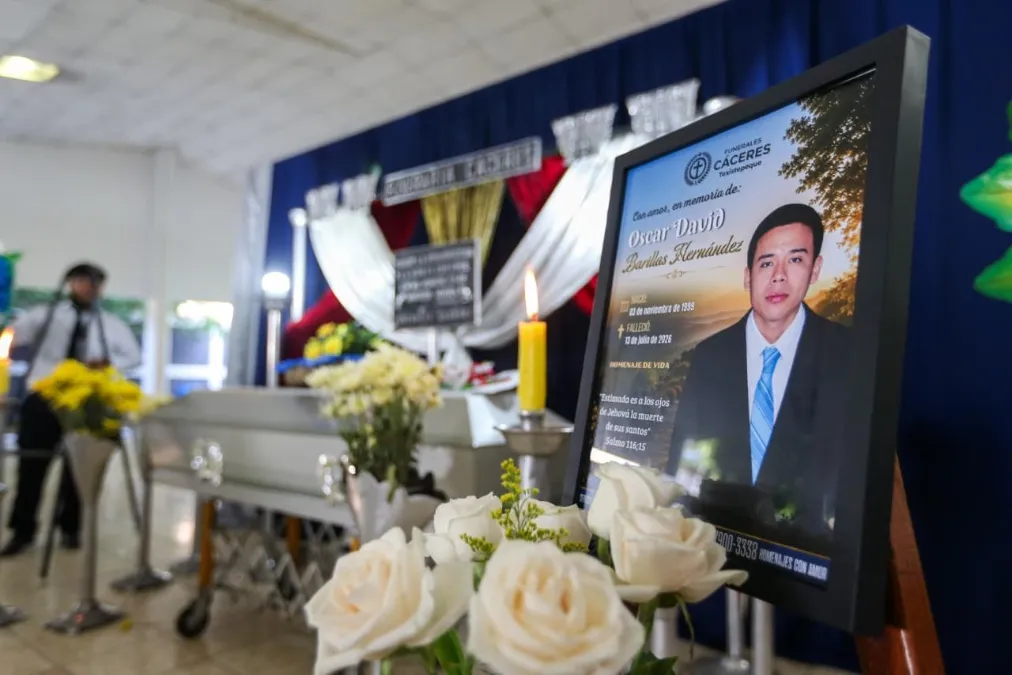
“They killed my son,” are the first words spoken by Reyna, the mother of Oscar David Barillas, whom she is burying today after he spent four years in prison. He was arrested at his workplace. She tries to express her emotions and thoughts, but her tears and the pain she feels keep her from going on. She is 30 minutes away from burying one of her sons.
Reyna looks exhausted. She has held a wake for her late son for two full days at the convention center next to the central plaza in Texistepeque, Santa Ana.
The two-day wake has been hard, but her exhaustion is even greater because a few days ago she had to undergo surgery to remove a breast due to her breast cancer.
“They came and grabbed my son at the place where he was working, a construction site. He was a bricklayer’s assistant. Some people saw when they took him to the police station and how they beat him. They hung him from the ceiling with chains and they abused my son terribly,” Reyna recalls.
This happened during the first year of the state of exception in 2022, and since then Reyna has spent her time looking for ways to see her son, who had been in poor health since returning from a trip to seek better economic opportunities in the United States.
Kidney failure was severely affecting him, but even so, he decided to go out and look for work, his mother says.
After his arrest, Óscar was taken to the former women’s prison in Ilopango, then transferred to another detention center in San Francisco Gotera, Morazán, but he spent much of his detention in hospitals because of his serious health condition.
“A doctor told me to go see my son at the hospital, that he was in very serious condition, so I tried, but all I got was the guard insulting me and treating me badly. He wouldn’t let me see him,” Reyna said.
Four years went by as she tried to get information. The only thing they told her at the prisons was to come back in six months. After that time, they would tell her again to come back in six months. Then it became a year. And to this day, no institution has contacted her — not even to notify her of her son’s death.
“The funeral home showed up at my workplace and told me my brother was dead,” recalled one of Oscar David’s brothers.
“Ever since they were little, I taught them to work to earn their own money,” Reyna recalls, just a few meters from the cemetery.
Oscar David died on July 13, 2026, and despite his fragile health due to kidney failure, according to the Forensic Medicine Institute, he died of pulmonary edema — like the majority of the 547 people who have died in the custody of the Salvadoran state.
“No me dejaron verlo (…) mataron a mi hijo”: madre entierra a su hijo fallecido tras cuatro años detenido bajo régimen de excepción en El Salvador
Francisco Rubio
“Mataron a mi hijo”, son las primeras palabras que dice Reyna, madre de Oscar David Barillas a quien hoy entierra tras haber permanecido cuatro años en prisión. Fue capturado en su lugar de trabajo. Intenta expresar sus emociones y pensamientos, pero el llanto y el dolor que siente le impiden seguir, está a 30 minutos de enterrar a uno de sus hijos.
Reyna se ve agotada, ha velado a su hijo fallecido durante dos días completos en el centro de convenciones que está a la par de la plaza central de Texistepeque, Santa Ana.
Los dos días de vela han sido duros, pero el cansancio es mayor ya que hace unos días tuvo que someterse a una cirugía para retirarle un seno por el cáncer de mama que padece.
“A mi hijo lo llegaron a agarrar al lugar donde estaba trabajando, una construcción. Él era ayudante de albañil. Unas personas vieron cuando se lo llevaron a la delegación y como lo golpearon, me lo colgaron con unas cadenas del techo y me maltrataron todo a mi hijo”, recuerda Reyna.
Esto ocurrió en el primer año del régimen de excepción en el año 2022, y desde entonces Reyna ha pasado buscando formas de ver a su hijo, ya que se encontraba mal de salud desde que regresó de un viaje para intentar tener mejores oportunidades económicas en Estados Unidos.
La insuficiencia renal lo estaba afectando en gran medida, pero aun así decidía salir a buscar trabajo, según comenta la madre.
Luego de su captura, Óscar fue llevado a ex cárcel de mujeres en Ilopango, después fue trasladado a otro centro de detención en San Francisco Gotera, Morazán, pero su aprehensión la vivió en gran medida en hospitales por su grave estado de salud.
“Un médico me dijo que fuera a ver a mi hijo al hospital, que estaba bastante grave, así que lo intenté, pero solo fui a que el custodio me insultara y me tratara mal. No me dejó verlo”, expresó Reyna.
Pasaron cuatro años intentando tener información, lo único que le decían en los centros penales era que regresara en seis meses, luego de ese tiempo le volvían a decir que dentro de seis meses, después pasó a ser un año y hasta la actualidad, ninguna institución se comunicó con ella ni siquiera para notificarle la muerte de su hijo.
“Llegó la funeraria a mi trabajo y me avisaron que mi hermano estaba muerto”, recordó uno de los hermanos de Oscar David.
“Desde pequeños les enseñé a trabajar para ganarse su dinerito” recuerda Reyna a pocos metros del camposanto.
Oscar David falleció el 13 de julio del 2026 y a pesar de su delicado estado de salud por la insuficiencia renal, según medicina legal, falleció por un edema pulmonar, como la mayoría de las 547 personas que han muerto bajo la custodia del estado salvadoreño.