
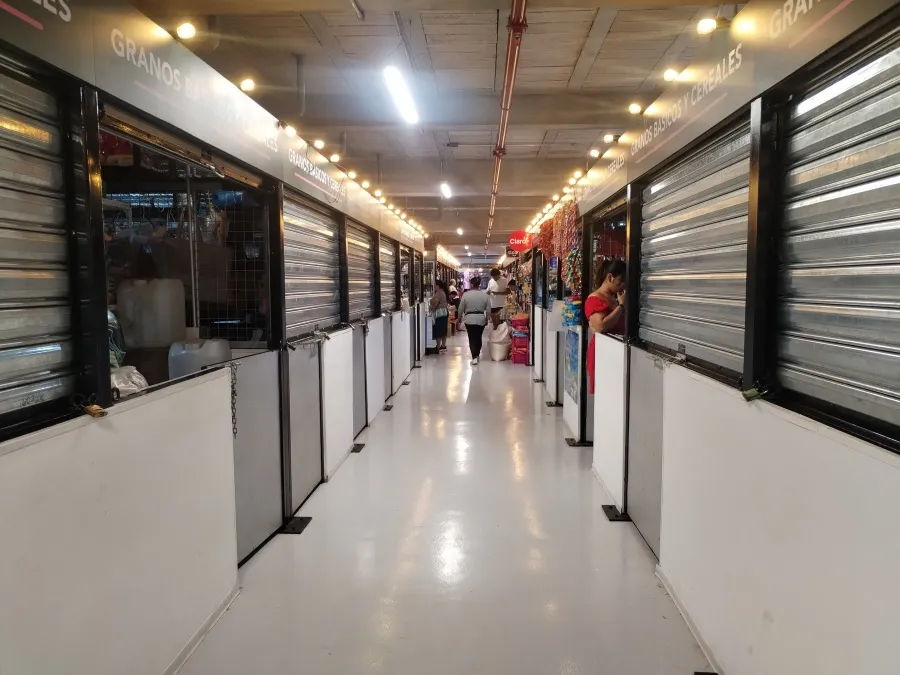
On one of the four levels of the new Chalchuapa market in Santa Ana Oeste, Magdalena (not her real name) has her stall. It is 11 a.m. on a Tuesday and she still has not made her “nombre de Dios” — as she calls making the first sale of the day. She is sitting in a plastic chair checking her phone inside her stall, where she sells various products. Over the course of two hours, only one person peeked into the area where her business is located, looked around, turned around, and left. “That’s how it is here, and sometimes nobody shows up the entire day,” the vendor told LA PRENSA GRÁFICA.
This marketplace was inaugurated on November 8, 2025. It was built by the Municipal Works Directorate (DOM) with an initial budget of $12 million that ultimately rose to $17.6 million. Construction began in 2023 with a commitment to finish in 240 days, but it was completed two years and seven months later.
Magdalena says she arrived eight months ago with hopes of improving her sales after spending more than two years in temporary stalls. She signed a one-year lease contract with the National Markets Directorate (DMN) for her new stall; she did not get to choose it, and ended up with one located at the back of one of the corridors where few people pass through.
“It’s been eight difficult months. I couldn’t describe them any other way. You have to pull money from other places to cover the payments because sales are extremely low in here. My contract says I have to pay $20 a month, but for several months now I haven’t even made enough for that. But that’s how it is — I’m not leaving because the contract also says that if I give up my stall, I have to keep paying for the remaining months,” she says.
The vendor explained that to obtain a stall she had to register with the Ministry of Finance to declare VAT monthly, something she says they were never told about beforehand. They have two options for filing their sales declarations: they can request a free service through the market’s administration or hire a private accountant, but that can cost up to $50 a month.
In December 2025, the administration of this market told this newspaper that “all the stalls were leased and that there was a waiting list of people interested in obtaining one”; seven months later, the administration says “there are stalls available.”
The vendors say that many chose to abandon their stalls to sell as street vendors, in order to increase their sales and earn enough to cover the payments required by their contracts. In other cases, they say there are vendors who have lost their stalls for publicly stating that nobody buys anything inside the market.
“In this market there are more empty stalls than occupied ones. If you go up to the rooftop level, there are more empty than occupied; the same thing happens on the third level. I’ve invested $1,000 since I came here and I haven’t been able to make it back. What they tell me (the administration) is to invest more, but where am I going to get more? We work on loans here. I feel like it’s really awful that they demand we not say that nothing sells when that’s the reality,” said Magdalena.
Meanwhile, outside the market is Juan (name changed), who three months ago decided to sell as a street vendor even though it is prohibited and despite having a stall in the market. He says his daily earnings outside the market are between $5 and $10 a day, but that it is more than what he was making inside at his shoe stall. The vendor says he keeps paying the lease on his stall because he “holds out hope that someday sales inside the market will improve.”
“We imagined a market where people would come in like before, and at the beginning it was like that, because the publicity and people’s curiosity did everything, but that enthusiasm has passed. We’re in a clean, orderly place — no one denies that, and we’re grateful for it — but a vendor doesn’t live on that. The reality is that people don’t come in; they stay at the stalls near the entrances, and most of us in here are struggling without selling,” Juan noted.
The vendors say they do not know what is causing customers not to come to the market administered by the National Markets Directorate. An attempt was made to obtain a response from the institution regarding the complaints raised by the vendors, but it was not possible.
RELATO: “En este mercado hay más puestos solos que ocupados”
Por Oscar Reyes
En uno de los cuatro niveles del nuevo mercado de Chalchuapa, en Santa Ana Oeste, tiene su puesto Magdalena (nombre ficticio). Son las 11 de la mañana de un martes y continúa sin hacer “nombre de Dios”, como se refiere a hacer la primera venta del día. Está sentada en una silla de plástico revisando su celular al interior de su local donde ofrece productos varios. Durante dos horas solo se asomó una persona a la zona donde está su negocio, observó, se dio la vuelta y se retiró. “Así es acá y a veces no se asoma nadie en todo el día”, expresó la comerciante a LA PRENSA GRÁFICA.
Este centro de abastos fue inaugurado el 8 de noviembre de 2025. Fue construido por la Dirección de Obras Municipales (DOM) con un presupuesto inicial de $12 millones que al final ascendió a $17.6. Su ejecución inició en 2023 con el compromiso de finalizarlo en 240 días, pero se concluyó dos años y 7 meses después.
Magdalena cuenta que hace ocho meses llegó con la ilusión de mejorar sus ventas tras estar más de dos años en puestos provisionales. Firmó un contrato con la Dirección de Mercados Nacionales (DMN) por un año por el arrendamiento de su nuevo local; no lo eligió ella, y le tocó uno ubicado al fondo de uno de los pasillos donde pocas personas transitan.
“Han sido ocho meses difíciles. No podría describirlos de otra manera. Toca sacar dinero de otros lados para cubrir los pagos porque las ventas son bajísimas acá adentro. El contrato me dice que debo pagar $20 mensuales, pero llevo varios meses que no saco ni para eso, pero así es esto, no me voy porque el contrato también me dice que si lo dejo (puesto), debo seguir pagando los meses que restan”, manifiesta.
La comerciante explicó que para obtener un local tuvo que inscribirse en el Ministerio de Hacienda para declarar mensualmente el IVA, algo que asegura no les notificaron antes. Tienen dos opciones para realizar la declaración de sus ventas; pueden solicitar un servicio gratuito con la administración del mercado o contratar un contador particular, pero esto puede costar hasta $50 mensuales.
En diciembre de 2025, la administración de este mercado afirmó a este periódico que “todos los puestos estaban arrendados y que existía un listado de espera de personas interesadas por obtener uno”; siete meses después, la administración dice que “hay locales disponibles”.
Los comerciantes aseguran que muchos optaron por abandonar sus locales para vender de manera ambulante, para aumentar sus ventas y obtener los fondos suficientes para cubrir con los pagos que les establece el contrato. En otros casos, mencionan que hay comerciantes que han perdido sus locales por expresar públicamente que adentro del mercado no se vende.
“En este mercado hay más puestos solos que ocupados. Si usted sube a la terraza, hay más solos que ocupados; lo mismo pasa en el tercer nivel. Yo he invertido $1,000 desde que me vine y no he podido sacarlo. Lo que me dicen ellos (administración) es que invierta más, pero ¿de dónde voy a agarrar más? Nosotros acá trabajamos con préstamos. Siento que es bien feo que ellos nos exijan que no declaremos que no se vende cuando es así”, dijo Magdalena.
Mientras que afuera del mercado está Juan (nombre cambiado), quien desde hace tres meses decidió vender de manera ambulante a pesar de que está prohibido y de tener un puesto en el mercado. Asegura que las ganancias diarias que obtiene afuera del mercado son de entre $5 y $10 diarios, pero que es más de lo que ganaba adentro en su puesto de calzado. El comerciante dice que sigue pagando el arrendamiento del local porque “mantiene la esperanza de que algún día mejoren las ventas adentro del mercado”.
“Nos imaginamos un mercado donde las personas entraran como era antes y al inicio fue así, porque la propaganda y el interés de las personas lo hacían todo, pero ese entusiasmo ya pasó. Estamos en un lugar aseado con orden, eso no se niega y se agradece, pero el vendedor no vive de eso; la realidad es que las personas no entran, se quedan en los puestos de las entradas y la mayoría de acá estamos sufriendo sin vender”, apuntó Juan.
Los vendedores afirman que desconocen cuáles son las causas por las que los clientes no llegan al mercado que es administrado por la Dirección Nacional de Mercados. Se intentó obtener una postura de la institución sobre los señalamientos hechos por los comerciantes, pero no fue posible.