
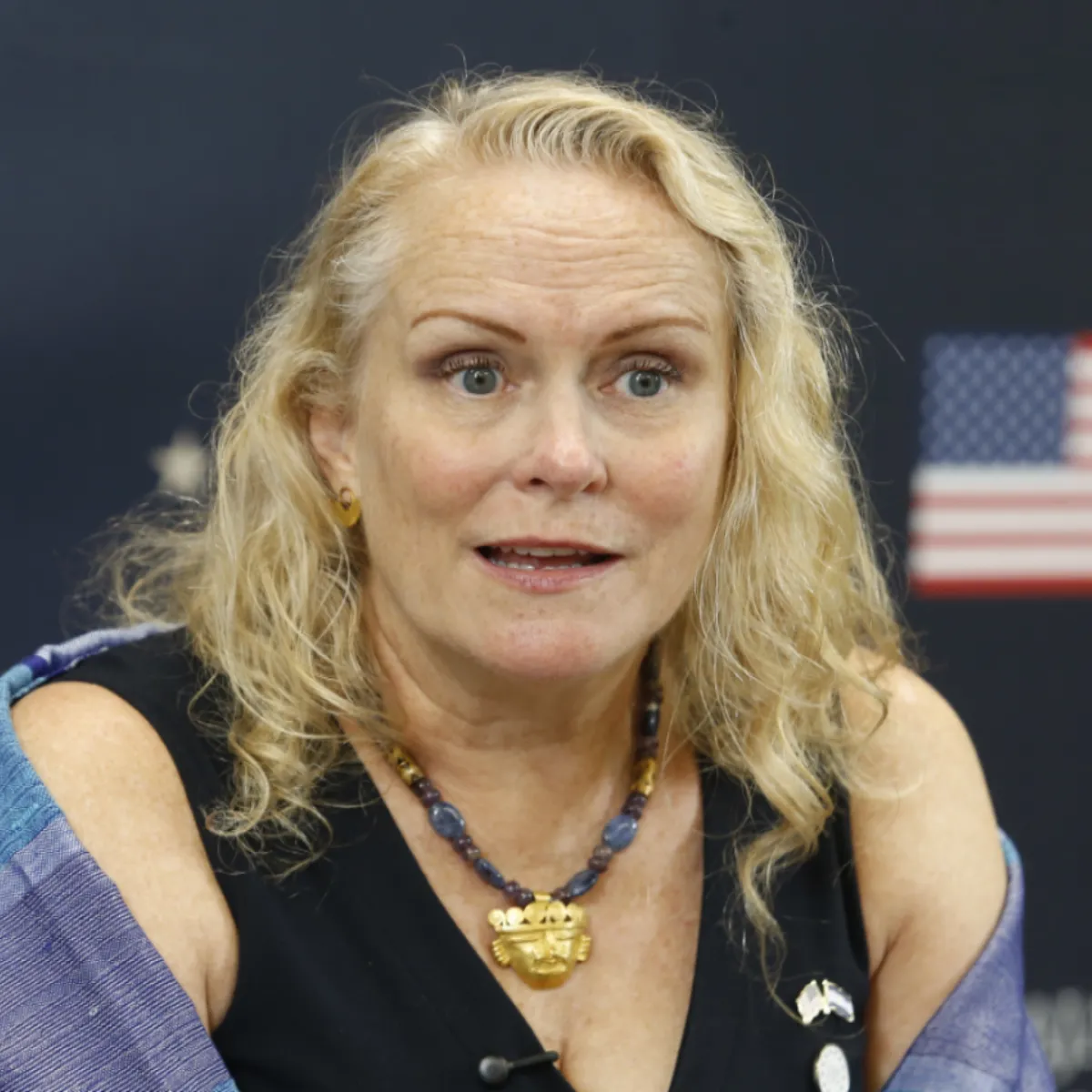
The arrival of the Donald Trump administration has changed the tone of the political relationship between the United States (US) and the government of Nayib Bukele, now marked by greater affinity between the two leaders. However, Washington maintains that this closeness has not altered the pillars of its policy toward El Salvador, which continue to focus on investment, the fight against transnational organized crime, and irregular migration.
This was stated by the US Embassy’s Chargé d’Affaires, Naomi Fellows, during an interview with LA PRENSA GRÁFICA, in which she noted that the greater closeness between Trump and Bukele is due to similarities in their political philosophy, without this implying changes in the bilateral agenda that has historically been maintained in the country.
“I believe that, depending on the character and political philosophy of leaders of different countries, and even the personalities of the leaders themselves, there are approaches and distances, but that is seen all over the world. El Salvador is not unique in that,” said the diplomat when asked about the reasons that marked a change in the relationship with President Bukele, which became politically tense at the beginning of Joe Biden’s administration, but has strengthened after Trump’s arrival.
“I would say that now we have leaders in both countries who may be philosophically closer, but that does not mean that the cooperation we have maintained with El Salvador on migration issues, on security issues, cooperation on economic issues has changed; it has not changed in any way,” she said.
The diplomat also clarified that the relationship between leaders constitutes only “a very small part” of the ties between the two countries. She insisted that, despite the change of administrations in Washington, the objectives of cooperation remain intact.
“The focus on trade, the focus on investment between the two countries, all the economic issues, as well as stopping illegal migration and combating drug trafficking and international criminal groups have always been the basis of our relationship,” she said.
However, during the Trump administration, Washington’s concerns about democracy, judicial independence, human rights, and the fight against corruption do not appear as frequently on the US government’s public agenda as during the Biden administration. Asked about this, Fellows assured that these issues remain part of the bilateral dialogue, although now they are addressed in a reserved manner.
“There are times, with certain administrations, when perhaps the conversation is more public and other times when they are private conversations, but that does not mean that the conversations have changed or that the topics discussed have changed,” she said.
At the same time, she said that the US government recognizes the changes recorded in security during Bukele’s administration when analyzing the human rights situation.
“We continue meeting and talking with civil society groups and with the Government, and we also recognize that the security situation in this country has changed incredibly and that this has created many opportunities. We recognize the work that the government of El Salvador has done to bring the perpetrators of crimes to justice, and all of that is part of human rights. But that conversation (about human rights) has never stopped; it continues and is still ongoing,” she said.
New focus of US cooperation
Fellows also stated that the closure of the United States Agency for International Development (USAID) did not mean the end of all US cooperation with El Salvador, but rather a change in the assistance model.
She explained that the new strategy seeks to reduce the dependence of recipient countries on external financing.
“The change in focus has been less about assistance just by giving money and more about assistance (for) how to help countries reach a point of self-sustainability, so that they can manage these programs, that they themselves can provide the money and manage this type of aid for their population,” she said.
The diplomat assured that the United States maintained cooperation programs in areas such as security and health.
“We continue working with the Police and the Prosecutor’s Office, and it is more like mutual work, and we also continue working very closely with the Salvadoran Armed Forces. In other areas where we have also continued working has been in the health area; we are supporting DoctorSV and we also continue supporting HIV/AIDS combat programs,” she indicated.
Although she said that the support received by the DoctorSV platform is financial, she did not provide details about the amount or the activities that are supported.
“I do not have the exact details at the moment, but we had a certain amount of money and, so, we spoke with the group that is managing DoctorSV to see how we could direct it to support the efforts they are making,” she responded.
Regarding funding for civil society organizations, Fellows insisted that the objective of the cooperation approach is to promote organizations that are less dependent on external resources.
“That is where we really enter the conversation about sustainability, that organizations are self-sufficient, that their existence does not depend on money coming from outside. Some programs do continue, others do not. Obviously, programs in terms of security continue, some health programs continue. Others are being reevaluated,” she said.
TPS and migration
Given the expectation of a new extension of Temporary Protected Status (TPS), Fellows was asked whether the good relationship between Trump and Bukele could influence the continuity of protection for Salvadorans, but the diplomat avoided linking that decision to the political moment between the two.
She explained that the Department of Homeland Security evaluates the conditions that gave rise to the migration protection and the current situation of each country before making a decision.
“In El Salvador (the event that gave rise to TPS) was the destruction in almost the entire country after the 2001 earthquake. It is always evaluated whether that continues or if there is a new situation, what the situation is and what people would return to in their country,” she explained.
The diplomat stated that the criteria established in the legislation that created TPS “will always prevail over political decisions,” although she said that conversations between political leaders are spheres beyond her reach.
Fellows also indicated that cooperation on migration with the Government of El Salvador continues to focus on investigating criminal groups that engage in human trafficking of Salvadorans and to protect the border efficiently.
Meanwhile, asked about the reports by LA PRENSA GRÁFICA and other media regarding the disappearance of Salvadorans who were deported to the Terrorism Confinement Center (CECOT), Fellows stated that, after deportation, the national government is responsible for the migrants.
“When there is a deportation of people to El Salvador in which they arrive at the border of El Salvador, they are already the responsibility of the Salvadoran government. So, any indication or inquiries that families want to make, they have to make them with the government of El Salvador,” said the diplomat.
China
Regarding the relationship between El Salvador and China, Chargé d’Affaires Fellows stated that each country is sovereign to make its own decisions, but that it is necessary to evaluate “what the conditions are, what the quality of the products is and the quality of the work being proposed,” and she gave as an example a dam built by China in Ecuador, which allegedly faces environmental and infrastructure problems.
“We think, from the United States, that the American hemisphere also has to be seen as a sovereign area, as a totally sovereign area and, part of that, is to look at what really brings good benefits to a country and to the region as a whole, and what does not. What brings conditions or consequences that may not be obvious at first, but can be seen later, as has been seen in Ecuador, with the dam that is only 2 years old and is already almost about to collapse, right? So, very careful studies must be done on the different investments, what benefits they bring and what the costs are,” she said.
Embajada de EUA: Trump y Bukele tal vez estén filosóficamente más cerca, pero la cooperación no cambia
Por Claudia Palacios
La llegada de la administración de Donald Trump ha modificado el tono de la relación política entre Estados Unidos (EUA) y el gobierno de Nayib Bukele, marcada ahora por una mayor afinidad entre ambos mandatarios. Sin embargo, Washington sostiene que ese acercamiento no ha alterado los pilares de su política hacia El Salvador, que continúan centrados en la inversión, el combate al crimen organizado transnacional y la migración irregular.
Así lo afirmó la encargada de negocios de la Embajada de EUA, Naomi Fellows, durante una entrevista con LA PRENSA GRÁFICA, en la que señaló que la mayor cercanía entre Trump y Bukele responde a coincidencias en su filosofía política, sin que esto implique cambios en la agenda bilateral que históricamente se ha mantenido tenido en el país.
“Yo creo que, dependiendo de cuál es el carácter y la filosofía política de líderes de diferentes países, y hasta las personalidades de los líderes en sí, hay acercamientos y alejamientos, pero eso se ve en todas partes del mundo. El Salvador no es único en eso”, dijo la diplomática al ser consultada sobre los motivos que marcaron un cambio en la relación con el presidente Bukele, la cual se tensó a nivel político al inicio de la administración de Joe Biden, pero se ha fortalecido tras la llegada de Trump.
“Yo diría que ahora tenemos líderes en los dos países que filosóficamente tal vez estén más cerca, pero eso no quiere decir que la cooperación que nosotros hemos mantenido con El Salvador en temas de migración, en temas de seguridad, la cooperación en temas económicos ha cambiado; de ninguna manera ha cambiado”, dijo.
La diplomática también aclaró que la relación entre mandatarios constituye únicamente “una parte muy pequeña” de los vínculos entre ambos países. Insistió en que, pese al relevo de administraciones en Washington, los objetivos de la cooperación permanecen intactos.
“El enfoque en el comercio, el enfoque en la inversión entre los dos países, todos los temas económicos, así como parar la migración ilegal y combatir el narcotráfico y los grupos criminales internacionales siempre han sido la base de nuestra relación”, dijo.
Sin embargo, durante la administración Trump, las preocupaciones de Washington sobre democracia, independencia judicial, derechos humanos y combate a la corrupción no aparecen tan frecuentemente en la agenda pública del gobierno estadounidense como durante la administración Biden. Consultada al respecto, Fellows aseguró que esos temas siguen formando parte del diálogo bilateral, aunque ahora se abordan de forma reservada.
“Hay veces, con ciertas administraciones, que tal vez la conversación es más pública y hay otras veces que son conversaciones privadas, pero eso no quiere decir que las conversaciones hayan cambiado o que los temas que se hablan hayan cambiado”, dijo.
Al mismo tiempo, dijo que el gobierno estadounidense reconoce los cambios registrados en materia de seguridad durante la administración de Bukele al analizar la situación de derechos humanos.
“Nosotros continuamos reuniéndonos y hablando con grupos de la sociedad civil y con el Gobierno, y reconocemos también que la situación de seguridad en este país ha cambiado increíblemente y que esto ha creado muchas oportunidades. Reconocemos el trabajo que ha hecho el gobierno de El Salvador para llevar a los perpetradores de los crímenes ante la justicia, y todo eso es parte de los derechos humanos. Pero esa conversación (derechos humanos) nunca ha parado; continúa y se sigue haciendo”, dijo.
Nuevo enfoque de cooperación estadounidense
Fellows también sostuvo que el cierre de la Agencia de Estados Unidos para el Desarrollo Internacional (USAID) no significó el fin de toda la cooperación estadounidense con El Salvador, sino un cambio en el modelo de asistencia.
Según explicó, la nueva estrategia busca reducir la dependencia de los países receptores respecto al financiamiento externo.
“El cambio de enfoque ha sido menos de asistencia así por dar dinero y más en asistencia (para) cómo ayudar a los países a llegar a un punto de autosostenibilidad, que ellos puedan manejar estos programas, que ellos propiamente puedan dar el dinero y manejar este tipo de ayuda para su población”, dijo.
La diplomática aseguró que Estados Unidos mantuvo programas de cooperación en áreas como seguridad y salud.
“Seguimos trabajando con la Policía y la Fiscalía, y es más como trabajo mutuo, y seguimos también trabajando muy cercanamente con las Fuerzas Armadas salvadoreñas. En otras áreas donde también hemos continuado el trabajo ha sido en el área de salud; estamos apoyando a DoctorSV y también continuamos apoyando los programas de combate del VIH-Sida”, indicó.
Aunque dijo que el apoyo que recibe la plataforma DoctorSV es financiero, no brindó detalles sobre cuál es el monto o las actividades que se respaldan.
“No tengo los detalles exactos en el momento, pero teníamos una cantidad de dinero y, entonces, hablamos con el grupo que está manejando DoctorSV a ver cómo podríamos dirigirlo para apoyar los esfuerzos que están haciendo”, respondió.
Sobre el financiamiento para organizaciones de la sociedad civil, Fellows insistió en que el objetivo del enfoque de cooperación es promover organizaciones menos dependientes de recursos externos.
“Ahí es donde realmente entramos en la conversación sobre la sostenibilidad, que las organizaciones sean autosuficientes, que su existencia no dependa de dinero que viene de afuera. Algunos programas sí continúan, otros no. Obviamente, programas en términos de seguridad continúan, algunos programas de salud continúan. Otros están reevaluándose”, dijo.
TPS y migración
Ante la expectativa de una nueva prórroga del Estatus de Protección Temporal (TPS), Fellows fue consultada sobre si la buena relación entre Trump y Bukele podría influir en la continuidad de la protección para los salvadoreños, pero la diplomática evitó vincular esa decisión con el momento político entre ambos.
Explicó que el Departamento de Seguridad Nacional evalúa las condiciones que dieron origen a la protección migratoria y la situación actual de cada país antes de tomar una decisión.
“En El Salvador (el hecho que dio origen al TPS) fue la destrucción en casi todo el país después del terremoto del 2001. Siempre se evalúa si eso continúa o hay alguna situación nueva, cuál es la situación y a qué volvería la gente a su país”, explicó.
La diplomática afirmó que los criterios establecidos en la legislación que creó el TPS “siempre van a dominar sobre decisiones políticas” , aunque dijo que las conversaciones entre líderes políticos son esferas fuera de su alcance.
Fellows también indicó que la cooperación en materia migratoria con el Gobierno de El Salvador continúa enfocada en investigar grupos criminales que practican la trata de personas salvadoreñas y para proteger la frontera de manera eficiente.
Mientras, consultada sobre las denuncias reportadas por LA PRENSA GRÁFICA y otros medios con respecto a la desaparición de salvadoreños que fueron deportados al Centro de Confinamiento del Terrorismo (CECOT), Fellows afirmó que, tras la deportación, el Gobierno nacional es el encargado de responder por los migrantes.
“Cuando hay una deportación de gente a El Salvador en la que llegan en la frontera de El Salvador, ya son responsabilidad del gobierno salvadoreño. Entonces, cualquiera cualquier indicación o indagaciones que las familias quieran hacer, las tienen que hacer con el gobierno de El Salvador”, dijo la diplomática.
China
Sobre la relación entre El Salvador y China, la encargada Fellows afirmó que cada país es soberano de tomar sus decisiones, pero que se debe evaluar “cuáles son las condiciones, cuál es la calidad de los productos y la calidad del trabajo que se está proponiendo” y puso como ejemplo una represa construida por China en Ecuador, la cual presuntamente enfrenta problemas medioambientales e infraestructurales.
“Nosotros pensamos, desde los Estados Unidos, que el hemisferio americano también tenemos que mirarlo como un un área soberana, como un área total soberana y, parte de eso, es mirar qué trae beneficios realmente buenos a un país y a la región en sí en total, y qué no. Qué trae condiciones o consecuencias que tal vez no son obvias al principio, pero que se pueden ver más tarde, como se ha visto en Ecuador, con la lrepresa que solo lleva 2 años y ya casi está a punto de caerse ¿no? Entonces, hay que hacer estudios muy cautelosos sobre las diferentes inversiones, qué beneficios traen y cuáles son los costos”, dijo.