
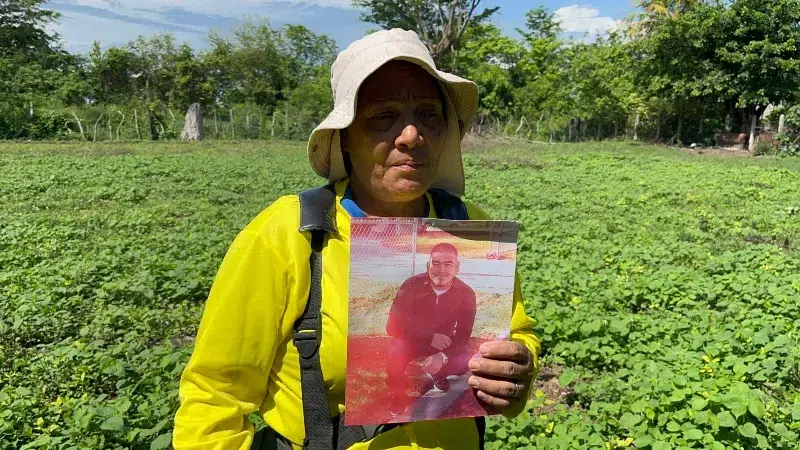
Sara gets the weed trimmer ready, holds it in her arms, and after turning it on begins clearing a plot of land behind her house to prepare the soil for planting and other farm work. These are now tasks she does alone, due to the arrest of her son, José Roger Urquía Rivas, under the state of exception in 2023.
Sara’s workload has multiplied. From early in the morning she has to look after her grandchildren, two minors left in her care following her son’s arrest. Then, with the rainy season underway in El Salvador, she has to keep an eye on the rains to start planting.
The recent passing of Tropical Storm Cristina helped prepare the soil, so Sara began planting corn in the Tilapa Abajo canton, in El Rosario, La Paz. She also has to tend to the roughly 140 broiler chickens she raises, and in the afternoon she checks on another half-manzana plot she had plowed.
While her grandchildren help out, Sara carries most of the burden, and she knows this is the time to step up the work, out of fear that a drought could make the situation even worse. She says her son’s arrest has been a hard blow — not just because of the worry, but because of the work she now has to do.
“He was my right hand [José Roger]. We used to grow corn and pipian squash, but now with his arrest everything has gotten harder for me,” Sara says.
Her son was arrested on August 30, 2023, after being deported while trying to reach the United States. Sara received a call telling her he would be detained for unlawful association, while she was tending to her small chicken farm. She went to the police station in Zacatecoluca, where officers told her he had been detained because he had “a red code,” but they didn’t show her any warrant.
José Roger is now held at the Ciudad Barrios prison in San Miguel, where she brings him packages and deposits money for him. That forces her to earn more income, making the planting and sale of corn and vegetables vital.
“They told me he’d be released soon, but to this day I’m still waiting. He was going to the United States with the idea of seeing his older children and so that I wouldn’t have to work. He used to tell me he didn’t want to see me working out in the sun anymore, but things didn’t turn out that way. I don’t know if it’s fate or the punishment the president has given us, but I have faith that his innocence will be proven,” she recalls.
José Roger, besides his farm work, worked as a private driver through an app, and years earlier had been a victim of the gangs — extorted and even physically attacked — which is why he sought to leave the country in the face of constant threats.
For Sara, her son’s arrest is also a direct blow to the country’s agricultural production. She says the detention of many farmworkers has made it harder to work the land properly.
“With this state of exception, this is what affects us poor people, the farmers, the most. If we don’t grow crops, there’s no corn, no beans, no rice, there’s nothing. They’re taking away the people who work the land. My right hand is locked up. It’s really hard for me — I do the work, but it’s still not enough,” she stresses.
The same in the Bajo Lempa
Like Sara, many Salvadoran women have taken on farm work after the arrest of their husbands or sons under the state of exception. Tasks like plowing the land, planting, harvesting, washing vegetables, and taking them to sell are now part of their daily lives. They say it’s double the effort, since they also have to care for their children and find money to buy packages for the prisons where their relatives are incarcerated.
One of them is Doña Candelaria Bonilla, in Jiquilisco, who grows corn, pipian squash, and “a little bit of everything.” After the arrest of her son, Luis Ronaldo Bonilla López, she has had to take up farm work again alongside her husband. In recent days her concern has been the weather, as they went from having “a drought” to intense rains that have damaged their vegetable crops.
“We planted the corn and the water hit it (Tropical Storm Cristina), and the pipian squash is flooded too, so things have gotten complicated. I couldn’t go further into the center of the plot because the ground is too waterlogged, but the way it looks I’m not going to harvest anything, and if it keeps raining I’ll lose what we planted,” she said.
Her son was arrested on December 22, 2022, and is being held at the Ciudad Barrios prison in San Miguel. Doña Candelaria doesn’t know how he’s doing and said “he’s innocent, and his arrest has affected us a lot. He always helped with the farm work since that’s what we do for a living. We hope it can soon be proven that he’s innocent of what they accuse him of.”
Delmy del Carmen lives in the La Casona community, in the Bajo Lempa, Usulután. On May 15, 2022, at 9:30 at night, her daughter, Karla Stefanny Chávez Villalobos, was arrested. Karla had been her support for harvesting, cleaning, and selling crops like chili peppers, tomatoes, green beans, corn, and pipian squash, so now Delmy has had to take on those burdens to provide for her family.
A few days ago she also planted corn and pipian squash, but due to the rains from Tropical Storm Cristina, “the pipian squash was lost because the area where we plant is somewhat low-lying and water pools up.” She will have to prepare the soil again and attempt a new planting, hoping the rainfall is adequate and doesn’t damage the harvest again.
“My daughter always helped us wash, cut, and take the produce to sell. Now that she’s not here, I have to do all that because it takes time. This is how we make our living — sometimes you get a little something and sometimes you don’t. But when we went to check on the crops, we found out they were lost. We miss her, to be with the family, and we also miss her helping hand with the work,” Delmy recounted.
Doña María grows corn, but this year she hasn’t been able to due to the drought affecting the eastern region. That is compounded by the arrest of her son, Jonathan Alexander Cruz Díaz, whom she hasn’t seen since April 17, 2022, when they took him from his home in Salinas de Sisiguayo, in the Bay of Jiquilisco, Usulután.
“We make our living from farming, and my son was my support. He’s innocent, he hasn’t done any of what they say, and I just ask God and the authorities to give him back to me. Now I have to do the planting work to bring in some income,” María stated.
According to human rights organizations, communities in the Bajo Lempa have reported the arrest of at least 110 people, most of them farmers, fishermen, boat operators, and taxi drivers. They have denounced arbitrary actions in the process, such as the failure to comply with release orders. Some cases have been brought before the Inter-American Commission on Human Rights (IACHR).
According to Ricardo Navarro, president of the Salvadoran Center for Appropriate Technology (CESTA), El Salvador favors the importation of basic grains without providing support for farmers, which, compounded by arrests under the state of exception, is hurting agricultural production.
“El Salvador should guarantee that the food we need is produced here. Instead, we depend more and more on imports. Every year basic grains are imported, and a large share of the vegetables we consume — between 80% and 90% — come from neighboring countries. What will happen when the effects of climate change get worse and those countries no longer have surpluses to export?” he pointed out.
Mujeres se encargan de la producción agrícola, tras capturas del régimen de excepción
Williams Sandoval
Sara alista la recortadora de hierba, se la pone en los brazos y tras encenderla comienza a deshierbar una parcela de tierra que tiene atrás de su casa para preparar el terreno y luego dedicarse a sembrar y realizar otras tareas agrícolas. Ahora son tareas que ella hace sola, debido a la captura de su hijo, José Roger Urquía Rivas, en el marco del régimen de excepción, en 2023.
Las tareas se han multiplicado para Sara. Desde temprano le toca atender a sus nietos, dos menores de edad que han quedado a su cuidado tras la detención de su hijo. Luego, con la entrada de la época lluviosa en El Salvador, ella debe estar atenta a las lluvias para comenzar la siembra.
El paso de la reciente tormenta tropical Cristina sirvió para preparar la tierra, por lo que Sara comenzó a sembrar la milpa en el cantón Tilapa Abajo, de El Rosario, en La Paz. También tiene que atender los cerca de 140 pollos de engorde que tiene y por la tarde supervisa otra parcela de media manzana que mandó a arar.
Si bien sus nietos le ayudan, la mayor carga la realiza Sara y sabe que este es el momento de intensificar las tareas, por temor a que una sequía complique más la situación. Sostiene que la captura de su hijo ha sido un duro golpe para ella, no solo en su preocupación, sino por el trabajo que le toca realizar.
Mi mano derecha era él (José Roger), cultivábamos la milpa y también pipianes, pero ahora con la detención de él todo se me ha dificultado”, menciona Sara.
Su hijo fue capturado el 30 de agosto de 2023 luego que fue deportado en su intento de llegar a Estados Unidos. Sara recibió una llamada diciéndole que él sería detenido por agrupaciones ilícitas, mientras ella atendía su pequeña granja de pollos. Se dirigió a la delegación policial de Zacatecoluca y los agentes le dijeron que fue detenido porque traía “un código rojo”, pero no le mostraron ninguna orden.
Ahora José Roger se encuentra recluido en el centro penal de Ciudad Barrios, San Miguel, donde le lleva paquetes y el deposita dinero. Eso le obliga a generar más ingresos, así que la siembra y venta de maíz y hortalizas se vuelve vital para ello.
Me dijeron que luego iba a salir, pero hasta la fecha sigo esperando. Él iba a Estados Unidos con la idea de ver a sus hijos grandes y para que yo no trabajara, me decía que ya no quería verme en el sol trabajando, pero las cosas no fueron así. No sé si es el destino o el castigo que nos ha dado el presidente, pero tengo fe en que se va a demostrar su inocencia”, recuerda.
José Roger, aparte de las tareas agrícolas, se dedicaba al transporte privado por medio de aplicación y años atrás fue víctima de las pandillas, siendo extorsionado e incluso agredido, por lo que buscó salir del país ante las constantes amenazas.
Para Sara la captura de su hijo es una afectación directa también a la producción agrícola en el país, pues menciona que la detención de muchos campesinos ha dificultado que se pueda trabajar de la mejor manera la tierra.
Con este régimen es lo que más nos afecta a nosotros los pobres, los agricultores, si nosotros no cultivamos no hay maíz, frijoles, arroz, no hay nada. Se llevan a la gente que cultiva la tierra. Mi mano derecha está detenida, me cuesta mucho, hago el trabajo pero aún falta”, destaca.
Lo mismo en el Bajo Lempa
Al igual que Sara, muchas mujeres salvadoreñas se dedican a las tareas agrícolas tras las capturas de sus esposos o hijos en el marco del régimen de excepción. Actividades como arar la tierra, sembrar, cosechar, limpiar las verduras e irlas a vender son parte de su vida diaria y aseguran que esto es un doble esfuerzo, pues además tienen que cuidar a sus hijos y buscar ingresos para la compra de los paquetes en los centros penitenciarios donde están sus familiares privados de libertad.
Otra de ellas es doña Candelaria Bonilla, en Jiquilisco, quien se dedica a la siembra de maíz, pipianes y “de todo un poquito”. Tras la captura de su hijo, Luis Ronaldo Bonilla López, le ha tocado retomar nuevamente las tareas agrícolas junto a su esposo. En los últimos días su preocupación ha sido el tema climático, pues pasaron de tener “una sequía” a unas intensas lluvias que han afectado el cultivo de sus hortalizas.
Sembramos la milpa y le agarró el agua (tormenta Cristina) y el pipián ya está lleno de agua también, así que se ha complicado. No me pude meter más al centro porque está muy aguado el terreno, pero así como veo no voy a sacar nada y si sigue lloviendo voy a perder lo que hemos sembrado”, mencionó.
Su hijo fue capturado el 22 de diciembre de 2022 y se encuentra recluido en el Centro Penal de Ciudad Barrios, en San Miguel. Doña Candelaria desconoce cómo se encuentra y mencionó que “él es inocente y su detención nos ha afectado mucho, siempre nos ayudaba en las tareas de la agricultura pues nosotros nos dedicamos a esto, esperamos que pronto pueda comprobarse que es inocente de eso que le acusan”.
Delmy del Carmen reside en la Comunidad La Casona, en el Bajo Lempa, Usulután y el 15 de mayo de 2022, a las 9:30 de la noche, fue capturada su hija, Karla Stefanny Chávez Villalobos, quien le daba el apoyo para la cosecha, limpieza y venta de cultivos como chile, tomate, ejote, maíz y pipián, por lo que ahora le ha tocado asumir esas cargas para llevar el sustento a su familia.
Hace unos días también sembró maíz y pipián, pero debido a las lluvias de la Tormenta Tropical Cristina “se perdió el pipián porque en la zona donde sembramos es algo bajo y se acumula el agua”. Le tocará preparar nuevamente la tierra e intentar una nueva siembra, esperando que la lluvia sea adecuada y no dañe nuevamente la cosecha.
Mi hija siempre nos ayuda a lavar, cortar, a llevársela a la venta. Ahora que no está, me toca a mí hacer eso porque lleva tiempo. Nosotros de esto vivimos, uno saca un su poquito y a veces no, pero ahora que fuimos a ver cómo estaban los cultivos, ya salió que se perdió. Nos hace falta ella, para estar en la familia y también nos falta su mano en el trabajo”, relató Delmy.
Doña María siembra milpa, pero este año no ha podido ante la sequía que ha afectado a la zona oriental. Eso se suma a la captura de su hijo, Jonathan Alexander Cruz Díaz, a quien no ve desde el 17 de abril de 2022 cuando lo sacaron de su casa en Salinas de Sisiguayo, en la Bahía de Jiquilisco, Usulután.
“Nos dedicamos a la siembra y mi hijo era mi sostén. Él es inocente, no ha hecho nada de lo que mencionan y solo le pido a Dios y a las autoridades que me lo devuelvan. Ahora me toca hacer las cosas de la siembra de la tierra para obtener algunos ingresos”, manifestó María.
De acuerdo con organizaciones de derechos humanos, en las comunidades del Bajo Lempa han reportado la captura de al menos 110 personas, la mayoría agricultores, pescadores, lancheros y taxistas y han denunciado arbitrariedades en el proceso como la falta de cumplimiento de órdenes de libertad. Algunos casos han sido expuestos ante la Comisión Interamericana de Derechos Humanos (CIDH).
Para el presidente del Centro Salvadoreño de Tecnología Aplicada (CESTA), Ricardo Navarro, en El Salvador se propicia más la importación de granos básicos sin que haya un apoyo para los agricultores, lo que sumado a las capturas de algunos en el marco del régimen afecta la producción agrícola.
“Se debería garantizar que en El Salvador se produzcan los alimentos que necesitamos. Sin embargo, dependemos cada vez más de las importaciones. Cada año se importan granos básicos y gran parte de las verduras que consumimos, entre el 80 % y el 90 %, provienen de países vecinos. ¿Qué ocurrirá cuando los efectos del cambio climático se agraven y esos países ya no tengan excedentes para exportar?”, indicó.