
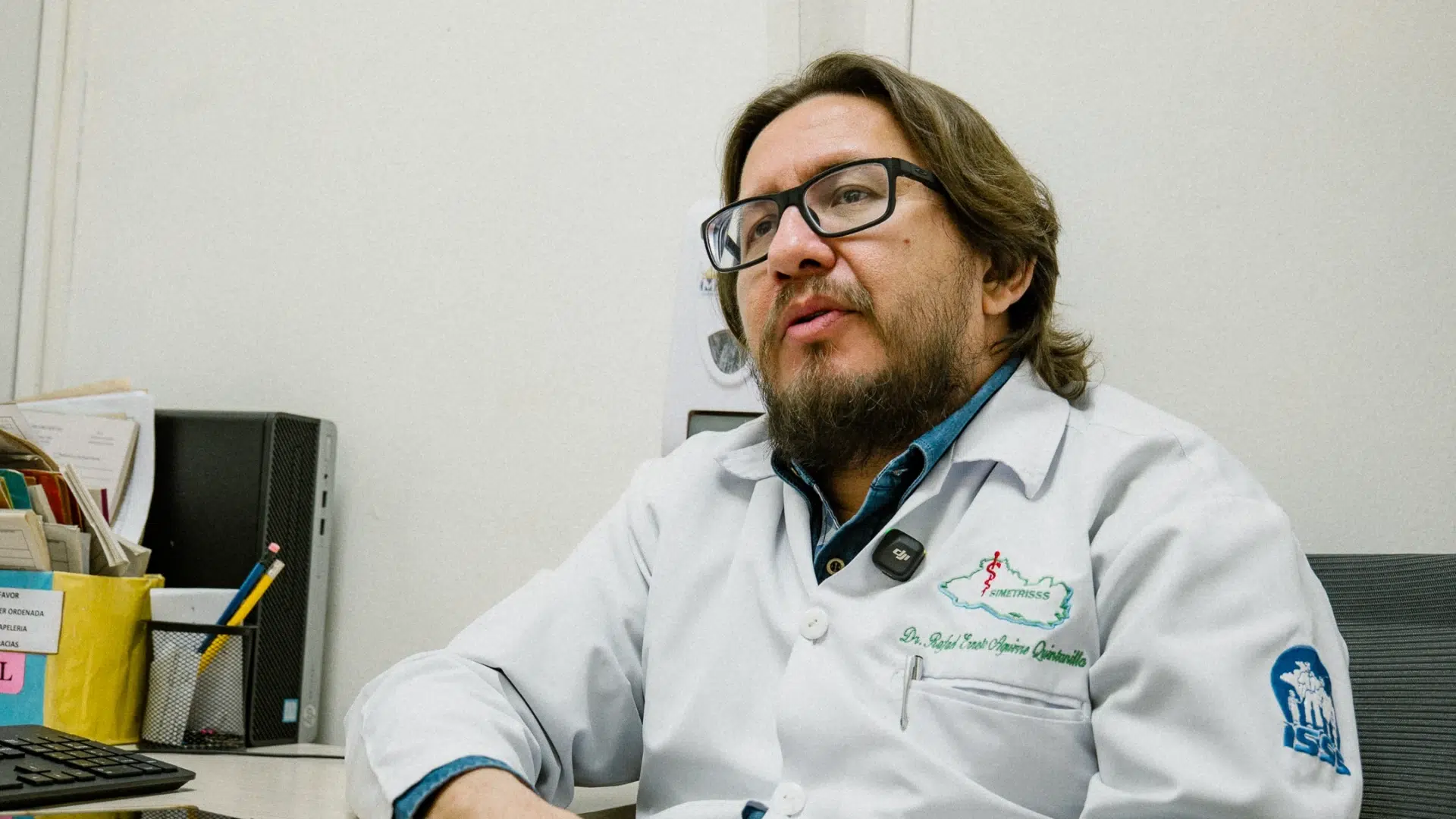
Dr. Rafael Ernesto Aguirre Quintanilla became secretary general of the Salvadoran Social Security Institute Medical Workers’ Union (SIMETRISSS) in October 2020. From that position, he has become one of the most outspoken critics of the deficiencies in El Salvador’s public health system, denouncing medicine shortages and the mass, unjustified firing of health workers. These denunciations have come at a cost. Today he faces fierce harassment campaigns on social media and an administrative process to remove him from his position.
In this interview with GatoEncerrado, Aguirre explains that ISSS authorities accuse him of disclosing information about medicine shortages and of assuming a role as an “institutional spokesperson” that is not his to take. In response to the accusation, the doctor argues that data on the system’s shortcomings is public, and that accessing confidential information is not necessary to know the reality of the institution.
Beyond the union’s support, Aguirre also has the backing of the National Coalition for the Defense of the Salvadoran People’s Health (CONADESA) and the Colegio Médico, which issued a statement rejecting the removal process and calling it “retaliation against a professional who has fulfilled his ethical duty to safeguard public health.”
Despite the process against him, Aguirre continues working, as he has for the past 20 years, as an internist with training in nephrology at the Oncology Hospital. He told this magazine that if the outcome ends up being his dismissal, it won’t stop him from continuing to call out the harmful decisions made by health sector authorities, the labor injustices, and the trampling of human rights under the current Nayib Bukele administration.
Note: This interview contains contextual paragraphs that accompany Dr. Aguirre’s responses. They may be useful for understanding references, data, or dates.
When you became secretary general of SIMETRISSS, you took on the role of spokesperson for a profession facing hardships and repression. Denouncing that carries risks. But even so, you took that risk. What motivated you to take on a more visible and critical role vis-à-vis the authorities?
Unions exist to fight for labor rights, for the professional and financial advancement of their members. But a very important point is that when you talk about professional advancement, you’re talking about professional prestige. Doctors seek prestige above all other professionals, and wanting to stand out is something innate in human beings. But what was the problem? Different situations started happening that we began to flag. First, the lack of opportunity for specialists and subspecialists to get a salary increase, professional advancement.
At that time, we only had permission to attend one national or international professional conference. Through all these struggles, and especially under this new administration, we managed to get three conferences and up to seven days of leave to attend them, because part of the professional development we need as doctors is being able to attend conferences, certificate programs, master’s programs, and so on. These were things that were being heavily restricted under the ARENA governments and a bit more under the FMLN governments.
All those details are what we kept accumulating, and we decided we had to fight for those salary and professional improvements. In that fight, we also started seeing the deficiency in the management of medical supplies and medications. All of these are the situations that have driven many leaders — not just in my case, but other secretaries as well — to take up this work of union struggle, the fight for the right to dignified health care, for quality medications for patients.
Context
The problem of medicine shortages is not new. In 2018, still under the administration of former President Salvador Sánchez Cerén, there was a shortage of irbesartan, a basic antihypertensive. As authorities explained at the time, an international alert had been issued after impurities were detected in certain batches, forcing the drug to be pulled. The union immediately demanded alternatives, arguing that without this medication, patients were at risk of suffering a stroke or heart attack due to uncontrolled blood pressure. Faced with the emergency, medical staff had to improvise a switch to a different antihypertensive and remain vigilant that the change did not cause adverse effects in their patients.
When did you take over as secretary general of SIMETRISSS?
I took over in October 2020 because many union members had started complaining that the 2019–2020 board of directors wasn’t showing up at their health centers. The big problem was that about 60% of that board — six out of eleven colleagues — were already over 50 and had chronic illnesses. They were afraid of going to the centers and catching Covid. And that’s a valid concern. So the board members rarely visited them, and that started generating a lot of frustration among the members.
The time came to change the board of directors, and some colleagues and I put ourselves forward with two goals: one, to visit colleagues and strengthen the demand for protective medical equipment — masks, face shields, all the medical supplies we needed at that point during the pandemic. In 2020 I took over and we got to work. The first thing was a plan to visit colleagues at their respective centers. Second, what else could we offer them so they’d see the union as attractive and wouldn’t just leave because nobody was coming to visit them. We introduced personalized assistance programs. What does that mean? Payment to attend conferences and certificate programs, legal support when affiliated colleagues faced medical lawsuits, whether for malpractice or any other situation.
We started building all of this up, to the point that we went from 800 affiliated doctors to about 1,300. It was a new boom for the union, and it gained strength. We were called in by the Ministry of Labor, we were called in by the administration to start having talks, to see how we could gradually improve both the labor rights of our colleagues and the quality of patient care, because doctors had started leaving the institution.
Context
According to Aguirre, staff turnover at the ISSS has been constant. From Nayib Bukele’s rise to power in June 2019 through 2022, an average of 35 to 40 doctors resigned each year. The crisis worsened in 2023, when the administration refused to negotiate the collective bargaining agreement, putting the protection fund clause in jeopardy. With this blockage, roughly $140 million earmarked for retirement severance packages for professionals was put at risk. The public administration’s justification was that the STISSS, the majority union, did not meet the 51% total membership required by the Labor Code. SIMETRISSS denounced this as the first time an administration had used a legal technicality as a pretext to bury a collective bargaining agreement. This triggered 250 doctors to resign between December 2023 and April 2024. This massive loss of talent forced the Social Security Institute to patch the gaps by using internists to fill specialty positions, as the president of the Colegio Médico, Iván Solano Leiva, denounced at the time.
You mention that when the union started gaining more strength, you had certain negotiations with the administration. What were your demands? What kind of responses did you get? What agreements were reached?
In 2021, we were the first board of directors of the doctors’ union to participate in collective bargaining negotiations. Never before in the union’s 27-year history had we been able to participate in contract negotiations. Our capacity for dialogue and for coordinating efforts was such that we were invited by the titular union, in this case the STISSS, to join the negotiating table. We didn’t have a vote, but we did have a voice. That’s how we managed to get them to provide us with lab coats — they’d never given us lab coats before; to get the three annual conferences; to raise the amount of leave time, for example, when a family member passes away, it used to be five days, we managed to raise it to seven; and other similar things we achieved through those collective bargaining negotiations.
We were expecting, in December 2023 when the contract expired, to be able to negotiate and keep up that dynamic, but unfortunately those problems arose, because in February 2023 we became aware of the medicine shortages that began due to the mismanagement of Dr. Mónica Ayala’s administration. Up to 80 medications were out of stock at that point. That’s when the first divorce between the administration and the union happened. Because after having been negotiating, after having been in a dynamic of dialogue — maybe not very fruitful, but at least sitting down and talking — that’s when the entire relationship broke down. And from then until now, we can say that we never again sat down with central authorities, directors, deputy directors, or managers. Instead, we only sat down with local directors of each health center, department heads, or mid-level managers at the administrative tower who had no say in decision-making.
Context
The allegations against Director General Mónica Ayala are not unfounded. According to Dr. Aguirre, the ISSS operates on a planning model two years in advance. This means that when she took office in August 2020, the institutional roadmap was already drawn up and covered through 2022. Therefore, the true face of her administration only began to show in the 2023 execution. The results were immediate. In February of that year, SIMETRISSS denounced that 80 essential medications were completely out of stock, including antihypertensives, antidiabetics, and antibiotics.
For you as a doctor, and for the doctors who are face-to-face with patients, what does a problem of this magnitude — the shortage of medications — mean?
First of all, the acute decompensation my patient can suffer. If they don’t have their antihypertensive on time, the risk of developing a stroke or heart attack goes up 60% in the first two months of stopping the medication. If they’re taking it irregularly, as sometimes happens, and patients say: “I’m going to save these 15 pills so they last me the month at least.” And they’re taking the treatment one day on, one day off — that also causes problems. On a smaller scale, sure, but in the long run it’s also going to lead to a lot of decompensation.
Second, the mortality caused by stopping medications. And third, the doctor’s reputation. What does that mean? “Who’s your doctor?” they ask the patient. “Oh, Dr. Aguirre.” And with that they tell the patient: “Man, Dr. Aguirre manages his patients terribly. They’re walking around with uncontrolled blood sugar, uncontrolled blood pressure. Hasn’t the doctor told you your cholesterol is high?” For all these problems, the doctor gets the blame — because either he doesn’t make a good diagnosis or he doesn’t do a proper treatment plan, when what’s actually happening is that he doesn’t have the medications. Now, what does a patient normally do? Buy them. Even on the black market, where medications are traded and everything. A lot of the time they’re adulterated medications or medications that no longer pass quality testing, and that causes the patient to decompensate.
Context
The medicine shortages denounced by Aguirre also translate into a direct impact on patients’ finances, a technical reality known as “out-of-pocket health spending.” This concept encompasses the money that families must take from their own budget to pay for consultations, lab tests, or medicines that the state is supposed to guarantee. According to the World Health Organization (WHO), when this spending absorbs an excessive share of income, it becomes “impoverishing expenditure,” forcing households to go into debt or sacrifice basic needs like food. In El Salvador, data from the Pan American Health Organization (PAHO) show that out-of-pocket household spending was 31.3% in 2024 — meaning that for every $100 earned, families had to spend more than $31 on medical care. Although the figure dropped from the 37.3% recorded in 2017, the current administration remains far from the international threshold recommended by the WHO, which requires this spending to stay below 20% to ensure the population’s financial protection.
Because of these denunciations and allegations, we know an administrative removal process has been opened against you. What are the formal arguments they’ve presented to sustain the removal process?
This is the excerpt from the summons: “In that context, the worker, in his capacity as a specialist physician at the ISSS Medical-Surgical and Oncology Hospital, does not have within his functional duties the administration of the national supply system, the authority of institutional communication regarding inventories, or the public disclosure of internal logistics information.” There you can see the three grounds. Not one is for patient mistreatment, for showing up late, for not meeting goals, for not following patient care protocols, or for not delivering medications to patients. In other words, it’s for the specific denunciations that have been made all these years about the lack of medical supplies and medications. So what they’re telling me is that since I don’t know about the inventories, I have no business talking about them. But I don’t talk about internal inventory — what I talk about are the complaints patients make through social media, through media outlets like radio and television, and that they’ve brought directly to us.
As an institution, we have the official medication list. It is, exactly as its name says, an official list that the institute makes available to all beneficiaries. All the antihypertensives, the antidiabetics, the cholesterol-lowering medications — they’re all there. I can select which medication is best for my patient. That’s what the official medication list is for. When I talk about official lists, I mean I’ve done a comparison of the official list with the lists that patients have given us, and they’ve matched up.
Context
As a result of the shortages strangling the institution, SIMETRISSS launched an initiative to distribute free medications, obtained through the solidarity of medical staff and private donors. According to Aguirre, they collected about 10,000 units of medication, including penicillin, antihypertensives, anticonvulsants, and antidepressants. With this contingency project, they helped more than 500 people who didn’t receive their treatments at the ISSS and who lack the resources to buy them at private pharmacies. This has been another mechanism through which they’ve been able to identify which medications are missing.
When were you notified of this process, and what irregularities have you identified in this procedure?
Look, this process unfortunately has multiple irregularities. I received the first summons on March 23. They were summoning me to the oncology department office for February 27, 2026 — that is, on March 23 they gave me a summons for February 27, a month earlier. When we noticed this legally aberrant situation, we confronted the person delivering it about why it had that date. Could a hearing have taken place that month of February without us being present, and they made some kind of decision? We don’t know.
We filed a written statement about it, pointing out why, institutionally, they were doing this to a union official, given that the Labor Code establishes that a union official cannot be subjected to the same process as an independent worker or any other type of worker. For a union official, you have to present the grounds for wanting to carry out the dismissal, demotion, or violation of labor rights before a competent judge. That’s the first thing they should have done, but they didn’t. They initiated the disciplinary process without court authorization. This is a practice they’ve been carrying out against union authorities, and at the Social Security Institute they should have acted differently. From the very first filing, we made it clear that we’ve requested the nullification of the process because it is not the appropriate venue where this should be adjudicated.
You were telling me that this summons arrived at the end of March with an erroneous date. Since then, aside from the filing you submitted, how has your defense process played out to confront this accusation? Have you had any dialogue or direct communication with higher authorities as a result of this process? Has Dr. Mónica Ayala been in contact with you?
Since then, we’ve had two subsequent hearings in which documents and testimonial evidence have been presented, and above all we’ve continued to stress that this is not the appropriate venue where these kinds of decisions should be made. But even so, they’ve ignored us and pressed on. They’re essentially checking off a legal requirement to proceed with the dismissal. That’s what we’ve established, and we’ve submitted filings stating that the relevant jurisprudence is not being applied. Well, the last one was a motion of inadmissibility and complete nullification of the process, to which they said they would withhold their response until they had a final verdict from a competent authority — in this case, the general directorate or the board of directors — and so far there has been no further response.
Based on your experience, do you believe this dismissal process is a response to technical or administrative reasons, or is it a purely political conflict?
Yes, that’s why in the denunciation we made on Monday (May 11), we said this is political persecution. We have no other name for it. I haven’t breached the institution’s cybersecurity, I haven’t leaked information, I haven’t gone and hacked information from the institution’s central servers, I haven’t shown up at the administrative tower to try to infiltrate the finance portfolios, the document portfolios, or the bidding files to see what’s happening with the medications. What we’ve simply done is compare the lists patients have given us with the official medication list, and they’ve matched. If the medications they tell us are missing coincide with the official medication list, there’s nothing more to look for. At no point have we engaged in any illegal means of obtaining data and documents, which is why we’ve requested that the process be declared null and void.
You’ve mentioned political persecution. On that subject, I want to ask whether you’ve faced any kind of pressure, warnings, or retaliation because of your public statements and denunciations. Even whether you’ve noticed any kind of surveillance, harassment, or intimidation from the authorities…
Harassment only on social media, with the accusations that have been made and thrown around on social media. People posting things like “He deserves it,” “Hope they fire you,” and worse things, right? Wishing you dead and other situations like that. As for persecution — seeing strange people following me or police showing up at my house asking about something — I haven’t had those warnings or that kind of persecution so far. Of course, I’m on alert for any situation like that, because I know the reality of this country. Many colleagues have lived through it — journalist colleagues, human rights defenders… I mean, there are people detained for that very reason who to this day haven’t even had their trials started; we’re talking about Ruth Eleonora López, Dr. Enrique Anaya as well. We’re watching and waiting, and obviously, despite the fear we feel, we keep raising our voices in defense of the population so they can get their medications on time.
Have you identified other similar cases of removal processes related to denunciations within the health system?
As such, this is the first time a doctor and union leader has been involved. I mean in this administration, because we’ve had cases of union leaders who were even imprisoned — we’re talking about Ricardo Monge and other union leaders who actually went to prison for offenses that were ultimately proven to be untrue. In this case, we can say that in this administration, within the institution, I’m the first to be caught up in a situation of political persecution or intimidation aimed at keeping me silent.
Context
Since the state of exception began in March 2022, civil society organizations have denounced the arbitrary detention of at least twenty union members. There are some quite emblematic cases, such as that of José Leonidas Bonilla Torres, a former union member of the Mejicanos municipal government who was detained one month after the state of exception began and who died in state custody on September 5, 2022. Bonilla had injuries on his body and signs of a possible homicide, according to the findings in the report “The Bukele Model: Security Without Human Rights,” published in 2024. The year after the state of exception began, the death in custody of Hever Chacón, a member of the Eastern Bus Terminal Workers’ Union, became known; he reportedly died from health problems.
Also widely denounced have been the cases of Sabino Ramos, a union member of the Panchimalco municipal government and cultural defender; Misael Gómez, a union member from Ciudad Delgado who was detained after a protest by the San Martín union on June 8, 2022; and Giovanni Aguirre, a union member of the San Salvador municipal government and member of the Bloc of Popular Resistance and Rebellion (BRP), detained just one week after attending a march. Various social organizations have stated that these actions were intended to repress critical voices and curb the organizing of workers demanding better labor conditions.
That’s exactly what I wanted to ask you about. Could one of the implications of this case be that other doctors and health system workers now face a risk of being silenced, or even of self-censorship, to avoid denouncing these kinds of situations?
Yes, the problem is that self-censorship is already there. Let’s remember that up to this point, only we, the union leaders — especially from SIMETRISSS: the secretary of conflicts, the secretary of organization and statistics, who are, so to speak, the union’s legal representatives — have been the ones speaking out. Why? Because the rank-and-file colleagues, the ones without union protections, are obviously afraid to say things. So they pass the information they want denounced to us, and we’ve been doing it throughout this entire time. Now, given this situation, we expect the self-censorship to be greater and the fear of retaliation among colleagues to be greater. Still, regardless of that, we’ve told our colleagues: “No, we can’t back down. We have to keep denouncing, keep up this work of defending labor rights and human rights for the population, and we can’t let this stop us.”
Looking ahead now, what scenario do you foresee for the ISSS if current conditions continue?
Right now, if we continue on exactly as we are, we’re going to fall into both a technical professional bankruptcy — from the lack of specialists and subspecialists — and a technical financial bankruptcy. We’re seeing people who have left the institution and have already been waiting a year to get their severance paid. There’s still no money to pay severances. What does that tell you? That the institution doesn’t have enough money. It either pays its suppliers, or it pays the fired workers, or it pays the workers who have resigned. You also see anonymous complaints from suppliers saying: “The institution hasn’t paid in six months, hasn’t paid in eight months.” There’s a situation of lack of money and lack of payment that’s becoming dangerous. There are cases of colleagues who are working on an interim basis and are being paid on the last day of the month, when normally monthly pay should come between the 20th and the 22nd.
Context
The crisis at the Social Security Institute is not strictly financial. In recent months, the Colegio Médico and SIMETRISSS have denounced the work overload caused by grueling shifts and a lack of rest. This situation translates into physical and mental burnout for staff that has a direct impact on patients, since the exhaustion of professionals makes quality care impossible. To reverse this collapse, the union compiled, in October 2025, a compendium of 17 managerial proposals that can serve as input in drafting the National Health Plan. The document is structured around three fundamental pillars: technical-legal proposals, technical-administrative proposals, and strategies to transform the institute’s public health system.
To wrap up, doctor — going back to your case — if this process were to come to fruition, what comes next for you? How do you handle it, and are you willing to continue denouncing even if you’re expelled from the ISSS?
Absolutely. We won’t be silenced even if they end up firing us. We know there are legal avenues we need to appeal to, and we’re going to use them — both the national avenues and the international bodies we have for making these kinds of denunciations. On top of that, CONADESA, the National Coalition for the Defense of Health, is still active. We’d give it even more strength, and we also don’t rule out the possibility of creating some kind of citizens’ movement in favor of not just the health of the Salvadoran people, but fundamental rights, water resources, education, and the environment. We’re going to incorporate all of that. So no, this is not going to silence us in any way. It’s going to give us much more strength to keep going.
GatoEncerrado: https://gatoencerrado.news/2026/06/05/no-vamos-a-callar-aunque-nos-despidan-doctor-rafael-aguirre-simetrisss/
“No vamos a callar aunque nos despidan”: Doctor Rafael Aguirre, SIMETRISSS
Por Guillermo Cartagena
El doctor Rafael Ernesto Aguirre Quintanilla se convirtió, desde octubre de 2020, en el secretario general del Sindicato de Médicos Trabajadores del Instituto Salvadoreño del Seguro Social (SIMETRISSS). Desde esa posición, se ha convertido en una de las voces más críticas contra las deficiencias del sistema de salud pública en El Salvador, denunciando el desabastecimiento de medicamentos y el despido masivo e injustificado del personal de salud. Estas denuncias le han pasado factura. Hoy enfrenta feroces campañas de acoso en redes sociales y un proceso administrativo para destituirlo.
En esta entrevista con GatoEncerrado, Aguirre explica que las autoridades del ISSS lo acusan de divulgar información sobre el desabastecimiento de medicinas y de asumir un rol de “comunicador institucional” que no le compete. Frente al señalamiento, el médico argumenta que los datos sobre las carencias del sistema son públicos, por lo que no hace falta acceder a información confidencial para conocer la realidad de la institución.
Más allá del apoyo del sindicato, Aguirre también cuenta con el respaldo de la Coordinadora Nacional para la Defensa de la Salud del Pueblo Salvadoreño (CONADESA) y del Colegio Médico, que a través de un comunicado manifestó su rechazo al proceso de destitución y lo calificó como “una represalia contra un profesional que ha cumplido con su deber ético de velar por la salud pública”.
Pese al proceso en su contra, Aguirre continúa trabajando, al igual que en los últimos 20 años, como médico internista con preparación en nefrología en el Hospital de Oncología. Afirmó a esta revista que si el desenlace termina siendo su despido, esto no le detendrá de seguir señalando las decisiones perjudiciales que toman las autoridades del sector Salud, las injusticias laborales y el atropello a los derechos humanos en la actual administración de Nayib Bukele.
Nota: Esta entrevista contiene párrafos de contexto que acompañan las respuestas del doctor Aguirre. Pueden resultar útiles para entender las referencias, datos o fechas.
Cuando usted se convirtió en secretario general del SIMETRISSS, asumió la vocería de un gremio que enfrenta dificultades y represión. Denunciar eso tiene sus riesgos. Pero aún así, usted ha asumido el riesgo. ¿Qué lo motivó a asumir un rol más visible y crítico frente a las autoridades?
Los sindicatos están para pelear los derechos laborales, para la mejora profesional y financiera de sus afiliados. Pero un punto muy importante es que cuando tú hablas de mejora profesional, hablas de un prestigio profesional. El médico busca un prestigio sobre todos los demás profesionales y es algo innato en el ser humano el querer sobresalir de los demás. ¿Pero cuál era el problema? Que empezaron a ocurrir las diferentes situaciones que nosotros empezamos a enmarcar. Primero, la falta de oportunidad que tenían los especialistas o subespecialistas de obtener un incremento salarial, una mejora profesional.
Para ese entonces, nosotros solamente teníamos permiso para asistir a un congreso nacional o internacional a nivel profesional. Nosotros logramos, a través de todas estas luchas y, sobre todo en esta nueva administración, que se nos dieran tres congresos y que se dieran hasta siete días de permiso para poder asistir a ellos, porque parte de la mejora profesional que como médico debemos de tener es el poder asistir a congresos, diplomados, maestrías, etcétera. Cosas que se estaban prohibiendo bastante en los gobiernos de Arena y un poco más en los gobiernos del Frente.
Todos esos detalles son los que nosotros fuimos acumulando y decidimos que había que luchar por esas mejoras salariales y profesionales. En esa lucha fuimos viendo nosotros también la deficiencia que ha estado ocurriendo con la gestión de insumos médicos y medicamentos. Todas esas son las situaciones que han llevado a muchos líderes, no solamente en mi caso, sino otros secretarios más, a tener esa labor de lucha gremial, lucha por los derechos de una salud digna, de obtener medicamentos de calidad para los pacientes.
Contexto
El problema de escasez de medicamentos no es reciente. En 2018, aún bajo la administración del expresidente Salvador Sánchez Cerén, hubo desabastecimiento de irbesartán, un antihipertensivo básico. Según explicaron las autoridades en aquel momento, hubo una alerta emitida a nivel internacional por la detección de impurezas en ciertos lotes, lo que obligó a retirar el fármaco. De inmediato, el sindicato exigió alternativas, argumentando que al no contar con este medicamento, los pacientes tenían el riesgo de experimentar un derrame cerebral o un infarto por la descompensación de su presión arterial. Ante la emergencia, el personal médico tuvo que improvisar un cambio de antihipertensivo y estar vigilantes de que ese cambio no implicara efectos adversos en sus pacientes.
¿Desde cuándo asume usted como secretario general de SIMETRISSS?
Yo asumo en octubre de 2020 a raíz de que muchos afiliados al sindicato se empezaron a quejar de que la junta directiva 2019-2020 no llegaba a sus centros de atención. El gran problema era que alrededor del 60% de esa junta, es decir, seis compañeros de 11, eran ya mayores de 50 años y tenían enfermedades crónicas. Ellos tenían miedo de llegar a los centros y contagiarse con el Covid. Y eso es válido pensarlo. Entonces, los compañeros muy pocas veces iban a visitarlos y eso empezó a generar mucha molestia en los afiliados.
Llega el momento de cambiar junta directiva y con unos compañeros nos proponemos en ese sentido: uno, visitar a los compañeros y fortalecer la exigencia de equipos médicos de protección, mascarillas, caretas, todos los insumos médicos que necesitábamos en esos momentos para la pandemia. En el 2020 yo asumo e iniciamos la labor. Lo primero fue un plan para visitar a los compañeros en sus centros respectivos. Segundo, qué otros elementos podíamos darles para que vieran atractivo el sindicato y no se salieran simple y sencillamente porque no los llegaban a visitar. Incluimos nosotros los programas de asistencia personalizada. ¿Qué significa? Pago por asistir a congresos y diplomados, apoyo jurídico cuando los colegas afiliados tenían demandas médicas, ya sea de mala praxis o de cualquier otra situación.
Empezamos a fomentar todo esto, al grado que de tener 800 médicos afiliados, llegamos a tener alrededor de 1,300. Fue un nuevo “boom” del sindicato y tomó fuerza. Fuimos llamados por el Ministerio de Trabajo, fuimos llamados por las administraciones para poder empezar a tener pláticas, ver de qué manera poder ir mejorando tanto los derechos laborales de los compañeros como las situaciones de atención al usuario, porque empezó a ocurrir la deserción de médicos de la institución.
Contexto
Según detalló Aguirre, la fuga de personal en el ISSS ha sido constante. Desde la llegada al poder de Nayib Bukele en junio de 2019 y hasta 2022, un promedio de 35 a 40 médicos renunciaron anualmente. La crisis se agudizó en 2023, cuando la administración se negó a negociar el contrato colectivo, poniendo en vilo la cláusula del fondo de protección. Con este bloqueo, cerca de 140 millones de dólares destinados a las indemnizaciones por retiro de los profesionales quedaron en riesgo. La justificación de la gestión pública fue que el STISSS, el sindicato mayoritario, no alcanzaba el 51% de la afiliación total exigida por el Código de Trabajo. Desde el SIMETRISSS denunciaron que esta era la primera vez que una administración utilizaba un tecnicismo legal como pretexto para enterrar un contrato colectivo. Esto provocó que 250 médicos renunciaran entre diciembre de 2023 y abril de 2024. Esta pérdida masiva de talento obligó al Seguro Social a parchar los vacíos utilizando a médicos internistas para cubrir plazas de especialidad, según denunció en su momento el presidente del Colegio Médico, Iván Solano Leiva.
Usted menciona que cuando el sindicato empezó a coger más fuerza tuvieron ciertas negociaciones con la administración. ¿Qué peticiones hicieron? ¿Qué tipo de respuestas obtuvieron? ¿A qué acuerdo se llegó?
En el 2021 fuimos la primera junta directiva del sindicato de médicos que participó en la negociación del contrato colectivo. Nunca antes en los 27 años de vida que tenía el sindicato habíamos podido participar en una negociación de contrato. Fue tanta la capacidad de diálogo y de articular esfuerzos que fuimos llamados por parte del sindicato titular, en este caso el STISSS, para conformar la mesa negociadora. No teníamos voto, pero sí teníamos voz. Así es como logramos que nos entregaran gabachas, nunca antes nos habían entregado gabachas; que nos entregaran los tres congresos anuales; que elevaran la cantidad ( de tiempo de permiso ), por ejemplo, cuando fallece un familiar, antes eran cinco días, lo logramos elevar a siete; y así diferentes situaciones que logramos a través de esa negociación de contrato colectivo.
Esperábamos, en diciembre de 2023 que vencía el contrato, poder negociar y mantenernos en esa dinámica, pero lastimosamente vinieron esos problemas, porque en febrero del 2023 nosotros nos dimos cuenta de la falta de medicamentos que empezó debido a la mala gestión de la administración de la doctora Mónica Ayala. Llegaron a faltar hasta 80 medicamentos en esa ocasión. Ahí ocurrió el primer divorcio entre la administración y el sindicato. Porque después de haber estado negociando, de haber estado en una dinámica de diálogo, tal vez no muy fructífero, pero sí por lo menos sentarnos y platicar, ahí se rompió toda la relación y desde entonces a la fecha podemos decir que nosotros no nos volvimos a sentar con autoridades centrales, directoras, subdirectoras, gerentes, sino que ya nos sentábamos solo con los directores locales de cada centro de atención, jefaturas o mandos medios de la torre administrativa que no tenían injerencia en toma de decisión.
Contexto
Los señalamientos contra la directora general, Mónica Ayala, no son fortuitos. Según explicó el doctor Aguirre, el ISSS opera bajo un modelo de planificación con dos años de anticipación. Esto significa que cuando la funcionaria asumió el cargo, en agosto de 2020, la hoja de ruta institucional ya estaba trazada y cubierta hasta 2022. Por lo tanto, el verdadero rostro de su administración empezó a reflejarse en la ejecución de 2023. Los resultados fueron inmediatos. En febrero de ese año, el SIMETRISSS denunció que 80 medicamentos esenciales estaban completamente agotados, entre ellos antihipertensivos, antidiabéticos y antibióticos.
Para usted como médico y para los doctores que están frente a frente con los pacientes, ¿qué implica un problema de estas características como el desabastecimiento de medicamentos?
En primer lugar, la descompensación aguda que puede sufrir mi paciente. Si no tiene su antihipertensivo a tiempo, el riesgo de que ellos desarrollen un derrame cerebral o un infarto al corazón se eleva un 60% en los primeros 2 meses de suspender el medicamento. Si lo está tomando de forma irregular, como a veces sucede y dicen ( los pacientes ): “Estas 15 tabletas las voy a guardar para que me duren el mes por lo menos”. Y están un día sí y un día, no tomando tratamiento, eso también genera problemas. Claro, en menor escala, pero que también a la larga va a llevar a muchas descompensaciones.
En segundo lugar, el hecho de la mortalidad que genera la suspensión de los medicamentos y, en tercer lugar, el prestigio del médico. ¿Qué es lo que quiere decir? “¿Y quién es su médico?”, le preguntan al paciente. “Ah, el doctor Aguirre”, y ya con eso le dicen al paciente: “Híjole, qué mal maneja el doctor Aguirre a sus pacientes. Andan descompensados de su azúcar, andan descompensados de su hipertensión. ¿Y que el doctor no le ha dicho que anda con el colesterol alto?”. De todas las alteraciones la culpa la tiene el doctor, porque o no hace buen diagnóstico o no hace buen abordaje, cuando lo que sucede es que no tiene los medicamentos. Ahora, ¿qué es lo que hace normalmente un paciente? Comprarlos. Aunque sea en el mercado negro, donde los medicamentos se transan y todo. Muchas veces son medicamentos alterados o son medicamentos que ya no pasan las pruebas de calidad y eso genera que el paciente se descompense.
Contexto
La escasez de medicamentos denunciada por Aguirre también se traduce en un impacto directo en la economía de los pacientes, una realidad técnica conocida como “gasto de bolsillo en salud”. Este concepto abarca el dinero que las familias deben extraer de su propio presupuesto para costear consultas, exámenes de laboratorio o medicinas que el Estado tendría que garantizar. Según la Organización Mundial de la Salud (OMS), cuando este desembolso absorbe una proporción excesiva de los ingresos, se transforma en un “gasto empobrecedor”, obligando a los hogares a endeudarse o a sacrificar necesidades básicas como la alimentación. En El Salvador, los datos de la Organización Panamericana de la Salud (OPS) revelan que el gasto de bolsillo en los hogares fue del 31.3% en 2024; es decir, de cada 100 dólares percibidos, las familias tuvieron que destinar más de 31 dólares a la atención médica. Aunque la cifra se redujo frente al 37.3% registrado en 2017, la administración actual se mantiene lejos del umbral internacional recomendado por la OMS, el cual exige que este gasto sea menor al 20% para garantizar la protección financiera de la población.
Por estas denuncias y señalamientos, sabemos que le han abierto un proceso administrativo de destitución a usted. ¿Cuáles son los argumentos formales que le han presentado para sostener el proceso de destitución?
Este es el extracto sacado del citatorio: “En ese contexto, el trabajador, en su calidad de médico especialista del Hospital Médico Quirúrgico y Oncológico del ISSS, no tiene dentro de sus atribuciones funcionales la administración del sistema de abastecimiento nacional, la atribución de comunicación institucional en materia de inventarios ni la divulgación pública de información logística interna”. Ahí ves tú las tres causales. Ninguna es por maltrato de paciente, porque llego tarde, porque no cumplo con las metas, porque no sigo los protocolos de atención de pacientes, porque no entrego medicamentos a los pacientes. O sea, es por la denuncia concreta que se ha estado haciendo todos estos años de la falta de insumos médicos y medicamentos. Entonces, me están diciendo ahí que como yo desconozco de los inventarios no tengo por qué estar hablando de ellos. Ahora, yo no hablo del inventario interno, yo de lo que hablo es de las denuncias que los pacientes hacen a través de redes sociales, de los medios de comunicación como la radio y la televisión y que nos han hecho llegar a nosotros de forma directa.
Nosotros como institución tenemos el listado oficial de medicamentos. Ese es, así como su nombre lo dice, un listado oficial que el instituto tiene a disposición de todos los derechohabientes. Todos los antihipertensivos, los antidiabéticos, los medicamentos para bajar la grasa, ahí están. Yo puedo hacer una selección de qué medicamento le conviene más a mi paciente. Para eso me sirve el listado oficial de medicamentos. Cuando yo hablo de listados oficiales, hablo que he hecho un comparativo del listado oficial con los listados que los pacientes nos han dado y ahí eso ha cuadrado.
Contexto
A raíz del desabastecimiento que asfixia a la institución, el SIMETRISSS lanzó una iniciativa de entrega gratuita de medicamentos, obtenidos gracias a la solidaridad de personal médico y donantes particulares. Según detalló Aguirre, recolectaron cerca de 10,000 unidades de medicamentos, que incluyen penicilina, antihipertensivos, anticonvulsivantes y antidepresivos. Con este proyecto de contingencia, beneficiaron a más de 500 personas que no recibieron sus tratamientos en el ISSS y que carecen de recursos para adquirirlos en farmacias privadas. Este ha sido otro mecanismo mediante el cual han logrado identificar los medicamentos que hacen falta.
¿Cuándo fue notificado de este proceso y cuáles son las irregularidades que usted identifica en este procedimiento?
Fijate que este proceso lastimosamente tiene múltiples irregularidades. El primer citatorio yo lo recibo el 23 de marzo. Me estaban citando a la oficina del departamento de oncología para el 27 de febrero del 2026, o sea, el 23 de marzo me dan el citatorio para el 27 de febrero, un mes atrás. Cuando nos percatamos de esa situación aberrante jurídica, le reclamamos a la persona que nos la estaba entregando que por qué tenía esa fecha. ¿Será que se dio una audiencia en ese mes de febrero que nosotros no estuvimos presentes y tomaron algún tipo de decisión? No lo sabemos.
Nosotros metimos un escrito al respecto, señalando por qué de forma institucional se estaba haciendo eso contra un directivo sindical, que el Código de Trabajo establece que a un directivo sindical no se le puede ejercer la misma acción que a un trabajador independiente o que a otro tipo de trabajador. A este tienes que presentarle el motivo por el cual le quieres hacer la destitución, la desmejora, la vulneración del derecho laboral ante un juez competente. Eso es lo primero que tenían que haber hecho, pero no lo hicieron. Ellos han iniciado el proceso sancionatorio sin tener el aval de los juzgados. Esa es una práctica que han estado ejerciendo con las autoridades sindicales y en el Seguro Social tenían que haber actuado de forma diferente. Desde el primer escrito nosotros dejamos claro que hemos pedido la nulidad del proceso por no ser la instancia correspondiente donde debe ser evacuado esto.
Me hablaba de que este citatorio llegó a finales de marzo con fecha errónea. Desde entonces, además del escrito que presentó, ¿cómo ha sido su proceso de defensa para hacerle frente a esta acusación? ¿Ha tenido algún diálogo o comunicación directa a partir de este proceso con autoridades superiores? ¿La doctora Mónica Ayala se ha puesto en comunicación con usted?
Desde ese momento hemos tenido ya dos audiencias posteriores en las cuales se han hecho la presentación de documentos, de pruebas testimoniales y sobre todo de seguir recalcando que no es la instancia respectiva donde debe de tomarse ese tipo de decisiones, pero aún así han hecho caso omiso y han continuado. Ellos prácticamente están cumpliendo un requisito de ley para proceder a la destitución. Eso es lo que nosotros hemos constatado y hemos entregado escritos de que no se está aplicando la jurisprudencia respectiva. Bueno, el último fue de improponibilidad y de nulidad completa del proceso, a lo cual ellos dijeron que se abstenían a la respuesta hasta que tuvieran el veredicto final por parte de una autoridad competente, en este caso sería de la dirección general o consejo directivo, a lo cual por el momento no ha habido mayor respuesta.
A partir de su experiencia, ¿considera que este proceso de despido responde a razones técnicas, administrativas o es un conflicto meramente político?
Sí, por eso nosotros en la denuncia que hacíamos el lunes ( 11 de mayo ) hablamos de que esto es una persecución política. No tenemos nosotros otro nombre que tratar. Yo no he vulnerado seguridad cibernética de la institución, yo no he filtrado información, no he ido a hackear información de los servidores centrales de la institución, no me he presentado a la torre administrativa para poder ver de qué manera me infiltro en las carteras de finanzas, en las carteras de documentos o de licitaciones para ver qué está pasando con los medicamentos. Simple y sencillamente lo que nosotros hemos hecho es comparar los listados que los pacientes nos han entregado con el listado oficial de medicamentos y estos han coincidido. Si los medicamentos que nos dicen son los que hacen falta y coinciden con el listado oficial de medicamentos, no hay dónde buscarle más. En ningún momento nosotros hemos procedido con alguna forma ilegal de obtención de datos y de documentos, por eso hemos solicitado que se declare nulo el proceso.
Usted ha mencionado persecución política. Sobre eso le quiero preguntar si ha enfrentado algún tipo de presión, advertencia o represalia debido a su pronunciamiento y denuncias públicas. Incluso, si usted ha podido observar algún tipo de seguimiento, algún tipo de acoso, hostigamiento de parte de las autoridades…
Hostigamiento solamente en redes sociales con las acusaciones que se han hecho y que se han lanzado en redes sociales. Gente ahí que colocan cosas como “Se lo merece”, “Ojalá te despidan”, y otras cosas peores, ¿verdad? Ya deseándole la muerte a uno y otro tipo de situaciones. En lo que respecta a persecución de ver a gente extraña persiguiéndome o policía llegando a mi casa a preguntar por algo, por el momento no he tenido esas advertencias o ese tipo de persecución. Claro, yo estoy atento por cualquier situación de esas, pues sé la realidad del país, muchos compañeros la han vivido, compañeros periodistas, compañeros defensores de derechos humanos, bueno hay capturados por esa misma situación y que a la fecha ni siquiera se les ha iniciado el juicio; estamos hablando de Ruth Eleonora López, el doctor Enrique Anaya también. Estamos a la expectativa y obviamente, a pesar del temor que tenemos, seguimos levantando nuestra voz en defensa de la población para que tenga sus medicamentos a tiempo.
¿Ha identificado otros casos similares de procesos de destitución por temas de denuncias dentro del sistema de salud?
Como tal, es la primera vez que un médico y líder sindical se ve involucrado. Me refiero en esta administración, porque hemos tenido casos de líderes sindicales que incluso estuvieron presos, estamos hablando de Ricardo Monge y otro tipo de líderes sindicales que ellos hasta han estado en la prisión por delitos que al final se demostraron que no eran ciertos. En este caso, podemos decir que en esta administración, en la institución, yo soy el primero que se ve involucrado en una situación de persecución política o de amedrentamiento para que guarde silencio.
Contexto
Desde que comenzó el régimen de excepción en marzo de 2022, organizaciones de la sociedad civil han denunciado la captura arbitraria de al menos una veintena de sindicalistas. Hay casos bastante emblemáticos, como el de José Leonidas Bonilla Torres, exsindicalista de la Alcaldía de Mejicanos que fue capturado un mes después de iniciado el régimen y quien falleció bajo custodia del Estado el 5 de septiembre de 2022. Bonilla presentaba lesiones en el cuerpo e indicios de un posible homicidio, de acuerdo a lo recogido en el informe “El Modelo Bukele: Seguridad Sin Derechos Humanos”, publicado en 2024. Al año siguiente de iniciado el régimen se conoció la muerte bajo custodia del sindicalista Hever Chacón, del Sindicato de Trabajadores de la Terminal de Oriente, quien falleció por supuestos problemas de salud.
También han sido ampliamente denunciados los casos de Sabino Ramos, sindicalista de la Alcaldía de Panchimalco y defensor cultural; Misael Gómez, sindicalista de Ciudad Delgado quien fue detenido luego de una protesta del sindicato de San Martín, el 8 de junio de 2022, y Giovanni Aguirre, sindicalista de la Alcaldía de San Salvador e integrante del Bloque de Resistencia y Rebeldía Popular (BRP), capturado apenas una semana después de haber asistido a una marcha. Diversas organizaciones sociales han expresado que estas acciones han tenido como finalidad reprimir las voces críticas y frenar la organización de trabajadores que exigen mejores condiciones laborales.
Justo sobre eso le quería preguntar. ¿Puede ser una de las implicaciones, a raíz de este caso, que para otros médicos y trabajadores del sistema de salud exista ahora un riesgo de silenciamiento o incluso de autocensura para no denunciar este tipo de situación?
Sí, el problema es que la autocensura sí la tenemos. Recordemos que hasta este momento solo nosotros, los líderes sindicales, sobre todo de SIMETRISSS, hemos sido el secretario de conflictos, el secretario de organización y estadística, que somos, por así decirlo, los apoderados legales del sindicato, que nos habíamos estado pronunciando. ¿Por qué? porque los compañeros operativos, los que no tienen fuero sindical, obviamente tienen temor de decir las cosas. Entonces, ellos nos pasan a nosotros la información que quieren que sea denunciada y nosotros lo hemos estado haciendo a lo largo de todo este tiempo. Ahora, ante esta situación, la autocensura esperamos que sea mayor y el temor por parte de represalias de los compañeros sea mayor. Igual, independientemente de eso, nosotros les hemos dicho a los compañeros: “No, no hay que echarnos para atrás, hay que seguir denunciando, hay que seguir en esa labor de defensa de los derechos laborales y de los derechos humanos para la población y no nos podemos detener por eso”.
Mirando ya hacia adelante, ¿qué escenario prevé usted para el ISSS si se mantienen las condiciones actuales?
En este momento, si continuamos tal cual está, vamos a caer tanto en una quiebra técnica profesional, por falta de especialistas y subespecialistas, como en una quiebra técnica financiera. Vemos nosotros que hay personas que se han retirado de la institución y ya llevan un año esperando que se les pague su indemnización. Todavía no hay dinero para pagar indemnizaciones. ¿Qué te señala eso?, que la institución no tiene el dinero suficiente. O paga a sus proveedores, o le paga a los trabajadores despedidos o le paga a los trabajadores que han renunciado. Tú ves también quejas de proveedores de forma anónima que dicen: “La institución ya tiene 6 meses que no paga, ya tiene 8 meses que no paga”. Hay una situación de falta de dinero y de falta de pago que se está volviendo peligrosa. Hay casos de compañeros que están de forma interina y les están pagando hasta el último de mes, cuando normalmente el pago de mes tiene que ir entre el 20 y el 22.
Contexto
La crisis en el Seguro Social no es estrictamente financiera. En los últimos meses, el Colegio Médico y el SIMETRISSS han denunciado la sobrecarga laboral provocada por jornadas extenuantes y la falta de descanso. Esta situación se traduce en un desgaste físico y mental para el personal que repercute directamente en los pacientes, ya que el agotamiento de los profesionales imposibilita una atención de calidad. Para revertir este colapso, el sindicato recopiló, en octubre de 2025, un compendio de 17 propuestas gerenciales que pueden servir como insumo en la elaboración del Plan Nacional de Salud. El documento se estructura en tres ejes fundamentales: propuestas técnico-legales, técnico-administrativas y estrategias para transformar la salud pública del instituto.
Para ir concluyendo, doctor, regresando a lo de su caso, si este proceso se llegara a concretar, ¿qué viene para usted? ¿Cómo lo maneja y si está dispuesto a continuar denunciando aún si es expulsado del ISSS?
Claro que sí. Nosotros no nos vamos a callar aunque sea que nos terminen despidiendo. Sabemos que hay instancias jurídicas a las que tenemos que apelar, vamos a utilizarlas, tanto nacionales como las instancias internacionales que tenemos para hacer todo este tipo de denuncias. Además, queda CONADESA, la Coordinadora Nacional por la Defensa de la Salud, está vigente. Le daríamos todavía mucha más fuerza y no descartamos tampoco la posibilidad de crear algún movimiento ciudadano en favor, ya no solo de la salud de la población salvadoreña, sino de los derechos fundamentales, recursos hídricos, educación y medioambiente. Todo eso lo vamos a incorporar. Así que no, en ningún momento esto nos va a silenciar, sino que nos dará mucha más fuerza para seguir adelante.
GatoEncerrado: https://gatoencerrado.news/2026/06/05/no-vamos-a-callar-aunque-nos-despidan-doctor-rafael-aguirre-simetrisss/