
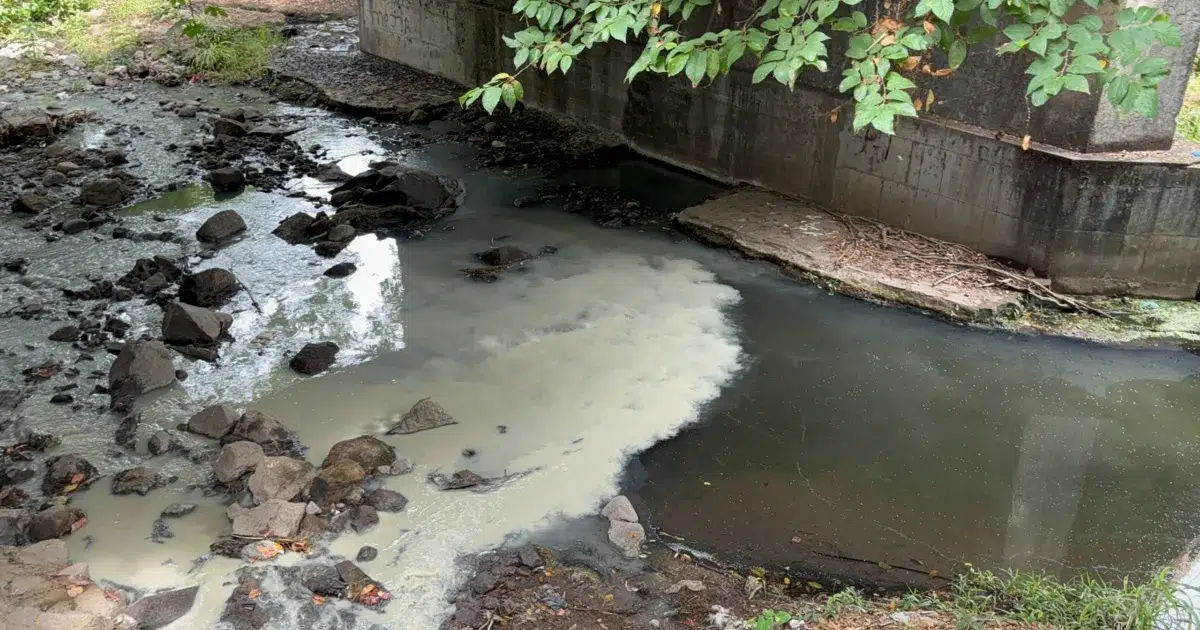
Dozens of residents from communities near the Zacatecoluca Prison Farm in La Paz Este gathered on Thursday, June 4, on the bridge over the El Espino River to express their opposition to the pollution of the waterway, caused by the direct discharge of sewage from the prison facility.
Men, women, and children carrying signs with messages asking the government to stop the daily pollution of the river gathered at the site.
“Mr. President, please listen to us, we can’t take it anymore, help us, the river is life for us. We want to be heard, our children are getting sick,” the signs read.
Residents said that until a few years ago, inhabitants of at least 35 communities that the river flows through used its water for household chores, bathing, and irrigating crops, but now it has turned into a massive sewer of whitish and green water.
The water that residents once used for bathing, washing, and watering their animals is now a sewer, the residents said.
The affected communities include El Polvillo, Apanta, La Lucha, Jardines de La Paz, Paredes, San Antonio Paredes, San Marcos de la Cruz, Entre Ríos, and many more.
Wendy Rivas, one of the community spokespersons, explained that the large sewage discharges begin at 8:00 p.m. “You can hear it clearly, it’s a huge gush of water coming down,” she said.
Another resident of the area, Pilar de Flores, who lives about a kilometer from the river, said the stench coming from the water is unbearable.
“In the early morning hours, when a lot of water has already come down, you can’t sleep anymore. It’s a terrible stench, as if dead animals had been thrown into the river. There are elderly people and children who get dizzy and vomit from that awful smell. We can’t take it anymore; the pools where we used to bathe are disgusting now,” she said.
According to residents’ testimonies, the health consequences for the inhabitants are alarming, as they have documented more than 2,000 people with parasitic and skin diseases.
One of those affected is Reina Isabel Castillo, who said her ten-year-old son has been hospitalized at the Zacatecoluca hospital for skin and stomach problems.
Residents gathered yesterday to demand an end to the river’s pollution
“My boy has asthma and that stench affects him. He was hospitalized for four days because he had rashes on his skin, itching, vomiting, diarrhea, and a fever. Everyone in the house has gotten sick. I don’t know where to go to wash clothes anymore, because the Espino River, which supplied us our whole lives, can’t be used anymore,” she said.
Aramis Garmendia, president of the Entre Ríos community, said they have spent six years “fighting” to stop the prison farm’s sewage from being dumped into the river.
“We’ve brought this problem to the attention of different entities like MARN (the Ministry of the Environment), ASA, and the Zacatecoluca mayor’s office, but they’ve never done anything,” he said.
He added that there is a ruling from the Environmental Court of Santa Tecla that ordered the Prison Farm to take corrective measures to prevent the pollution, but they were never carried out.
He also recalled that four years ago they met with staff from the Salvadoran Water Authority (ASA), who took water samples from the river, and although they said they would take action, to this day they have done nothing.
Many residents in the area have developed skin conditions and suffer from stomach illnesses
The Zacatecoluca Prison Farm was inaugurated in October 2017 with an investment of more than $7 million, and its original design included two wastewater treatment plants. However, the pollution of the river shows that these plants are not operating, residents said.
This newspaper contacted the Ministry of Justice and Public Security by phone to learn its position on the issue, but received no response.
“A todos en la casa nos han salido ronchas en la piel y seguido nos enfermamos de diarrea”
Alfredo Rodríguez
Decenas de pobladores de comunidades cercanas a la Granja Penitenciaria de Zacatecoluca, La Paz Este, se concentraron este jueves 4 de junio sobre el puente del río El Espino, para expresar su rechazo a la contaminación del afluente, que es causada por el vertido directo de las aguas negras provenientes de ese recinto carcelario.
Hombres, mujeres y niños portando pancartas con mensajes solicitando al Gobierno que detenga la contaminación diaria del río, se reunieron en el lugar.
“Señor Presidente, escúchenos por favor, ya no soportamos, ayúdenos, el río es vida para nosotros. Queremos que nos escuchen, nuestros niños están enfermando”, se leía en los carteles.
Los pobladores aseguraron que hasta hace unos años, los habitantes de al menos 35 comunidades que atraviesa el río usaban su agua para los quehaceres domésticos, el baño y el riego de cultivos, pero ahora se ha convertido en una enorme cloaca de agua blanquecina y verde.
El agua que antes era utilizada por los pobladores para bañarse, lavar y dar de beber a sus animales, hoy es una cloaca, dijeron los pobladores.
Entre las comunidades afectadas están: El Polvillo, Apanta, La Lucha, Jardines de La Paz, Paredes, San Antonio Paredes, San Marcos de la Cruz, Entre Ríos y muchas más.
Wendy Rivas, una de las voceras de las comunidades, explicó que las descargas grandes de aguas negras inician a las 8:00 de la noche. “Bien se escucha, es un chiflón de agua el que baja”, afirmó.
Otra residente de la zona, Pilar de Flores, quien vive aproximadamente a un kilómetro del río, relató que el mal olor que emana del agua es insoportable.
“En la madrugada, cuando ya ha bajado mucha agua ya no se puede dormir. Es un gran mal olor, como si animales muertos tiraran al río. Hay ancianos y niños a los que les dan mareos y vómitos por ese gran tufo. Ya no aguantamos, las pozas donde antes nos bañábamos hoy dan asco”, dijo.
Según testimonios de los pobladores, las consecuencias en la salud de los habitantes son alarmantes, ya que han documentado que más de 2,000 personas tienen enfermedades parasitarias y de la piel.
Uno de las afectadas es Reina Isabel Castillo quien contó que su hijo, de diez años, ha permanecido ingresado en el hospital de Zacatecoluca por problemas de la piel y del estómago.
Habitantes se concentraron ayer para pedir que pare la contaminación del río
“Mi niño es asmático y le afecta ese mal olor, estuvo cuatro días ingresado porque tenía unas ronchas en la piel, picazón, vómito, diarrea y fiebre; todos en la casa nos hemos enfermado. Ya no hallo donde ir a lavar, porque en el río Espino del que nos abastecimos toda la vida hoy ya no se puede usar”, relató.
Aramis Garmendia, presidente de la comunidad Entre Ríos, aseguró que tienen seis años de “luchar” para evitar que las aguas negras de la Granja Penitenciaria las tiren al río.
“Hemos hecho del conocimiento de diferentes entidades como el MARN (Ministerio de Medio Ambiente, la ASA, la alcaldía de Zacatecoluca, el problema, pero nunca han hecho nada”, dijo.
Añadió que existe una resolución del Juzgado de lo Ambiental de Santa Tecla que ordenó a la Granja Penitenciaria medidas correctivas para evitar la contaminación, pero nunca fueron cumplidas.
También, recordó que hace cuatro años se reunieron con personal de la Autoridad Salvadoreña del Agua (ASA), que tomó muestras de agua del río, y que aunque les dijeron que ejecutarían acciones, hasta la fecha no han hecho ninguna.
Muchos habitantes de la zonase han enfermado de la piel y padecen enfermedades estomacales
La Granja Penitenciaria de Zacatecoluca fue inaugurada en octubre de 2017 con una inversión de más de $7 millones, y en su diseño original se incluían dos plantas de tratamiento de aguas residuales. Sin embargo, la contaminación del río evidencia que estas plantas no están operando, manifestaron los habitantes.
Este periódico se comunicó vía telefónica con el Ministerio de Justicia y Seguridad Pública para conocer su postura sobre la problemática, pero no respondieron.