
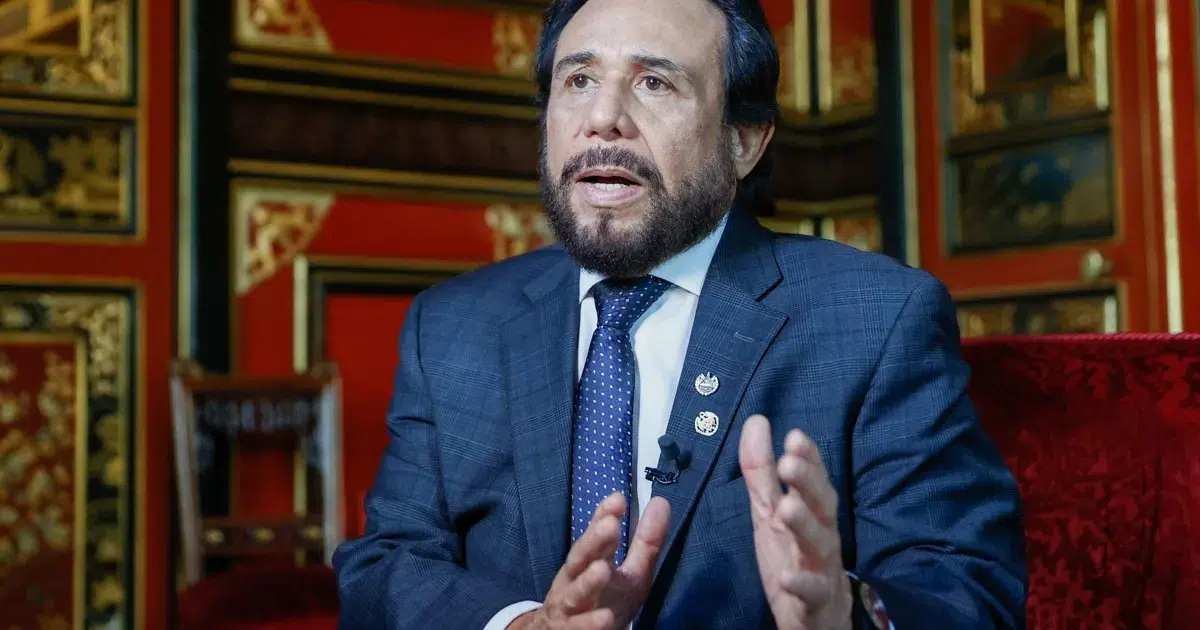
In an interview with the television program Diálogo 21, Vice President Félix Ulloa acknowledged that Article 168 of the Constitution requires the president of the Republic to submit any reports demanded by the Legislative Assembly, but he justified Nayib Bukele’s absence yesterday from the legislative floor by noting that the president has always “broken all those traditional canons.”
“He’s always kept us accustomed to that disruptive leadership, introducing new ways of doing politics; it’s the new politics, the politics of facts, of results, and not the politics of rhetoric, of grand speeches, sometimes very pompous, sometimes full of phraseology, that didn’t match reality,” he said.
Summons for a formal session issued by the Legislative Assembly on Wednesday, May 27, 2026.
Ulloa said the new way of fulfilling the principle of accountability during Bukele’s term is to show the work day by day, and that this “has inspired other executing units of the Executive Branch” to do the same.
“We’re seeing it in health care, but we can see it in public works, the major architectural and engineering projects that have been carried out, the highways, the bridges; that is to say, everything that’s been done through the Ministry of Public Works, and also in education, with this Two Schools a Day program, which is a marvel,” Ulloa said.
Yesterday, instead of attending the session that was officially convened by the president of the Legislative Assembly, Ernesto Castro, a member of the ruling party Nuevas Ideas, Bukele released a prerecorded presidential broadcast to inaugurate Hospital Rosales, a project that was a debt of his government and took seven years to build.
In the television broadcast, Bukele said he considered that “instead of hearing a speech” it was better to hear about the hospital and what it will offer citizens. The broadcast, in which the president can be seen touring the facilities of the new medical center, was recorded privately ahead of its release, and no members of the legislature took part.
However, after the broadcast aired, Castro declared the report “received” in a social media post. So far, neither the lawmakers nor the president have explained what procedure was followed to skip the plenary session that had already been convened. Sources who were present last night at the Legislative Assembly told LA PRENSA GRÁFICA that some lawmakers showed up at the state body for the event, since there had been no prior notice that the session was canceled.
In 2020, during the pandemic, Bukele also failed to appear before the Assembly. To do so, he submitted a formal letter to the Legislative Assembly requesting that the session be rescheduled, as he would be unable to attend due to the global health emergency. The full body accepted his request, though the new formal session was never convened.
Nuevas Ideas lawmaker William Soriano, for his part, told reporters who approached him during a visit to Hospital Rosales this morning that the national broadcast was “a more practical way of rendering accounts” and that he felt “satisfied” with the “report” Bukele presented.
“I think that was a stroke of genius by the president, being able to render accounts to the Salvadoran people. I’m satisfied with this accountability report from President Bukele, and as the president of the Legislative Assembly announced, the president’s report is considered received,” he said.
“Una genialidad” y “una nueva forma de hacer política”: así defienden Soriano y Ulloa que Bukele no rindiera cuentas ante la Asamblea
En una entrevista con el programa televisivo Diálogo 21 el vicepresidente Félix Ulloa admitió que el artículo 168 de la Constitución obliga al presidente de la República a presentar los informes que le sean exigidos por la Asamblea Legislativa, pero justificó la ausencia de Nayib Bukele ayer en el pleno legislativo indicando que el presidente siempre “ha roto todos esos cánones tradicionales”.
“Siempre nos tiene acostumbrados a ese liderazgo disruptivo, que presenta nuevas formas de hacer política; es la nueva política, la política de los hechos, de los resultados y no la política de la retórica, de los grandes de discursos, a veces muy pomposos, a veces llenos de fraseología, que no correspondían a la realidad”, indicó.
Convocatoria a sesión solemne emitida por la Asamblea Legislativa el miércoles 27 de mayo de 2026.
Ulloa dijo que la nueva forma de cumplir el principio de rendición de cuentas durante el mandato de Bukele es mostrar las obras día con día, y que esto “ha inspirado a otras unidades ejecutoras del Órgano Ejecutivo” a hacer lo mismo.
“Lo estamos viendo en el área de la salud, pero lo podemos ver en el área de las obras públicas, las grandes obras de de arquitectura, de ingeniería que se han desarrollado, las autopistas, los puentes; es decir, todo lo que se ha hecho desde el Ministerio de Obras Públicas y también en el área de la educación, con este programa de Dos Escuelas por Día que es una maravilla”, dijo Ulloa.
Ayer, en vez de atender a la cita que fue convocada oficialmente por el presidente de la Asamblea Legislativa, Ernesto Castro, miembro del partido oficial Nuevas Ideas, Bukele publicó una cadena presidencial pregrabada para inaugurar el Hospital Rosales, una obra que era una deuda de su Gobierno y tardó 7 años en construir.
En la cadena de televisión Bukele dijo que consideró que “en lugar de oír un discurso” era mejor escuchar sobre el hospital y lo que ofrecerá para la ciudadanía. La cadena, en la que se puede observar al presidente recorrer las instalaciones del nuevo centro de salud, se grabó de forma privada con antelación a su publicación y en ella no participaron miembros del legislativo.
Sin embargo, tras la emisión de la cadena, Castro dio “por recibido” el informe a través de un mensaje en redes sociales. Hasta ahora, ni los diputados ni el presidente explicaron cuál fue el procedimiento que se aplicó para omitir la sesión plenaria que ya estaba convocada. Fuentes que estuvieron presentes anoche en la Asamblea Legislativa dijeron a LA PRENSA GRÁFICA que hubo diputados que llegaron al órgano de Estado para el evento, debido a que no hubo aviso previo de cancelación de la sesión.
En 2020, durante la pandemia, Bukele también faltó a la cita con la Asamblea. Para hacerlo presentó una carta formal a la Asamblea Legislativa en la que solicitó reprogramar la cita, ya que no podría atenderla debido a la emergencia sanitaria mundial. El pleno aceptó su solicitud, aunque la nueva sesión solemne nunca se convocó.
El diputado de Nuevas Ideas, William Soriano, por su parte, dijo a periodistas que lo consultaron durante una visita que realizó al Hospital Rosales esta mañana, que la cadena nacional fue “una forma más práctica de rendir cuentas” y que se sentía “satisfecho” con el “informe” presentado por Bukele.
“Creo que esa fue una genialidad del presidente, poder rendirle cuentas al pueblo salvadoreño. Yo me siento satisfecho con este informe de rendición de cuentas del presidente Bukele, y como lo comunicó el presidente de la Asamblea Legislativa, se da por recibido el informe del presidente”, afirmó.