
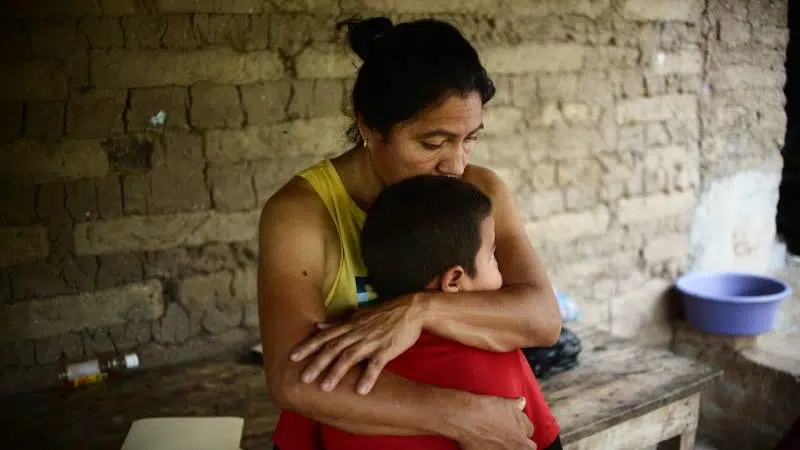
In El Salvador, 4 in 10 children and adolescents live in a state of abandonment—whether living with only their father, only their mother, or neither—according to data from the 2025 Multipurpose Household Survey (EHPM), prepared by the National Office of Statistics and Censuses (ONEC) of the Central Reserve Bank (BCR).
“The results show that, nationwide, 39.5% of children and adolescents ages 0 to 17 live without one or both parents—that is, approximately 4 in 10,” the government survey states.
An analysis by LPG Datos, the investigative unit of LA PRENSA GRÁFICA, details that the percentage of children facing abandonment in the country, 39.5%, is the highest since records began in 2014 (see attached chart).
How is it determined that a minor is in a state of abandonment? The EHPM document explains that it uses three indicators: one, the child or adolescent lives without their father, mother, or both because one or both left the home; two, migration for work purposes, when one or both parents leave their children with other family members or relatives; and three, when the father, mother, or both have died.
In that regard, 112,546 minors reported living without their father or mother because they had left the country to work, while 65,636 said that one or both parents had died.
“The results indicate that, due to migration, 112,000 children and adolescents (ages 0 to 17) live without one or both parents. Of them, 71.1% live without their father, 18.3% live without their mother, and 10.6% without both,” the EHPM states.
In its analysis, LPG Datos noted that the lowest percentage of children and adolescents facing abandonment was recorded in 2021, at 35.3%; however, there has been a clear upward trend since 2022. That year, the rate rose to 37%; in 2023 it was 37.9%; and in 2025 it reached 39.5%. There is no data for 2024 because the survey does not detail the cause of abandonment—whether it was due to migration, death, or both parents leaving the home.
Child and adolescent rights experts explained that one of the causes of abandonment not specified in the government survey could be related to mothers and fathers arrested under the state of exception, which has been in effect since March 27, 2022. According to official figures, there have been more than 91,000 arrests.
Mariana Moisa, a feminist anthropologist, explained that the child and adolescent abandonment figures are “alarming” and said it is important to note that mothers and fathers have abandoned their children, especially “when there are records [that these parents] have been arrested since 2022” due to the regime.
“What happens to the children left with grandmothers, with aunts and uncles? The state promotes childcare through policies like National Play Day (October 8), but there is a large number of children facing abandonment. Are children in El Salvador really happy? Or which children are the happy ones? It’s not the entire population,” Moisa questioned.
For her part, a child and adolescent rights specialist from the NGO Cristosal noted that the organization’s 2023 study, titled “Silence Is Not an Option,” identified an increase in children and adolescents facing abandonment due to the arrest of their parents.
“The research Cristosal has conducted reports that a significant percentage of these individuals had children, which means these children have been left without the protection of one or both parents. To date, none of these parents have been tried or convicted. This has had major repercussions on the lives of these children. Many of these individuals, or the vast majority of them, live in poverty or extreme poverty,” the specialist stated.
“Broadly speaking, I would conclude that one of the reasons children and adolescents find themselves in a state of abandonment is definitively the deprivation of liberty resulting from the state of exception,” she underscored.
That is the case of Manuel’s father (a fictitious name). His mother, Ana, said her son has not seen his father, who was arrested under the regime, since December 2023.
She said she has promised the boy he will see his father soon, although she is not certain that will happen. To this day, what that family lacks is answers.
The Cristosal source said that these cases of abandonment entail restrictions on the right to education, food, health, and a dignified life for children and adolescents, “and above all, maintaining relationships with their immediate family members—in this case, a father, mother, or grandmothers.”
The government survey also explored which parental figure is primarily responsible for child abandonment. Of the 634,820 minors in this situation, 79% pointed to the father, 10.6% to the mother, and 9.9% said both.
Moisa explained that abandonment by fathers is related to “irresponsible fatherhood.” She noted that in cases of separation, children and adolescents are left in the care of mothers or older sisters because they are labeled as “caregivers,” and the entire responsibility falls on them.
“Society holds only women responsible as caregivers. In fact, social policies are aimed at reinforcing this selfless motherhood and the idea that caregiving tasks belong exclusively to women. These types of policies help normalize the idea that women are solely responsible for caregiving. The care of sons and daughters in the face of a parent leaving the home or a separation falls primarily on women,” she stated.
Diego’s case (a fictitious name) is one of those cases of irresponsible fatherhood that Moisa pointed out. He never knew his father. The person caring for him said that when his mother became pregnant, the minor’s father “disappeared,” and before Diego turned two, his mother left him in the care of an aunt, who has raised him ever since.
For the Cristosal specialist, abandonment by fathers was also exacerbated by the state of exception, as the majority of reported arrests have involved men. And although there is no official data disaggregated by age and sex, based on information the organization has gathered alongside other NGOs, they estimate that the percentage of arrested males is higher than that of females.
“Historically, in cases of child and adolescent abandonment, the father has always been the primarily responsible party or the primary absentee. However, this situation is worsening and aligns with the data we have on people deprived of liberty under the state of exception, as well as on people who migrate. In the case of those deprived of liberty under the state of exception, due to the lack of official data disaggregated by sex and age, men account for up to 85% of individuals deprived of liberty, while women account for around 14.5%, and in approximately 10% of cases, both parents are deprived of liberty,” the source told this newsroom.
The experts pointed out that policies must be promoted to safeguard the well-being of children facing abandonment. They stressed that this is necessary.
Niñez en El Salvador: cuatro de cada 10 están en situación de abandono
Claudia Espinoza y LPG Datos
En El Salvador, 4 de cada 10 niños, niñas y adolescentes (NNA) viven en situación de abandono, ya sea que están solo con padre o madre o ninguno, según datos de la Encuesta de Hogares de Propósitos Múltiples (EHPM) 2025, elaborada por Oficina Nacional de Estadística y Censos (ONEC) del Banco Central de Reserva (BCR).
“Los resultados muestran que, a nivel nacional, 39.5 % de NNA de 0 a 17 años viven sin alguno o sin ambos padres, es decir, aproximadamente 4 de cada 10”, detalla la encuesta elaborada por el Gobierno.
Un análisis de LPG Datos, la unidad de investigación de LA PRENSA GRÁFICA, detalla que el porcentaje de niñez en abandono en el país, el 39.5 %, es la porcentaje más alto desde 2014 de cuando se tiene registro (ver gráfica anexa).
¿Cómo se determina que un menor de edad está en abandono? El documento de la EHPM explica que toma en cuenta tres indicadores: uno, que el NNA vive sin padre, madre o ambos, porque alguno de ellos o ambos dejó el hogar; dos, la migración por motivos de trabajo, cuando uno de los padres o ambos dejan a sus hijos con otros familiares o parientes; y tres, cuando padre, madre o ambos murieron.
En ese sentido, 112,546 menores manifestaron que vivían sin su padre o madre porque estos se fueron del país a trabajar; mientras que 65,636 mencionaron que uno de los dos o ambos murieron.
“Los resultados indican que, debido a la migración, 112 mil niños, niñas y adolescentes (0 a 17 años) viven sin alguno o sin ambos padres, de ellos el 71.1 % viven sin la presencia de su padre; el 18.3 % viven sin la madre y el 10.6 % sin ambos”, detalla la EHPM.
Dentro del análisis de LPG Datos, la unidad precisó que fue en 2021 cuando se registró el porcentaje más bajo de niñez y adolescencia en abandono, de 35.3 %; sin embargo, desde el 2022 hay una clara tendencia al alza. Ese año el porcentaje se elevó a 37 %; en 2023 fue de 37.9; y en 2025 fue de 39.5 %. En 2024 no hay datos porque la encuesta no detalla la causa del abandono: si sucedió por migración, muerte o porque ambos padres se marcharon del hogar.
Expertas en temas de derechos de la niñez y la adolescencia explicaron que una de las causas de abandono, que no se precisa en la encuesta del Gobierno, podría estar relacionada a padres o madres capturados en el marco del régimen de excepción, vigente desde 27 de marzo de 2022. Según cifras oficiales, son más de 91,000 las capturas.
Mariana Moisa, antropóloga feminista, explicó que las cifras de abandono de niñez y adolescencia son “alarmantes” y consideró que es importante incluir que madres y padres han abandonado a sus hijos, sobre todo “cuando hay registros (que estos padres) han sido capturados desde 2022” debido al régimen.
“¿Qué pasa con las infancias que quedan con abuelas, con tíos? El Estado promueve el cuidado de las infancias con políticas como el Día Nacional del Juego (8 de octubre), pero hay una cantidad de niños y niñas en abandono. ¿Realmente las infancias en El Salvador son felices? o ¿cuáles infancias son las felices? No es toda la población”, cuestionó Moisa.
Por su parte, una especialista en derechos de niñez y adolescencia de la oenegé Cristosal destacó que el estudio publicado en 2023 por la organización denominado “El silencio no es opción”, identificó un incremento de niños, niñas y adolescentes en situación de abandono debido a la captura de sus padres.
“Las investigaciones que Cristosal ha realizado reportan que un porcentaje importante de estas personas tenían hijos e hijas y que esto significa que estos niños y niñas han quedado sin la protección de uno o de ambos padres. Hasta la fecha, ninguno de estos padres han sido juzgados ni condenados. Esto ha traído repercusiones grandes en la vida de niños y niñas. Muchas de estas personas o en su gran mayoría estas personas viven en condición de pobreza o pobreza extrema”, indicó la especialista.
“En términos generales podría concluir que una de las causales por las que niños, niñas y adolescentes se encuentran en condición de abandono definitivamente es la privación de libertad producida por el régimen de excepción”, subrayó.
Ese es el caso del papá de Manuel (nombre ficticio). Su madre, Ana, contó que desde diciembre de 2023 su hijo no ve a su padre, capturado en el régimen.
Ella dijo que le ha prometido al niño que pronto verá a su padre, aunque no tiene la certeza que así sea. Hasta hoy de lo que esa familia carece es de respuestas.
Y es que la fuente de Cristosal dijo que los abandonos implican la limitación del derecho a la educación, alimentación, salud, vida digna para la niñez y adolescencia, “y sobre todo mantener relaciones con sus familiares directos, en este caso papá, mamá, abuelas”.
Un dato que también exploró la encuesta realizada por el Gobierno fue qué figura parental es la principal responsable del abandono infantil. De los 634,820 menores que están en esa situación, el 79 % señaló al padre, el 10.6 % a la madre y el 9.9 % de los menores dijo que ambos.
Moisa explicó que el abandono de los padres está relacionado con las “paternidades irresponsables”. Que en casos de separación, la niñez y los adolescentes quedan al cuidado de las madres o hermanas mayores porque son catalogadas como “cuidadoras”, y toda la responsabilidad recae sobre ellas.
“La sociedad responsabiliza únicamente a las mujeres como las cuidadoras. De hecho, las políticas sociales están encaminadas a reforzar esa maternidad abnegada y que las tareas de cuidado son exclusivas de las mujeres. Este tipo de políticas contribuyen a naturalizar que las mujeres somos las únicas responsables de los cuidados. Los cuidados de los hijos y de las hijas frente a una situación de abandono del hogar o una separación, recae principalmente sobre las mujeres”, aseguró.
El de Diego (nombre ficticio) es uno de esos casos de paternidades irresponsables que señaló Moisa. Él no conoció a su padre. La persona que está a su cargo dijo que cuando su madre se embarazó, el padre del menor “desapareció” y antes que Diego cumpliera los dos años, la madre de este lo dejó a cargo de una tía, quien hasta hoy ha asumido su crianza.
Para la especialista de Cristosal, el abandono del padre se agravó también con el régimen de excepción, ya que la mayoría de capturas reportadas han sido hombres. Y aunque no hay datos oficiales desagregando edad y sexo, según información que ha recabado la organización junto a otras oenegés, estiman que el porcentaje de la población masculina capturada es superior a la femenina.
“En el histórico de abandono de niños, niñas y adolescentes, siempre el padre ha sido el principal responsable o el principal ausente. Sin embargo, esta situación se agrava y coincide con los datos que tenemos de las personas que se encuentran privadas de libertad con el régimen de excepción, al igual que las personas que migran. En el caso de las personas privadas de libertad por el régimen de excepción, por la falta de datos oficiales con respecto a desagregación por sexo y edad, los hombres llegan a representar el 85 % de personas privadas de libertad, mientras que las mujeres andan por el 14.5 % y aproximadamente el 10 % son ambos padres los que están privados de libertad”, señaló la fuente a esta redacción.
Las expertas señalaron que se deben promover políticas que velen por el bienestar de la niñez en situación de abandono. Destacaron que es necesario.