
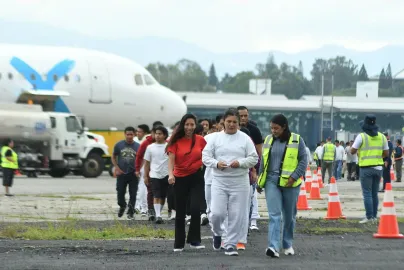
The General Directorate of Migration reported that between January and March 2026, the country received 5,351 deported Salvadorans. This figure is 90.2% higher than the number recorded in 2025—nearly double—when 2,813 people were forcibly returned in the first quarter.
Most deportations were carried out by air (94%) and originated in the United States. According to the government agency, the U.S. forcibly returned 5,033 people in the first quarter, accounting for 94% of the total. The figure also represents a 0.97% increase over deportations from that country reported the previous year.
The country with the second-highest number of forced returns was Mexico, with 253 Salvadorans sent back to El Salvador, representing 4.7% of the total. Unlike the U.S., the figures changed little compared to the 226 deportations carried out in the first quarter of 2025.
It is worth noting that, beyond the U.S., deportations from other countries also grew exponentially, rising from 13 last year to 92 this year—six times higher than in 2025. However, Migration does not provide detailed information on which other countries deported Salvadorans.
The increase in deportees also coincides with a rise in return flights documented by organizations such as Human Rights First, which monitors these transfers. Between January and March 2026, 41 flights from the U.S. were reported, an increase of eight flights compared to the same months in 2025.
Migration figures across the continent over the past year have taken historic turns following the implementation of new immigration policies by the U.S. government.
On January 20, 2025, Donald Trump was sworn in as president of the United States, ready to immediately fulfill the promise he made to voters during the campaign to accelerate deportations of immigrants in the country. That same day, he declared an emergency at the southern border, ordered a halt to the entry of migrants—including those with court dates in immigration proceedings—and deployed the National Guard to the area.
Furthermore, the deepening of this policy is reflected in the steady increase in return flights throughout the previous year, which ended with a record 175 flights carrying deportees, 55 more than in 2024, representing a 46% increase. So far in 2026, the upward trend has continued.
“We are no longer talking just about more flights; now the official data also show a sharp increase in deported people, confirming a real hardening of the U.S. immigration system toward the region,” said César Ríos of the Asociación Agenda Migrante El Salvador.
The activist noted that in the first quarter of 2026, the U.S. increased flights carrying deported Salvadorans by 24%, “but now official Migration figures also confirm a much sharper increase in deported people.”
Separately, Human Rights First also reported that at least 444 Salvadoran asylum seekers have received transfer orders to third countries such as Honduras, Guatemala, Ecuador, and Mexico. This stems from another of the immigration policies pushed by Trump, which seeks to outsource immigration services to other nations with which the U.S. has signed agreements to receive migrants.
The organization has warned in its reports that many of the transfer countries do not meet the conditions to provide adequate protection to asylum seekers under international standards. Faced with this situation, many people end up choosing to return to their home countries, even though their safety may also be at risk.
The latter could explain the increase in returns from other countries reported by Migration; however, the lack of detail on the expelling countries makes it impossible to determine whether they are among those that have signed safe-third-country agreements with the U.S. to receive Salvadorans. Human Rights First has also denounced the lack of transparency in the handling of these agreements.
Salvadoreños deportados aumentan 90.2 % en primer trimestre de 2026
Claudia Palacios
La Dirección General de Migración reportó que, entre enero y marzo de 2026, el país recibió a 5,351 personas salvadoreñas deportadas en el país. Esta cifra es 90.2 % mayor que lo registrado en 2025 -casi el doble-, cuando llegaron 2,813 personas retornadas forzosamente en el primer trimestre.
La mayor parte de deportaciones se llevaron a cabo por vía aérea (94 %) y provino de Estados Unidos. Según la institución pública, el país norteamericano retornó forzadamente a 5,033 personas en el primer trimestre del mes, lo que equivale al 94 % del total. La cifra además representa un incremento del 0.97 % con respecto a las deportaciones desde ese país reportadas el año anterior.
El segundo país con mayor cantidad de retornos forzados fue México, con 253 personas salvadoreñas enviadas a El Salvador, lo que representa el 4.7 % del total. A diferencia de EUA, las cifras variaron poco con respecto a las 226 deportaciones realizadas en el primer trimestre de 2025.
Es de destacar que, además de EUA, crecieron exponencialmente las deportaciones de otros países, pasando de 13 el año pasado a 92 este año; es decir, seis veces más que en 2025. Sin embargo, Migración no proporciona información detallada sobre cuáles fueron los demás países que deportaron salvadoreños.
El incremento en las personas deportadas coincide también con el aumento de vuelos de retorno documentado por organizaciones como Humans Rights First, que mantiene un monitoreo de estos traslados. Entre enero y marzo de 2026 se reportaron 41 vuelos provenientes de EUA, un aumento de 8 vuelos con respecto a los mismos meses de 2025.
Las cifras sobre movimientos migratorios en el continente en el último año han dado giros históricos a partir de la implementación de nuevas políticas migratorias tomadas por el Gobierno de EUA.
El 20 de enero de 2025, Donald Trump tomó posesión como presidente de EUA, dispuesto a cumplir inmediatamente la promesa que hizo a sus votantes durante la campaña de acelerar las deportaciones de inmigrantes en ese país. Ese mismo día declaró una emergencia en la frontera sur, ordenó parar el ingreso de migrantes -incluyendo aquellos que tenían citas en cortes migratorias- y desplegó a la Guardia Nacional en la zona.
Además, la profundización de esta política se refleja en el incremento constante de vuelos de retorno a lo largo de todo el año anterior, el cual cerró con un récord de 175 vuelos con personas deportadas, 55 más que en 2024, lo que representa un incremento del 46 %. Este 2026, la tendencia se ha mantenido al alza.
“Ya no estamos hablando solo de más vuelos; ahora los datos oficiales muestran también un aumento fuerte en personas deportadas, lo que confirma un endurecimiento real del sistema migratorio estadounidense hacia la región”, dijo César Ríos, de la Asociación Agenda Migrante El Salvador.
El activista refirió que en el primer trimestre de 2026 EUA incrementó en 24 % los vuelos con salvadoreños deportados, “pero ahora también las cifras oficiales de Migración confirman un aumento mucho más fuerte de personas deportadas”.
Por otro lado, Humans Rights First también reportó que al menos 444 salvadoreños solicitantes de asilo han recibido órdenes de traslado a terceros países como Honduras, Guatemala, Ecuador y México. Esto, a partir de otra de las políticas migratorias impulsadas por Trump, que busca tercerizar los servicios migratorios a otras naciones, con los cuales ha firmado acuerdos para recibir migrantes.
La organización ha denunciado en sus reportes que muchos de los países de traslado no cumplen con las condiciones para brindar protección adecuada a los solicitantes de asilo, según estándares internacionales. Ante esta situación, muchas personas terminan optando por retornar a sus países, aunque su seguridad también corra peligro.
Esto último podría explicar el incremento en los retornos provenientes de otros países reportado por Migración; sin embargo, la falta de detalle sobre los países expulsores no permite determinar si se trata de aquellos que han firmado convenios de tercer país seguro con EUA para la recepción de salvadoreños. Humans Rights First también ha denunciado la opacidad en el manejo de estos acuerdos.