
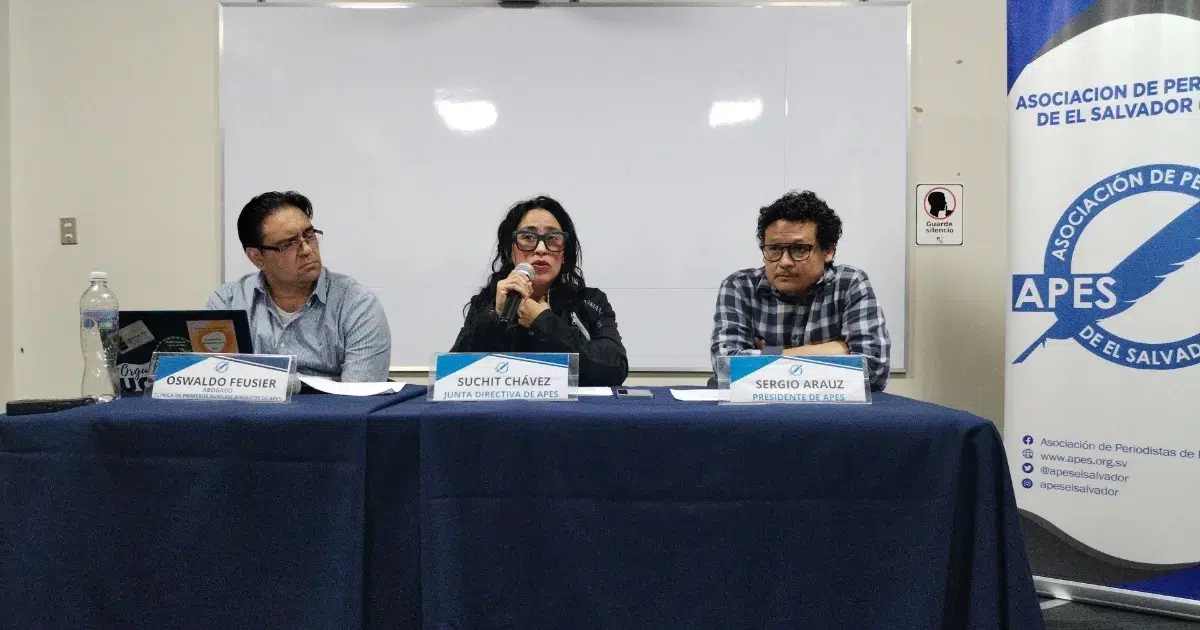
The Association of Journalists of El Salvador (APES), through its complaint monitoring center, has recorded a total of 1,526 attacks against media professionals over the past three years, the majority perpetrated by state agents.
In its latest report on press freedom during 2025, the association detailed 426 complaints received that year; in 2024 there were 789, the highest level documented; and in 2023 there were 311. The association maintained that although the data reflect a reduction this past year, an “adverse context for the practice of journalism” persists.
APES receives these reports of attacks through phone calls or interviews with journalists who have suffered some form of violation due to their professional work, as well as through a registry of media workers who left the country due to fear or threats. This report shows a 9% reduction compared to the attacks recorded in 2024, which the association recognizes as an election year with a more complicated context for journalistic work.
The data also indicate that at least 53 journalists left the country “due to harassment, surveillance, and threats, out of fear or warnings from sources about possible arrest warrants.”
APES notes that of those cases, 35 had planned to return, considering their departure a temporary measure; however, by the end of December 2025, these media workers were still abroad because they believed “there are no guarantees for the practice of their profession.”
Other impacts include 88 cases of digital harassment, the most frequent type of attack against journalists, followed by 53 cases of stigmatizing statements, 51 of harassment, 44 of restrictions on journalistic work, 32 of defamation and an equal number of instances of intimidation, 28 of insults, 15 of physical attacks, 13 of arbitrary detention, and 10 of surveillance, these last ones being attacks “of a serious nature,” according to APES.
“There were journalists who were surveilled by police officers asking implausible questions, and we understand that as harassment. That’s the increase you see in cases that appear serious, because the attacks are physical, personal, and direct. While digital harassment is the most common, there are more cases that are direct,” said Súchit Chávez, a member of the APES board of directors and part of the team that produced the report.
The most frequent type of aggressor in the 2025 report corresponds to social media users with 110 instances, followed by police (PNC) officers with 51 cases, also 51 cases involving former officials, 45 involving public employees, 29 involving military personnel, among others.
Of the attacks, 198 were against men and 89 against women, including gender-based attacks such as harassment, sexist comments, personal disparagement, and attacks on their physical appearance. According to the association, between 2024 and 2025, cases of harassment against women journalists tripled.
APES president Sergio Arauz noted that the impacts also reach the general public, in the sense that the amount of information available to them decreases as investigative outlets are shut down.
“This report captures something important that has to do not only with the amount of information people have received, but also with the fact that the majority of the outlets it highlights point to in-depth journalism, fact-checking journalism; these are outlets whose method is specialized reporting, and in that sense, Salvadorans have access to less information. There are people producing content, but this affects that production of material,” he said.
This past February, APES presented its report on the situation of community media in El Salvador, documenting the closure of several outlets or media spaces by the end of 2025. It indicated that 9 out of 10 media workers surveyed are afraid to practice their profession due to the harassment and surveillance they have experienced.
On April 30, the international organization Reporters Without Borders presented its report on press freedom worldwide, revealing that El Salvador dropped eight places compared to 2025 and now ranks 143rd globally, on a continuing downward trend.
APES registró 1,526 agresiones a periodistas en los últimos tres años
Por Williams Sandoval
La Asociación de Periodistas de El Salvador (APES), a través de su centro de monitoreo de denuncias, ha registrado un total de 1,526 agresiones contra profesionales del gremio durante los últimos tres años, la mayoría perpetradas por agentes del Estado.
En su más reciente informe sobre la libertad de prensa durante 2025, la asociación detalló 426 denuncias recibidas ese año, en 2024 hubo 789, el nivel más alto documentado, y en 2023 fueron 311, sosteniendo que, aunque los datos reflejan una reducción este último año, se mantiene un “contexto adverso para el ejercicio periodístico”.
La APES recibe dichas agresiones a través de llamadas o entrevistas a los periodistas quienes han sufrido algún tipo de vulneración por su labor profesional, así como un registro con los comunicadores que salieron del país ante el temor o amenazas. Este informe muestra una reducción del 9% en relación de las agresiones registradas en el año 2024, que la asociación reconoce como un año electoral en donde hubo un contexto más complicado para la labor.
Los datos también indican que al menos 53 periodistas salieron del país “por razones de acoso, vigilancia, amenazas bajo el temor o la advertencia realizada por fuentes sobre posibles órdenes de captura”.
La APES indica que de esos casos 35 tenían previsto regresar al considerar la salida como una medida temporal, sin embargo al final de diciembre de 2025 estos comunicadores aún se mantenían fuera por considerar “que no existen garantías para el ejercicio de la profesión”.
Otras afectaciones indican 88 casos de acoso digital, como el más recurrente en contra de los periodistas, seguido de 53 de declaraciones estigmatizantes, 51 de acoso, 44 de restricción al ejercicio periodístico, 32 de difamación e igual número de intimidaciones, 28 de insultos, 15 de agresiones físicas, 13 de retención arbitraria y 10 de vigilancia, siendo estos últimos agresiones “de gravedad”, según externó la APES.
“Hubo periodistas que tuvieron vigilancia de policías con preguntas inverosímiles y eso entendemos como acoso. Ese es el incremento que ven en los casos que parecen graves, pues las agresiones son físicas, personales y directas. Si bien el acoso digital es mayoritario, pero hay más casos que son directos”, destacó Súchit Chávez, parte de la junta directiva de la APES y del equipo que realizó el informe.
El tipo de agresor más frecuente del informe de 2025 corresponde a usuarios de redes sociales con 110 situaciones, seguido de agentes de la Policía Nacional Civil (PNC) con 51 casos, también 51 casos por exfuncionarios, 45 por empleados públicos, 29 por militares, entre otros.
De las agresiones, 198 son contra hombres y 89 hacia mujeres que incluyen agresiones por género como acoso, comentarios sexistas, descalificaciones personales y ataques por su apariencia física. Según el gremio, entre 2024 y 2025 los casos de acoso contra las mujeres periodistas se triplicaron.
El presidente de la APES, Sergio Arauz mencionó que las afectaciones también llegan a la población en el sentido que disminuye la cantidad de información que tienen a disposición ante el cierre de espacios de investigación.
“Este informe recoge algo importante que tiene que ver con no solo con la cantidad de información que ha recibido la gente, sino que la mayoría de medios que señala apunta al periodismo de profundidad, de verificación, son medios que tienen como método la información especializada y en ese sentido los salvadoreños tienen acceso a menos información. Hay gente produciendo, pero esto afecta esta producción de material”, destacó.
En febrero pasado, la APES presentó su informe sobre la situación de los medios comunitarios en El Salvador exponiendo el cierre de algunos espacios o medios informativos al cierre de 2025. Este indicó que 9 de cada 10 comunicadores consultados tienen temor de ejercer su profesión ante el acoso y seguimiento recibido.
El 30 de abril pasado, la organización internacional Reporteros Sin Fronteras presentó su informe sobre libertad de prensa en el mundo y expuso que en el caso de El Salvador bajó ocho escalones en relación al año 2025 y se ubica en la posición 143 a nivel global, con una constante hacia la baja.