
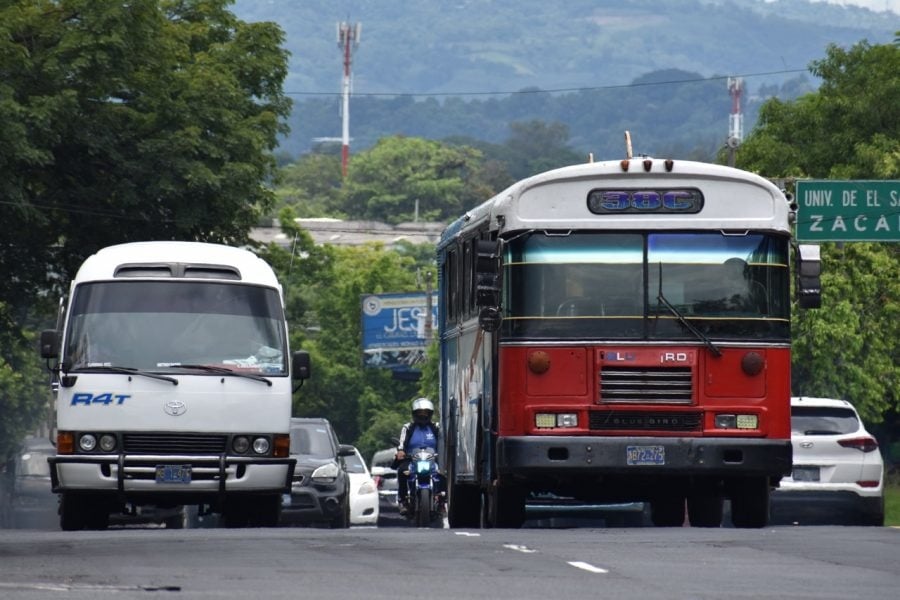
Faced with rising fuel prices, public transport operators are asking the Salvadoran government to establish a $2 to $2.50 cap on diesel, which is used by buses and microbuses, to ease costs that they say currently exceed $0.88.
“We know there is an opportunity (to set the price) if you look at all the taxes on fuel, and knowing that this sector provides service to that 70% of the population that depends on it, it really has to guarantee service in optimal conditions with all safety measures, just as we are concerned about. That risk is always there. So we believe what it has to do is give some kind of relief to the sector in this crisis and the ones that have continued,” said Lucio Vásquez, spokesperson for the National Transport Roundtable, in an interview on Frente a Frente.
Vásquez acknowledged that the Salvadoran government already subsidizes fuel prices and that El Salvador has the lowest price in the region, but he said they are in an economic crisis.
“What we suggest is this: there is really a whole bundle of taxes inside each gallon of fuel, and just by removing that bundle of taxes, he (President Nayib Bukele) could already give us a preferential price,” he added.
Currently, when Salvadorans buy fuel, they pay 13% Value Added Tax (IVA) per gallon, plus $0.16 for the Economic Stabilization and Development Fund (FEFE), $0.10 for the Transportation Contribution tax (Cotrans), and $0.20 for the Road Conservation Fund (Fovial).
Calculating those taxes against the current diesel price of $4.30, in effect through April 27, they add up to $1.01 in total: $0.55 in IVA and the rest in the other charges. In other words, after deducting the taxes, diesel would cost $3.29.
In last Wednesday’s plenary session, the Arena party asked to suspend the IVA on fuels for three months to ease the burden on Salvadorans’ wallets, but the motion did not get the votes.
“Fare adjustment”
Another of the measures preliminarily proposed by the National Transport Roundtable is a “fare adjustment,” that is, raising the fare every Salvadoran pays when boarding a bus or microbus.
“After more than 20 years, it is illogical that there has not been some kind of adjustment,” he said on Frente a Frente.
Vásquez clarified that the issue of raising fares is “complex,” but insisted that it must be evaluated together with other measures such as a direct fuel subsidy or changes to the compensation scheme.
The sector will also propose alternatives to guarantee the sustainability of the system, given the progressive reduction in the number of units in circulation.
According to its estimates, this year more than 70% of the buses that should be replaced might not be renewed, which would further reduce the available fleet.
“We are going to prepare the proposal and deliver it as soon as possible,” he said.
The transport sector said that once it has a concrete proposal, it will meet again with authorities from the Ministry of Public Works and Transportation (MOPT), with whom it met last Wednesday night.
At that meeting, the MOPT promised to pay the overdue subsidy, which according to the bus operators’ calculations totals between $12 million and $15 million.
Diario El Mundo: https://diario.elmundo.sv/nacionales/buseros-piden-poner-techo-de-2-a-2-50-al-diesel
Buseros piden poner techo de $2 a $2.50 al diésel
Iliana Cornejo
Ante el incremento del precio de los combustibles, los empresarios del transporte público piden al Gobierno salvadoreño establecer un techo de $2 a $2.50 al diésel, utilizado para los buses y autobuses colectivos, para aliviar el gasto que hasta el momento aseguran supera los $0.88.
«Nosotros sabemos que hay una oportunidad (de fijar el precio), si usted contempla todos los impuestos que tiene el combustible y sabiendo que este sector presta el servicio a ese 70% de la población que tiene que darle, que le tiene que garantizar realmente así como nosotros, que es lo por lo que estamos preocupados, tiene que garantizarle el servicio en óptimas condiciones con todas las medidas de seguridad. Ese riesgo está latente. Entonces, creemos nosotros que lo tiene que hacer es darle algún tipo de salvataje al sector en esta crisis y en las que se han mantenido», manifestó el vocero de la Mesa Nacional de Transporte, Lucio Vásquez, en la entrevista de Frente a Frente.
Vásquez reconoció que el Gobierno salvadoreño subsidia ya el precio de los combustibles y que El Salvador tiene el menor precio en la región, pero afirmó que ellos están en crisis económica.
«Nosotros lo que le sugerimos nosotros es, mire, realmente hay una camándula de impuestos dentro del galón de combustible que solo quitándonos esa camándula de impuestos, él (el presidente Nayib Bukele) puede darnos ya un precio preferencial», añadió.
Actualmente, cuando un salvadoreño compra combustible, por cada galón de paga el 13 % del Impuesto al Valor Agregado (IVA), $0.16 del Fondo de Estabilización y Fomento Económico (FEFE), $0.10 para el impuesto Contribución al Transporte (Cotrans), y $0.20 para el Fondo de Conservación Vial (Fovial).
Calculando los impuestos con el costo del diésel, $4.30, vigente hasta el 27 de abril, suman $1.01, en total; $0.55 de IVA y el resto mencionado. Es decir, que descontando los impuestos, el diésel quedaría a un precio de $3.29.
En la sesión plenaria del pasado miércoles, el partido Arena pidió en la sesión plenaria suspender el IVA para los combustibles por tres meses para aliviar el bolsillo de los salvadoreños, pero la moción no tuvo votos.
«Nivelación» de tarifa
Otra de las medidas preliminarmente planteadas por la Mesa Nacional de Transporte es la «nivelación» de la tarifa de transporte, es decir, aumentar el precio al pasaje que cada salvadoreño paga al subirse a un bus o microbús.
“Después de más de 20 años es ilógico que no haya algún tipo de ajuste”, sostuvo en Frente a Frente.
Vásquez aclaró que el tema del aumento al pasaje es “complejo”, pero insistió en que debe evaluarse junto a otras medidas como el subsidio directo al combustible o cambios en el esquema de compensación.
El sector también planteará alternativas para garantizar la sostenibilidad del sistema, ante la reducción progresiva de unidades en circulación.
Según sus estimaciones, este año podrían dejar de renovarse más del 70 % de los buses que deberían sustituirse, lo que reduciría aún más la flota disponible.
“Vamos a elaborar la propuesta y entregarla lo más pronto posible”, indicó.
El sector transporte aseguró que al tener la propuesta concreta se reunirán nuevamente con las autoridades del Ministerio de Obras Públicas y Transporte (MOPT), con quienes se reunieron el pasado miércoles en la noche.
En esa reunión, el MOPT les prometió que les pagarán el subsidio atrasado, que según los cálculos de los buseros suman entre $12 y $15 millones
Diario El Mundo: https://diario.elmundo.sv/nacionales/buseros-piden-poner-techo-de-2-a-2-50-al-diesel