
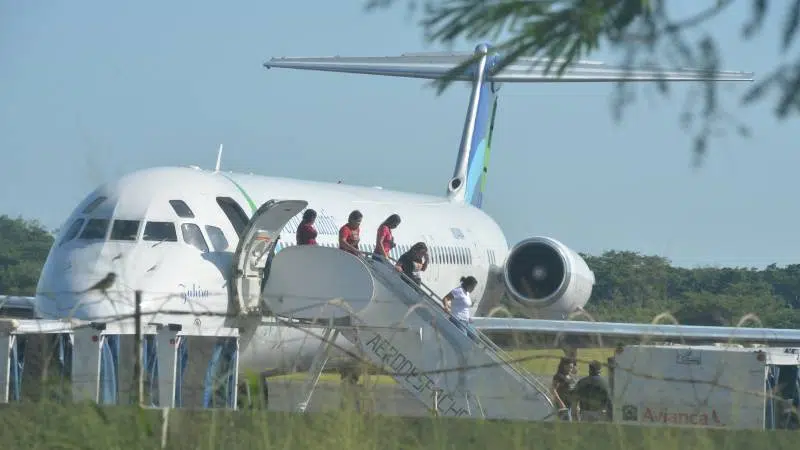
The pace of deportation flights from the United States to El Salvador accelerated once again during 2025, the first year of President Donald Trump’s second term, in a context defined by immigration policies designed to fast-track expulsions and tighten internal enforcement.
A review of air monitoring reports from ICE Flight Monitor and Human Rights First shows that 181 deportation flights to El Salvador were recorded during 2025 — a figure exceeding those observed under the administration of Joe Biden. This dynamic set the tone for the Trump administration, which came to power pledging mass deportations and harsher restrictions on migrant entry and residency.
Although flight volumes had previously reached elevated levels — including 2022, when 184 flights to El Salvador were tallied, the highest on record for the period analyzed — specialists caution that the current increase unfolds within a distinctly different political context, one in which immigration policy has once again become a central pillar of the United States government’s agenda.
The historical comparison reveals that aerial deportations have operated continuously under successive administrations, albeit with clear shifts in intensity. In 2021, the first year of the Biden administration, 111 flights to El Salvador were recorded.
That number climbed to 184 the following year, driven in part by the resumption of immigration enforcement operations after mobility restrictions imposed during the COVID-19 pandemic, and subsequently declined to 115 flights in 2024, the last full year before the change of government in Washington.
The jump recorded in 2025 breaks that stabilizing trend and coincides with executive actions aimed at expanding immigration detentions, curtailing protections for migrants, and accelerating expulsion proceedings.
At the same time, despite the 57 percent spike in flights, the number of people deported from the United States rose only modestly, according to El Salvador’s Dirección General de Migración (General Directorate of Migration). In 2025, the agency recorded the deportation of 14,794 Salvadoran nationals from the United States — an increase of just 605 people, or 4.3 percent, compared with 2024.
International affairs analyst Napoleón Campos explained that the number of flights serves as an operational indicator of the direction United States immigration policy is taking.
“What we are seeing is an acceleration of the immigration apparatus. We do not necessarily know how many people are on each flight, but we do know that immigration policy is operating with greater intensity,” he stated.
According to Campos, the increase reflects the current administration’s determination to deliver on campaign promises tied to historic deportations and stricter border control.
“The deportation system itself has not changed — it has been a permanent fixture in the United States. What has changed is the speed and the political emphasis with which it is now being carried out,” he noted.
The specialist added that the immigration crackdown is also evident in asylum restrictions, the expansion of administrative detentions, and a heightened role for federal agencies charged with immigration enforcement — measures that send deterrent signals to migrant communities both inside and outside the United States.
Migration expert Celia Medrano agreed that the increase must be analyzed within broader regional transformations.
“The rise in flights does not necessarily mean more people are being deported; rather, it reflects changes in the logistics and the manner in which the United States is managing immigration expulsions,” she explained.
Medrano pointed out that the United States has diversified its transfer mechanisms through agreements with third countries, routing migrants first through Mexico or Guatemala before their final return.
“Some of those expelled no longer return directly to their country of origin, which reveals an increasingly restrictive environment for migrants,” she said.
The specialist added that the structural causes of migration persist and that tougher policies do not eliminate migration but instead reshape its routes and risks.
Campos noted that the impact of these measures is already visible in regional migration patterns.
Fear of raids, detentions, and deportations has influenced individual decisions, giving rise to phenomena such as self-deportation and a decline in the intention to migrate to the United States.
The analyst explained that some individuals have chosen to remain in their countries of origin or return voluntarily in the face of the growing risk of encountering more aggressive immigration proceedings — evidence that immigration policy produces effects even before formal deportations take place.
Specialists warn that the increase in flights must also be read as part of a broader migration deterrence strategy. Campos observed that the objective extends beyond expelling people; it aims to send a preemptive message to those considering migration.
“Current policies seek to create a cautionary effect: the potential migrant sees the deportations and decides not to leave,” he explained.
Flights to El Salvador must also be understood in light of the historic weight of Salvadoran migration to the United States. Although the country does not rank among the top regional destinations in absolute flight numbers, it maintains a constant presence within the deportation system owing to the size of its diaspora and decades of migratory movement.
Specialists note that the increase recorded in 2025 does not necessarily represent a historic high, as the highest recent volume remains tied to the second year of the Biden administration.
Nevertheless, the uptick carries political significance because it occurs immediately after Trump’s return to power and alongside a governmental discourse centered on hardening immigration policies.
Campos believes that the future trajectory will depend largely on judicial disputes currently underway in the United States over due process, civil rights, and the limits of executive authority on immigration matters.
In parallel, analysts warn that the immigration crackdown is also beginning to affect economic and social dynamics in countries of origin.
The decline in the intention to migrate documented in recent studies has been linked more to heightened migration risks than to internal structural improvements — suggesting that it is United States policies that are redefining regional migration behavior.
Primer año de Trump: 181 vuelos de deportación hacia El Salvador
El ritmo de vuelos de deportación desde Estados Unidos hacia El Salvador volvió a incrementarse durante 2025, primer año del segundo mandato del presidente Donald Trump, en un contexto marcado por la aplicación de políticas migratorias orientadas a acelerar expulsiones y reforzar controles migratorios internos.
Una revisión de los reportes de monitoreo aéreo de ICE Flight Monitor y Human Rights First muestra que, durante 2025, se registraron 181 vuelos de deportación hacia El Salvador, cifra superior a la observada durante la administración de Joe Biden. Esta dinámica marcó el inicio de la administración Trump, quien llegó al poder prometiendo deportaciones a gran escala y restricciones más severas al ingreso y permanencia de migrantes.
Aunque el volumen de vuelos ya había alcanzado niveles elevados anteriormente —incluido 2022, cuando se contabilizaron 184 vuelos hacia El Salvador, el registro más alto del periodo analizado— especialistas advierten que el aumento actual ocurre dentro de un contexto político distinto, en el que la política migratoria se convirtió nuevamente en uno de los ejes centrales del gobierno estadounidense.
La comparación histórica muestra que las deportaciones aéreas han funcionado de manera continua bajo distintos gobiernos, pero con variaciones claras en intensidad. En 2021, primer año de la administración de Joe Biden, se registraron 111 vuelos hacia El Salvador.
El número aumentó a 184 el año siguiente, en parte por la reactivación de operaciones migratorias tras las restricciones de movilidad provocadas por la pandemia de COVID-19, y posteriormente descendió hasta 115 vuelos en 2024, último año completo antes del cambio de gobierno en Washington.
El salto registrado en 2025 rompe esa tendencia de estabilización y coincide con decisiones ejecutivas dirigidas a ampliar detenciones migratorias, reducir mecanismos de protección a migrantes y acelerar procesos de expulsión.
Por otro lado, pese a que el número de vuelos tuvo un alza equivalente al 57%, las cifras de personas deportadas desde EUA presentan un incremento leve, según la Dirección General de Migración de El Salvador. En el 2025 la institución registró la deportación de 14,794 personas salvadoreñas desde EUA. Esto representa un aumento del 605 personas -un 4.3%- en comparación con 2024.
El internacionalista Napoleón Campos explicó que el número de vuelos constituye un indicador operativo del rumbo que adopta la política migratoria de los Estados Unidos.
“Lo que estamos viendo es una aceleración del aparato migratorio; no necesariamente sabemos cuántas personas vienen en cada vuelo, pero sí que la política migratoria está operando con mayor intensidad”, afirmó.
Según Campos, el incremento responde a la intención de la actual administración de materializar promesas de campaña vinculadas a deportaciones históricas y control fronterizo más estricto.
“No cambia la existencia del sistema de deportaciones, que ha sido permanente en Estados Unidos; lo que cambia es la velocidad y el énfasis político con el que ahora se ejecuta”, señaló.
El especialista añadió que el endurecimiento migratorio se refleja también en restricciones al asilo, ampliación de detenciones administrativas y mayor protagonismo de agencias federales encargadas del control migratorio, medidas que envían señales disuasivas hacia comunidades migrantes dentro y fuera de EUA.
La experta en migración Celia Medrano coincidió en que el aumento debe analizarse dentro de transformaciones regionales más amplias.
“El incremento de vuelos no necesariamente significa más personas deportadas, sino cambios en la logística y en la forma en que Estados Unidos está gestionando las expulsiones migratorias”, explicó.
Medrano señaló que EUA ha diversificado las modalidades de traslado mediante acuerdos con terceros países, enviando migrantes primero hacia México o Guatemala antes de su retorno definitivo.
“Parte de las personas expulsadas ya no regresan directamente a su país de origen, lo que evidencia un entorno cada vez más restrictivo para migrantes”, dijo.
La especialista añadió que las causas estructurales de la migración continúan vigentes y que el endurecimiento de políticas no elimina la migración, sino que modifica sus rutas y riesgos.
Campos agregó que el impacto de estas medidas comienza a observarse en el comportamiento migratorio regional.
El temor a redadas, detenciones y deportaciones ha influido en decisiones individuales, generando fenómenos como la autodeportación o la reducción en la intención de migrar hacia Estados Unidos.
El analista explicó que algunas personas han optado por permanecer en sus países de origen o regresar voluntariamente ante el riesgo creciente de enfrentar procesos migratorios más agresivos, lo que demuestra que la política migratoria produce efectos incluso antes de que ocurran deportaciones formales.
Especialistas advierten que el aumento de vuelos también debe leerse dentro de una estrategia de disuasión migratoria más amplia. Campos señaló que el objetivo no se limita a expulsar personas, sino a enviar un mensaje preventivo hacia quienes consideran migrar.
“Las políticas actuales buscan generar un efecto ejemplarizante: que el migrante potencial vea las deportaciones y decida no salir”, explicó.
Los vuelos hacia El Salvador también deben entenderse dentro del peso histórico de la migración salvadoreña hacia Estados Unidos. Aunque el país no figura entre los principales destinos regionales en términos absolutos de vuelos, mantiene presencia constante dentro del sistema de deportaciones debido al tamaño de su diáspora y décadas de movilidad migratoria.
Especialistas señalan que el incremento registrado en 2025 no implica necesariamente un récord histórico, ya que el mayor volumen reciente continúa asociado al segundo año del gobierno Biden.
Sin embargo, el repunte adquiere relevancia política porque ocurre inmediatamente después del retorno de Trump al poder y en paralelo con un discurso gubernamental centrado en endurecer las políticas migratorias.
Campos considera que la evolución futura dependerá en gran medida de disputas judiciales actualmente en curso en Estados Unidos sobre debido proceso, derechos civiles y límites a las facultades ejecutivas en materia migratoria.
En paralelo, analistas advierten que el endurecimiento migratorio también comienza a incidir en dinámicas económicas y sociales en países de origen.
La disminución en la intención de migrar registrada en estudios recientes ha sido asociada más al aumento del riesgo migratorio que a mejoras estructurales internas, lo que sugiere que son las políticas estadounidenses las están redefiniendo el comportamiento migratorio regional.