
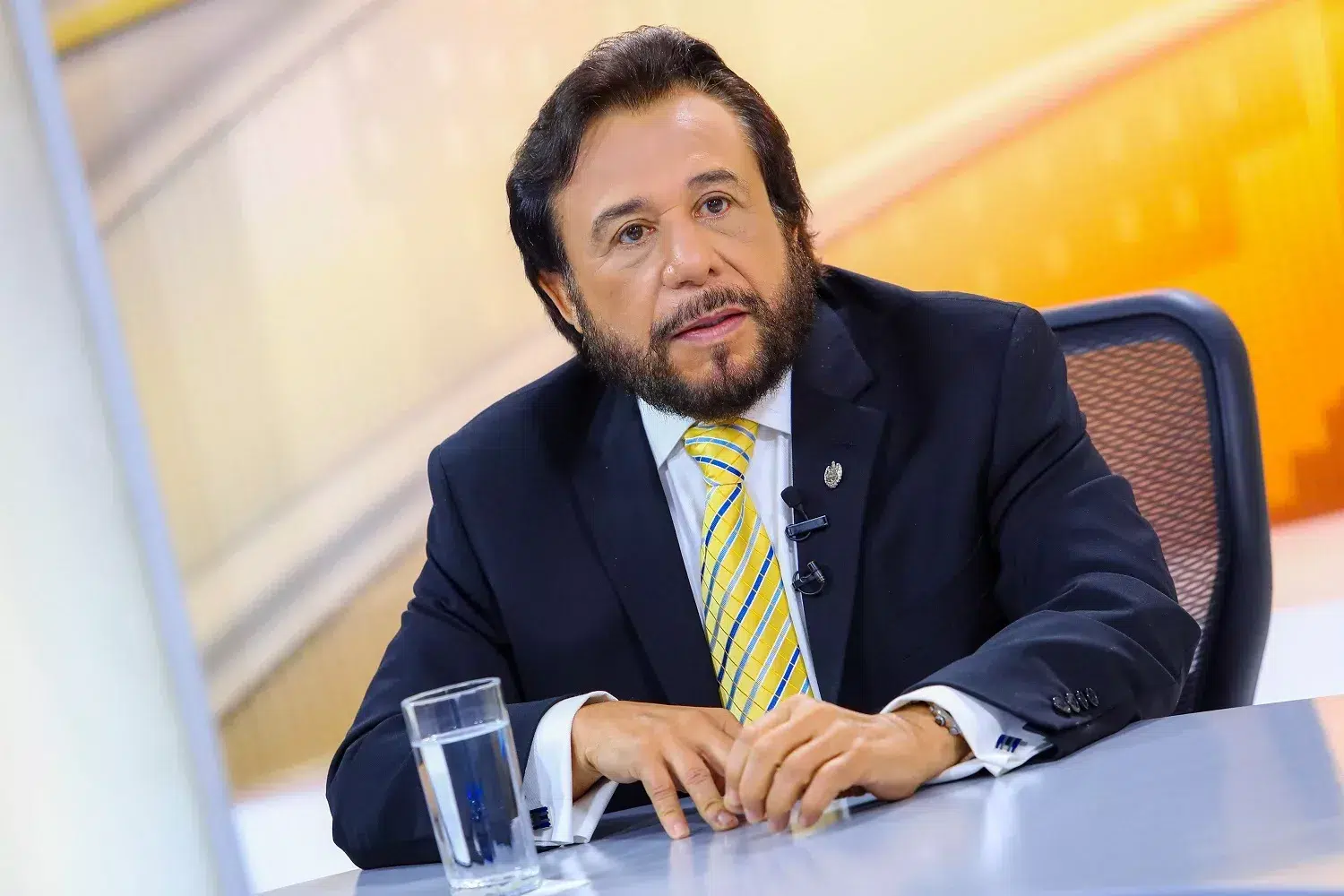
Statements by Vice President Félix Ulloa in Spain have sparked backlash from human rights organizations and victims’ collectives after he denied that deaths recorded in Salvadoran prisons are linked to the state of exception.
The measure, in force since March 27, 2022, was renewed once again on January 29 of this year and will remain in effect until March 1, 2026. Since its implementation, the ruling party reports more than 91,000 people arrested under the measure, which has drawn scrutiny both domestically and internationally.
Ulloa claimed that since its approval, the state of exception “has not curtailed a single public liberty,” and has merely suspended two constitutional guarantees: the maximum administrative detention period—extended from 72 hours to 15 days—and the inviolability of telecommunications, in cases linked, according to him, to criminal structures.
He maintains that these measures “are not meant for everyone,” yet Cristosal has denounced that in the case of Ruth López—despite her being accused of an ordinary crime—the Fiscalía General de la República (Attorney General’s Office) filed charges 15 days later as though she were being processed under the state of exception.
Human rights organizations flatly contradict the vice president. On February 16, 2026, Legal Humanitarian Aid reported that 486 people had died in Salvadoran prisons over 47 months of the state of exception without having been convicted at trial. The organization detailed that 94 percent of the deceased had no gang affiliation and died in state custody in total impunity. The organization noted that the actual death toll may exceed one thousand. However, access to official data remains blocked.
For Samuel Ramírez, spokesperson for MOVIR, the official sustains a government narrative that denies arbitrary arrests and fundamental rights violations during the state of exception as part of a communications strategy designed to preserve its popularity. “The state of exception prevents the truth and transparency from coming to light,” he stressed.
Along the same lines, Sonja Wolf, a researcher at the Universidad Panamericana in Mexico City, weighed in. On her X profile, she stated that if people demand the state of exception and leaders like Bukele, it is because they are misinformed about the institutional capture, opacity, and abuses associated with both the state of exception and the Bukele government. “The publicity is misleading,” Wolf wrote.
The MOVIR representative affirmed that documented evidence of alleged human rights violations already exists at the international level, including investigations into deaths in detention centers and testimony from relatives of detained individuals.
Moreover, he pointed out that the Salvadoran president himself acknowledged in Costa Rica the release of 8,000 innocent people captured during the state of exception—which, in his view, lays bare the process’s failures. “That is an atrocity,” Ramírez declared.
Regarding the reports of deaths in penitentiary centers, Ulloa argued that prison deaths “occur in every country” and cited figures from Spain to suggest that this is not an exceptional situation attributable to the state of exception. He also asserted that popular support for the measure justifies its continuity.
“Ninety-six percent of the population wants the state of exception—why remove it?” he said, affirming that the measure will remain in force as long as the public so desires. In Ulloa’s view, there is confusion and erroneous interpretations generated outside the country due to media distortion.
However, YSUCA has documented reports of torture and deaths inside Salvadoran prisons under the state of exception. Last year, this outlet recorded the testimony of a man who spent nearly a year in prison before being released under alternative measures, as no crime had been proven against him. During his confinement, he endured mistreatment, punishment, and a beating that nearly killed him.
“There are holes over there that still have not been filled up. You had better not end up there and show up on the list as absent,” a guard told the detainees. “And those are the famous clandestine graves they talk about, the nameless pit?” “Those are the ones,” a fellow inmate replied.
His is not the only documented case. “They beat my son to death,” a 74-year-old woman declared last October after losing her son following his arrest during the state of exception.
Not even three months had passed since the young Salvadoran’s arrest when prison staff called his family to inform them he had died. His body bore signs of beatings and torture, his relatives say. This outlet verified photographs that corroborated the denunciation made by the deceased’s mother.
Through the communications unit of the Attorney General’s Office, this outlet sought a response regarding Legal Humanitarian Aid’s data. It also inquired whether the office has on record any complaints of arbitrary detentions under the state of exception or has received reports concerning the alleged existence of clandestine graves inside Salvadoran prisons. As of this publication, this outlet is still awaiting a response.
Ulloa niega impacto del régimen en muertes carcelarias y enfrenta rechazo de organizaciones
Las declaraciones del vicepresidente Félix Ulloa en España han generado rechazo entre organizaciones de derechos humanos y colectivos de víctimas, luego de que negara que las muertes registradas en cárceles salvadoreñas estén relacionadas con el régimen de excepción.
La medida, vigente desde el 27 de marzo de 2022, fue prorrogada nuevamente el 29 de enero de este año y estará en vigor hasta el 1 de marzo de 2026. Desde su implementación, el oficialismo reporta más de 91,000 personas capturadas en el marco de esta medida que recibe señalamientos a nivel nacional e internacional.
Ulloa afirmó que desde su aprobación “no ha afectado una sola libertad pública”, sino que únicamente ha suspendido dos garantías constitucionales: el plazo máximo de detención administrativa —ampliado de 72 horas a 15 días— y la inviolabilidad de las telecomunicaciones, según él, en casos vinculados a estructuras criminales.
Asegura que estas medidas “no son para toda la gente”, pero Cristosal ha denunciado que, a Ruth López, pese a ser acusa de un delito ordinario, Fiscalía presentó el requerimiento 15 días después como si fuera bajo el estado de excepción.
Organizaciones de derechos humanos contradicen al vicemandatario. El 16 de febrero del 2026, el Socorro Jurídico Humanitario informó que 486 personas habían muerto en cárceles salvadoreñas en 47 meses del régimen de excepción, sin haber sido vencidas en juicio. Detalló que el 94% de las personas no tenían perfil de pandilleros y murieron bajo custodia estatal y en total impunidad. La organización señaló que la cifra de muertes puede superar las mil. Sin embargo, no se puede tener acceso a datos oficiales.
Para Samuel Ramírez, vocero del MOVIR, el funcionario mantiene la narrativa oficial que niega capturas arbitrarias y violaciones a derechos fundamentales durante el régimen de excepción como parte de una estrategia comunicacional para preservar su popularidad. “El régimen no permite que se conozca la verdad y la transparencia”, subrayó.
En esa misma linea, opinó Sonja Wolf, investigadora de la Universidad Panamericana de la Ciudad de México. En su perfil de X manifestó que, si la gente pide el régimen de excepción y líderes como Bukele, es porque está desinformada sobre la cooptación institucional, la opacidad y los abusos asociados al régimen de excepción y el gobierno de Bukele. “La publicidad es engañosa”, expresó Wolf.
El representante del MOVIR afirmó que a nivel internacional ya existe información documentada sobre presuntas violaciones a derechos humanos, incluyendo investigaciones sobre muertes en centros penales y testimonios de familiares de personas detenidas.
Es más, señaló que el propio presidente salvadoreño reconoció en Costa Rica la liberación de 8,000 personas inocentes capturadas durante el régimen de excepción, lo que —a su juicio— evidencia fallas en el proceso. “Eso es una barbarie”, expresó Ramírez.
Sobre las denuncias de fallecimientos en centros penitenciarios, Ulloa sostuvo que las muertes en prisión “ocurren en todos los países” y citó cifras de España para señalar que no se trata de una situación excepcional atribuible al régimen. También afirmó que el respaldo popular a la medida justifica su permanencia.
El 96 % de la población quiere la ley de excepción ¿por qué quitarlo?”, dijo al afirmar que la medida continuará vigente mientras la población así lo desee. A juicio de Ulloa, hay una confusión e interceptaciones erróneas que se hacen fuera del país debido a una tergiversación de los medios.
Sin embargo, YSUCA ha documentado denuncian de torturas y muertes dentro de las cárceles salvadoreñas bajo el estado excepcional. Este medio registró el año pasado el testimonio de un hombre que permaneció en esa cárcel cerca de un año, pero quedó libre con medidas sustitutivas, debido a que no se le ha comprobado delito alguno. En su estadía sufrió malos tratos, castigos e incluso una golpiza que casi lo deja sin vida.
«Allá hay unos hoyos que no se terminan de llenar todavía. No vayan a llegar ustedes allí y aparezcan en la lista como ausentes», les dijo un custodio a los detenidos. ¿Y esas son las famosas fosas clandestinas que dicen ellos, el hoyo sin nombre?». «Esas son», le respondió un compañero.
No es el único caso documentado. “A mi hijo lo mataron a golpes”, manifestó en octubre pasado una mujer de 74 años que perdió a su hijo tras ser capturado durante el régimen de excepción.
No habían pasado ni tres meses del arresto del joven salvadoreño, cuando personal del penal llamó a su familia para informar que había fallecido. Su cuerpo tenía señales de golpes y tortura, afirman sus familiares. Este medio verificó las fotografías que evidenciaban lo que denuncia la madre del fallecido.
A través de la unidad de comunicaciones de la Fiscalía General de la República, este medio gestionó la postura sobre los datos del Socorro Jurídico. También se consultó si registran denuncias de detenciones arbitrarias bajo el estado de excepción o si han recibido denuncias sobre la existencia de presuntas fosas clandestinas en las cárceles salvadoreñas. Al cierre de esta nota, este medio se mantiene a la espera de la información.