
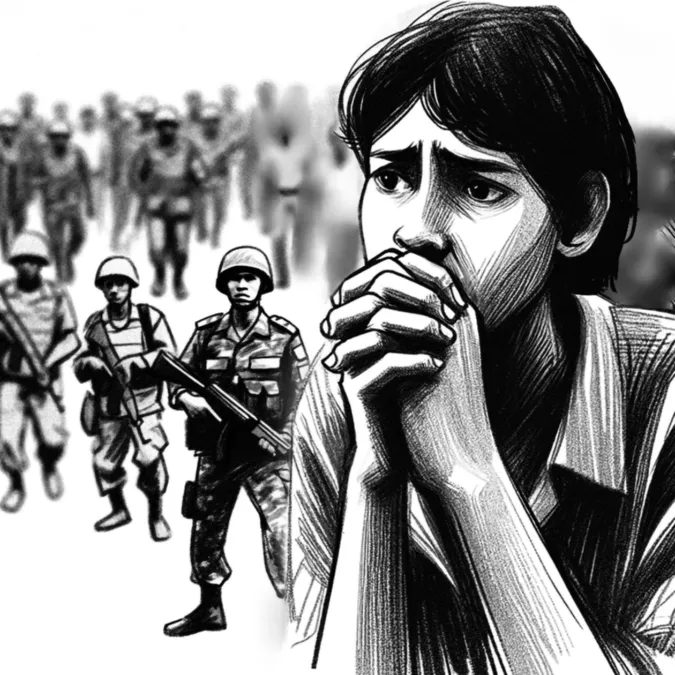
On the morning of Thursday, May 4, 2023, an Armed Forces sergeant with four years of service at the General Staff (*Estado Mayor*) in San Salvador left his home for a cultural center in the country’s western region. A farmer by trade and taking advantage of his day off, he went to pick up the farming supply kit the government distributes to local producers.
He was dressed in civilian clothes but carried his institutional ID and his issued sidearm. While standing in line, police officers approached him, pulled him out of the queue, and took him away before his father’s stunned gaze. In that moment, the soldier tried to reassure his family, never imagining it would be the last time they would speak to him.
As one of his sisters recalls, he told his father: “Do not worry. I will be right back to get in line and pick up my fertilizer.” Although the sergeant went with the officers voluntarily and without handcuffs—on the understanding that they merely wanted to ask him “a few questions”—the situation changed entirely upon arrival at the local police precinct.
Hours later, when his father showed up at the station, he found his son already in handcuffs. The authorities refused to hand over any documentation or explain the grounds for the detention. When the father insisted, vouching for his son’s character as a hardworking young man with no criminal record, the police response was curt and final: “The order comes from above,” his sister recounts one of the officers saying.
The officers even returned the sergeant’s issued weapon and phone to his father, acknowledging that everything was legally registered, yet upheld the detention.
The soldier is currently held at a penal farm after being transferred through various prisons across the country. Despite a good-conduct certification issued by his commanding officers at the General Staff and the absence of any allegations linking him to criminal organizations, he is being prosecuted for the crime of unlawful association.
*Members of the Santa Marta community and relatives of the environmentalists indicated they are considering an appeal of the court’s ruling that decreed civil liability in the abstract for four of the eight defendants (LPG photo: Williams Sandoval)*
For the family, one of the starkest contradictions emerged during one of the transfers, when a police officer confirmed to his sister-in-law that the sergeant had no gang connections whatsoever. “When they transferred him from one prison to another, my sister-in-law asked why they had sent him so far away, and the officer told her it was because he was clean—that he had no ties to gangs,” his sister recounts.
The family denounces a judicial process riddled with irregularities, negligent legal defense, and a complete lack of transparency.
Initially, they hired a private attorney who, according to the family member, took their money without providing information about hearing dates and failed to appear at a preliminary hearing scheduled for June 2023.
The family then sought a second attorney to request a hearing to review the detention measures, only to encounter the impossibility of even verifying the soldier’s physical condition. His sister says the attorney was unable to see him due to technical failures.
“When she arrived, they told her the system was down and that it was impossible to connect the video call,” his sister laments.
In October 2025, a public defender took over the case. According to the family, he explained that the sergeant did not appear in any of the gang classification lists maintained by authorities in the country’s western region—deepening their questions about the reasons for his arrest.
“That lawyer told me that in the area, gang members are classified into three groups. He searched all of them, and my brother did not appear in any. Thank God he is not grouped with any of them—that is why we cannot understand his detention,” she adds.
More than two years after his arrest, the sergeant’s family lives in constant uncertainty. Month after month, they deposit money for food and hygiene packages without even being certain he is still alive.
The authorities have repeatedly denied requests for a medical file that the family has sought to confirm he is alive; they have had no access.
Since that day—May 4, 2023—the family denounces not only the total absence of any communication but also the refusal to grant alternative measures to detention.
“Lo capturaron haciendo fila para el paquete agrícola”, el caso de un sargento detenido bajo el régimen de excepción
La mañana del jueves 4 de mayo de 2023, un sargento de la Fuerza Armada, con cuatro años de servicio en el Estado Mayor en San Salvador, salió de su vivienda rumbo a una sede cultural ubicada en la zona occidental del país. Como agricultor y aprovechando su día de descanso, acudió a retirar el paquete agrícola que el Gobierno entrega a productores de la zona.
Vestía de civil, pero portaba su carné institucional y su arma de equipo. Mientras hacía fila, agentes policiales se le acercaron, lo apartaron de la hilera y se lo llevaron ante la mirada atónita de su padre.En ese instante, el militar intentó tranquilizar a su familia, sin imaginar que sería la última vez que hablarían con él.
Según recuerda una de sus hermanas, él le dijo a su padre: “No se preocupe. Ya voy a venir a hacer fila para retirar mi abono”. Aunque el sargento acompañó a los agentes de forma voluntaria y sin estar esposado, bajo la premisa de que únicamente le harían “unas preguntas”, la situación cambió por completo al llegar a la delegación policial correspondiente.
Horas más tarde, cuando su padre se presentó en el lugar, lo encontró ya esposado. Las autoridades se negaron a entregarle documentación alguna o a explicar los motivos de la detención. Ante la insistencia del padre, quien defendía la conducta de su hijo como un joven trabajador y sin antecedentes, la respuesta policial fue breve y definitiva: “La decisión viene de arriba”, relata su hermana que les dijo uno de los agentes.
Incluso, los policías devolvieron al padre el arma de equipo y el teléfono del sargento, reconociendo que todo estaba legalmente registrado, pero mantuvieron la detención.
Actualmente, el militar permanece recluido en una granja penitenciaria, luego de haber sido trasladado por distintas cárceles del país. Pese a que su jefatura en el Estado Mayor emitió una constancia de buena conducta y a que no existen señalamientos de vínculos con estructuras criminales, es procesado por el delito de agrupaciones ilícitas.
Miembros de la comunidad Santa Marta y familiares de los ambientalistas señalaron que analizan apelar la decisión del Tribunal que decretó responsabilidad civil en abstracto para cuatro de los ocho procesados (Foto de LPG: Williams Sandoval)
Para la familia, una de las mayores contradicciones ocurrió durante uno de los traslados, cuando un policía confirmó a su cuñada que el sargento no tenía relación alguna con pandillas.“Cuando lo trasladaron de un penal a otro, mi cuñada preguntó porqué se lo habían llevado tan lejos y el policía le dijo que era porque él estaba limpio, que no tenía ningún vínculo con las pandillas”, cuenta su hermana.
La familia denuncia que el proceso judicial ha estado marcado por irregularidades, negligencia en la defensa y opacidad.
Inicialmente, contrataron a un abogado privado que, según la familiar, les cobró dinero sin brindarles información sobre las fechas de los procesos y no se presentó a una audiencia inicial programada para junio de 2023.
Posteriormente, la familia buscó a una segunda abogada que intentara solicitar una audiencia de revisión de medidas, pero se enfrentó con la imposibilidad de verificar siquiera el estado físico del militar. Su hermana menciona que la abogada no pudo verlo por fallas tecnológicas.
“Cuando llegó le dijeron que no había sistema y que esto impedía enlazar la videollamada”, lamenta su hermana.
En octubre de 2025, un abogado público asumió la defensa del caso. Según la familia, él les explicó que el sargento no aparecía dentro de la clasificación de grupos de pandillas que las autoridades manejan en la zona occidental del país, lo que incrementó aún más los cuestionamientos sobre las razones de su captura.
“Ese abogado me dijo que en la zona los pandilleros están clasificados en tres grupos. Buscó en todos y en ninguno apareció mi hermano. Gracias a Dios, él no está agrupado con ninguno de esos, por eso no entendemos su detención”, añade.
Tras más de dos años de captura, la familia del sargento se mantiene en incertidumbre constante. Mes a mes depositan dinero para alimentación y paquetes de higiene, sin tener certeza siquiera de que continúe con vida.
Las autoridades han negado reiteradamente el envío de un expediente médico que los familiares han solicitado para constatar que se encuentra con vida, pero no han tenido acceso.
Desde aquel 4 de mayo de 2023, la familia denuncia no solo que la comunicación ha sido completamente nula, sino la negativa de otorgarle medidas sustitutivas.