
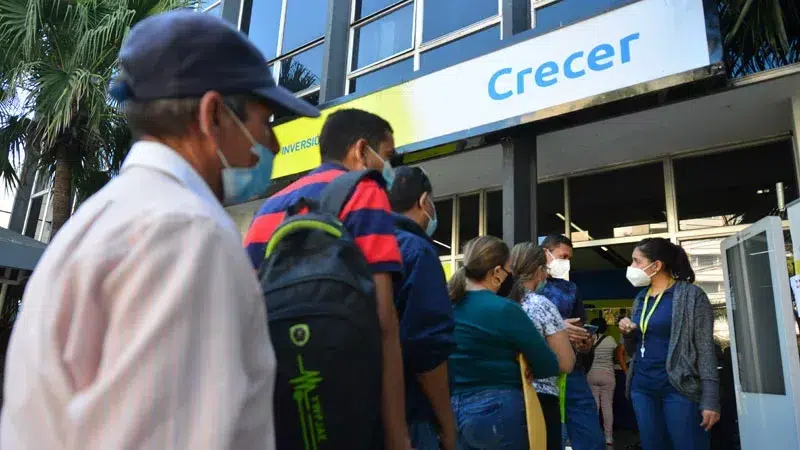
In El Salvador, the pension system has become the focal point of public debate in recent days—not out of any urgency to improve post-retirement benefits or extend coverage to the majority of the working population, but because of the financial pressure bearing down on the State.
So explains César Villalona, a Dominican-Salvadoran economist with 40 years of research and university teaching experience, who warns that the current discussion is driven more by the Government’s fiscal crisis and the demands of the International Monetary Fund (IMF) than by any focus on human rights and social protection.
In this interview, the economist dissects the structural failures of El Salvador’s pension system, which, in his view, suffers from extraordinarily low coverage, inadequate pensions, and the State’s mounting indebtedness to workers’ funds.
The expert underscores that only a minority will ever manage to retire, while the bulk of the economically active population will be shut out of a pension in old age. Villalona also raises the alarm over the intensive use of pension funds to finance the State—a debt that now exceeds $11.2 billion and that could become a ticking time bomb starting in 2027, when the Government will have to resume payments it has deferred for several years.
Against this backdrop, the researcher argues that the pension debate reflects a broader fiscal crisis, whose solutions could carry steep social costs if the needs of workers and retirees are not placed at the center.
Why is El Salvador’s pension system back in the spotlight?
The system is back in the spotlight primarily because of the Government’s financial problems—not because anyone is discussing low pensions or low coverage, which should be the heart of the debate. The real human problem within the system is that only 27% of the economically active population contributes, and of that share, barely around 18% will ever manage to retire.
Why will the rest not manage to retire?
Because many people fail to meet the age and contribution-year requirements. In practice, the majority of the population will never receive a pension because they do not contribute on a continuous basis. Out of every 100 people, only 27 contribute, and of those, roughly 40% will never reach 25 years of contributions or the minimum required age: 60 for men and 55 for women.
This is due to low contribution density. There are people over 50 who have accumulated only six or seven years of contributions. They will reach retirement age but not the legally mandated contribution period, so they end up withdrawing their money without ever receiving a pension. In the end, very few actually manage to retire. The core problem is coverage.
What are the main structural problems of the current system?
The system has three major problems. The first is low coverage: a pension is a human right, yet it remains reserved for a minority.
The second is that pensions are far too low: most hover around the minimum pension, which currently stands at $304. And the third is the financial problem, which is the only one that truly features in the public debate.
The Government is not discussing how to expand coverage or how to guarantee dignified pensions. The issue lands on the agenda because the International Monetary Fund (IMF) demands a reform proposal as part of a financial agreement.
What is the underlying financial problem?
The State owes pension funds more than $11.2 billion. It is an enormous figure. When the current president took office in 2019, that debt stood at approximately $5.071 billion.
This indebtedness began in 2007, during the administration of Antonio Saca, when the AFPs were authorized to lend money to the State to pay pensions under the public system, supplement pensions for those who had opted into the transition, and cover the minimum pension. The mechanism has been in place ever since.
The difference is that previous governments borrowed but also repaid. The current government inherited a debt of just over $5 billion and drove it past $11.2 billion in barely six years, doubling what had accumulated over 13 years.
And how do you read that?
This is explained by two factors. First, the Government is borrowing more money than it actually needs to cover its pension obligations, which indicates that part of those funds is being diverted to other purposes. That became evident in October, when instead of drawing the customary $47 million from the AFPs, $105 million was drawn to pay the year-end bonus. And now in January you will see that what they call the “25th paycheck” will be paid with AFP loans. So the debt has grown by 120%.
Second, the Government stopped repaying the debt. Starting in 2023, it decided to pay nothing: 2023, 2024, 2025, 2026, and 2027. That means in 2027 it will need to come up with roughly $800 million that does not currently exist in the budget.
How will it obtain those funds? Will payments also be due in the years ahead?
The problem does not end in 2027. From that year onward, the Government will have to resume annual payments on a debt structured over 30 years. Some loans mature in 20 years, others in 25 or 26, which means that every year enormous sums will come due, with no clear budget line to cover them.
Why does this concern the International Monetary Fund?
It concerns the Fund because this problem affects public finances. What the Fund seeks is for the Government to service its external debt and its debt to private banks, in order to avert a default. That is why it imposes austerity and spending-cut programs.
In the case of the AFPs, the Fund is not concerned in the same way because AFPs are not banks. They earn through commissions, not through interest on loans. Even if the Government fails to pay, the AFPs do not collapse immediately because they have already collected their profits.
What truly concerns the IMF is that the State might be unable to pay the banks, the multilateral institutions, or international bondholders, since the Fund represents the interests of the global financial system.
There is one concern the Fund does have: where will the Salvadoran State find those $800 million? And if it finds them and pays the Pension Fund but cannot service the external debt, then the IMF will demand that it guarantee compliance with its external borrowing commitments. That is why it requested a reform by February, and that is why the issue is under debate.
Why is this described as an economic problem rather than a human one?
It is human up to a point, because if the State does not pay and the funds run dry, more than 200,000 people currently receiving pensions could be left with nothing, and more than 800,000 contributors would lose their money.
However, the government’s reform does not seek to expand coverage or raise pensions; it seeks to resolve the State’s financial problem with the AFPs. The human dimension is not on the table.
Given this context, what scenarios does the Government face heading into the 2027 payments?
One option is to defer the payments and push them to later years—2033, for example. The problem is that the individual account expires this year, and the solidarity collective account expires in 2029.
The AFPs manage approximately $15.8 billion, but more than 70% of that money has been lent to the State. If the Government keeps borrowing and does not repay, the funds could be depleted—which would be catastrophic, since more than 200,000 people would be left without a pension and more than 800,000 contributors would lose their savings. But that is not going to happen.
Why do you believe that will not happen?
Because the Government is not going to make a mistake of that magnitude. A collapse of the pension system would trigger a financial and political meltdown that no government can survive.
Returning to the earlier topic, what is the difference between the individual account and the solidarity collective account?
When a person works and receives a salary, 7.25% is deducted and the employer contributes 8.25%. That money goes to the AFP, which first takes its commission and then distributes the rest: 60% goes to the individual account and 40% to the solidarity account.
The individual account is used to pay the pension during the first years of retirement. When that money runs out, the solidarity account supplements the pension to cover the remaining years of life.
However, the State uses the solidarity account as a source of financing by issuing certificados de obligación previsional (pension obligation certificates), committing to repay that money over a period of up to 30 years at a set interest rate.
But the following year it does the same thing again—it issues more. Every year it draws more than $600 million. It is the Instituto Salvadoreño de Pensiones (Salvadoran Pension Institute) that channels those resources to the Ministry of Finance, which then does three things with the loan.
What are those three things?
First, it pays the pensions of 80,000 retirees from the Seguro Social (Social Security system) and from INPEP, the former public system. Second, there is a group of AFP retirees—no longer under the public system—to whom the State provides a supplement. This group is what they called the “optados,” people whose pensions turned out very poorly under the new system.
Previously, the average salary of the last three years was used for the calculation, but upon switching to the AFPs, the calculation was based on the last ten years. So the pension would come out at something like $280, and Francisco Flores proposed making up the difference. That is why the Ministry of Finance now contributes an amount to bring it up to around $700. And third, it supplements those who receive a pension below the AFP minimum. In other words, someone earning $600 who retires would get a pension of about $210, but the minimum is $304. The State covers the rest, and that is why it borrows from the Pension Fund. These are three separate burdens. This has been going on since 2001. The governments of Francisco Flores and Antonio Saca financed it by selling bonds abroad—legal instruments.
What happened with that mechanism under subsequent governments?
When the government of Mauricio Funes took over, it found this system already in place and maintained it to solve a concrete problem: how to come up with between $500 and $600 million a year to cover pension obligations. The difference is that at that time the State borrowed but also repaid principal and interest, and there was a ceiling: it could not borrow from the AFPs beyond 45% of the funds.
Was that ceiling always respected?
Yes, until it was reached in 2017, during the government of Salvador Sánchez Cerén. At that point, the AFPs could no longer lend more, and the fragility of the system was laid bare. Even so, the State continued to pay what it owed, and the so-called “pension cost” appeared clearly in the budget.
What changed with the reform approved in 2022 and in effect since 2023?
Several grave things changed. First, the certificados de inversión previsional (pension investment certificates) were eliminated, but others were created under a different name: certificados de obligación previsional (pension obligation certificates). In practice it is the same thing, but now with no borrowing limit.
Today the State already owes more than 70% of the funds, when the previous ceiling was 45%.
Second, the Instituto Salvadoreño de Pensiones (Salvadoran Pension Institute) was created to issue these certificates, replacing Bandesal. Third, it was agreed that nothing would be paid to the AFPs for four years: 2023, 2024, 2025, and 2026. No previous government did anything of the sort. It is even more serious than that. And fourth, far more money began to be drawn than was needed for these obligations.
How much money did the State actually need to cover its pension obligations?
Between $350 and $400 million a year was enough to cover three items: pension payments, refunds, and pension obligations. Yet more than $700 million a year has been taken. That means the money is being used for other purposes.
What other purposes could those be?
They are using money to solve other problems. I believe—though I cannot assert it with certainty—that they used that money to advance the year-end bonus payment in October of last year and for other expenditures. I am almost certain they are using it to resolve other government problems. If they are using it for something else, they are violating the law, but I am not speaking of corruption—I am saying they may be using it to pay salaries or fund the Ministry of Health.
What does the use of pension funds for other government expenditures reveal?
It reveals that public finances are in bad shape. The agreement with the International Monetary Fund is clear proof of that.
What is the cause?
Because this government has driven debt up excessively. When the current administration took office, it inherited a debt of roughly $19 billion; now it stands at nearly $34 billion. In the first six years of Bukele, the debt grew more than under the three previous governments combined. Pension debt alone climbed from $5 billion to more than $11 billion under this government. The single largest line item in the budget is debt service. And it is debt to pay debt. Last year they paid approximately $1.75 billion in debt and received approximately $1.7 billion in loan disbursements. On paper, $1.75 billion came in and $1.7 billion went out. In other words, they were left with a surplus of $50 million, yet the debt grew by $1.6 billion because more than 60% goes to interest—and that is why the indebtedness never shrinks.
It is a disaster—excessive military spending, massive propaganda—because poverty has risen, schools have been closed, health clinics shut down, and a huge number of people laid off.
They have squandered vast sums of money. There are abundant signs of public corruption, information under seal for seven years in the Legislative Assembly. What is a lawmaker trying to hide who does not want anyone to access the Assembly’s budget information? Direct purchases are made and there is opacity. Perhaps part of the public-finance problem has to do with corruption. For my part, in my analysis of the budget over these years, the numbers do not add up—there are $3.5 billion I cannot account for. Because one looks at a debt that has grown by more than $13 billion, and the government tells me that poverty, which stood at 22.8% of Salvadoran households in 2019, was at 25.8% in 2024—that is, 3 percentage points higher.
How is it possible that both debt and poverty grow? That poverty figure comes from official data. In that context of high debt, it reached 90% of GDP; by the time it hit 80%, the country should no longer have been creditworthy, yet the Fund tolerated it. The Fund observed that the government was not paying the AFPs because it had no source of funds, saw that the Salvadoran State was at risk of defaulting on its debt, and recommended corrective measures.
The Fund lent it $1.37 billion but demanded spending cuts and increased revenue. It also demands a three-point increase to the VAT and the submission of a pension reform to solve this problem.
With the latest reform, did pensions actually improve?
The reform modified the calculation formula and, on the surface, may nudge the pension up slightly. For example, if a person retires today at age 60, earned $1,000, and has accumulated $50,000, that amount is divided by 250 months. That yields a base pension of roughly $200. Then they add a 30% increase, bringing it to about $260, and with the return calculation it reaches approximately $280. In other words, this person’s $1,000 salary is replaced by a pension of $280 per month. It ultimately ends up at $304 because the State covers the rest.
So what does that 30% increase actually mean?
It means the pension rises slightly, but remains insufficient. Moreover, that 30% is not contributed by the AFP or the State: it comes out of the worker’s own fund. In practice, the money runs out faster. If before the individual fund could last about 12 years, now it could last nine or even less. In other words, the monthly amount is marginally improved, but at the cost of reducing the period over which the person will receive that pension.
What happens when the individual fund runs out?
When the individual account is exhausted, the solidarity account kicks in. The problem is that this account is also at risk. According to the most recent actuarial report, both the individual and the solidarity accounts could be depleted by 2029. This is happening because the State has drawn heavily on these funds and has stopped repaying since 2023.
If there is no reform this very year, by 2029 there simply would be no money to pay pensions.
What options does the Government have to confront this crisis?
One option is to raise taxes—the VAT, for example. A two-point increase could generate between $650 and $700 million. But that would drive up the cost of all goods and services, directly hitting the population.
What would the impact be?
A VAT increase would make everything more expensive. The goods and services consumed by the population would carry a higher tax, exactly as the International Monetary Fund recommends. However, the Government resists this measure because of the severe impact it would have on prices.
The effect is not confined to the point of final purchase. Businesses also pay VAT when they acquire machinery and raw materials, which raises their production costs. That increase is ultimately passed on to product prices, generating a chain reaction throughout the entire economy.
As a consequence, the country could face inflation exceeding 10%, which would directly erode the population’s purchasing power. Furthermore, high inflation forces banks to raise interest rates to prevent capital flight, making both consumer credit and business loans more expensive.
This scenario punishes those who carry debt, businesses that depend on financing, and, particularly, exporters, who lose competitiveness in international markets due to rising costs.
Are there other alternatives?
Another option is to eliminate or reduce subsidies, which would also have an immediate impact on the cost of living. There is also talk of closing ministries or laying off public employees, but even closing several ministries would not yield the $800 million needed.
Are there alternatives that would not hurt the majority of the population?
I am not wedded to a single proposal; what I am laying out is a menu of options. There are various ways out of the problem, though some will definitively never be adopted.
For example, economist Oscar Cabrera, director of FUDECEN and former president of the Central Bank, has a study showing that a wealth tax could generate more than $460 million for the State. Wealth is understood as the difference between a person’s assets and liabilities: the value of their property—homes, vehicles, savings, and receivables—minus their debts.
Under this proposal, those with a net worth exceeding one million dollars would pay a 2% tax. Starting at five million, the rate would rise to 3%, up to $30 million, and 5% for wealth above that threshold. In total, roughly 110 individuals with large fortunes in the country would be affected. This would include even the president’s own family.
Unlike consumption taxes, this measure does not drive up prices or directly impact the population, because it taxes accumulated wealth rather than everyday spending. However, it is unlikely that the current Government would adopt this option, since it would directly affect the country’s leading economic groups.
Even though the Plan Cuscatlán promised a progressive tax reform—meaning that those who have the most would contribute the most to financing the State—measures of this kind would only be viable under a government with a redistributive vision.
What does the outlook for the coming years look like?
Everything points to a severe fiscal adjustment after the elections. The IMF agreement is not meeting its targets: the debt-to-GDP ratio has not fallen—it has risen. That opens the door to a harsher renegotiation, with steeper demands.
Faced with this outlook, beyond the figures and reforms, César Villalona insists that the pension debate lays bare the problem at its root: a State that finances its operations with workers’ savings while postponing the decisions needed to guarantee dignified and sustainable pensions.
YSUCA: https://ysuca.org.sv/2026/02/pensiones-un-derecho-que-aun-no-llega-a-la-mayoria/
Pensiones: un derecho que aún no llega a la mayoría
En El Salvador, el sistema de pensiones se ha vuelto el centro del debate público en estos días, no por la urgencia de mejorar el monto tras la jubilación, ni por ampliar la cobertura a la mayoría de la población trabajadora, sino por la presión financiera que enfrenta el Estado.
Así lo explica César Villalona, economista dominicano salvadoreño con 40 años de labores de investigación en la docencia universitaria, quien advierte que la discusión actual está marcada más por la crisis fiscal del Gobierno y las exigencias del Fondo Monetario Internacional (FMI) que por un enfoque en derechos humanos y protección social.
En esta entrevista, el economista desmenuza las fallas estructurales del sistema previsional salvadoreño que, a su juicio, tiene una cobertura extremadamente baja, pensiones insuficientes y un endeudamiento creciente del Estado con los fondos de los trabajadores.
El experto subraya que solo una minoría logrará jubilarse, mientras la mayoría de la población económicamente activa quedará excluida de una pensión en la vejez. Villalona también alerta sobre el uso intensivo de los fondos de pensiones para financiar al Estado, una deuda que ya supera los 11,200 millones de dólares y que podría convertirse en una bomba de tiempo a partir de 2027, cuando el Gobierno deberá retomar pagos que ha postergado durante varios años.
Bajo este panorama, el investigador plantea que el debate previsional refleja una crisis fiscal más amplia, cuyas soluciones podrían tener altos costos sociales si no se colocan en el centro las necesidades de los trabajadores y pensionados.
¿Por qué el sistema de pensiones en El Salvador vuelve a estar en debate?
El sistema vuelve al debate principalmente por el problema financiero del Gobierno, no porque se estén discutiendo las pensiones bajas ni la baja cobertura, que deberían ser el centro de la discusión. El verdadero problema humano del sistema es que solo el 27 % de la población económicamente activa cotiza, y de ese porcentaje apenas alrededor del 18 % logrará jubilarse.
¿Por qué los demás no lograrán jubilarse?
Porque muchas personas no alcanzan los requisitos de edad y de años cotizados. En la práctica, la mayoría de la población nunca tendrá una pensión porque no cotiza de manera continua. De cada 100 personas, solo 27 cotizan y, de esas, cerca del 40 % no llegará a los 25 años de cotización ni a la edad mínima requerida: 60 años en hombres y 55 en mujeres.
Esto se debe a la baja densidad de cotización. Hay personas de más de 50 años que apenas acumulan seis o siete años cotizados. Llegarán a la edad de jubilación, pero no al tiempo exigido por la ley, por lo que terminarán retirando su dinero sin pensionarse. Al final, quienes logran jubilarse son muy pocos. El principal problema es la cobertura.
¿Cuáles son los principales problemas estructurales del sistema actual?
El sistema tiene tres grandes problemas. El primero es la baja cobertura: la pensión es un derecho humano, pero está reservado para una minoría.
El segundo es que las pensiones son muy bajas: la mayoría ronda la pensión mínima, que actualmente es de 304 dólares. Y el tercero es el problema financiero, que es el único que realmente está presente en el debate público.
El Gobierno no está discutiendo cómo ampliar la cobertura ni cómo garantizar pensiones dignas. El tema entra en la agenda porque el Fondo Monetario Internacional (FMI) exige una propuesta de reforma como parte de un acuerdo financiero.
¿Cuál es el problema financiero de fondo?
Que el Estado le debe a los fondos de pensiones más de 11,200 millones de dólares. Es una cifra enorme. Cuando el presidente actual asumió en 2019, esa deuda era de aproximadamente 5,071 millones de dólares.
Este endeudamiento comenzó en 2007, durante el gobierno de Antonio Saca, cuando se autorizó que las AFP prestaran dinero al Estado para pagar pensiones del sistema público, complementar pensiones de personas optadas y cubrir la pensión mínima. Desde entonces, el mecanismo se mantuvo.
La diferencia es que los gobiernos anteriores pedían prestado, pero también pagaban. El actual gobierno encontró una deuda de poco más de 5,000 millones y la elevó a más de 11,200 millones en apenas seis años, duplicando lo acumulado en 13 años.
¿Y qué lectura hace usted de eso?
Esto se explica por dos razones. Primero, el Gobierno está pidiendo más dinero del que realmente necesita para cubrir las obligaciones previsionales, lo que indica que parte de ese fondo se está usando para otros fines. Eso quedó en evidencia cuando, en octubre, en lugar de tomar los 47 millones habituales de las AFP, se tomaron 105 millones para pagar el aguinaldo. Y ahora en enero ya verán que con lo que le llaman la quincena 25 la van a pagar con préstamos de las AFP. Entonces, ha crecido 120% la deuda.
Segundo, el Gobierno dejó de pagar la deuda. Desde 2023 decidió no abonar nada: 2023, 2024, 2025, 2026 y 2027. Eso significa que en 2027 tendrá que conseguir alrededor de 800 millones de dólares que hoy no existen en el presupuesto.
¿Cómo va a conseguir esos fondos? ¿En los años próximos también habrá que hacer pagos?
El problema no es solo 2027. A partir de ese año el Gobierno deberá retomar pagos anuales por una deuda que es a 30 años. Algunos préstamos vencen en 20 años, otros en 25 o 26, lo que implica que todos los años habrá que pagar enormes cantidades de dinero, sin que exista una partida clara para hacerlo.
¿Por qué esto preocupa al Fondo Monetario Internacional?
Al Fondo Monetario le preocupa porque este problema afecta a las finanzas públicas. Lo que el Fondo busca es que el Gobierno pague su deuda externa y la deuda con la banca privada, para evitar una bancarrota. Por eso impone programas de ajuste y recorte del gasto.
En el caso de las AFP, el Fondo no se preocupa de la misma manera porque las AFP no son bancos. Ellas ganan a través de comisiones, no de los intereses de los préstamos. Aunque el Gobierno no pague, las AFP no quiebran inmediatamente porque ya obtuvieron su ganancia.
Lo que realmente le preocupa al FMI es que el Estado no pueda pagar a los bancos, a los organismos multilaterales o a los tenedores de bonos internacionales, ya que el Fondo representa los intereses del sistema financiero global.
Hay una preocupación del Fondo: ¿de dónde va a sacar esos 800 millones el Estado salvadoreño? Y si los saca y paga al Fondo de Pensiones, pero no puede pagar la deuda externa, ahí sí el FMI le va a pedir que garantice el cumplimiento de sus compromisos de endeudamiento externo. Por eso le pidió una reforma para febrero y por eso el tema está en debate.
¿Por qué se dice que este es un problema económico y no humano?
Es humano hasta cierto punto, porque si el Estado no paga y los fondos se agotan, más de 200,000 personas que hoy reciben pensión podrían quedarse sin ella, y más de 800,000 cotizantes perderían su dinero.
Sin embargo, la reforma del gobierno no busca mejorar la cobertura ni aumentar las pensiones, sino resolver el problema financiero del Estado con las AFP. El tema humano no está sobre la mesa.
Bajo este contexto, ¿cuáles son los panoramas que tiene el Gobierno de cara a los pagos de 2027?
Una opción es prorrogar los pagos y extenderlos a años posteriores, por ejemplo, hasta 2033. El problema es que la cuenta individual vence este año y la cuenta colectiva solidaria vence en 2029.
Las AFP administran alrededor de 15,800 millones de dólares, pero más del 70 % de ese dinero está prestado al Estado. Si el Gobierno sigue pidiendo y no paga, los fondos podrían agotarse, lo que sería una catástrofe porque más de 200,000 personas se quedarían sin pensión y más de 800,000 cotizantes perderían sus ahorros. Pero eso no va a suceder.
¿Por qué cree que eso no va a pasar?
Porque el Gobierno no va a cometer un error de ese tamaño. Un colapso del sistema previsional implicaría un hundimiento financiero y político que ningún gobierno puede sostener.
Regreso al tema anterior, ¿cuál es la diferencia entre la cuenta individual y la cuenta colectiva solidaria?
Cuando una persona trabaja y recibe un salario, se le descuenta el 7.25 % y el empleador aporta el 8.25 %. Ese dinero llega a la AFP, que primero retira su comisión y luego distribuye el resto: un 60 % va a la cuenta individual y un 40 % a la cuenta solidaria.
La cuenta individual sirve para pagar la pensión durante los primeros años de jubilación. Cuando ese dinero se agota, la cuenta solidaria complementa la pensión para cubrir los años restantes de vida.
Sin embargo, el Estado utiliza la cuenta solidaria como fuente de financiamiento mediante la emisión de certificados de obligación previsional, comprometiéndose a pagar ese dinero en un plazo de hasta 30 años y con una tasa de interés.
Pero al año siguiente vuelve a hacer lo mismo, emite. Todos los años está agarrando más de 600 millones. Es el Instituto Salvadoreño de Pensiones quien le pasa esos recursos al Ministerio de Hacienda quien hace tres cosas con ese préstamo.
¿Cuáles son esas tres cosas?
En primer lugar, le paga la pensión a 80,000 personas jubiladas del Seguro Social – y del INPEP, el antiguo sistema público. Segundo, hay un grupo de personas jubiladas de las AFP, ya no del sistema público, a las que el Estado le da un complemento. Ese grupo es lo que le llamaron optados y son a quienes las pensiones le salieron muy mal con el nuevo sistema.
Antes le calculaban el salario promedio de los últimos 3 años, pero al pasarse a las AFP el cálculo fue de los últimos 10 años. Entonces le sale una pensión como de $280 y Francisco Flores sugirió poner el resto. Es por eso que ahora Hacienda pone un monto para completar uno $700. Y tercero, le complementan a quienes reciben una pensión por debajo de la mínima en la AFP. Es decir, quienes tienen un salario de $600 y se jubila la pensión le va a salir de $210, pero la mínima son de $304. El Estado pone el resto de ese monto y por eso pide prestado al Fondo de pensiones. Son tres cargas. Esto viene desde el 2001. El gobierno de Francisco Flores y de Antonio Saca lo hizo vendiendo bonos en el exterior -papeles legales-.
¿Qué pasó con ese mecanismo en los gobiernos siguientes?
Cuando llega el gobierno de Mauricio Funes, encuentra ese sistema funcionando y lo mantiene para resolver un problema concreto: cómo conseguir entre 500 y 600 millones de dólares al año para cubrir obligaciones previsionales. La diferencia es que en ese momento el Estado pedía prestado, pero también pagaba capital e intereses, y existía un límite: no podía endeudarse con las AFP más allá del 45 % de los fondos.
¿Ese límite se respetó siempre?
Sí, hasta que se llegó al tope en 2017, durante el gobierno de Salvador Sánchez Cerén. En ese momento las AFP ya no podían prestar más y ahí se evidenció la fragilidad del sistema. Aun así, el Estado seguía pagando lo que debía y el llamado “costo previsional” aparecía claramente en el presupuesto.
¿Qué cambia con la reforma aprobada en 2022 y vigente desde 2023?
Cambian varias cosas graves. Primero, se eliminan los certificados de inversión previsional, pero se crean otros con distinto nombre: certificados de obligación previsional. En la práctica es lo mismo, pero ahora sin límite de endeudamiento.
Hoy el Estado ya debe más del 70 % de los fondos, cuando antes el tope era 45 %.
Segundo, se crea el Instituto Salvadoreño de Pensiones, que emite estos certificados, y ya no Bandesal. Tercero, se acuerda no pagar nada a las AFP durante cuatro años: 2023, 2024, 2025 y 2026. Ningún gobierno anterior hizo algo así. Es más grave. Y cuarto, se empieza a tomar mucho más dinero del necesario para estas necesidades.
¿Cuánto dinero necesitaba realmente el Estado para cubrir sus obligaciones previsionales?
Entre 350 y 400 millones de dólares al año eran suficientes para cubrir tres cosas: pago de pensiones, devoluciones y obligaciones previsionales. Sin embargo, se han tomado más de 700 millones de dólares anuales. Eso significa que el dinero se está usando para otros fines.
¿Qué otros fines podrían ser?
Están utilizando dinero para resolver otros problemas, yo creo, no lo puedo asegurar, que utilizaron ese dinero para dar el anticipo del aguinaldo –en octubre del año pasado- y para otros gastos. Estoy casi seguro de que lo están utilizando para resolver otros problemas del gobierno. Si lo están utilizando para otra cosa están violando la ley, pero no estoy hablando de corrupción, estoy hablando que a lo mejor lo usan para pagar salarios o ministerio de Salud.
¿Qué demuestra el uso de fondos previsionales para otros gastos del gobierno?
Demuestra que las finanzas públicas están mal. El acuerdo con el Fondo Monetario Internacional es una prueba clara de eso.
¿A qué se debe eso?
Porque este gobierno ha elevado demasiado la deuda. Cuando la administración actual llegó la encontró en unos 19 mil millones de dólares la deuda y ahora la tiene en casi 34 mil millones. En los primeros seis años de Bukele, la deuda creció más que en los tres gobiernos anteriores juntos. Solo la deuda previsional subió de 5 mil a más de 11 mil millones en este gobierno. El mayor pago del presupuesto es el pago de la deuda. Y es deuda para pagar deuda. El año pasado pagaron deuda como por $1,750 y recibieron desembolso de préstamos como por $1,700. Contablemente entraron 1,750 y pagarán $1,700. Es decir, le sobraron $50 millones y la deuda creció en $1,600 poque más del 60% es de intereses y por eso no baja el endeudamiento.
Es un desastre, mucho gasto militar, mucha propaganda, porque la pobreza ha subido, han cerrado escuelas, unidades de salud y han despedido a un montón de gente.
Han dilapidado mucho dinero, hay muchos indicios de corrupción pública, hay reservas de información por siete años en la Asamblea ¿Qué quiere ocultar un diputado que no quiere que tenga acceso a la información del presupuesto de la Asamblea?, se hacen compras directas y hay opacidad. A lo mejor parte del problema de las finanzas públicas tiene que ver con la corrupción. A mí, por ejemplo, en mi análisis del presupuesto de estos años no me dan las cuentas de $3,500 millones que no sé a dónde se han ido. Porque uno ve esa deuda que ha crecido más de $13,000 millones y el gobierno me dice que la pobreza, que estaba en 22.8 % de los hogares salvadoreños en 2019, en 2024 estaba en 25.8 %, es decir, 3 puntos porcentuales más.
¿Cómo es posible que la deuda crezca y también la pobreza? Esa información de la pobreza es tomada de datos oficiales. En ese contexto de alta deuda fue que llegó a ser el 90 % del PIB; ya cuando llegó al 80 %, el país no debió ser objeto de crédito y el Fondo se lo toleró. El Fondo observó que el gobierno no le paga a las AFP porque no tiene de dónde sacar el dinero, vio que el Estado salvadoreño está en riesgo en el pago de la deuda y sugirió tomar medidas.
El Fondo le prestó $1,370 millones, pero le pidió recortar gastos e incrementar ingresos. También le pide que le suba tres puntos al IVA y presente una reforma de pensión para solucionar este problema.
Con la última reforma, ¿realmente mejoraron las pensiones?
La reforma modificó la forma de cálculo y, en apariencia, puede hacer que la pensión suba un poco. Por ejemplo, si una persona se jubila hoy con 60 años, ganaba 1,000 y tiene acumulados 50 mil dólares, ese monto se divide entre 250 meses. Eso da una pensión base de alrededor de 200 dólares. A eso le suben un 30% que representa unos $260 y con el cálculo de rendimiento llega como a los $280. Es decir, a esta persona se le sustituye un salario de 1,000 por una pensión de $280 al mes. Al final queda en $304 porque el Estado pone el resto.
Entonces, ¿qué significa ese aumento del 30 %?
Significa que la pensión sube un poco, pero sigue siendo insuficiente. Además, ese 30 % no lo pone ni la AFP ni el Estado: sale del propio fondo del trabajador. En la práctica, lo que ocurre es que el dinero se agota más rápido. Si antes el fondo individual podía durar unos 12 años, ahora podría durar nueve o incluso menos. Es decir, se mejora levemente el monto mensual, pero a costa de reducir el tiempo durante el cual la persona recibirá esa pensión.
¿Qué pasa cuando se acaba el fondo individual?
Cuando se termina la cuenta individual, entra a funcionar la cuenta solidaria. El problema es que esa cuenta también está en riesgo. Según el informe actuarial más reciente, tanto la cuenta individual como la solidaria podrían agotarse en 2029. Esto ocurre porque el Estado ha utilizado de manera intensiva estos fondos y ha dejado de pagar desde 2023.
Si no hay una reforma este mismo año, en 2029 simplemente no habría dinero para pagar pensiones.
¿Qué opciones tiene el Gobierno para enfrentar esta crisis?
Una opción es subir impuestos, por ejemplo, el IVA. Un aumento de dos puntos podría generar entre 650 o 700 millones de dólares. Pero eso encarecería todos los productos y servicios, afectando directamente a la población.
¿Cómo impactaría esto?
Un aumento del IVA encarecería todo. Los productos y servicios que consume la población tendrían un impuesto mayor, tal como lo recomienda el Fondo Monetario Internacional. Sin embargo, el Gobierno se resiste a esa medida por el fuerte impacto que tendría en los precios.
El efecto no se limita al momento de la compra final. Las empresas también pagan IVA cuando adquieren maquinaria y materias primas, lo que eleva sus costos de producción. Ese aumento termina trasladándose al precio de los productos, generando un efecto en cadena a lo largo de toda la economía.
Como consecuencia, el país podría enfrentar una inflación superior al 10 %, lo que afectaría directamente el poder adquisitivo de la población. Además, una inflación elevada obliga a los bancos a subir las tasas de interés para evitar la salida de ahorros, encareciendo tanto los créditos como los préstamos empresariales.
Este escenario golpea a quienes tienen deudas, a las empresas que dependen del financiamiento y, de manera particular, a las exportadoras, que pierden competitividad en los mercados internacionales debido al aumento de sus costos.
¿Hay otras alternativas?
Otra opción es eliminar o reducir subsidios, lo que también tendría un impacto inmediato en el costo de la vida. También se habla de cerrar ministerios o despedir empleados públicos, pero incluso cerrando varios ministerios no se alcanzan los 800 millones necesarios.
¿Existen alternativas que no afecten a la mayoría de la población?
No me estoy casando con una sola propuesta, lo que planteo es un menú de opciones. Hay distintas salidas al problema, aunque algunas definitivamente no se van a tomar.
Por ejemplo, el economista Oscar Cabrera, director de FUDECEN y expresidente del Banco Central, tiene un estudio que muestra que un impuesto al patrimonio podría generar más de 460 millones de dólares para el Estado. El patrimonio se entiende como la diferencia entre los activos y los pasivos de una persona: es decir, el valor de sus bienes —como viviendas, vehículos, ahorros y cuentas por cobrar— menos sus deudas.
Bajo esta propuesta, quienes tengan un patrimonio superior al millón de dólares pagarían un impuesto del 2 %. A partir de los cinco millones, la tasa subiría al 3 %; hasta los 30 millones, y del 5 % para patrimonios mayores a esa cifra. En total, los afectados serían alrededor de 110 personas con grandes fortunas en el país. Esto afectaría incluso a la misma familia del mandatario.
A diferencia de los impuestos al consumo, esta medida no encarece los precios ni golpea directamente a la población, porque grava la riqueza acumulada y no el gasto cotidiano. Sin embargo, es poco probable que el actual Gobierno adopte esta opción, ya que afectaría directamente a los principales grupos económicos del país.
Aunque en el Plan Cuscatlán se prometió una reforma tributaria progresiva, es decir, que quienes más tienen aporten más al financiamiento del Estado. Pero este tipo de medidas, solo serían viables en un gobierno con una visión redistributiva.
¿Qué panorama se vislumbra para los próximos años?
Todo apunta a que después de las elecciones habrá un ajuste fiscal fuerte. El acuerdo con el FMI no está cumpliendo sus metas: la relación deuda–PIB no ha bajado, ha subido. Eso abre la puerta a una renegociación más dura, con mayores exigencias.
Ante este panorama, más allá de cifras y reformas, César Villalona insiste en que el debate previsional revela el problema que esta de fondo: un Estado que financia su funcionamiento con el ahorro de los trabajadores, mientras pospone decisiones que garanticen pensiones dignas y sostenibles.
YSUCA: https://ysuca.org.sv/2026/02/pensiones-un-derecho-que-aun-no-llega-a-la-mayoria/