
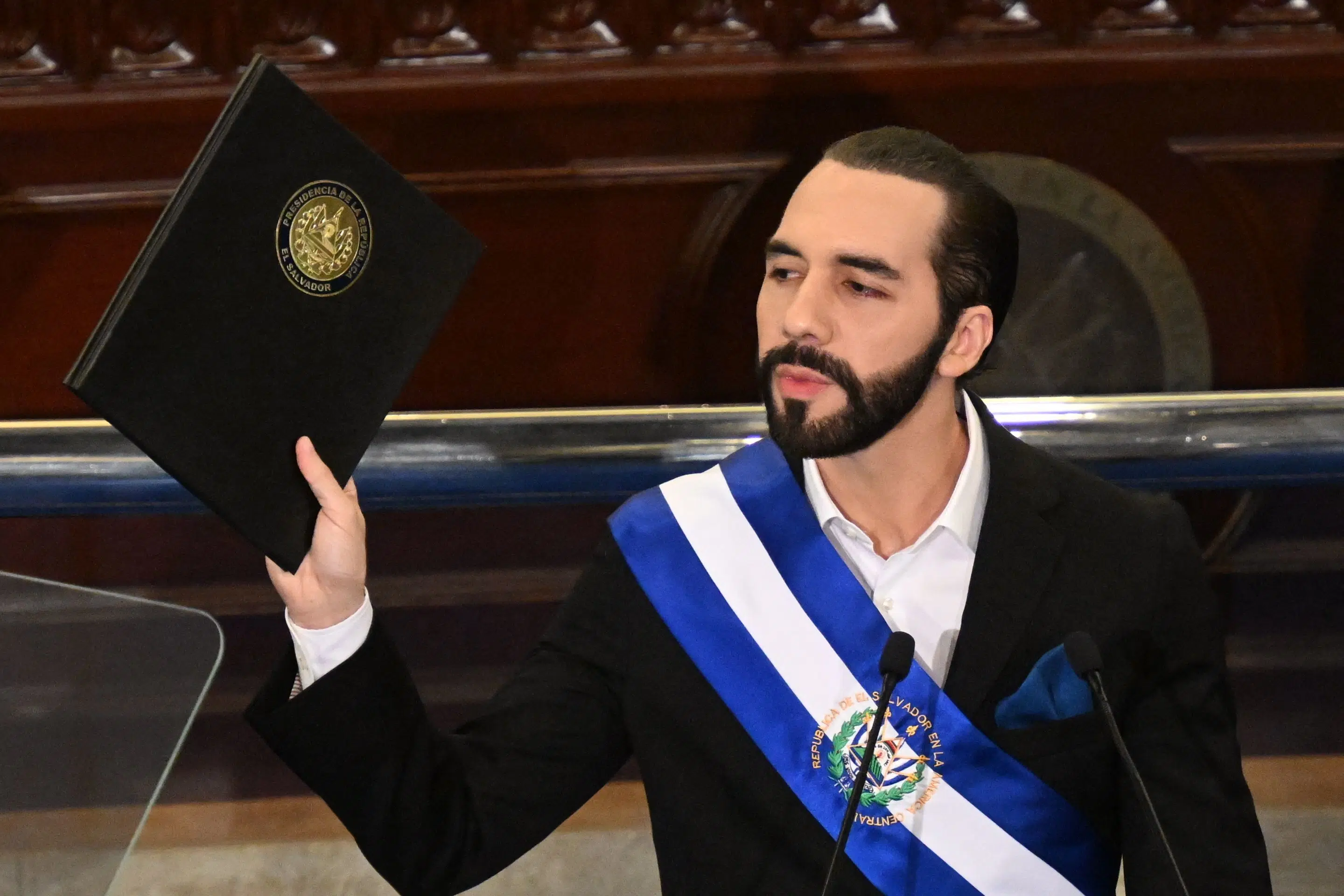
The architects of democratic blackout reveal themselves as leaders capable of dragging vast masses of citizens to the system’s periphery, there to cross the Acheron. As in *Rhinoceros*, Ionesco’s theater-of-the-absurd play that turned the inhabitants of a French town into monsters, victims of “rhinoceritis”: at first it seemed overblown, preposterous—then the metamorphosis took hold. Are they really so far removed from the Vikings who stormed the Capitol, or the Bolsonarista hooligans who tried to seize the institutions of Brasilia?
Nayib Bukele is neither a real-estate mogul like Donald Trump nor a feral economist like Javier Milei—a self-proclaimed Jeff Beck devotee who dishevels himself onstage with the air and gestures of Gary Glitter. Unlike either of them, Bukele more closely resembles a Stendhal character in his passion, ambition, and, above all, his pursuit of Napoleonic glory. Though Bukele is now deep in the throes of that final imperial phase: just as Trump crowns himself king on X and appears dropping excrement from the cockpit of a fighter jet, Bukele’s own profile on the same platform proclaims him a Philosopher King.
Unlike Trump, Milei, Santiago Abascal, or even Isabel Díaz Ayuso, Bukele shares his trajectory with J. D. Vance, Trump’s vice president and Peter Thiel’s political arm—both possessing a significant progressive past they dissolved to embrace disruptive populism. Nayib Bukele is someone who, from adolescence, felt the living pulse of his Palestinian blood and the revolutionary voltage of Roque Dalton’s poetry.
Gabriel Labrador, a journalist in exile from El Faro—the Salvadoran outlet forced to relocate its newsroom to Costa Rica—recounts in a lengthy profile of Bukele that his father, a fourth-generation Palestinian, was a prosperous merchant, polygamist, and man of the left who gave Nayib a privileged life and education, even paving the way for him to approach the Farabundo Martí National Liberation Front (FMLN). Bukele, a young and brilliant adman, took charge of the FMLN’s image and went a step further by running for mayor of a small city. The young man who at university had sported a T-shirt reading “Class Terrorist” thus won his first election.
Bukele launched his political career with the fervor of Che, but unlike Che, he already knew how to navigate the jungle of the real—and quickly began waging guerrilla warfare on social media. Though he was only a digital *foquista* at the time, from the presidency he would demonstrate how violence can be inflicted on daily life even while trumpeting its eradication. But back then, in 2012, he was only 30, a mayor declaring: “I am a radical leftist, because I want radical change in El Salvador, where the law of the jungle must no longer prevail.”
The next step was the mayoralty of San Salvador, but the revolutionary instinct gradually yielded to the populist gaze. He distanced himself from the FMLN, and, as writer Tom Stevenson recounts, he was already plotting a new political party “that would be neither left nor right”—a movement to transcend the old politics. The candidate had already moved on. By the time he won the capital’s mayoralty, he had more Twitter followers than Salvador Sánchez Cerén, then president of the country.
In his book *Bukele, el rey desnudo* (Bukele, the Naked King), Óscar Martínez—journalist, author, and editor-in-chief of El Faro—offers a diabolical synthesis of this drift: “Bukele has been popular since he won the capital’s mayoralty in 2015. Even more so with the absolute majority that made him president in 2021. He occupied the Legislative Assembly to illegally replace the attorney general investigating him and the Supreme Court justices who challenged him, installed his own people, and wielded absolute power.”
When Bukele was elected president in 2019, he became the youngest head of state in Latin America. He had abandoned the FMLN, and under his new political vehicle he buried the two-party system, leaving behind predecessors who had been arrested or indicted—all of them drawn from El Salvador’s two dominant parties, which had governed without interruption for more than two decades. It had been a period of chronic poverty, boundless violence, and mass emigration. Bukele, beholden to no one, arrived as an anti-corruption reformer: “There is enough money for everyone, as long as nobody steals.” The slogan can still be heard today. The money is still nowhere to be found.
The world first took notice of him at the 2019 United Nations General Assembly when, mid-speech, he snapped a selfie from the podium—pedagogically, no less, informing the assembled world leaders that “a couple of Instagram pictures can have more impact than any speech in this assembly.” His way of undermining the institutional authority of the UN by degrading it in situ without dropping the veneer of civility is more effective than Trump’s tirades from that same lectern. It is no accident that, at every opportunity, he invokes Alexander the Great and Steve Jobs.
During his first presidency, he held a minority in the Legislative Assembly and could not even control the budget. Faced with this, he announced a security plan that lacked the chamber’s backing. Bukele proved he had a shortcut: the hard way. He summoned the people before the Legislative Palace and ordered soldiers and police to do the same. He entered the building, sat in the Assembly president’s chair, and declared: “I think it is perfectly clear who is in control of the situation.”
The story is quite simple. To end the violence and the permanent state of anarchy, the rule of law was abolished: through the state of exception, constitutional rights were suspended. El Salvador holds the distinction of the largest prison population per capita in the world. Detainees do not have to appear before a judge, nor are they given a reason for their arrest. Political opponents have been jailed or, if luckier, driven into exile. Bukele commands; he holds the monopoly on violence and proclaims it on X: “the coolest dictator in the world.”
It is true that the reduction in homicides began during Bukele’s first presidency, Óscar Martínez acknowledges, “but it was he who drove it to historic lows thanks to nearly three years of pacts with criminals followed by the state of exception. Secret pacts and a police state—that was his formula.”
Bukele crushed the criminal maras, but he had first struck deals with them to win the capital’s mayoralty and then the presidency. In the end, he broke with the gangs—but did so by fracturing the rule of law. The figures are damning: 87,000 Salvadorans imprisoned in three years across 22 prisons, of which only one is ever shown. Inside it, visitors have included Kristi Noem, Trump’s Secretary of Homeland Security; Patricia Bullrich, Milei’s Security Minister; and, most recently, José Antonio Kast, Chile’s president-elect. All keenly interested in a system that lowers the crime rate and inflates the vote count.
Bukele’s ideological pivot must not be seen as a pendulum swing across the political spectrum but as a Copernican turn from the Constitution to democracy’s ragged fringes, a periphery where he embraces, among others, Trump and Benjamin Netanyahu, who, just as he welcomes a gentile like Milei, congratulates himself on having a descendant of Palestinians on the Peace Council for Gaza.
When Vox’s leaders speak or Isabel Díaz Ayuso erupts with authoritarian overtones, one must discern that their denunciation of democratic dysfunctions does not lead to their remedy but to the suppression of the system itself—as demonstrated by the vanguard Bukele represents: someone who came to power invoking the fraternal equality proclaimed by the Bible, only to end in the Apocalypse: the lukewarm shall be vomited out. Óscar Martínez warns as much: “We have not yet seen his most violent phase.”
Nayib Bukele, el populista milenial que mandó parar la democracia
Los promotores del apagón democrático se revelan como líderes con el poder de arrastrar amplias masas de ciudadanos hasta la periferia del sistema para cruzar el Aqueronte. Como en El Rinoceronte, aquella obra de Ionesco del teatro del absurdo que convertía en monstruos a los habitantes de un pueblo francés, víctimas de “rinocerontitis”: al principio parecía exagerado, descabellado, después se producía la metamorfosis. ¿Acaso están muy alejados de los vikingos que colapsaron el Capitolio o los hooligans bolsonaristas que quisieron tomar las instituciones de Brasilia?
Nayib Bukele no es un empresario de bienes raíces como Donald Trump ni un economista asilvestrado como Javier Milei, declarado admirador de Jeff Beck pero que se despeina en los escenarios con aire y gestos de Gary Glitter. A diferencia de ellos, Bukele se acerca más a un personaje de Stendhal en el sentido de la pasión, la ambición y, sobre todo, la búsqueda de la gloria napoleónica. Aunque Bukele está ahora en el trance de esta última fase imperial ya que, al igual que Trump se proclama rey en X y aparece soltando excrementos al mando de un caza, Bukele en su estado de la misma red se autodefine como un Philospher King.
A diferencia de Trump, Milei, Santiago Abascal o, incluso, Isabel Díaz Ayuso, Bukele comparte su deriva con J. D. Vance, el vicepresidente de Trump y brazo político de Peter Thiel, con un significativo pasado progresista que licuó para abrazar el populismo disruptor. Nayib Bukele es alguien que sintió desde adolescente el latido vivo de su sangre palestina y la tensión revolucionaria de la poesía de Roque Dalton.
Gabriel Labrador, periodista en el exilio de El Faro, medio salvadoreño que se vio obligado a trasladar su redacción a Costa Rica, cuenta en un largo artículo sobre Bukele que su padre, cuarta generación de palestinos, era un próspero comerciante, polígamo y hombre de izquierdas, quien dio una vida y una educación privilegiada a Nayib, abriéndole, incluso, el camino para acercarse al Frente Farabundo Martí de Liberación Nacional (FMLN). Bukele, un joven y brillante publicista, se hizo cargo de la imagen del FMLN y dio un paso más al presentarse como candidato al ayuntamiento de una pequeña ciudad. El joven que en la universidad había lucido una camiseta en la que se leía Class Terrorist ganaba así su primera elección.
Bukele iniciaba su carrera política con la pulsión del Che pero, a diferencia de este, ya sabía moverse en la selva de lo real y rápidamente comenzó a utilizar la guerrilla en las redes sociales. Aunque era solo un foquista digital ya demostraría, desde la presidencia del país, cómo se puede aplicar la violencia en la vida cotidiana al tiempo que se pregona combatirla. Pero entonces, corría el año 2012, solo tenía 30 años, era alcalde y declaraba: “Soy de izquierda radical, porque quiero cambios radicales en El Salvador, donde no debe imperar más la ley de la jungla”.
El siguiente paso fue el ayuntamiento de El Salvador pero el instinto revolucionario fue cediendo a la mirada populista. Se distanció del FMLN y cuenta el escritor Tom Stevenson que ya pretendía formar un nuevo partido político «que no sería ni de izquierdas ni de derechas», sino un movimiento que trascendería la vieja política. El candidato ya estaba en otra parte. Cuando ganó el ayuntamiento de la capital tenía más seguidores en Twitter que Salvador Sánchez Cerén, entonces presidente del país.
En su libro Bukele, el rey desnudo, el periodista, escritor y jefe de redacción de El Faro, Óscar Martínez, hace una síntesis diabólica de esta deriva: “Bukele es popular desde que ganó la alcaldía de la capital en 2015. Más con la mayoría absoluta que lo hace presidente en 2021. Ocupó la Asamblea Legislativa para sustituir ilegalmente al fiscal general que lo investigaba y a los magistrados de la Corte Suprema que lo cuestionaban, puso a los suyos y tuvo poder absoluto”.
Cuando Bukele es elegido presidente en 2019 se convierte en el jefe de Estado más joven de América Latina. Había abandonado el FMLN y bajo su nueva agrupación enterraba el bipartidismo y dejaba atrás a sus anteriores predecesores que habían sido arrestados o acusados, y todos ellos procedían de los dos principales partidos políticos de El Salvador, que habían gobernado sin interrupción durante más de dos décadas. Había sido un período de pobreza crónica, violencia infinita y emigración masiva. Bukele, por libre, llegaba como un reformista anticorrupción: «Hay suficiente dinero para todos, siempre y cuando nadie robe“. Aún hoy se escucha este lema. El dinero se sigue echando en falta.
El mundo lo conoció en la Asamblea General de las Naciones Unidas de 2019, cuando, en medio de su discurso, se hizo un selfie desde la tribuna con matices pedagógicos, ya que indicó a los líderes mundiales presentes que «un par de imágenes en Instagram pueden tener más impacto que cualquier discurso en esta asamblea». Su modo de intentar minar el poder institucional de la ONU degradándolo in situ sin perder las formas es más efectivo que los improperios de Trump en ese mismo atril. No en vano, cada vez que puede, invoca a Alejandro Magno y a Steve Jobs.
En su primera presidencia estaba en minoría en la Asamblea Nacional, donde no podía controlar ni siquiera el presupuesto. Así las cosas, anunció un plan de seguridad que no contaba con el apoyo de la cámara. Bukele demostró que disponía de una vía rápida: por las malas. Convocó al pueblo ante el Palacio Legislativo y ordenó a los militares y policías a hacer lo mismo. Entró al edificio, se sentó en la silla del presidente de la Asamblea y dijo: “Creo que está muy claro quién tiene el control de la situación”.
El cuento es muy sencillo. Para acabar con la violencia y el estado permanente de anarquía, se suprimió el Estado de derecho, ya que a través del estado de excepción se suspendieron los derechos constitucionales. El Salvador ostenta el título de la mayor población carcelaria per cápita del mundo. Los detenidos en las cárceles no tienen que comparecer ante un juez ni se les da una razón para su detención. Los opositores políticos han sido encarcelados o, con más suerte, expulsados al exilio. Bukele manda, está al frente del monopolio de la violencia y lo proclama en X: «el dictador más cool del mundo».
Es verdad que la reducción de homicidios empezó con la primera presidencia de Bukele, cuenta Óscar Martínez, “pero fue él quien la consolidó hasta mínimos históricos gracias a sus casi tres años de pactos con los criminales y el posterior régimen de excepción. Pactos secretos y estado policial, esa fue su fórmula”.
Bukele puso fin a las maras criminales pero pactó con ellas para alcanzar la alcaldía de la capital y ser presidente después. Al final, rompió con las pandillas pero lo hizo fracturando el Estado de derecho. Las cifras son lapidarias: 87.000 salvadoreños presos en tres años en 22 cárceles de las cuales solo se enseña una. En ella se ha visto a Kristi Noem, secretaria de seguridad de Trump; a Patricia Bullrich, ministra de Seguridad de Milei y, recientemente, a José Antonio Kast, el presidente electo de Chile. Todos muy interesados en este sistema que reduce la tasa de delito e incrementa el número de votos.
El giro ideológico de Bukele no se debe entender como un péndulo en el arco político sino como un giro copernicano desde la Constitución al arrabal del sistema democrático, periferia en la que se abraza, entre otros, con Trump y Benjamín Netanyahu, quien al igual que da la bienvenida a un gentil como Milei se congratula de tener a un descendiente de palestinos en el Consejo de Paz para Gaza.
Cuando hablan los dirigentes de Vox o irrumpe Isabel Díaz Ayuso con ecos autoritarios, hay que discernir que la denuncia que hacen de las disfunciones democráticas no conduce a su superación sino a la supresión del sistema como lo demuestra la vanguardia que representa Bukele, alguien que llegó al poder planteando la igualdad fraterna que invoca la Biblia para acabar en el Apocalipsis: los tibios serán vomitados. Lo augura Óscar Martínez: “Todavía no hemos visto su etapa más violenta”.