
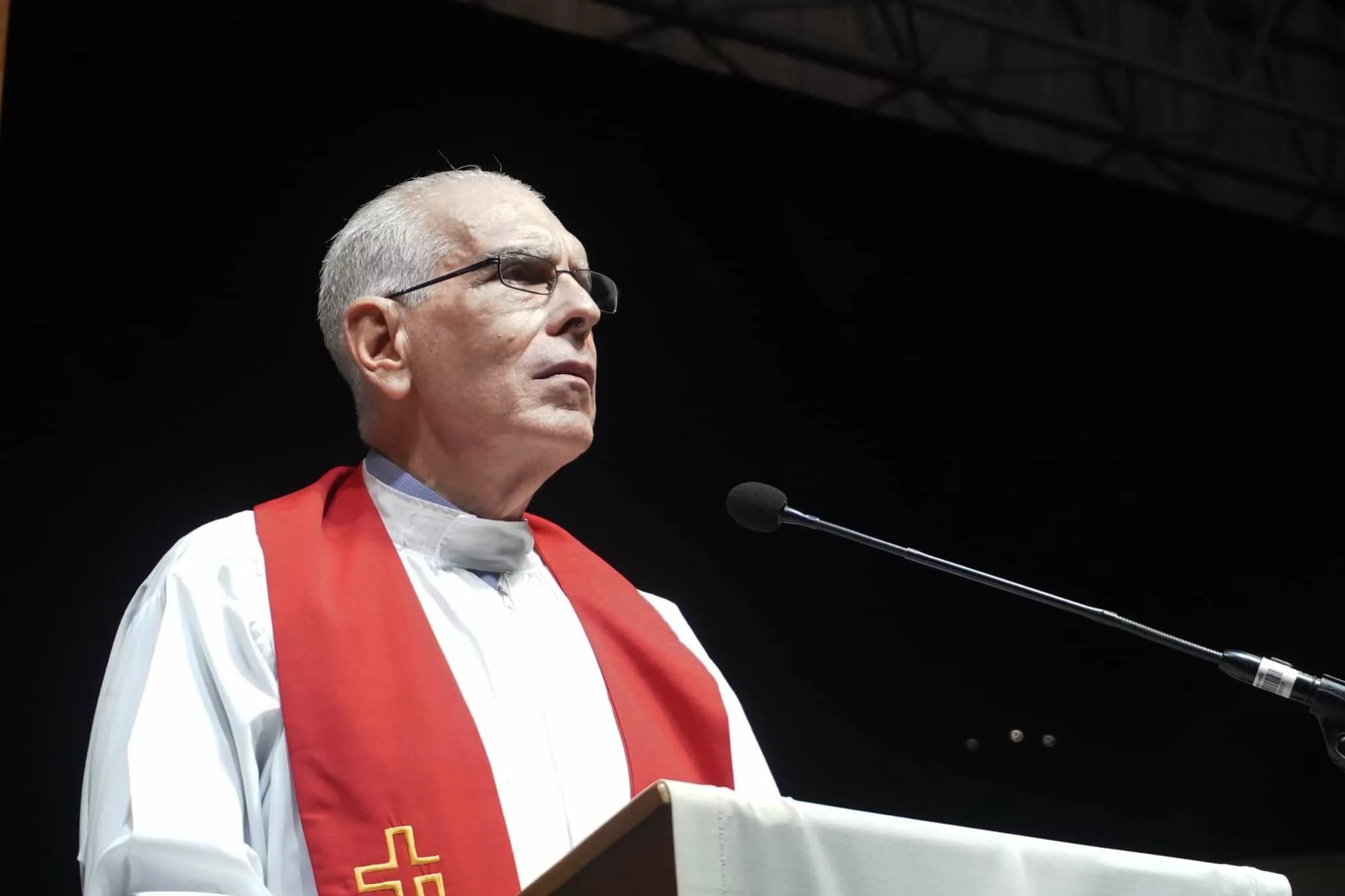
Pope Leo XIV laments, in his message for this year’s World Day of Peace, the frequency with which faith is “dragged” into political combat. Faith is wielded to bless nationalism and to provide religious justification for violence and armed struggle. That is precisely what the prayer breakfast showcased a few days ago on national broadcast. The heads of the three branches of government, led by Bukele, certain U.S. politicians, and a select group of guests gathered at the National Palace to pray and have breakfast.
In his remarks, Bukele attributed the success of the state of exception directly to God. God, he claimed, heard his pleas and those of his security team and took the reins of the crackdown into His own hands. Irrefutable proof that God provides when there is faith. The current security situation would thus be a divine marvel that no one can question or explain—not even the experts. A genuine miracle whose secret is prayer. Countries that have tried to replicate Bukele’s model have failed because they only adopted the plan but did not pray.
If God is the direct author of security, He is also responsible for the state of exception, which encompasses violence, arbitrariness, and injustice. Therefore, the innocent victims, the abandoned spouses and children, and those who died from torture and lack of medical care in the regime’s prisons must resign themselves and accept the will of God. Their submission will be infinitely rewarded in eternity. Bukele says he is nothing more than the instrument, the chosen one, to carry out that providential divine will.
The Pope, by contrast, calls on believers to repudiate “those forms of blasphemy that darken the holy name of God.” Justice and human dignity, the message warns, are “highly exposed” to the power of the strongest and most violent, who have made war fashionable. The world’s powerful invoke God’s name to justify their outrages. In that same vein, Bukele trusts that this God, to whom he commends himself, will solve the problems of employment, health, education, and the environment. And if those solutions do not arrive or are slow to appear, he invites trust in His providence. God knows the timing, and His timing is perfect. Bukele merely prays.
This stance is foreign to the biblical tradition. The God of Scripture acts through envoys to whom He entrusts a mission. This is the case with Moses, the prophets, and Jesus himself. Yet from time to time, impostors appear proclaiming “I am He.” The Gospel warns the Christian community not to believe them. The criterion of the Last Judgment in Matthew 25 is unambiguous. The disciple of Jesus feeds the hungry and gives drink to the thirsty, welcomes the stranger, clothes the naked, and visits the sick and the imprisoned. In truth, the question was already posed in Genesis, when God asks Cain about his brother and Cain replies that he is not his brother’s keeper.
The God of Jesus is a God of peace, which means, in the words of Leo XIV, protecting what is holy: human life, above all the lives most threatened by an order shaped by “enormous concentrations of economic and financial interests” that “seek to profit from everything” and drive politicians and society toward violence and war. The biblical God challenges that order from the very beginning of history, harbors dreams that inspire His prophets, and is determined to rescue humanity from bondage both ancient and new.
Justice and law, dialogue and listening—these are the paths that liberate from such bondage. The challenge, according to the Pope, lies in shaping social relations humanely so as to live “a disarmed and disarming peace.” A peace that not only rejects all forms of violence but also strives to disarm the violent.
The prayer breakfast, broadcast nationwide to a country where most people cannot afford three meals a day, resembles the prayer of the Pharisee. Jesus spoke of him to warn his disciples. The Pharisee entered the temple ostentatiously to boast that he was not like other men and that he faithfully observed the law, yet he did not leave justified. Jesus counsels the one who prays to enter their room and close the door so as to enter into intimate and personal communion with God. And He, who sees in secret, will reward them.
God does not desire glory for Bukele. The glory of God, as Monsignor Romero said, is the poor who live. In Bukele’s El Salvador, the majority—who were not invited to the prayer breakfast—do not live a dignified life. Monsignor Romero was sent by God to defend them and to demand law and justice. Sin crushed him. It thought it had silenced him, but his word lives.
* Rodolfo Cardenal, Director of the Monsignor Romero Center.
UCA: https://noticias.uca.edu.sv/articulos/la-oracion-cristiana
La oración Cristiana
El papa León XIV lamenta, en el mensaje para la Jornada por la Paz de este año, la frecuencia con la que se “arrastra” la fe al combate político. La fe se usa para bendecir el nacionalismo y para justificar religiosamente la violencia y la lucha armada. Eso fue, justamente, el desayuno de oración exhibido hace unos días en cadena nacional. Los jefes de los tres poderes del Estado, encabezados por Bukele, algunos políticos estadounidenses y un selecto grupo de invitados se reunieron en el Palacio Nacional para rezar y desayunar.
En su intervención, Bukele atribuyó directamente a Dios el éxito del régimen de excepción. Dios habría escuchado sus súplicas y las de su equipo de seguridad, y habría tomado en sus manos las riendas de la represión. Prueba fehaciente de que Dios provee cuando hay fe. La seguridad actual sería, pues, un portento divino, que nadie puede cuestionar ni explicar. Ni siquiera los expertos. Un milagro auténtico, cuyo secreto es la oración. Los países que han intentado replicar el modelo de Bukele han fracasado, porque solo tomaron el plan, pero no oraron.
Si Dios es el autor directo de la seguridad, también es responsable del régimen de excepción, que incluye violencia, arbitrariedad e injusticia. Por tanto, las víctimas inocentes, las parejas y los hijos abandonados, y los muertos por causa de la tortura y la falta de cuidados médicos en las presiones del régimen deben resignarse y aceptar la voluntad de Dios. Su conformidad será recompensada infinitamente en la eternidad. Bukele dice que él no es más que el instrumento, el elegido, para hacer realizar esa voluntad divina providente.
El papa, en cambio, pide a los creyentes desmentir “esas formas de blasfemia que opacan el santo nombre de Dios”. La justicia y la dignidad humanas, denuncia el mensaje, están “muy expuestas” al poder de los más fuertes y violentos, quienes han puesto la guerra de moda. Los poderosos del mundo usan el nombre de Dios para justificar sus desafueros. En esa misma línea, Bukele confía en que ese Dios, al que se encomienda, resolverá los problemas de empleo, salud, educación y medioambiente. Y si esas soluciones no llegan o tardan en aparecer, invita a confiar en su providencia. Dios sabe el cuándo y su tiempo es perfecto. Bukele solo reza.
Esta postura es ajena a la tradición bíblica. El Dios de la Escritura actúa a través de enviados, a quienes encomienda una misión. Es el caso de Moisés, de los profetas y del mismo Jesús. Sin embargo, de vez en cuando aparecen impostores diciendo “yo soy”. El Evangelio avisa a la comunidad cristiana no creerles. El criterio del juicio final de Mateo 25 es claro. El discípulo de Jesús da de comer al hambriento y de beber al sediento, acoge al extranjero, viste al desnudo y visita al enfermo y al preso. En realidad, la cuestión ya está planteada en el Génesis, cuando Dios pregunta a Caín por su hermano y este responde que no es su guardián.
El Dios de Jesús es un Dios de paz, que significa, en palabras de León XIV, proteger lo que es santo: la vida humana, sobre todo la más amenazada por un orden configurado por “enormes concentraciones de intereses económicos y financieros”, que “intenta sacar provecho de todo” y empujan a los políticos y a la sociedad a la violencia y la guerra. El Dios bíblico cuestiona ese orden desde el comienzo de la historia, tiene sueños que inspiran a sus profetas y está decidido a rescatar a la humanidad de las esclavitudes antiguas y nuevas.
La justicia y el derecho, el diálogo y la escucha son los caminos que liberan de esas esclavitudes. El desafío consiste, según el papa, en configurar humanamente las relaciones sociales para vivir “una paz desarmada y desarmante”. Una paz que no solo rechaza toda forma de violencia, sino que también se esfuerza para desarmar a los violentos.
El desayuno de oración, exhibido en cadena nacional a un país cuyas mayorías no tienen con qué hacer los tres tiempos, se parece a la oración del fariseo. Jesús se refirió a él para prevenir a sus discípulos. El fariseo entró ostentosamente en el templo para jactarse de no ser como los demás y de cumplir fielmente la ley, pero no salió justificado. Jesús recomienda al orante entrar en su habitación y cerrar la puerta para entrar en comunión íntima y personal con Dios. Y Él, que ve en lo secreto, lo recompensará.
Dios no quiere la gloria de Bukele. La gloria de Dios, como dijo Mons. Romero, es el pobre que vive. En El Salvador de Bukele, las mayorías, que no fueron invitadas al desayuno de oración, no tienen una vida digna. Mons. Romero fue enviado por Dios para defenderlas y para exigir derecho y justicia. El pecado lo aplastó. Pensó que lo callaba, pero su palabra vive.
* Rodolfo Cardenal, director del Centro Monseñor Romero.
UCA:https://noticias.uca.edu.sv/articulos/la-oracion-cristiana