
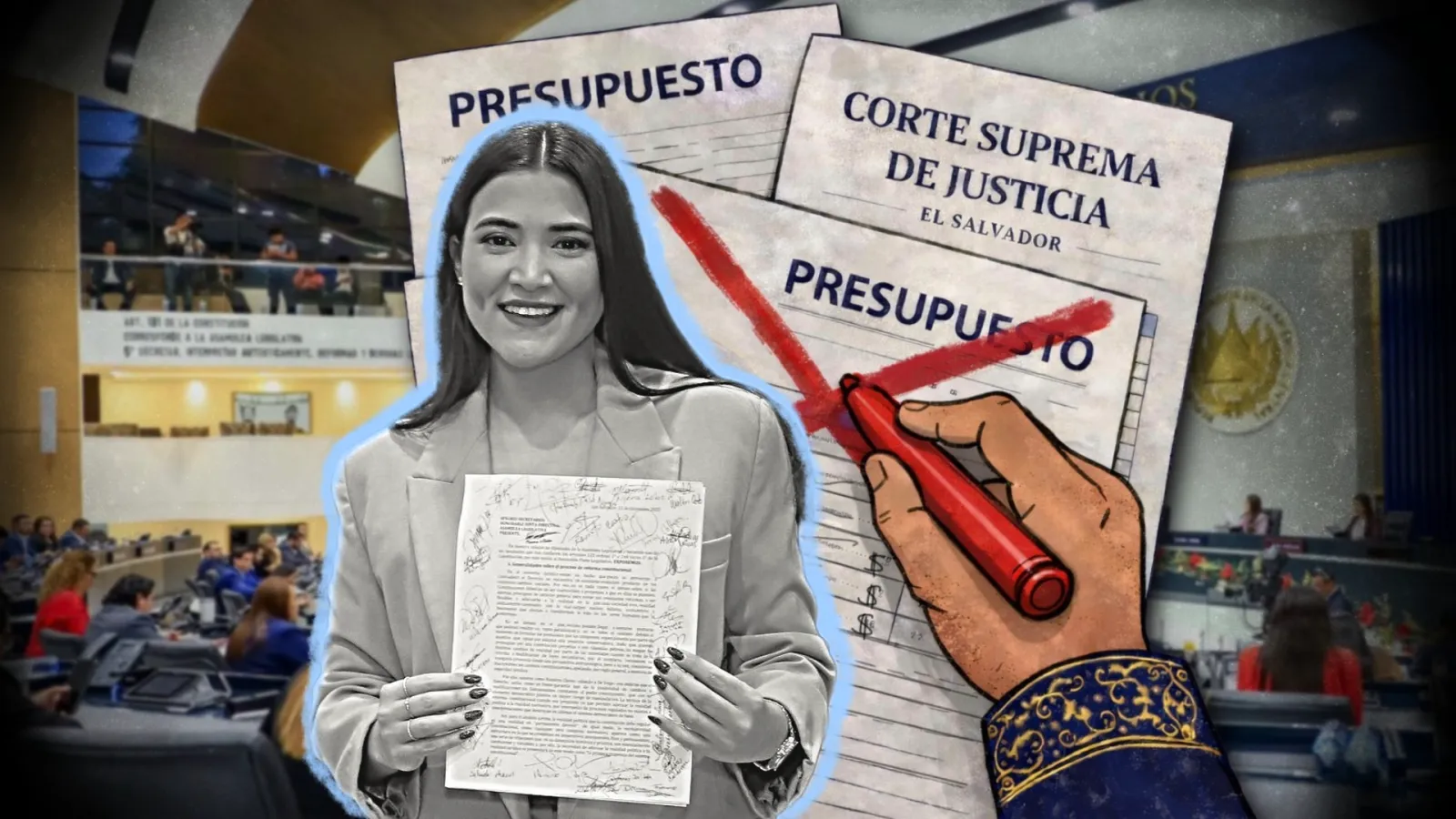
The Asamblea Legislativa, controlled by Nayib Bukele’s party, removed the constitutional safeguard that guaranteed the economic independence of the Judicial Branch, which previously secured no less than 6 percent of the state’s current revenues annually. With votes from Nuevas Ideas and its allies, that percentage was excised from the fourth paragraph of Article 172 of the Constitution of the Republic—a provision incorporated in 1991 during the Peace Accords process to prevent the Supreme Court of Justice from having to negotiate its funding with the other two branches of government.
The new text indicates that the Judicial Branch’s budget allocation will be made according to the “reasonable needs” it presents, leaving it subject to the decisions of the Executive, which proposes the budget, and the Asamblea Legislativa, which approves it.
This new blow by bukelismo against the Judicial Branch is not an isolated incident, but rather a maneuver that compounds the offensive launched on May 1, 2021, when the ruling party decapitated the Sala de lo Constitucional (Constitutional Chamber) and imposed magistrates aligned with its interests. That assault was followed by reforms and a purge of judges, culminating in absolute control of the Supreme Court, which is now reduced to a subordinate, docile instance tailored to Bukele’s interests.
In the same plenary session on December 16, the ruling party also pushed through another constitutional reform to extend the term of TSE magistrates from five to six years; it further included a transitional article to prematurely end the tenure of the current TSE officials. According to the ruling party, this was done to “synchronize” the officials’ terms with the upcoming elections in 2027.
The constitutional changes were executed in a span of six hours and with a waiver of procedure (a mechanism routinely employed by Nuevas Ideas to shortcut the process and bypass any committee discussions where the reforms would have to be debated). In a single afternoon, the Assembly held two plenary sessions to approve and ratify agreements that, according to Nuevas Ideas lawmaker and faction chief Christian Guevara, had already been published in the Official Gazette. This claim was refuted by Vamos lawmaker Claudia Ortiz, who added that violating due process could render the act unconstitutional: “The latest Official Gazette published is from December 10. Today is December 16,” she noted.
These fast-tracked reforms—which are dispatched in less time than a standard workday—are possible because, in the previous legislative term, Nuevas Ideas amended Article 248 of the Constitution to allow a single legislature the authority to both propose and ratify constitutional changes without waiting for the subsequent legislative period.
Judicial Branch Budget in the Crosshairs
Ruling party lawmaker Alexia Rivas, who championed the reform to Article 172 on the floor, invoked the principle of “financial balance” and erroneously argued that the 6 percent allocation was established in 1983 when the current Constitution was created.
The allocation of 6 percent of the budget to the Judicial Branch was one of the outcomes of the Peace Accords process designed to endow it with economic independence. A transitional provision established that it would take effect gradually, progressively, and proportionally until full coverage was reached within a period of no more than four years.
Since the dismissal of the Constitutional Chamber magistrates in May 2021, Bukele has controlled the Supreme Court of Justice, but with this reform, he completes the mutilation of its economic independence.
Nuevas Ideas also contended that other government institutions lack constitutionally mandated budget allocations, though they omitted that those entities are dependencies of the Executive Branch and, therefore, had no need for a budget independent of political will. In its proposal, the ruling party asserted that there are other areas of “even greater importance” requiring more funding, such as Health, Security, and Education; consequently, funds destined for the Judicial Branch must be disbursed according to the needs of each year and the considerations of the Ministry of Finance.
For 2026, the Supreme Court submitted a budget of 533.4 million dollars, which has not yet been approved by the Assembly, leaving uncertainty over whether that amount will be maintained.
“The Legislative Assembly has posed a false dilemma between the rights to Health, Education, and the administration of justice. Access to justice is of equal relevance to adequate health services and a quality education system,” noted Acción Ciudadana (Citizen Action), which maintained that the reform opens the door to a significant reduction in resources that will further weaken El Salvador’s already overburdened and inefficient justice system.
Synchronization of the TSE with the Presidential Term
The second reform modified the first paragraph of Article 208, extending the term of TSE magistrates from five to six years to align the Constitution with the new six-year presidential term, approved in a constitutional reform on July 31 that also permits Bukele’s indefinite reelection.
Just as was done in the previous reform to allow Bukele to end his current mandate on June 1, 2027, a transitional article was included to prematurely conclude the tenure of the current TSE magistrates so that they end their service on July 31, 2027, after which new magistrates will serve six-year terms. The current magistrates were elected in September 2024 and were set to conclude their terms in 2029.
“What we are doing is aligning the timelines of institutions so our country functions better within electoral cycles,” argued Dania González, the other Nuevas Ideas lawmaker who managed the reform.
Arena lawmaker Marcela Villatoro pointed out that Article 208 states the TSE term is five years, but this does not imply those five years must coincide exactly with the election of the President of the Republic: “I am hearing excuses regarding chronological consistency, because the timelines do not match. Neither of those excuses has anything to do with the constitutional text. So, better to be honest and tell people that what you want is for your cronies to remain as magistrates,” she asserted.
The TSE is currently directed by Roxana Soriano, a trusted figure within bukelismo, who was a pre-candidate for lawmaker for the Nuevas Ideas party and was subsequently elected as president of the Corte de Cuentas de la República (Court of Accounts of the Republic). It was from that institution that the Assembly moved her to the TSE.
Vamos alternate lawmaker Cesia Rivas maintained that neither of the two constitutional reforms approved by the Assembly was designed to directly favor the people: “All have been to fit into that plan you have to perpetuate yourselves in power,” she criticized.
In neither of the two reforms did officials from the Supreme Court of Justice or the Supreme Electoral Tribunal issue a statement. In both cases, the heads of those institutions are aligned with bukelismo.
Gato Encerrado: https://gatoencerrado.news/2025/12/17/presupuesto-del-organo-judicial-queda-a-voluntad-del-ejecutivo-tras-reforma-expres/
Presupuesto del Órgano Judicial queda sujeto a voluntad del Ejecutivo tras reforma constitucional exprés
La Asamblea Legislativa, controlada por el partido de Nayib Bukele, quitó el candado constitucional que garantizaba la independencia económica del Órgano Judicial y le aseguraba, cada año, no menos del 6 % de los ingresos corrientes del Estado. Con los votos de Nuevas Ideas y sus aliados, se eliminó ese porcentaje del inciso cuarto del artículo 172 de la Constitución de la República, una disposición incorporada en 1991, en el proceso de los Acuerdos de Paz, para evitar que la Corte Suprema de Justicia tuviera que negociar su financiamiento con los otros dos poderes del Estado.
La nueva redacción indica que la asignación presupuestaria del Órgano Judicial se hará según las “necesidades razonables” que presente, quedando sujeto a las decisiones del Ejecutivo, que propone el presupuesto, y de la Asamblea Legislativa, que lo aprueba.
Este nuevo golpe del bukelismo al Poder Judicial no es un hecho aislado, sino una maniobra que se suma a la ofensiva iniciada el 1 de mayo de 2021, cuando el oficialismo descabezó la Sala de lo Constitucional e impuso magistrados alineados a sus intereses. A ese asalto le siguieron reformas y una purga de jueces que culminaron en el control absoluto de la Corte Suprema, que hoy está reducida a una instancia subordinada, dócil y funcional para los intereses de Bukele.
En la misma sesión plenaria del 16 de diciembre, el partido oficialista también impulsó otra reforma constitucional para ampliar de cinco a seis años el mandato de las magistraturas del Tribunal Supremo Electoral (TSE); además, incluyeron un artículo transitorio para finalizar anticipadamente el periodo de los actuales funcionarios del TSE. Esto se hizo, según el oficialismo, para “sincronizar” los periodos de los funcionarios y las próximas elecciones que se realizarán en 2027.
Las modificaciones a la Constitución se hicieron en un lapso de seis horas y con dispensa de trámite (mecanismo utilizado de forma recurrente por Nuevas Ideas para abreviar el proceso y evitar que estas reformas pasaran por alguna comisión donde tenían que ser discutidas). En una misma tarde, la Asamblea realizó dos sesiones plenaria para aprobar y ratificar los acuerdos que, según el diputado y jefe de fracción de Nuevas Ideas, Christian Guevara, ya habían sido publicados en el Diario Oficial, lo cual fue desmentido por la diputada de Vamos, Claudia Ortiz, quien añadió que al violentar el debido proceso podría ser inconstitucional: “El último Diario Oficial que está publicado es del 10 de diciembre. Hoy es 16 de diciembre”, señaló.
Estas reformas exprés —que se despachan en menos tiempo que una jornada laboral común— son posibles porque, en la legislatura anterior, Nuevas Ideas reformó el artículo 248 de la Constitución con el fin de que una misma legislatura tenga la potestad de reformar y ratificar las modificaciones constitucionales, sin tener que esperar el siguiente periodo legislativo.
Presupuesto del Órgano Judicial en la mira
La diputada oficialista, Alexia Rivas, quien impulsó en el pleno la reforma al artículo 172, invocó el principio de “equilibrio financiero” y erróneamente argumentó que el porcentaje del 6 % se asignó en 1983 cuando se creó la Constitución vigente.
La asignación del 6 % del presupuesto al Órgano Judicial fue uno de los puntos del proceso de los Acuerdos de Paz para dotarlo de independencia económica. En una disposición transitoria, se estableció que sería efectiva en forma gradual, progresiva y proporcional hasta su total cobertura en un plazo no mayor de cuatro años.
Desde la destitución de los magistrados de la Sala de lo Constitucional en mayo de 2021, Bukele controla la Corte Suprema de Justicia, pero con esa reforma termina de mutilar su independencia económica.
Nuevas Ideas también argumentó que otras instituciones del gobierno no tienen asignaciones presupuestarias por Constitución, aunque omitió decir que esas son dependencias del Poder Ejecutivo y, por lo tanto, no tenían la necesidad de un presupuesto independiente de la voluntad política. En la iniciativa, el partido oficialista planteó que existen otras áreas que tienen una “importancia aún mayor” y que requieren más presupuesto como Salud, Seguridad y Educación; por lo que, los fondos destinados al Órgano Judicial deben efectuarse conforme a las necesidades de cada año y según las consideraciones del Ministerio de Hacienda.
Para 2026, la Corte Suprema presentó un presupuesto de 533.4 millones de dólares, que aún no ha sido aprobado por la Asamblea y queda en duda si se mantendrá ese monto.
“La Asamblea Legislativa ha planteado un falso dilema entre los derechos a la Salud, Educación y a la administración de justicia. El acceso a la justicia es de igual relevancia que contar con servicios de salud adecuados y un sistema educativo de calidad”, señaló Acción Ciudadana, quien mantuvo que la reforma abre la posibilidad de una significativa reducción de recursos que debilitará el ya saturado e ineficiente sistema de justicia salvadoreño.
Sincronía del TSE con el mandato presidencial
La segunda reforma modificó el artículo 208, inciso primero, ampliando el periodo de los magistrados del TSE de cinco a seis años para homologar la Constitución con el nuevo periodo presidencial de seis años, aprobado en una reforma constitucional el 31 de julio que también permite la reelección indefinida de Bukele.
Al igual que se hizo en la anterior reforma para que Bukele termine su mandato actual el 1 de junio 2027, se incluyó un artículo transitorio para finalizar anticipadamente el cargo de los actuales magistrados del TSE, para que concluyan su gestión el 31 de julio de 2027 y a partir de entonces los nuevos magistrados cumplirán períodos de seis años. Los actuales magistrados fueron elegidos en septiembre de 2024 y finalizaban sus cargos en 2029.
“Lo que nosotros estamos haciendo es ordenar los tiempos de las instituciones para que nuestro país funcione de mejor manera dentro de los ciclos electorales”, argumentó Dania González, la otra diputada de Nuevas Ideas que gestionó la reforma.
La diputada de Arena, Marcela Villatoro, señaló que el artículo 208 dice que el periodo del TSE es de cinco años, pero no quiere decir que tienen que ser exactamente esos cinco años al mismo tiempo que se elige Presidente de la República: “Estoy oyendo de las excusas, son por congruencia cronológica, porque los tiempos no coinciden. Ninguna de esas dos excusas tiene que ver con el texto constitucional. Entonces, mejor sincerarse y díganle a la gente que lo que quieren es que continúen sus cheros siendo magistrados”, sostuvo.
El TSE es dirigido actualmente por Roxana Soriano, una persona de confianza para el bukelismo, quien fue precandidata a diputada del partido Nuevas Ideas y luego fue elegida como presidenta de la Corte de Cuentas de la República. De esa institución es que la Asamblea la movió hacia el TSE.
La diputada suplente de Vamos, Cesia Rivas, sostuvo que ninguna de las dos reformas constitucionales aprobadas por la Asamblea han sido para favorecer directamente a la gente: “Todas han sido para encajar en ese plan que ustedes tienen de perpetuarse en el poder”, criticó.
En ninguna de las dos reformas, los funcionarios de la Corte Suprema de Justicia y los del Tribunal Supremo Electoral se pronunciaron. En ambos casos, los titulares de esas instituciones están alineados al bukelismo.
Gato Encerrado: https://gatoencerrado.news/2025/12/17/presupuesto-del-organo-judicial-queda-a-voluntad-del-ejecutivo-tras-reforma-expres/